
The latest info on influencer marketing trends, micro influencer news, and the world of social media

Black Friday falls on November 27, 2026, followed by Cyber Monday on November 30. For ecommerce sellers and content creators, that makes the real campaign deadline much earlier than the sale itself. Products must arrive, content must be approved, links must work, and audiences must recognize the offer before purchase intent peaks.
A strong black friday influencer marketing 2026 campaign is therefore not a single sponsored post. It is a coordinated system that connects creator selection, product seeding, offer design, content rights, tracking, inventory, and multiple publishing waves. This guide provides a practical 90-day plan for building that system without turning every creator into the same discount script.
Cyber Week demand is spread across several distinct shopping moments. In 2025, Adobe measured U.S. online spending of $6.4 billion on Thanksgiving, $11.8 billion on Black Friday, and $14.25 billion on Cyber Monday. Total Cyber Week spending reached $44.2 billion. Those figures support separate creator waves for discovery, offer launch, weekend reminders, and the final Cyber Monday push rather than concentrating every post on Friday.
Shopping behavior also differs by day and device. The National Retail Federation’s 2025 holiday-weekend survey counted 85.7 million online shoppers on Black Friday and 75.9 million on Cyber Monday, including 46.9 million who shopped on mobile that Monday. Creator landing pages, Amazon listings, discount-code instructions, and checkout flows must therefore work cleanly on a phone.
The opportunity extends beyond one storefront. Shopify reported approximately $14.6 billion in global merchant sales during its 2025 Black Friday Cyber Monday weekend, while TikTok Shop reported more than $500 million in four-day U.S. sales and nearly 10 million creator-affiliate shoppable videos during its campaign. Sellers should design a channel-specific path from content to checkout instead of copying one link and caption everywhere.
Black Friday influencer marketing is a coordinated creator campaign that helps shoppers discover, evaluate, and purchase promoted products around Black Friday and Cyber Monday. It may combine product seeding, sponsored content, affiliate links, live shopping, UGC licensing, brand ambassadors, and paid amplification. The strongest programs connect each creator deliverable to a defined buyer decision.
The distinction between product seeding and an unconditional gift matters. If a creator must publish specific content, meet a deadline, or grant usage rights, those requirements should be stated as a structured product-for-content agreement. The Stack Influence guide to hiring influencers explains how product seeding, paid sponsorships, affiliate partnerships, UGC-only work, and ambassador arrangements solve different campaign jobs.

The Six-Window Black Friday Creator System starts 90 days before Black Friday and continues through a two-week post-event period. Each window has a separate operational goal, which prevents late shipping, rushed approvals, inactive codes, and duplicate content from colliding during Cyber Week.
Choose the products, discount structure, bundles, inventory limits, target customer, and allowable creator cost before recruiting. A large headline discount is not automatically a strong offer if the product is unfamiliar, the margin disappears after fulfillment, or the promoted SKU is likely to sell out before creator content peaks.
Creators should evaluate the same economics from their side. Before accepting, confirm whether compensation is product-only, flat-fee, affiliate, or blended; whether commission applies before or after discounts; and whether returns, cancellations, or attribution windows affect earnings.
Build a larger qualified pool than the final number of activations because availability, rates, conflicts, and shipping eligibility will remove candidates. The goal is not to collect names. It is to secure creators who can communicate the product credibly, meet the publishing window, and support the required commerce path.
A 2026 Modash survey of 53 influencer marketers found that planning began in late July on average, plans were finalized by mid-August, and almost all creators were hired by the end of September. It also found that 92.6% had been unable to work with a creator they wanted, with 71.1% of that group citing budget. These are survey findings, not universal benchmarks, but they show why October should be an execution month rather than the first outreach month.
Use past partners where evidence supports the relationship. In the same survey, 81% said fewer than half of their Black Friday collaborations were new relationships. Familiar creators already understand the product and workflow, while new creators can be tested through smaller seeding, affiliate, or UGC assignments before receiving a critical Cyber Week slot.
Ship products early enough for genuine use, troubleshooting, and reshoots. A beauty product, food item, household tool, or technical accessory may require different testing time, so the production calendar should begin with the experience needed to make an honest recommendation.
Provide a brief with the buyer problem, proof points, prohibited claims, required disclosure, offer details, landing destination, deliverable, due date, approval process, and usage rights. Keep the creative direction specific enough to prevent errors but open enough for the creator’s normal voice and format.
Brands can use a managed product-seeding workflow when individual outreach, shipping coordination, creator follow-up, and completion tracking become the bottleneck. Stack Influence works with roughly 600,000 vetted creators through a gifted-first model and supports creator activation, product seeding, campaign coordination, UGC generation, and completed-post accountability in one ecommerce workflow.
Complete factual review, disclosure checks, link QA, code testing, captions, subtitles, and alternate assets before the main sales window. Approval should protect accuracy and compliance, not rewrite every creator into the brand’s voice.
Begin publishing non-discount discovery content during this period. Demonstrations, comparisons, routines, gift-recipient ideas, and problem-solution videos give audiences time to understand the product before the price becomes the main message. The broad holiday influencer campaign guide offers additional gift-guide and seasonal content formats that can support this warming stage.
Assign each creator to a defined wave instead of asking everyone to publish the same message. A practical sequence is:
TikTok creators can add live demonstrations or shoppable content where the product and account are eligible. Instagram creators can combine Reels, Stories, link stickers, codes, and commerce-oriented captions. The TikTok influencer qualification guide and Instagram influencer qualification guide explain how to assess product communication, audience evidence, commercial readiness, and reliability on each channel.
The campaign is not finished when the discount ends. Collect source files, post URLs, performance screenshots, usage permissions, audience questions, top comments, code data, and creator feedback while the information is still easy to retrieve.
Reuse only the content and placements covered by the agreement. The UGC licensing and usage-rights guide explains why organic reposting, paid advertising, editing, duration, territory, and creator-identity permissions should be treated as separate rights.
The most useful Black Friday creator is the one who can move a relevant audience from product problem to purchase decision without creating operational risk. Nano influencers and micro influencers can be particularly practical when the product serves a concentrated interest, needs explanation, benefits from multiple creative variations, or can be seeded economically.
Score creators across five dimensions:
Do not rank every candidate with one blended score. A creator who makes excellent UGC may not have the strongest distribution, while a commerce creator may convert well but offer less visual variety. Assign a role first, then compare creators against the evidence required for that role.
For Amazon sellers, distinguish general social creators from Amazon influencers with storefront or affiliate capabilities. For DTC brands, look for creators who can send shoppers to a focused Shopify landing page rather than a crowded home page. The Shopify influencer marketing playbook provides a broader workflow for codes, creator content, and store-level conversion.
Different Black Friday formats answer different shopper questions. A campaign becomes repetitive when every creator receives the same “sale is live” instruction, so select formats according to the stage of the buyer journey.
The campaign should pass a Black Friday Readiness Gate before any creator receives a final go-live date. Five approvals are required:
Material relationships must be disclosed clearly. The Federal Trade Commission’s influencer guidance says creators who recommend brands need a good disclosure of that relationship. A free product, payment, commission, or other material connection should not be hidden behind vague language or placed where shoppers are unlikely to notice it.
Paid reuse requires an additional permission check. Meta’s official documentation explains that partnership ads can run with creators, brands, or other partners when the relevant permissions are in place. Decide before production whether content may be amplified, because paid usage can affect creative requirements, compensation, and the creator’s approval decision.
Brands should measure Black Friday influencer ROI by connecting creator delivery, audience response, shopping intent, net sales, contribution margin, and reusable content. Last-click revenue alone misses creative value and assisted demand, while views alone miss commercial performance. The measurement window and attribution method must be defined before links, codes, or posts go live.
Use the Signal-to-Sale Stack:
Amazon sellers can use Amazon Attribution to measure non-Amazon channels including social, video, email, affiliate, and influencer campaigns. Amazon says the free solution reports clicks, product-detail views, add-to-cart activity, purchases, units, product sales, and new-to-brand metrics within a 14-day attribution window. The Stack Influence Amazon marketing guide provides related implementation context.
Shopify sellers should combine creator-specific UTMs, discount codes, affiliate reporting, landing-page analytics, and order data. TikTok Shop campaigns should reconcile creator and shop reporting with net orders and returns. No method captures every assisted exposure, so treat same-period sales growth as an observed outcome, not automatic proof that one creator caused it.
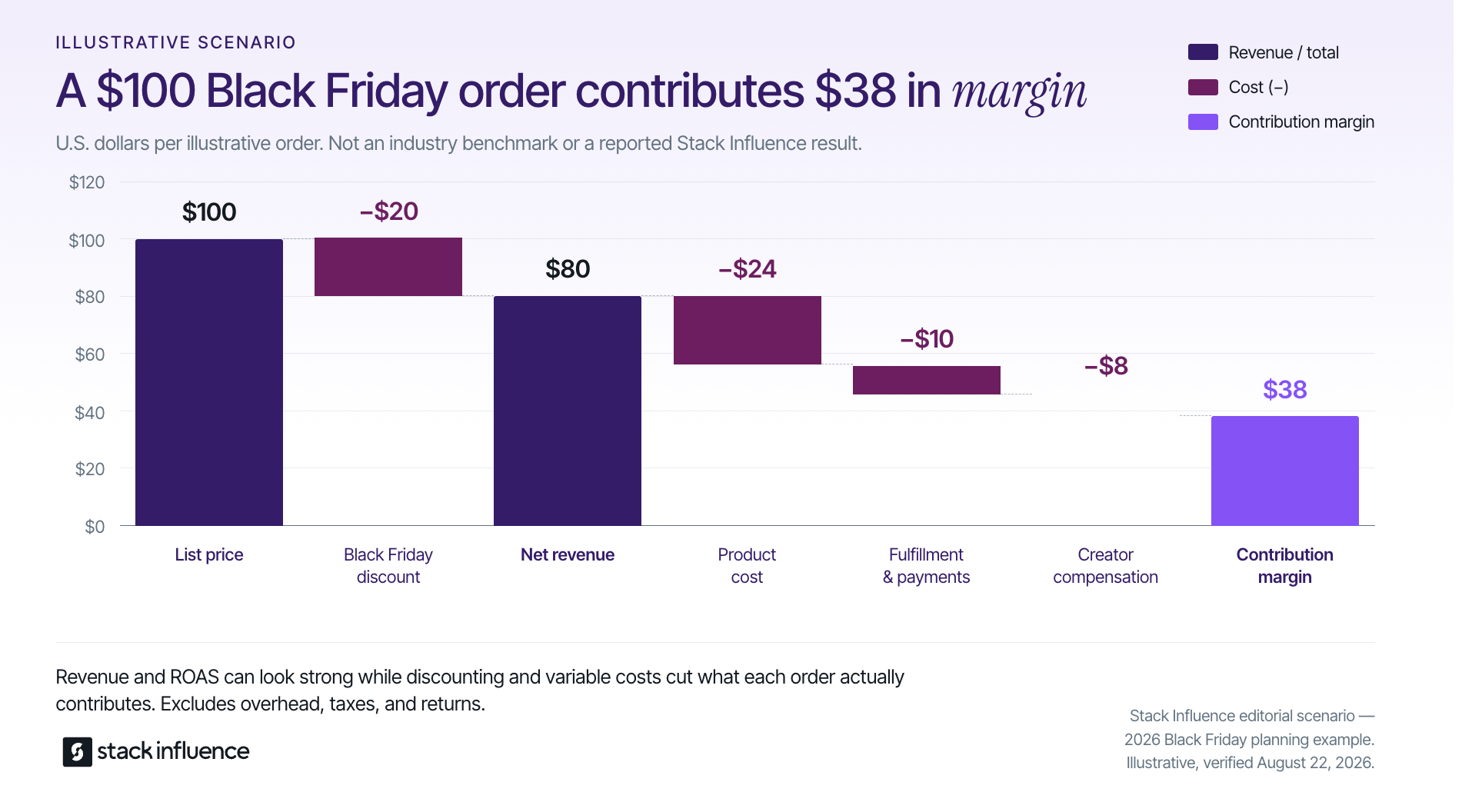
Margin must sit beside revenue. Consider an illustrative $100 list-price order: a $20 Black Friday discount leaves $80 in net revenue. Subtract $24 in product cost, $10 in fulfillment and payment costs, and $8 in allocated creator compensation or commission, and the contribution margin is $38 before overhead, taxes, and returns. A campaign can show attractive revenue or ROAS while producing weak economics if discounting, returns, or creator costs rise.
Marketplace movement may require a longer window than the promotion itself. During a verified three-month Stack Influence campaign for Targus, the campaign included 120 creator promotions, 275,560 social impressions, and 4,323 engagements. Average monthly unit sales were 56 at the start and 221 during the campaign, while Amazon Best Seller Rank moved from #151,547 to #47,811. The example does not predict Black Friday results, but it shows why campaign reporting can connect creator output, attention, sales, and marketplace indicators rather than reducing performance to one metric.
Black Friday influencer campaigns often fail between otherwise competent teams. The creator publishes on time, but the discount starts later. The link reaches the wrong SKU. Inventory disappears after the first wave.
The brand may expect paid usage that was never licensed, while the creator may expect a commission that the tracking setup cannot verify. These are coordination failures, not audience failures.
Prevent these failures with a preflight test 72 hours before each wave:
With four to six weeks remaining:
With fewer than two weeks remaining, product seeding may not leave enough time for genuine use and reliable shipping. Focus on creators who already own the product, existing affiliates, approved UGC, or content that can be produced without pretending to have experience the creator does not have.
Black Friday influencer marketing 2026 will reward teams that create proof before pressure. The discount can accelerate a decision, but the creator still needs to show why the product matters, who it serves, and what makes the offer worth acting on.
For sellers, the next step is to map one hero product through the Six-Window Black Friday Creator System, then confirm creator capacity, inventory, tracking, rights, and contribution margin. For creators, the next step is to evaluate the complete partnership package rather than accepting a deadline and discount code without the operational details.
A managed micro-influencer and product-seeding workflow can help ecommerce teams coordinate creator activation, product logistics, UGC, and completed posts as one campaign. The benefit is not more holiday noise. It is a campaign that reaches Cyber Week with the proof, creative, tracking, and accountability already in place.
Cyber Monday 2026 falls on Monday, November 30. For ecommerce sellers and content creators, the opportunity is not a single discount post. It is a compressed creator-commerce campaign in which product availability, content proof, mobile checkout, links, rights, and timing must work together.
A creator can publish persuasive UGC and still produce weak business results if the offer is unclear or the destination breaks. A seller can offer a strong discount and still miss demand if creators receive products too late. This guide to Cyber Monday influencer marketing 2026 provides a dated execution framework, channel-specific setup for Amazon and Shopify, a creator-ready content brief, and a measurement system that separates attention from profitable commerce.
Cyber Monday influencer marketing is the coordinated use of creators, UGC, product seeding, affiliate links, discount codes, and paid amplification to influence discovery and purchase around Cyber Monday. In 2026, the strategy should cover the weeks before and after November 30, not only the Monday itself, because shopping activity and creator exposure begin earlier.
Cyber Monday falls on Monday, November 30, in 2026. That fixed date gives sellers a clear deadline for inventory, offers, links, content approvals, and creator posting windows. It also gives creators time to avoid conflicting category partnerships and reserve production capacity before Q4 schedules become crowded.
The latest completed event shows why the execution details matter. Adobe reported $14.25 billion in U.S. online spending on Cyber Monday 2025, with mobile devices generating 57.5% of that revenue. Adobe measures transactions across U.S. retail sites, so its figures describe online spending rather than all retail activity.
The National Retail Federation reported 75.9 million Cyber Monday online shoppers, including 46.9 million who shopped online through a mobile device. That means about 61.8% of surveyed online shoppers used mobile, although an individual shopper could also have used another device. NRF survey counts and Adobe transaction data use different methodologies, but both point to the same practical requirement: every creator path must work cleanly on a phone.
Cyber Monday is one part of a larger seasonal system. Brands planning gift guides, Christmas content, or broader promotional themes can coordinate this article with Stack Influence’s guide to holiday influencer marketing campaign ideas, while keeping the Cyber Monday workflow focused on one conversion deadline.
The Cyber Monday Conversion Clock assigns a distinct job to six periods before and after November 30. It prevents a common scheduling mistake: asking creator recruitment, shipping, production, approval, and conversion to happen during the same week.
Choose a hero SKU or tight bundle, calculate contribution margin after the planned discount, confirm inventory, and select the destination. Creators should also reserve production capacity and avoid category conflicts before Q4 schedules become crowded.
Before outreach, answer five questions:
Creator selection should combine audience relevance with operational reliability. Sellers can use a structured influencer hiring system, then adapt platform-specific research for finding TikTok influencers and finding Instagram influencers.
Activate creators in waves so the first group can reveal shipping, brief, claim, or tracking problems before the campaign scales. Agreements should cover deliverables, dates, compensation or reimbursement, revisions, disclosures, exclusivity, links, affiliate terms, content rights, and paid amplification. An automated product-seeding workflow can reduce follow-up when many nano influencers or micro influencers participate.
Stack Influence works with roughly 600,000 vetted creators, making a managed cohort workflow practical when a seller needs to activate creators without handling every outreach and follow-up task separately.
The first creative objective is product proof, not a countdown graphic. Ask creators to capture:
Brands should review factual accuracy, prohibited claims, product presentation, disclosures, and rights without editing every creator into the same spokesperson. Authentic creator voice is part of the value.
Use demonstrations, gift-use cases, comparisons, routines, FAQs, and comment replies to make the product recognizable before deal week. Sellers can distribute approved user-generated content across ecommerce touchpoints, including product pages, email, organic social, and retargeting when rights permit.
Select amplification candidates using qualified signals such as purchase questions, saves, clicks, and add-to-cart activity, not likes alone. Creators should leave enough space in their feeds for the final offer so the Cyber Monday post does not feel repetitive.
Deal-week content should progress from awareness to proof to truthful urgency:
TikTok reported more than $500 million in U.S. TikTok Shop sales during its four-day 2025 Black Friday and Cyber Monday period, while creator affiliates published nearly 10 million shoppable videos across the broader campaign. These figures describe TikTok Shop, not the entire influencer economy, but they show why shoppable content and operations must be ready before the final day.
Sellers can retarget engaged visitors, promote a genuine extension when one exists, shift to shipping or gift messaging, and retain evergreen creator proof. Creators should submit live links, metrics, invoices, raw files, and authorization details according to the agreement.
Reconcile orders, codes, tags, returns, commissions, files, and rights before closing the campaign. Invite strong performers into an ambassador or affiliate program so Cyber Monday can qualify longer creator partnerships.

A creator cannot communicate an offer the seller has not fully defined. Maintain one source of truth for the product, destination, promotion, deadlines, tracking, claims, disclosures, rights, and contacts.
The minimum offer packet should include:
Creators should test the final link and code on a phone before publishing. They should keep the exact offer in writing because an incorrect price or expiration claim can create audience complaints even when the creative is strong.
Amazon sellers should choose one ASIN, deal page, or Amazon storefront that matches the creator’s promise and displays the relevant variation and promotion clearly on mobile.
Amazon Attribution is a free measurement solution for eligible advertisers that measures non-Amazon marketing across social, video, email, search, and other channels. Amazon reports a 14-day attribution window and metrics including clicks, detail-page views, add-to-cart activity, purchases, units, and product sales. Create separate tags by creator or creative group so one shared link does not erase useful differences.
Eligible U.S. Seller Brand Owners can review the Amazon Brand Referral Bonus, which Amazon describes as an average credit of about 10% on qualifying sales measured through Amazon Attribution. Confirm eligibility and current terms inside the seller account before modeling the credit. Stack Influence’s Amazon influencer marketing workflow connects creator activation with marketplace-focused product seeding and UGC execution.
Shopify Campaigns supports custom UTM parameters for individual influencers. Use a naming convention that separates the event, platform, creator, and creative, then lock final links before scheduling because Shopify warns that later edits or deletions can disrupt reporting or create broken paths.
A Shopify shareable discount link can open a selected product or collection and apply an active code when requirements are met. Test it in a private mobile browser, verify discount combinations, and confirm the store time zone. Stack Influence’s Shopify influencer marketing workflow connects product seeding, creator content, and traffic to a brand-owned storefront.
Cyber Monday creative should reduce uncertainty quickly. Give creators four communication jobs while preserving their own language, pacing, and visual style.
One production session can create a discovery cut, an objection-focused retargeting cut, and a concise deal-day cut. Brands should request those functions rather than prescribing every word.
Disclosure belongs inside the creative. The Federal Trade Commission says creators should clearly and conspicuously disclose material connections, including free products or other value received from a brand. Disclosures should be hard to miss, and product claims should reflect the creator’s actual experience and available support.
Rights determine whether a strong post can be amplified. Meta describes Instagram partnership ads as a way to amplify content with a creator’s handle. Secure permission, authorization method, usage period, edit boundaries, channels, and compensation before publication.
A day-of-only post is usually too late because Cyber Monday shoppers are already comparing products, saving links, and responding to earlier Black Friday offers. Creator content performs a different job at each stage: discovery before deal week, proof during the weekend, and urgency on Monday. Posting only at the end removes the first two jobs.
Adobe measured $44.2 billion in online spending across Cyber Week 2025. Black Friday reached $11.8 billion and grew 9.1% year over year, faster than Cyber Monday’s 7.1% growth, which Adobe linked to earlier deals. Adobe’s Cyber Monday channel analysis supports building familiarity before the final conversion window.
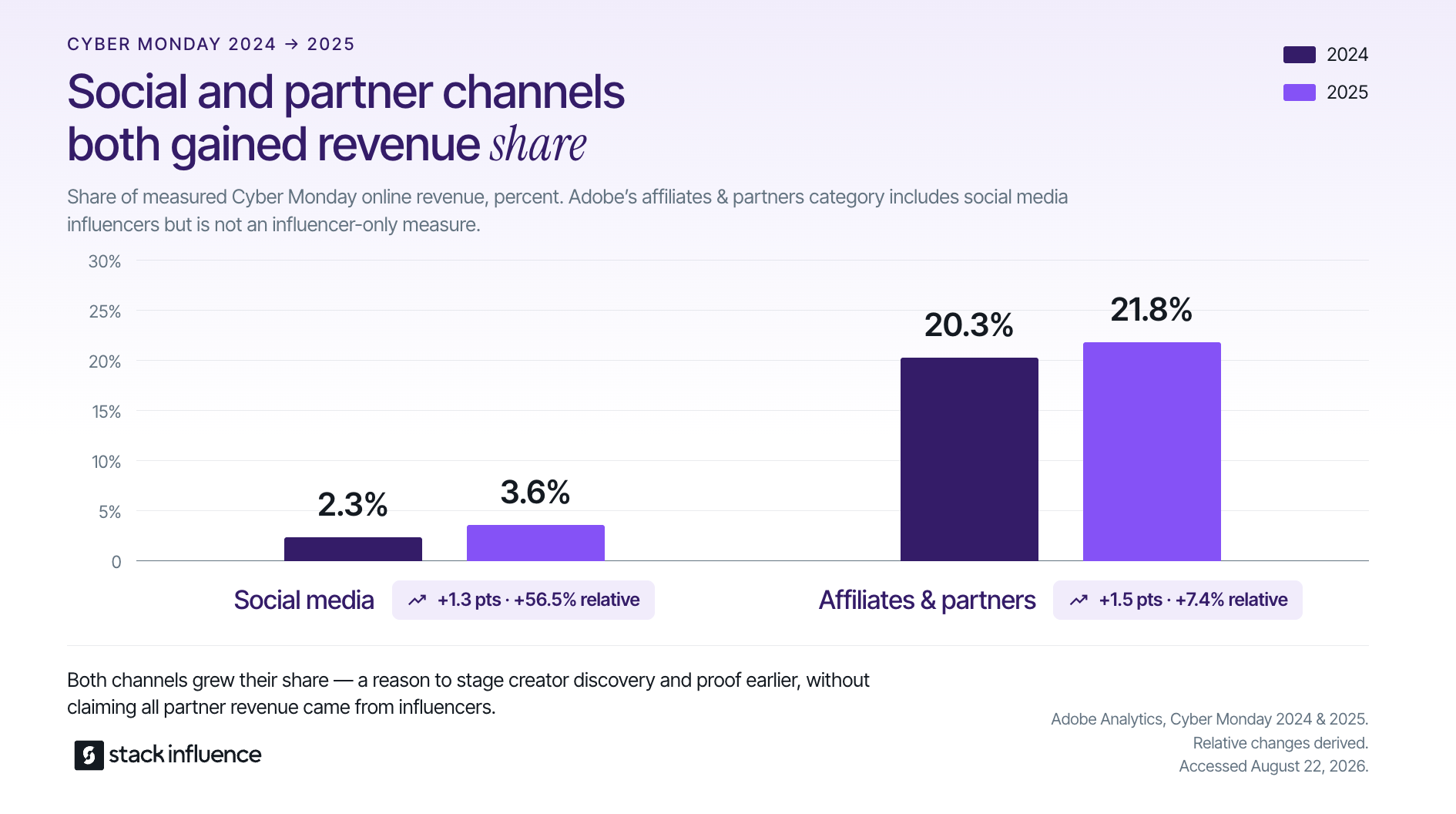
Adobe also reported that social media’s share of Cyber Monday online revenue rose from 2.3% in 2024 to 3.6% in 2025. Its affiliates and partners category increased from 20.3% to 21.8%. Adobe says the latter includes social media influencers but is broader than influencer-only revenue, so 21.8% should not be presented as an influencer sales share.
Use three touches:
Each post then serves one useful purpose instead of repeating the same urgent advertisement.
Measure Cyber Monday creator campaigns across three time windows and five performance layers. The windows separate audience building, deal-period conversion, and residual value. The layers connect creator delivery to attention, traffic, commerce, and reusable content, preventing impressions or one attribution report from becoming the entire verdict.
Use the Three-Window Creator Commerce Scorecard:
Measure five connected layers:
Use consistent formulas. Completion rate equals completed creators divided by activated creators. Contribution profit equals net revenue minus discounts, product cost, fulfillment, returns, creator or affiliate costs, and media. Cost per usable asset equals campaign cost divided by rights-cleared assets that meet the reuse standard.
Attribution remains incomplete because copied links, code leakage, cross-device journeys, branded search, marketplace browsing, and platform windows can separate exposure from the recorded order. Report tracked conversions precisely, then treat broader sales, rank, or search movement as context rather than proof that one post caused the outcome.
Creators should retain live URLs, screenshots, publication times, platform analytics, link results when available, and the agreed invoice or affiliate report. This evidence supports both payment and renewal decisions.
Most Cyber Monday influencer campaign problems are operational and preventable. Correct them before deal week instead of asking creators to compensate with more posts.
Stack Influence is a micro-influencer marketing platform for ecommerce brands built around gifted-first product seeding, vetted creator activation, campaign coordination, UGC generation, and completed-post accountability. The platform moves brands from creator participation to completed content rather than stopping at profile discovery.
Its completion-only structure is sometimes described as influencer insurance because campaign charges are tied to completed posts. For Cyber Monday, that model connects product delivery, follow-up, approvals, live-post tracking, and asset collection through one micro-influencer promotion workflow.
A verified six-month Stack Influence case study for NYK1 recorded 483 creator promotions, 2.15 million social impressions, and 83,471 engagements. During the measured campaign, average monthly unit sales increased from 482 to 2,965, while Amazon Best Seller Rank moved from #9,223 to #743. This is not a Cyber Monday benchmark, and the case study does not isolate creator activity as the sole cause.
The operational lesson is that volume matters when product receipt, deadlines, links, rights, and completion are coordinated. For Cyber Monday 2026, proof assets should be ready by November 8 and creators scheduled before deal week, not recruited on November 30.
Cyber Monday influencer marketing 2026 should connect one defensible offer with a sequenced creator story, a mobile-ready purchase path, creator-specific measurement, and clear content rights. The Conversion Clock gives each task a deadline, while the Three-Window Creator Commerce Scorecard shows whether execution created attention, profitable orders, reusable assets, or all three.
Start by mapping one hero product through the six phases and testing the complete customer path on a phone. When creator sourcing, product seeding, coordination, and completion would otherwise become the bottleneck, evaluate a managed micro-influencer workflow that can turn the campaign plan into finished creator content before the retail deadline.
A creator can look perfect in a feed and still be the wrong commercial hire. Ecommerce sellers often discover that after the product ships: the audience was mismatched, the brief was vague, the rights were missing, or the campaign could not be measured. Content creators experience the same failure from the other side when a brand requests “one quick post” without defining the work.
Learning how to hire influencers means treating the collaboration like a small, creative procurement decision, not a popularity contest. This guide shows brands and creators how to define the role, find candidates, verify fit, structure compensation, negotiate rights, document the agreement, manage delivery, and measure contribution across Amazon, Shopify, and DTC campaigns.
To hire an influencer is to contract a creator for two possible assets: access to an audience and production of content. The agreement may use product seeding, a cash fee, affiliate commission, or a hybrid. Hiring is complete only when scope, compensation, rights, disclosure, delivery, and measurement are documented.
Separate these roles before building a shortlist:

The Five-Part Influencer Hiring Packet moves a collaboration from vague interest to an executable deal. Build it before discovery, update it as evidence arrives, and use the same fields to compare candidates or evaluate an incoming brand deal.
The Role Card states what the creator is being hired to do. Define one primary outcome, target customer, platform, content job, call to action, destination, and proof standard.
A useful Role Card might say: “Demonstrate one customer problem in a short-form video, publish it to the agreed channel, and direct viewers to a trackable product page.” That is easier to source and price than “create buzz.” Use a broader influencer marketing strategy when several channels or creator roles must work together.
The Candidate Proof File contains the evidence required before an offer. Review roughly 20 recent posts, including several commercial posts when available, rather than selecting from one viral example.
Capture audience demographics and location, examples in the required format, meaningful native metrics, sponsored-content frequency, competitor conflicts, deadline history, and disclosure behavior. Request creator-provided analytics screenshots when audience composition materially affects the decision.
For creators, a media kit and portfolio should show who the content serves, which formats you execute well, what commercial actions you can track, and how reliably you deliver.
The Offer Sheet states the product, cash fee, commission, deliverables, timeline, revision allowance, approval process, expenses, and payment trigger. It should also separate the posting fee from content production, raw files, paid-media permission, and exclusivity.
The quoted creator fee is not always the full hiring cost. Consider a clearly illustrative deal with a $500 creator fee, $50 in landed product cost, $15 shipping, a separate $300 license for 90 days of paid usage, and four hours of internal coordination valued at $50 per hour, or $200. The total is $1,065, so the creator fee represents 46.9% of the modeled commitment and the total is 2.13 times the quoted fee. These assumptions are not an industry benchmark, but they show why both sides should price the complete scope.
The Rights Schedule defines what happens to the content after delivery. State whether the brand may repost organically, edit the asset, request raw files, use the creator’s name or likeness, run paid ads, authorize partnership ads, place the content on product pages, or license it to retailers.
Every right needs a duration, territory, channel, and permitted use. “Full rights” is too vague to protect either side. Stack Influence’s guide to UGC licensing rights explains the difference between receiving a post and receiving permission to reuse that post commercially.
The Completion Record defines what counts as finished, such as a live URL, disclosure, approved caption, downloadable file, analytics snapshot, invoice, or affiliate destination.
Define the payment event and cure process before launch. State any required live period, review window, and included revision limit instead of negotiating them after delivery.
Ecommerce brands should source influencers from customers, native social search, platform marketplaces, referrals, creator databases, affiliate programs, and managed campaign platforms. The right source depends on the bottleneck. Manual discovery offers control, databases accelerate research, and managed workflows support activation, product seeding, follow-up, completion tracking, and UGC collection.
Start with people who already know the product. Search customer tags, mentions, affiliate applicants, community discussions, and creator posts about the category. Familiarity can reduce education time, but it does not replace vetting.
Native platform tools can add first-party context. Instagram’s creator marketplace lets eligible brands search creator and audience attributes, review portfolios, send project details, and discuss rates through Meta Business Suite. Meta’s creator marketplace overview describes the current workflow.
Shopify sellers can use customer data, direct outreach, affiliate applications, and Shopify Collabs. Shopify’s current documentation says merchants can send direct invites, accept creator applications, issue gifts or discount codes, track affiliate sales, and send payments. It also says new creator signups are currently paused, so creators without an existing Collabs account should not rely on it as their only route to brand partnerships. Shopify Collabs documentation provides the latest status.
For larger searches, compare creator databases by data freshness, audience analysis, supported platforms, export limits, contact coverage, and brand-safety workflow. Stack Influence’s guide to Instagram influencer database platforms explains how self-service research differs from managed activation.
Vet influencers by testing five kinds of evidence: audience relevance, content capability, engagement quality, commercial readiness, and operational reliability. Do not ask whether a creator is “good” in the abstract. Ask whether the available evidence supports the exact Role Card, channel, product, rights package, and deadline in this campaign.
Use two passes. First remove clear mismatches involving audience, category, disclosure, conflicts, or format. Then compare qualified candidates on the proof that matters for the campaign.
Check these areas:
Follower count estimates potential distribution, but it is not a hiring verdict. Nano influencers and micro influencers can be strong hires when niche relevance, product demonstrations, credible UGC, or creative variety matter.
Compensation should follow the work, risk, distribution, and rights being purchased. Compare the complete package, not the headline fee.
Use the model that matches the Role Card:
A practical influencer seeding guide helps distinguish a gift from a required product-for-content exchange. For paid and blended deals, compare the full range of influencer compensation models before negotiating.
A strong influencer offer makes the commercial decision easy to understand without removing creative judgment. State why the creator fits, what the product is, what must be delivered, where it will appear, when it is due, what compensation is included, which rights are requested, how approval works, and when payment occurs.
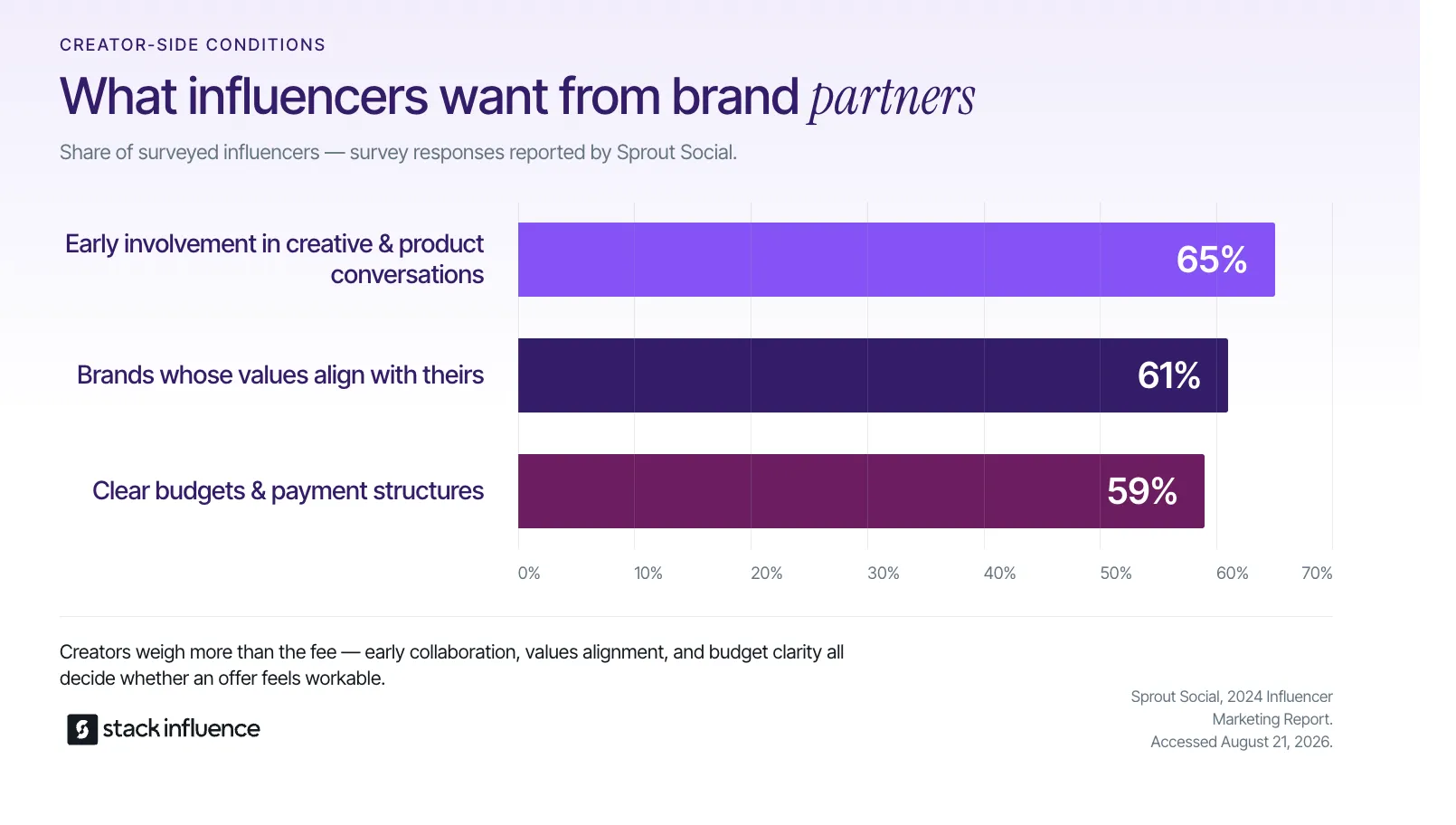
Creator input is not a courtesy added after the deal. Sprout Social’s current guide, citing its 2024 Influencer Marketing Report, says 65% of influencers want early involvement in creative or product-development conversations, 61% want to work with brands whose values align with theirs, and 59% want companies to provide clear budgets and payment structures. Sprout Social’s hiring guidance supports a collaborative, transparent offer rather than a rigid last-minute brief.
A complete first offer should include:
Creators should quote the requested package, not only “a post.” Confirm production, publishing, raw files, cutdowns, paid amplification, exclusivity, rush timing, travel, and revisions. Stack Influence’s influencer outreach guide provides a fuller communication workflow.
An influencer contract should cover the parties, deliverables, deadlines, compensation, expenses, content approval, usage rights, exclusivity, disclosure, measurement, cancellation, and remedies. Even a small campaign needs written terms when a post, payment, product reimbursement, license, or specific content output is required. Higher-value or regulated campaigns may require qualified legal review.
At minimum, document:
Disclosure is a shared operating requirement, not a caption afterthought. The FTC says a financial, employment, personal, family, free-product, discounted-product, or other material relationship should be disclosed when the creator endorses the product. FTC disclosure guidance also makes clear that receiving something of value can trigger disclosure even without cash payment.
Platform rules must be checked separately. TikTok’s guidance, last updated in April 2026, says creators posting content that promotes a brand, product, or service must turn on the commercial content disclosure setting. TikTok’s commercial content documentation explains the setting and consequences of missing disclosure.
A reusable influencer contract template can standardize the recurring clauses, while a campaign schedule handles the product, dates, deliverables, and negotiated rights.
Hiring does not end at signature. Operations determine whether the creator becomes a completed post, useful UGC asset, attributable test, and repeatable relationship.
Use a simple completion sequence:
Stack Influence is designed for ecommerce brands that want this execution layer connected in one workflow. The platform works with roughly 600,000 vetted creators and uses a gifted-first product-seeding model that supports sourcing, vetting, creator coordination, UGC generation, and completed-post accountability. Its automated product-seeding workflow is particularly practical when manual shipment tracking and follow-up become the campaign bottleneck.
The Creator Contribution Chain separates hiring quality from content delivery, audience response, commerce, and long-term asset value. This prevents one viral view count or one short sales window from becoming the entire verdict. Each layer answers a different question, and the evidence becomes stronger as it moves closer to a business outcome.
Track five layers:
Configure measurement before outreach. Google Analytics campaign parameters can identify the source, medium, campaign, and creative associated with referral traffic. Amazon sellers can use Amazon Attribution to measure the on-Amazon impact of eligible non-Amazon channels, including social and affiliate or influencer campaigns.
Eligible U.S. Seller Brand Owners enrolled in the program can also review whether the Amazon Brand Referral Bonus changes the economics of qualifying attributed sales. Amazon says the credit averages 10% of qualifying sales, but eligibility and current program terms should be confirmed before budgeting. Stack Influence’s Amazon influencer marketing solutions and guide to influencer marketing KPIs provide additional marketplace and reporting context.
Attribution has blind spots. View-through influence, copied links, cross-device journeys, branded search, and delayed purchases can escape a creator tag. Separate direct attribution from assisted evidence, use a window appropriate to the purchase cycle, and avoid causal claims the campaign design cannot support.
Creators evaluate the brand’s product, audience fit, communication, content quality, payment reliability, and reputation before accepting. Hiring is a two-sided risk decision because a public partnership can affect audience trust and future brand relationships.
Sprout Social reports that 93% of influencers say the quality of a brand’s existing social content affects whether they agree to collaborate. Sprout Social’s relationship research supports a practical conclusion: improve the brand’s own profile, product explanation, landing page, customer experience, and response process before blaming weak acceptance on the creator list.
Brands should make themselves easier to hire:
Creators should perform the same diligence. Confirm the legal entity, product category, expected claims, approval process, rights, payment terms, and contact person before committing audience trust or production time.
The practical answer to how to hire influencers is to define the job, collect proof, price the whole scope, document the deal, manage completion, and measure contribution in layers. The creator with the largest audience is not automatically the strongest hire, and the cheapest quote is not automatically the lowest-cost campaign.
Start with one clearly defined product and one Role Card. Build the Five-Part Influencer Hiring Packet, compare creators against the same evidence, and retain the partners who combine credible content with dependable execution. Ecommerce teams that need to scale can then move from manual coordination to a managed product-seeding workflow without losing the discipline that made the first tests useful.
Finding names on TikTok takes minutes. Finding creators who understand your buyer, can produce convincing product content, and will follow through is the real work. For ecommerce sellers and content creators, learning how to find TikTok influencers should lead to a qualified shortlist, not a spreadsheet full of popular accounts.
This guide shows you how to search TikTok, use TikTok One and TikTok Shop Affiliate, evaluate micro influencers and nano influencers, structure outreach, and connect creator partnerships to sales and reusable UGC. The goal is a discovery system that works for one pilot and can still work when the campaign expands.
An influencer search works only when the campaign job is defined. In this guide, a TikTok influencer is a creator whose content, audience, or commerce activity can affect product discovery, consideration, or purchase. That can include nano influencers, micro influencers, UGC creators, TikTok Shop affiliates, and larger personalities. This broader definition of TikTok influencer marketing keeps the search tied to the outcome rather than a fixed follower tier.
Choose one primary job before building a shortlist:
Turn that job into a one-page creator brief. Include the product, target customer, problem being solved, required format, compensation model, geography, deadline, disclosure expectations, content rights, and measurement method. A skincare seller seeking shoppable demonstrations should search differently from a software brand seeking educational reach.
For content creators, the same exercise improves positioning. “Lifestyle creator” gives a brand little to search for. “Budget meal-prep creator for busy parents” connects a topic, audience, and commercial use case.
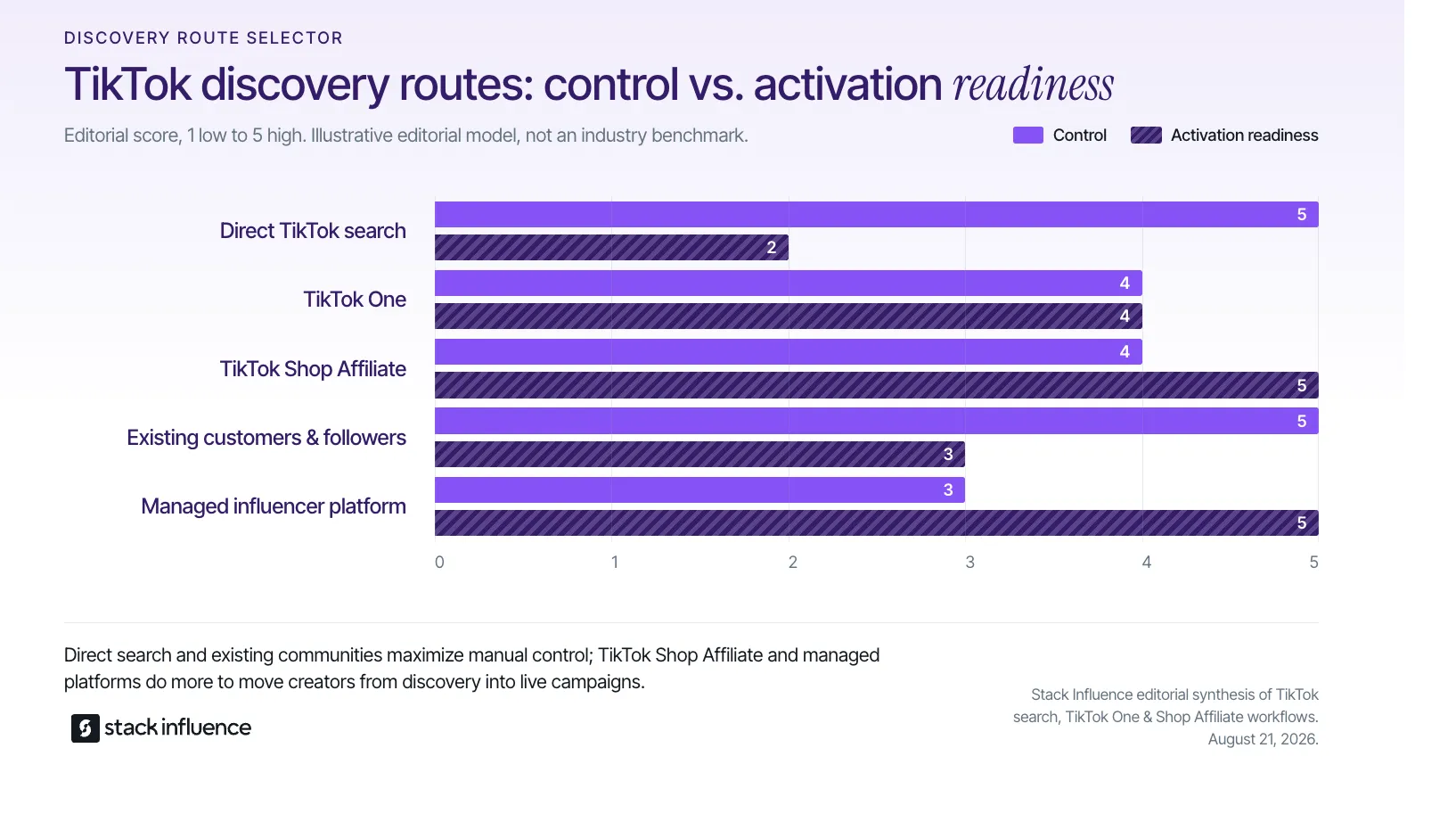
You can find TikTok influencers through direct TikTok search, TikTok One, TikTok Shop Affiliate Center, your existing customer community, and managed influencer marketing platforms. The right route depends on whether you need maximum manual control, commerce-ready creators, faster activation, or end-to-end campaign execution. Most scalable programs combine at least two routes.
Use this editorial 1-to-5 decision model as a planning tool, not an industry benchmark. A higher control score means your team chooses creators more directly. A higher activation-readiness score means the route includes more support for invitations, product collaboration, communication, or completion.
TikTok’s Discover and Search tools can surface creators, videos, hashtags, sounds, and sponsored content. Search for the content your buyer would watch, not only the label an influencer might use. A TikTok user finder workflow can help when you have a partial username, memorable phrase, product clue, or existing video.
Build queries from four layers:
Open promising videos, then inspect the creator’s profile, recurring topics, comment section, tagged brands, linked storefronts, and recent posting pattern. Comments often reveal adjacent creators because niche communities interact with one another. Search competitor product names too, but distinguish genuine category expertise from accounts that post any product offered to them.
TikTok One gives advertisers a structured creator-search workflow. TikTok’s current documentation says brands can search by username or keyword, use AI search when available to selected customers, filter by creator and audience details, and evaluate median video views, engagement, audience demographics, content portfolios, and performance trends. Shortlists can then feed directly into project invitations. TikTok One’s creator discovery documentation is the most reliable place to verify the available filters for your account and region.
TikTok One is practical when a brand needs more evidence than public profile browsing provides. It also reduces the handoff between discovery and invitation, although the final decision should still include a manual content review.
TikTok Shop sellers can use Affiliate Center to find creators and choose between Open Collaboration and Target Collaboration. Open Collaboration makes selected products visible to a broader creator pool, while Target Collaboration lets a seller invite specific creators to promote specific products. TikTok’s affiliate collaboration guide also supports creator filtering, invitations, product selection, samples, and performance tracking.
Use Open Collaboration to discover unexpected creator-product matches, then move proven creators into targeted offers. Use Target Collaboration when the product needs a precise message, launch date, audience, or content style.
Review customers, email subscribers, tagged videos, brand mentions, affiliate applicants, and followers. A smaller creator who already understands the product may require less education and produce more credible content than a larger account with no connection to the category.
Ask customer support and community teams for names. They often know which customers publish tutorials, answer questions, or recommend the brand without being prompted. Existing affinity is not proof of campaign fit, but it is a strong lead source.
A creator database helps a team research profiles. A managed platform supports the work after discovery, including activation, product seeding, communication, content tracking, and completion. Stack Influence’s TikTok influencer solutions are built around vetted creator participation and managed ecommerce campaign execution.
Stack Influence works with roughly 600,000 vetted creators through a gifted-first product-seeding model. Its completions-only structure is designed so brands pay for completed creator posts rather than treating every shipped product as a completed campaign result.
The 12-Post Creator Review is a fast evidence framework for moving a creator from “interesting” to “qualified.” Review the creator’s 12 most recent non-pinned posts so one viral outlier, one sponsored video, or one inactive period does not control the decision. Twelve is an editorial starting point, not a universal platform benchmark.
Evaluate six signals:
The micro-influencer recruitment and vetting guide expands the audience and reliability checks, while the guide to fake engagement on TikTok covers suspicious follower and interaction patterns.
Do not treat follower count as the final score. Followers can indicate potential distribution, but the 12-post evidence shows whether the creator can repeatedly make relevant content, hold attention, discuss products credibly, and support the campaign’s actual job.

Contact a TikTok influencer with a concise offer that explains why the creator fits, what the product is, what content or outcome is requested, how compensation works, and when the project runs. Include product logistics, disclosure rules, usage rights, approval boundaries, and tracking before the creator accepts so both sides can evaluate the same opportunity.
A practical first message contains six elements:
The influencer outreach guide provides a fuller brand-and-creator workflow. For creators pitching brands, the same structure works in reverse: name the audience, propose a concrete video idea, show relevant proof, state the deliverable, and make the reply easy.
Treat influencer seeding as an operational process rather than “send and hope.” TikTok Shop’s current sample rules say sellers should review free-sample requests within 7 days, ship within 7 days after approval, and expect free-sample creators to post within 14 days of delivery. Those platform-defined windows total 28 days, excluding carrier transit.
Disclosures are part of activation, not a cleanup step. The FTC says a free or discounted product is a material connection that should be disclosed, and TikTok requires creators promoting a brand, product, or service to use its commercial content disclosure setting. Review the FTC’s influencer disclosure guidance and TikTok’s commercial content disclosure requirements before publishing.
Separate posting permission from reuse rights. State whether the brand may repost, edit, use the content in paid ads, request raw files, or use the asset on product pages, and define the permitted duration.
Measure influencer discovery from the first profile reviewed through the business outcome. A large creator list is not success if few creators qualify, accept, complete content, or generate useful audience and commerce signals.
Track the chain in six layers:
Match tracking to the storefront. Shopify Collabs can support creator invitations, gifts, discount codes, affiliate links, sales tracking, and payments. Amazon sellers can use Amazon Attribution to measure how non-Amazon channels, including social and influencer campaigns, affect activity on Amazon. DTC teams can add campaign parameters through Google Analytics URL builders so traffic-acquisition reporting distinguishes creators, campaigns, and content.
Attribution still has blind spots. A shopper may watch a creator, search the brand later, switch devices, buy through another link, or purchase after a code expires. Use channel data, storefront movement, content performance, and contribution economics together. Treat correlated improvement as evidence to investigate, not automatic proof that one post caused every sale.
Most guides about how to find TikTok influencers stop when the shortlist is built. That is where the operational work begins. Every candidate needs an owner, contact path, offer, response status, product status, deadline, disclosure check, rights record, tracking method, and completion result.
This distinction explains why creator databases and managed campaign platforms solve different problems. A database expands research and manual choice. A managed workflow connects creator activation, product seeding, communication, UGC generation, and completed-post accountability.
The corrective insight is simple: optimize for qualified completions, not names collected. A smaller list that reliably produces useful content can create more value than a large database export that never reaches an accepted brief.
Content creators become easier for brands to find by making their niche, audience, recent performance, commercial experience, and contact path obvious. TikTok One says advertisers can filter and evaluate creators using details such as country, industry, language, follower count, audience characteristics, median video views, engagement, and recent content. Creators should make those signals consistent and current.
TikTok’s brand-discovery guidance for creators provides a useful view of what advertisers inspect.
Improve findability with five actions:
The guide on how to find your niche as an influencer can help turn a broad creator identity into a searchable content promise.
Learning how to find TikTok influencers means connecting search, evidence, activation, and measurement. Start with one campaign job, search through at least two routes, apply the 12-Post Creator Review, and pilot with creators whose content and operating habits support the same goal.
For ecommerce sellers, the next step is to decide whether the bottleneck is discovery, vetting, outreach, product seeding, or completion. For content creators, the next step is to make your niche and commercial proof easier to evaluate. Stack Influence can support brands that want vetted creator activation, gifted-first product seeding, UGC generation, and completed-post accountability managed through one workflow.
Finding creators is easy. Finding creators who reach the right shoppers, produce useful content, and complete the work is the real challenge.
For ecommerce sellers, how to find Instagram influencers is a sourcing, qualification, logistics, and measurement problem. For content creators, the system works in reverse: clear niche, audience, deliverables, and reliability make profiles easier for brands to select.
This guide shows both sides how to move from discovery to measured Amazon, Shopify, product-seeding, affiliate, and UGC campaigns.
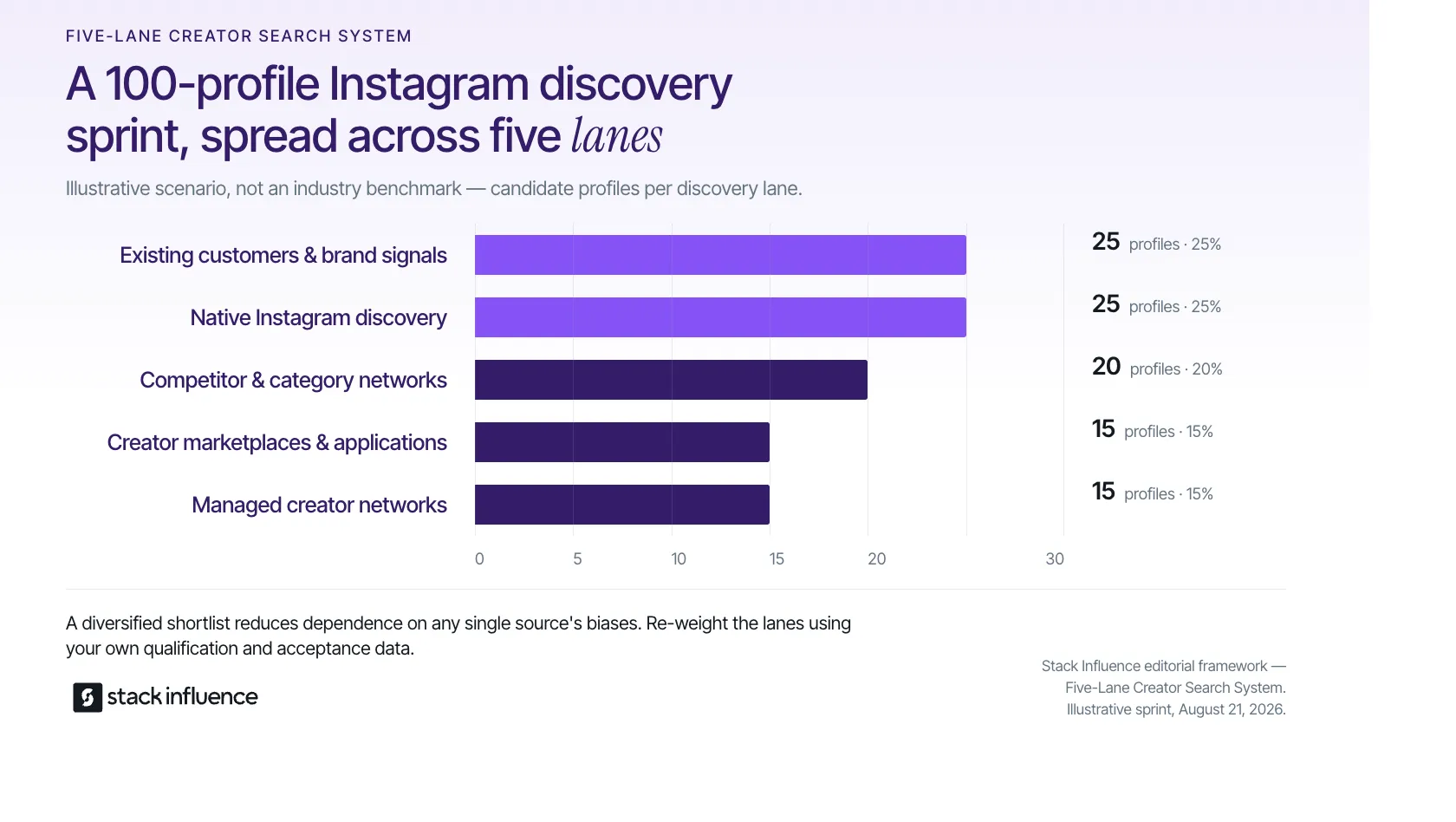
The Five-Lane Creator Search System builds a diversified candidate pool before any outreach begins. Each lane reveals a different type of creator signal, so ecommerce brands are less likely to overvalue whichever profiles happen to appear first in Instagram Search or a software database.
Before searching, turn the campaign goal into a one-page creator brief. Include:
A clear brief prevents a common failure: searching for “good influencers” without defining what good means for the campaign.
Start with people who already know the product or category. Review customer tags, brand mentions, affiliate applicants, email subscribers, repeat purchasers, community members, and authentic UGC already posted without a formal campaign.
This lane can surface natural product affinity. A smaller creator who understands the customer problem may be more credible than a larger account meeting the product for the first time.
Use Instagram Search as a research tool, not just a hashtag lookup. Combine the product category, customer problem, format, location, profession, and use case, then follow strong results through tagged posts, collaborators, similar accounts, and comments.
Instagram's official search explanation describes results across accounts, audio, hashtags, and places. In practice, the strongest searches are usually specific, such as “small apartment organization,” “new mom meal prep,” or “curly hair wash day,” rather than broad labels like “lifestyle influencer.”
Use the guide to finding micro influencers to expand a promising account into a larger niche map. Record each profile's discovery source for later analysis.
Study adjacent brands, category educators, retailers, publications, events, and complementary products. Review tagged content and past collaborations to identify creators who already know how to explain the category.
Do not simply copy a competitor's roster. Check for exclusivity conflicts, repeated sponsorships, audience fatigue, and whether the creator's relationship with the category still feels credible. The goal is to understand the creator ecosystem, then identify underused voices and adjacent communities.
Creator marketplaces make discovery more structured. Meta says brands using Instagram's Creator Marketplace can search and filter creators, review creator portfolios and expressed interests, and send partnership opportunities through a dedicated messaging workflow. Creators join through the professional dashboard and can present preferred interests and portfolio information. Access and eligibility can vary by account and market.
A brand-owned application form can collect profiles, audience geography, content examples, preferred categories, compensation preferences, and turnaround time. Creators should treat marketplace portfolios and application answers as sales assets by showing specific work and reliable execution.
Managed influencer marketing platforms support the execution layer as well as creator sourcing. This is especially practical when an ecommerce team wants product seeding, outreach, creator communication, deliverable tracking, and UGC generation managed as one campaign.
Stack Influence is built around vetted micro-influencer activation and gifted-first product seeding. The platform works with roughly 600,000 vetted creators, approximately 78% of whom are female, and uses a completions-only model in which platform charges are tied to completed creator posts. This model is sometimes described as “influencer insurance” because campaign budget is protected from creator drop-off at the platform-fee level.
Brands can combine manual discovery with automated product-seeding execution. A creator database may help build a shortlist, while a managed workflow helps move from names to accepted offers, shipped products, completed posts, and reusable content.
For planning purposes, consider an illustrative 100-profile discovery sprint: source 25 candidates from existing customers and brand signals, 25 from native Instagram discovery, 20 from competitor and category networks, 15 from creator marketplaces or applications, and 15 from managed creator networks. This is not an industry benchmark. It is a diversification model designed to prevent one discovery channel from determining the entire shortlist.
The right Instagram influencer is a creator whose audience, content behavior, commercial role, and operating reliability match a specific campaign job. Follower count alone cannot establish that fit. Ecommerce brands may need distribution, UGC production, affiliate sales, Amazon storefront traffic, or long-term advocacy, and each job requires a different creator profile.
A useful first distinction is between creator roles:
Nano influencers and micro influencers are commonly grouped by follower range, but definitions vary. The practical choice is between concentrated community relevance and broader distribution, not a universal cutoff. Stack Influence's explanation of micro influencers and their campaign role provides more context.
Amazon sellers should also distinguish a general Instagram creator from a participant in the Amazon Influencer Program. Qualifying Amazon influencers can receive a customizable Amazon presence and vanity URL, which can support storefront-focused content. That feature does not replace creator qualification, but it changes the possible path from Instagram content to Amazon shopping.
Qualify Instagram influencers by reviewing evidence across six areas: audience, content, engagement, commercial behavior, operational readiness, and brand safety. The goal is not to produce a perfect score from public data. It is to identify enough supporting evidence, unresolved questions, and disqualifying risks to decide whether outreach is worth the time.
Use the following Evidence Before Outreach checklist.
Professional accounts can share data from Instagram Insights, including account and content performance. Brands should request screenshots or exports that match the relevant period and verify that the audience data belongs to the account being evaluated. Creators should keep this evidence current so they can answer qualified brand inquiries quickly.
The InfluencerRank study analyzed 18,397 influencers and 2,952,075 posts using behavior, social relationships, and time dynamics. The practical lesson is to evaluate consistency and change over time rather than treating one follower count or engagement rate as a verdict. The InfluencerRank paper explains the methodology.
For a repeatable operational process, connect this evidence review to a documented micro-influencer recruitment and vetting workflow. Record why each creator advanced, paused, or was rejected so future campaigns can improve the qualification criteria.
A qualified shortlist becomes useful when the offer matches the creator's role, product economics, and required predictability. Outreach should state the offer, deliverable, deadline, usage rights, and measurement plan.
Common collaboration structures include:
The practical influencer outreach guide covers message structure and follow-up, while the influencer seeding guide explains why product, deliverables, creator fit, rights, and measurement should be resolved before shipping.
State the format, posting window, approval process, disclosure, usage period, exclusivity, compensation, and cancellation terms plainly before the creator accepts.
The Federal Trade Commission says a material connection can include payment or free products. Its social media disclosure guidance says disclosures should be hard to miss and placed with the endorsement. Meta also requires the Paid Partnership label for branded content, but a platform tool may not satisfy every disclosure obligation.
Creators should make their niche, audience, partnership options, and proof easy to understand. A professional account, clear bio, consistent content pillars, current contact method, portfolio or media kit, audience analytics, and examples of product storytelling reduce the effort a brand must spend determining whether a collaboration is worth pursuing.
Creators do not need to imitate larger accounts. They need a specific audience promise, repeatable execution, and a concise portfolio covering audience geography, formats, selected results, turnaround expectations, rights options, and preferred categories. The Instagram sponsorship guide explains how to turn that evidence into a professional pitch.

Most guides stop when a spreadsheet has enough names. That is only the end of sourcing. Campaign value depends on creator acceptance, product delivery, communication, completed content, disclosure, rights collection, reporting, and follow-up.
This distinction changes the platform decision. A database supports research and list building, while a managed influencer marketing platform or micro influencer agency can support product delivery, creator follow-up, content review, rights collection, and reporting. The workflows can be complementary.
Stack Influence is designed for this activation layer. Its gifted-first workflow combines vetted creator participation, product-seeding coordination, creator communication, UGC generation, and completed-post accountability for ecommerce campaigns. This is particularly practical for Amazon sellers, Shopify brands, and DTC teams seeking repeatable creator activation rather than a one-time list of profiles.
For content creators, reliability is a discovery advantage. Clear responses, accurate disclosure, on-time delivery, and useful reporting make repeat brand partnerships more likely.
Ecommerce sellers should measure Instagram influencer tests as a sequence of delivery, attention, traffic, conversion, content, and relationship outcomes. These layers appear on different timelines and should not be collapsed into one engagement rate. The measurement plan should begin before outreach so every creator receives the right link, code, baseline, and reporting requirement.
Use a six-layer measurement stack:
For Amazon campaigns, Amazon Attribution measures how non-Amazon marketing channels, including social and influencer activity, contribute to shopping actions. Eligible Brand Referral Bonus activity can also include qualifying additional brand purchases for up to 14 days after an attributed click, according to Amazon's Brand Referral Bonus documentation.
For Shopify campaigns, Shopify Collabs creator analytics can report visits, sales, orders, conversion rates, commission, and gifted value by creator. Sellers should still compare those platform signals with store analytics, margin, refund behavior, and new-customer quality.
Use a staged 90-day observation plan. On day 0, confirm the deliverable and tracking setup. During days 1 to 7, evaluate delivery, reach, engagement quality, and creative usefulness.
During days 1 to 14, review attributable Amazon activity and the applicable referral window. During days 15 to 30, examine Shopify traffic, sales, conversion, and code or affiliate behavior. During days 31 to 90, assess content reuse, repeat exposure, marketplace trends, and ambassador or affiliate potential.
This timeline is a decision framework, not a promise that every outcome will appear within 90 days. Dark social, untracked sharing, view-through influence, multi-device journeys, coupon leakage, organic search, and marketplace algorithms can all weaken attribution. Correlation across the campaign period should not be described as proof that a single post caused every change.
A verified Stack Influence Targus case illustrates layered reporting. During a three-month new-product campaign, 120 creator promotions produced 275,560 impressions and 4,323 engagements, while average monthly unit sales moved from 56 to 221 and Amazon Best Seller Rank moved from #151,547 to #47,811. The figures describe outcomes observed during the same period, not proof that creator content alone caused every change.
Use the ecommerce influencer ROI checklist to connect campaign metrics to economics, and the Shopify influencer marketing playbook to plan store-specific tracking and creator workflows.
Most wasted effort comes from searching too early, collecting too little evidence, or failing to design the campaign after the shortlist is built. Avoid these mistakes:
The most reliable way to find Instagram influencers is to connect five activities: define the creator's job, diversify discovery, qualify evidence, structure a workable offer, and measure the campaign on the correct timeline.
Ecommerce sellers can begin with a focused 100-profile sourcing sprint and a small, instrumented campaign. Content creators can use the same framework to make their audience, creative strengths, partnership options, and reliability easier to evaluate.
When campaign volume grows, a managed product-seeding workflow can reduce the operational gap between finding creators and receiving completed content. The next step is to choose one campaign goal, write the creator brief, and build the first diversified shortlist around evidence rather than follower count.
The best micro influencer marketing platforms do more than place your profile in a database. They determine which brands you can reach, how opportunities arrive, what you are expected to create, whether compensation comes through product, fees, commission, or a hybrid, and how much control you retain over your content.
For content creators, that changes the comparison. A platform with the largest network is not automatically the most useful. The right choice is the one that gives your current niche, audience, content skills, and business goals a realistic path to worthwhile creator partnerships. This guide compares eight active platforms from that creator-first perspective and gives you a practical method for choosing your first two.
A micro influencer marketing platform connects smaller content creators with brands, campaign briefs, product seeding opportunities, paid content work, affiliate programs, or UGC assignments. Some platforms act as searchable marketplaces, while others manage activation and delivery. The creator-facing value depends on access, compensation, workflow clarity, rights, and the likelihood of repeat work.
Micro influencer definitions vary, so follower count should be treated as one input rather than a universal rule. Stack Influence's guide to influencer tiers uses 10,000 to 100,000 followers for the micro tier and 1,000 to 10,000 for the nano tier, but individual platforms may accept creators below, within, or above those ranges.
A creator platform also differs from a brand-only influencer database. A database may let marketers search profiles without giving creators an application path. A true creator-facing platform gives you a way to build a profile, receive or find opportunities, review a brief, complete deliverables, and move through approval or payment.
The Creator Opportunity Ledger is a five-part method for evaluating platforms before you invest hours building profiles and sending applications. It replaces vague questions such as “Is this platform popular?” with information that affects your actual creator business.
Record these five fields for every platform:
Network size belongs in the ledger, but it should not control the decision. Public claims verified in August 2026 include 1.1 million or more creators on Collabstr, roughly 600,000 vetted creators in Stack Influence's supplied company data, 200,000 global creators on LTK, more than 100,000 influencers and UGC creators on Insense, and more than 70,000 opt-in creators on TRIBE. Those totals use different definitions and do not reveal how many suitable opportunities a particular creator will see.
This is the corrective insight most platform roundups miss: creators do not earn from network size. They earn from relevant opportunities that survive the full path from invitation or application to approved deliverable and usable compensation. A smaller, tightly matched platform can create more value than a huge marketplace where your niche is crowded or the deal structure does not fit your work.
The same distinction applies to product seeding. A structured campaign with defined requirements is different from no-obligation public relations gifting, as the practical guide to influencer seeding explains. Before accepting, identify whether the product is a gift, compensation for required content, or the first step in a larger paid relationship.
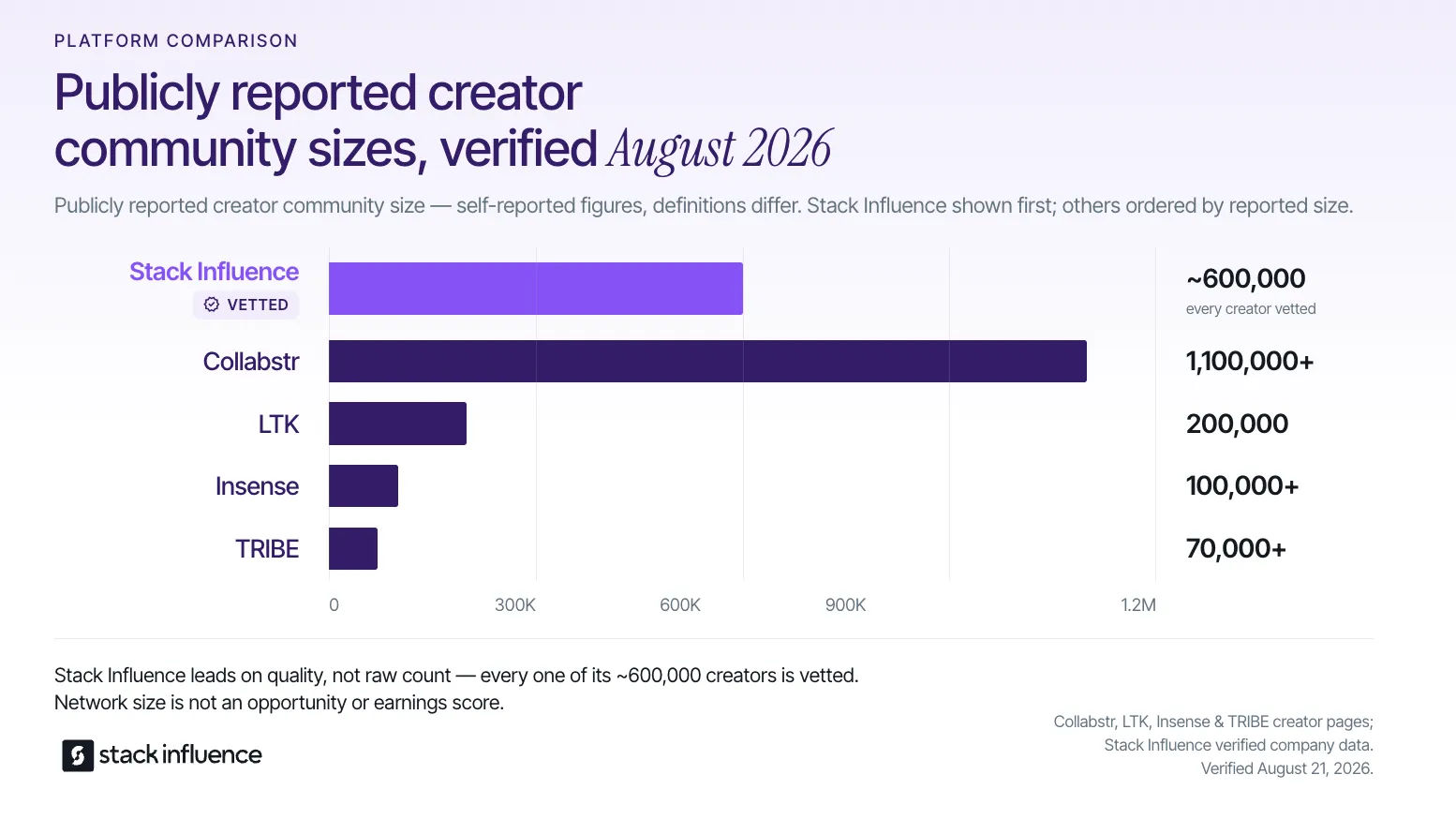
These eight platforms were selected because they maintain an active creator-facing workflow and support at least one meaningful path to product seeding, sponsored content, UGC, affiliate income, or shoppable commerce. The list is not based on a fabricated composite score. Each review uses the Creator Opportunity Ledger and current official platform information available in August 2026.
Stack Influence is a micro influencer marketing platform built around gifted-first product seeding and managed campaign execution for ecommerce brands. The platform coordinates creator activation, product ordering or reimbursement, campaign communication, completed posts, and UGC collection rather than operating only as a searchable profile directory. Its supplied company data describes a network of roughly 600,000 vetted creators.
The current Stack Influence creator FAQ says creators can apply with at least 200 Instagram followers and original content. Standard campaigns compensate participants with free product, while some opportunities may include additional monetary compensation. The FAQ also states that creators should contact campaign support if they do not feel comfortable sharing a product after trying it.
Best-Fit Workflow: Stack Influence is especially useful for micro influencers, nano influencers, UGC creators, and bloggers who want structured ecommerce product experiences, clear campaign checkpoints, and completed-post accountability without managing every brand interaction through scattered direct messages. The model is particularly practical for building product demonstration experience and a credible history of completed brand collaborations.
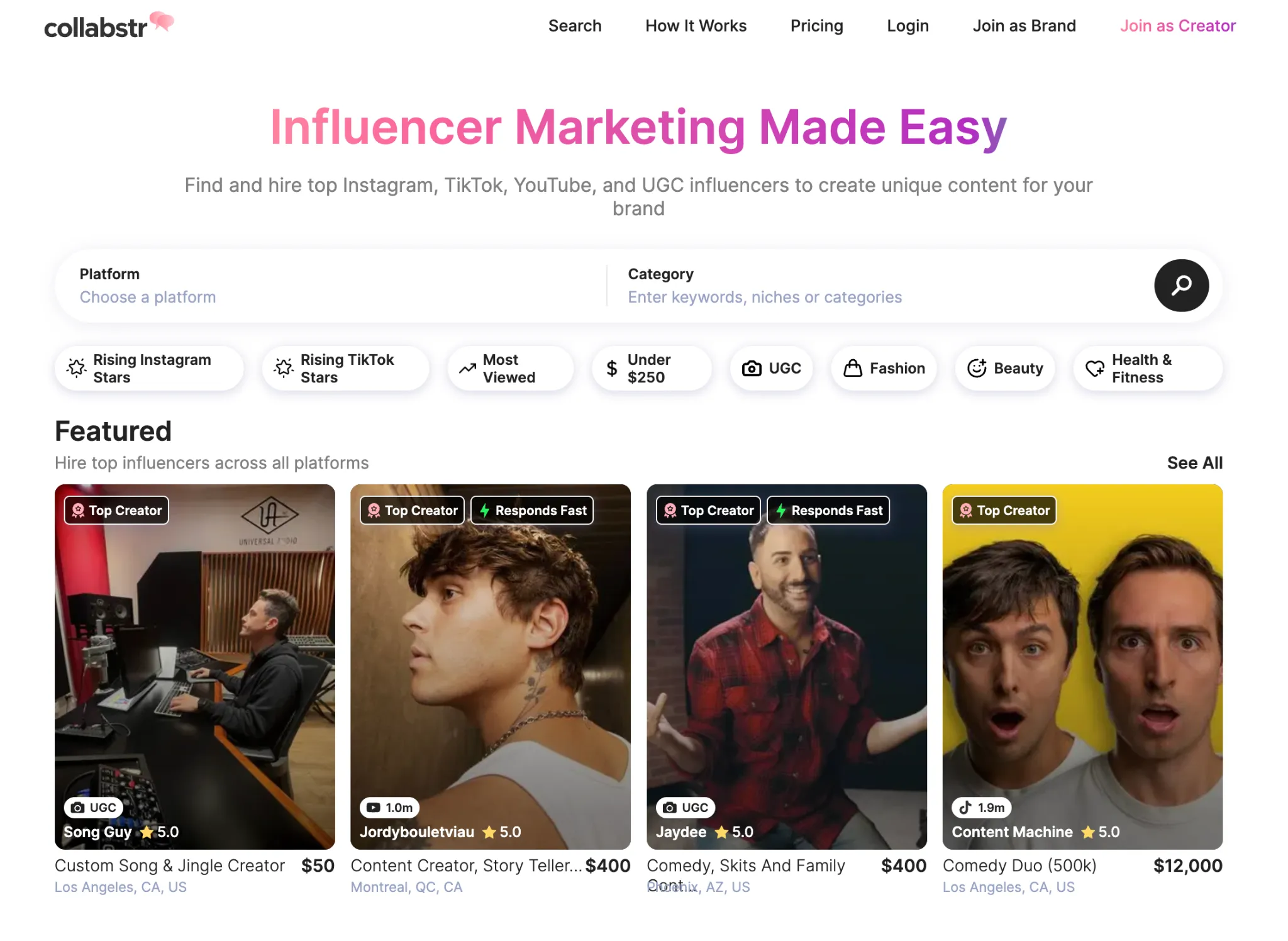
Collabstr's creator marketplace combines an inbound service storefront with open campaign applications. Creators can list platforms, content types, and rates, then let brands order packages directly. They can also browse active campaigns and apply with their own pricing, which gives creators two distinct ways to generate opportunities.
Collabstr says brands fund orders before work begins, with funds held until delivery and approval. Completed orders and reviews become part of the creator's marketplace record, so a strong operating history can improve future conversion. What to know: the storefront model rewards precise packages, clear revision limits, and explicit usage terms, while a broad marketplace can require frequent profile optimization to remain competitive.
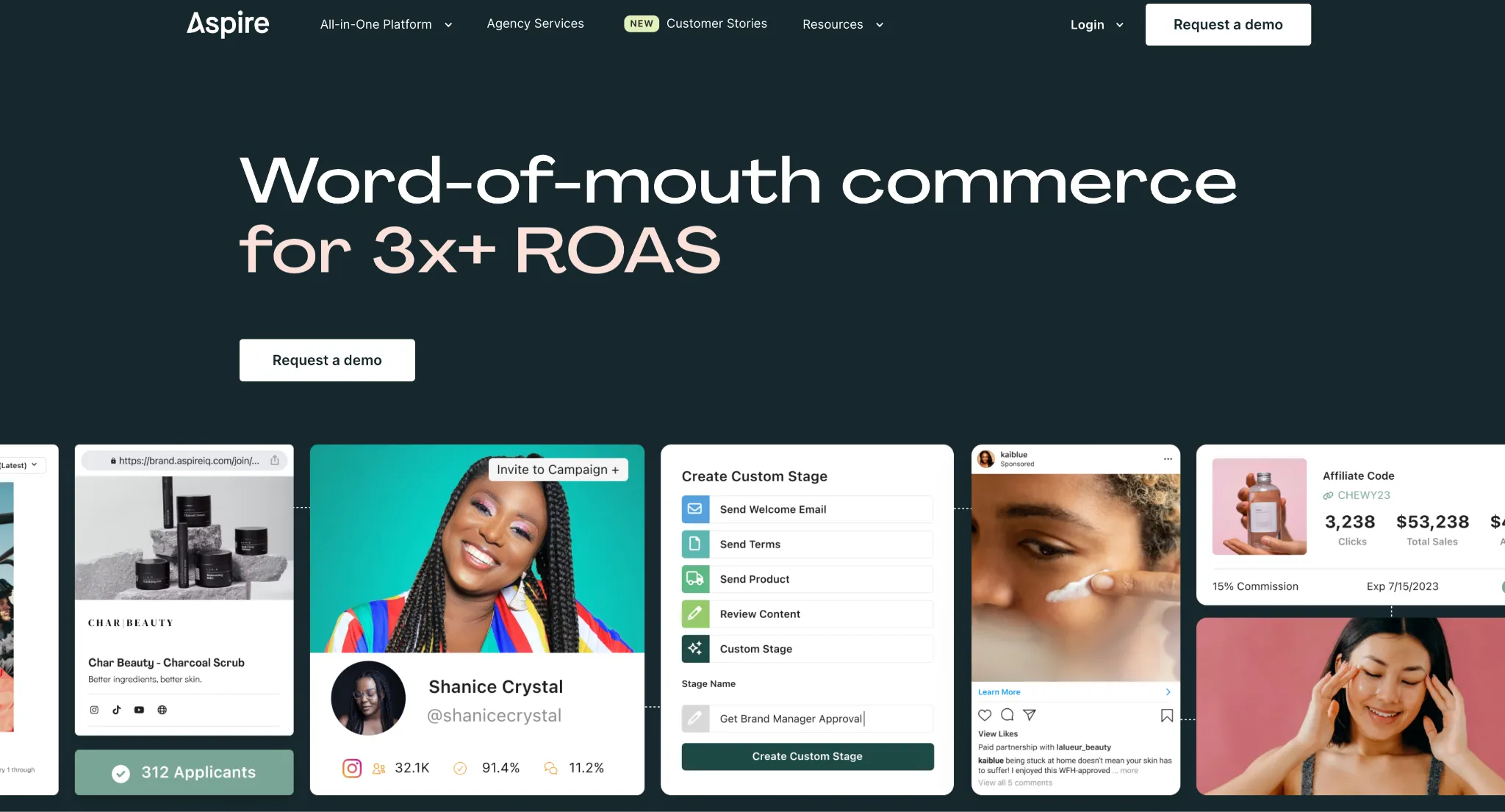
Aspire's creator marketplace lets creators connect social accounts, set categories and rates, browse campaigns, filter by channel or compensation type, and manage agreements, product selection, drafts, and final deliverables through its portal. The platform also offers curated matching, which can supplement self-directed applications.
Aspire states that creators can join, apply, and collaborate for free. Its marketplace includes gifted, ambassador, affiliate, content, and paid opportunities, so it can support a creator who wants to move from one-off campaigns toward recurring partnerships. What to know: marketplace volume does not guarantee selection, and creators still need a current portfolio, tailored applications, and rates that reflect the exact scope and rights requested.
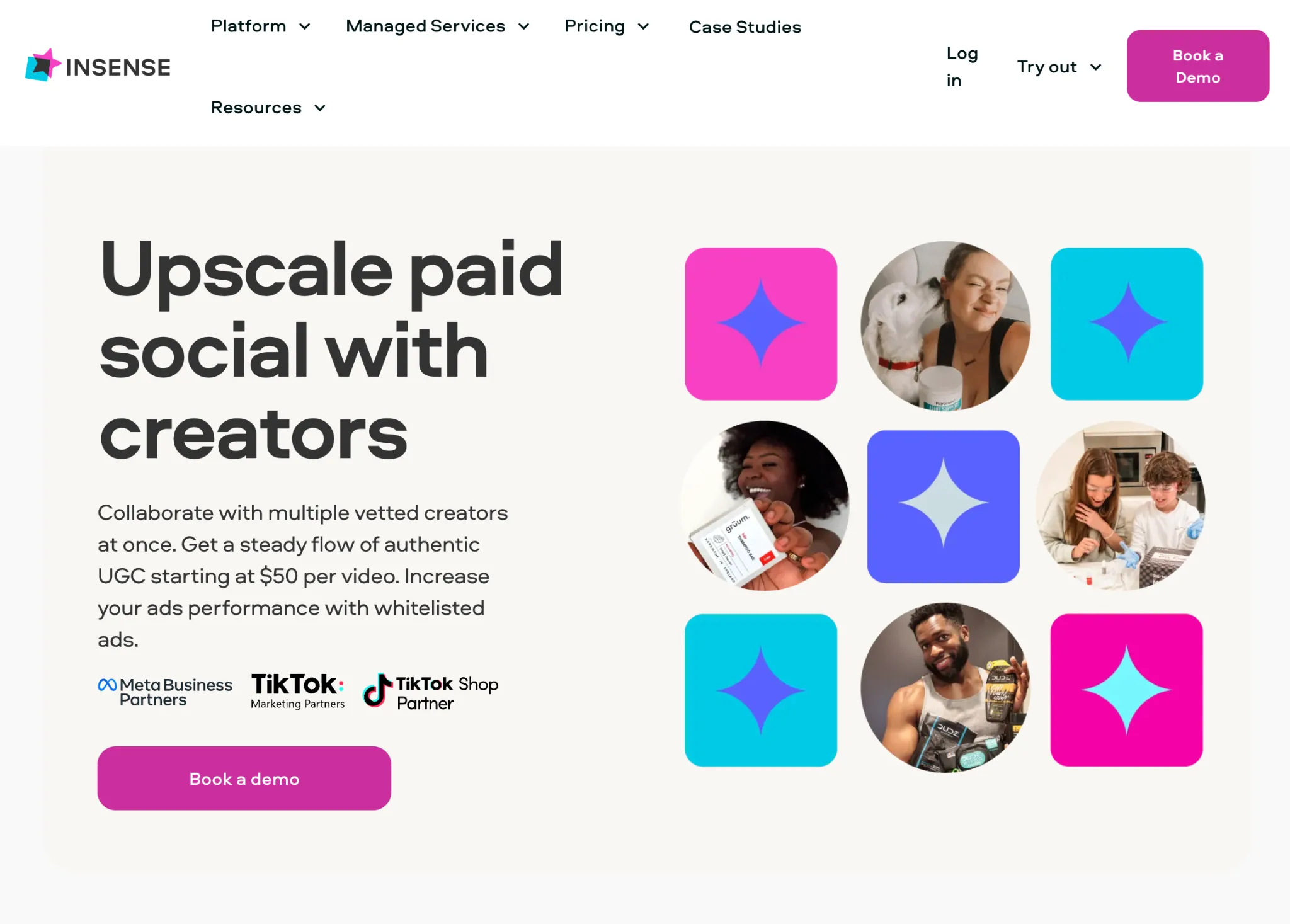
Insense for creators spans influencer posting, product seeding, content-only UGC, affiliate work, Meta partnership ads, TikTok Spark Ads, and TikTok Shop campaigns. Its official page says payment is reserved after a creator is hired and released after approved deliverables, while badges and brand ratings help creators build marketplace credibility.
Insense currently publishes minimum profile signals that include at least 1,000 Instagram followers, at least 500 median TikTok views, and at least a 1 percent engagement rate. What to know: the platform's variety creates different rights obligations. A content-only video, an organic post, and an ad-authorized asset should not share one price without accounting for production, license duration, paid media, and any account authorization.
The impact.com influencer marketplace combines creator campaigns with affiliate links, promo codes, gifts, workflow management, analytics, and multiple compensation structures. Creators can filter campaigns by vertical, location, or compensation type and send proposals rather than waiting only for inbound invitations.
The platform supports flat fees, commissions, and performance-based payouts, which makes it useful for creators who want to connect content with tracked commerce. What to know: commission and performance deals transfer more outcome risk to the creator. Confirm the base fee, attribution window, eligible products, returns treatment, discount-code logic, payment schedule, and access to performance data before treating projected commission as earned income.
Creator.co's creator platform supports brand discovery, applications, direct invitations, collaboration management, payment tracking, portfolio building, and campaign performance records. A creator profile functions as a media kit containing content, audience information, previous collaborations, and performance evidence.
The platform also offers education and a creator community, which can be useful for people formalizing their commercial workflow. What to know: Creator.co states that content made through its campaigns grants usage rights to the partnering brand under its terms. Creators should read the campaign-specific agreement, identify the license duration and media, and price the value of those rights rather than evaluating the production fee alone.
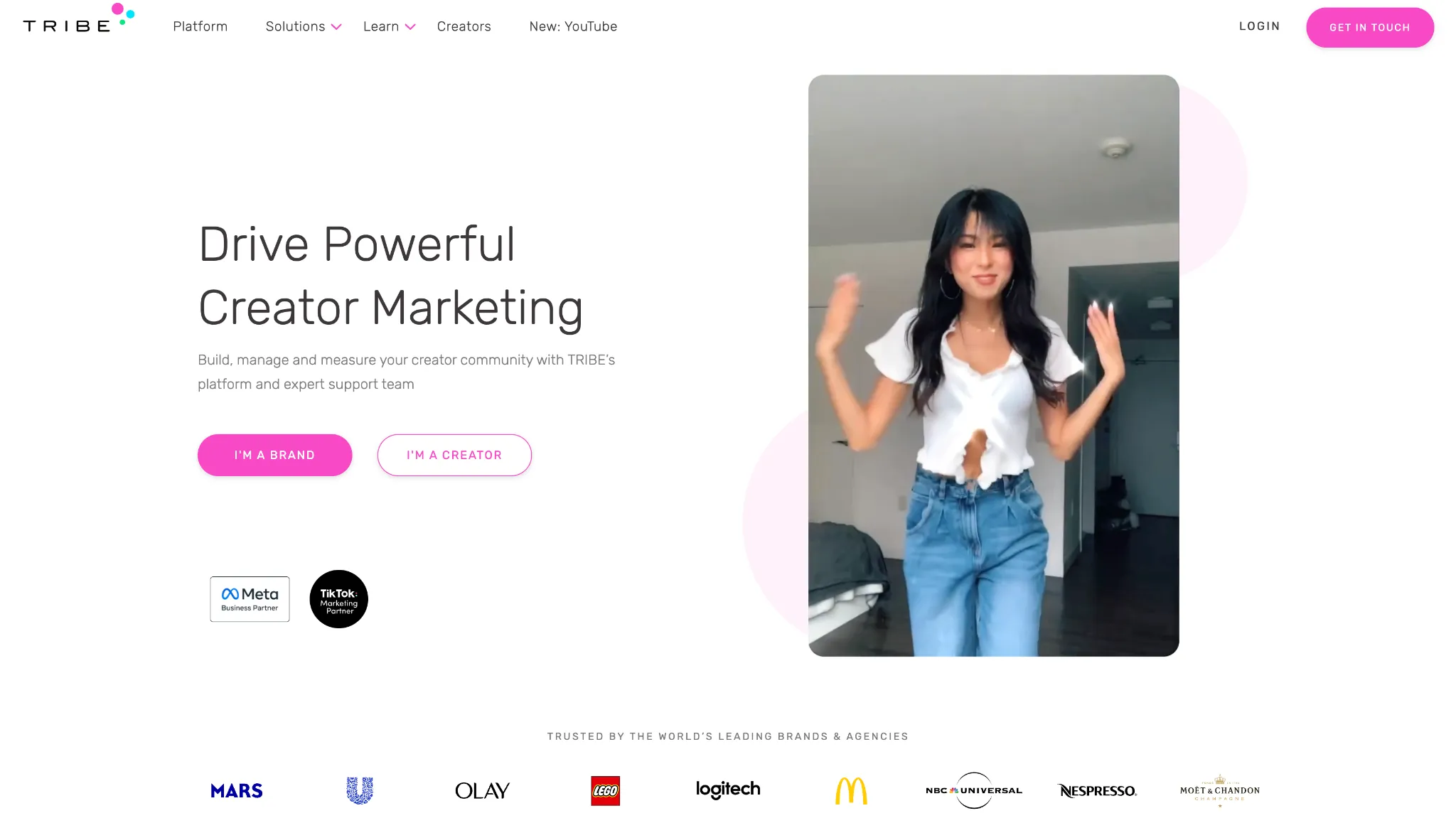
TRIBE's creator platform is built around creator-led campaign participation. Creators choose briefs, develop a pitch or submission, set or review compensation, and use a centralized platform for approvals, legal terms, and payment. TRIBE also supports social posts and licensed content.
The model gives creative quality a visible role in selection and can reward creators who are skilled at developing campaign-specific concepts. What to know: a pitch-first workflow can consume meaningful unpaid ideation time when submissions are not selected. Treat early pitches as controlled concepts, reserve full production for the appropriate approval stage, and include content rights, revisions, and out-of-pocket production expenses in the proposed fee.
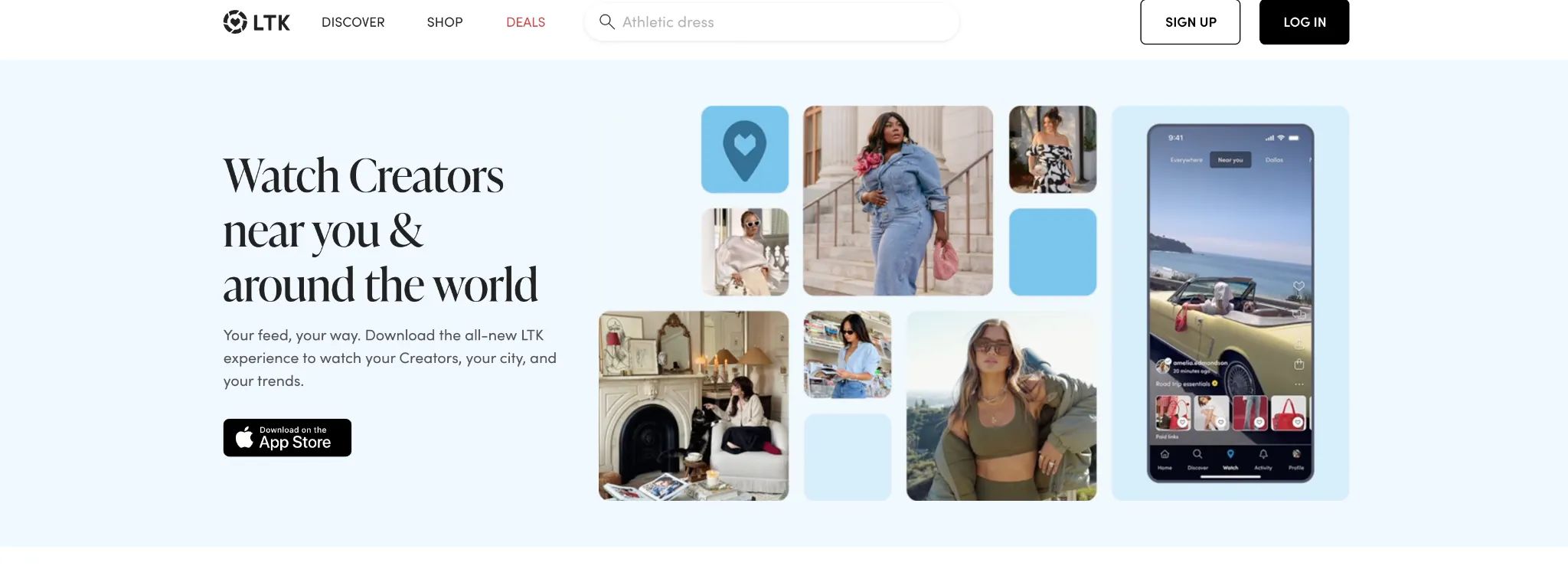
LTK's creator program centers on shoppable content, personalized creator storefronts, brand collaborations, product links, distribution tools, and performance data. LTK says applicants should have a public profile, an engaged following, and a consistent record of high-quality shoppable content.
The platform is especially relevant for creators whose audiences regularly ask where to buy fashion, beauty, home, wellness, travel, food, or lifestyle products. What to know: LTK is application-based and expects ongoing commerce-oriented publishing. Creators who treat the storefront as an occasional link archive may capture less value than those who can maintain product curation, consistent distribution, and performance review as a recurring workflow.
Use these labels as a shortlist, not as universal rankings:
The most useful comparison is not “Which platform has everything?” It is “Which platform solves my next constraint?” A new nano influencer may need structured product experience. An experienced UGC creator may need clearer licensing opportunities. A commerce-focused creator may need stronger affiliate tracking, while an established niche influencer may need repeat ambassador work.
The Anchor-and-Expansion method prevents platform overload. Choose one anchor platform whose workflow fits your current strengths, then add one expansion platform that introduces a different opportunity source or compensation model. Do not join six marketplaces and mistake profile creation for business development.
A practical pairing may look like this:
A broader guide to creator apps can help separate partnership platforms from editing, analytics, and monetization tools. The brand-deal guide for TikTok and Instagram creators can then help you improve the portfolio and pitch that those platforms expose to brands.
For an illustrative five-hour weekly platform operating budget, allocate 2 hours to campaign search and applications, 1.25 hours to platform-ready samples and portfolio assets, 0.75 hours to profile and rate-card maintenance, 0.5 hours to follow-up and campaign administration, and 0.5 hours to performance review and post-campaign reporting. That equals 40 percent, 25 percent, 15 percent, 10 percent, and 10 percent of the five-hour budget. This is a planning scenario, not an industry benchmark.
Run the pair for 60 days before adding another platform. Record qualified opportunities, accepted deals, total work hours, compensation, rights, payment speed, and repeat invitations. Keep the pair when it produces commercial value or strong portfolio evidence, and replace the weaker platform when it produces activity without progress.
Content rights can be worth as much as production because the same asset may be used in different places, for different durations, and with different commercial reach. A creator should separate the work of making content from the license that lets a brand publish, advertise, edit, or reuse it.
Clarify these rights before accepting:
This is also where UGC platforms and influencer platforms diverge. The content creator's guide to UGC marketing explains that a UGC deal can pay for the asset even when the creator never distributes it to an audience. An influencer deal usually includes audience access, while a hybrid deal can include both posting and brand reuse.
Disclosure is separate from licensing. The Federal Trade Commission's disclosure guidance says free or discounted products can create a material connection and that the disclosure should be clear, hard to miss, and placed with the endorsement. A platform's built-in label may help, but creators remain responsible for making the relationship understandable to viewers.
Creators should measure a platform as a funnel from qualified access to durable commercial value. Track opportunities, acceptance, delivery, economics, rights, and repeat work separately. The best platform is not necessarily the one with the most invitations. It is the one that turns reasonable effort into worthwhile, well-defined, and repeatable partnerships.
Use six measurement layers:
Calculate net effective hourly value as:
(Cash Received + Realistic Product Value + Earned Commission - Direct Expenses) ÷ Total Hours Worked
Use the price you would reasonably have paid for a product, not an inflated retail number that has no value to you. Keep gifted value, cash income, and commission separate in your records so one strong product does not hide weak cash flow.
A creator-focused analytics dashboard should also separate campaign delivery from audience performance and attributed commerce. Views and engagement explain response, while clicks, codes, affiliate sales, and brand reporting provide outcome evidence. Attribution can miss cross-device purchases, delayed searches, retail sales, and conversions outside the tracked window, so report directly measured outcomes without pretending they capture every influenced purchase.
Compare your numbers after a consistent window, such as 60 days or ten qualified applications, rather than after one rejection. Then compare the platform's effective hourly value with the wider factors described in the guide to how much micro influencers make, including niche, format, audience quality, production effort, and deal structure.
Choose two platforms that match your current proof and create different kinds of upside. One should provide a realistic path to opportunities now, while the other should expand your compensation, distribution, or relationship model. Review both for 60 days using the same ledger and replace activity that does not produce qualified progress.
Use these starting points:
Do not apply to every visible campaign. A qualified application should pass four checks: the product fits your audience, the compensation fits the work, the rights fit the fee, and the timeline fits your production capacity. Relevance improves both acceptance odds and the chance that the resulting content feels believable.
The best micro influencer marketing platforms for creators are not interchangeable directories. Each one creates a different exchange among brand access, creative work, audience distribution, product value, cash compensation, performance upside, licensing, and long-term relationships.
Start with the Creator Opportunity Ledger, choose an Anchor-and-Expansion pair, and measure the full deal rather than the visible fee alone. For creators who want structured ecommerce product seeding and completed campaign workflows, evaluating the current Stack Influence creator opportunities is a logical next step. The goal is not to collect more platform accounts. It is to build a smaller system that produces better work, clearer value, and stronger repeat partnerships.
Finding Amazon influencers is easy if success means collecting handles. It is much harder if you need creators who can explain your product credibly, reach likely buyers, publish reliably, and send measurable traffic to Amazon.
For ecommerce sellers, the real task is not discovery alone. It is building an evidence trail from a creator's existing content and Amazon presence to a campaign your team can activate, track, and improve. This guide explains where to search, how to vet candidates, what to include in the first collaboration, and how to turn a promising creator into a repeatable partner.
An Amazon influencer is a content creator approved for the Amazon Influencer Program, an extension of Amazon Associates that gives qualifying creators a customizable Amazon presence and a vanity URL for curated recommendations. Sellers should distinguish these creators from ordinary affiliates, UGC creators, and social influencers who may promote Amazon products without operating an influencer storefront.
Amazon's storefront is a creator-owned recommendation page, not the same thing as a seller's Amazon Brand Store. The creator may organize products into Idea Lists and support recommendations with photos, videos, or livestreams, while earning commissions on qualifying purchases.
Stack Influence's Amazon Influencer Program guide explains the program from the creator and seller perspectives. The current definition should still be verified against Amazon's official Influencer Program documentation, because eligibility, tools, and regional availability can change.
For seller planning, separate four creator types:
One person can occupy all four roles. The important question is which role your campaign actually needs.
Ecommerce sellers can find Amazon influencers through Amazon Creator Connections, Amazon Live, influencer storefronts, social search, native creator marketplaces, existing customers, and managed influencer marketing platforms. The strongest process uses several sources, then verifies the same creator across Amazon, social content, audience behavior, and campaign communication before outreach begins.
Discovery is a genuine industry bottleneck. In IAB's 2025 Creator Economy Ad Spend & Strategy Report, one-third of brands identified finding the right creators as their biggest hurdle. Creator reputation was cited by 58% of brands and audience alignment by 56% as leading selection criteria, which is why a large list without evidence creates more work rather than better matches.
Amazon's help documentation dated July 21, 2026 describes Amazon Creator Connections as a marketplace service connecting brands with Amazon Creators. Brands can offer bonus commissions for qualifying sales generated by creator content, and the portal provides aggregate campaign performance data. Check your advertising console for current account access and campaign options.
Creator Connections is useful when the seller wants an Amazon-native path from campaign offer to tracked sales. It should still be treated as one sourcing pool, because acceptance inside a marketplace does not remove the need to review category relevance, content quality, reputation, and offer fit.
Amazon Live surfaces creators who already demonstrate products in shoppable video. Sellers can watch how a creator explains features, handles questions, compares options, and moves viewers toward a buying decision. Amazon says its Live experiences can feature relevant talent and shoppable content across several Amazon surfaces.
Use Stack Influence's guide to finding Amazon Live influencers as a research companion. Record the creator's category, recurring formats, storefront URL, posting recency, audience questions, and whether similar products already dominate the creator's content.
Search by buying situation rather than by the phrase "Amazon influencer." A seller of compact kitchen storage should test queries such as "small apartment pantry organization," "renter kitchen makeover," and "Amazon kitchen organization" across TikTok, Instagram, and YouTube.
Native tools can shorten the search. TikTok Creator Marketplace is TikTok's official brand-creator collaboration platform, Instagram Creator Marketplace provides creator recommendations through Meta's first-party data, and YouTube Creator Partnerships enables brands to discover eligible YouTube Partner Program creators for brand deals. Availability and features vary by account and region.
Existing customers can reveal creators who already understand the product category. Review tagged posts, customer survey responses, brand mentions, affiliate applications, newsletter subscribers, and repeat purchasers who publish useful content.
Influencer marketing platforms solve different parts of the workflow. A searchable database helps with manual list building, while a managed platform can connect discovery to creator activation, product seeding, coordination, UGC collection, and completion tracking.
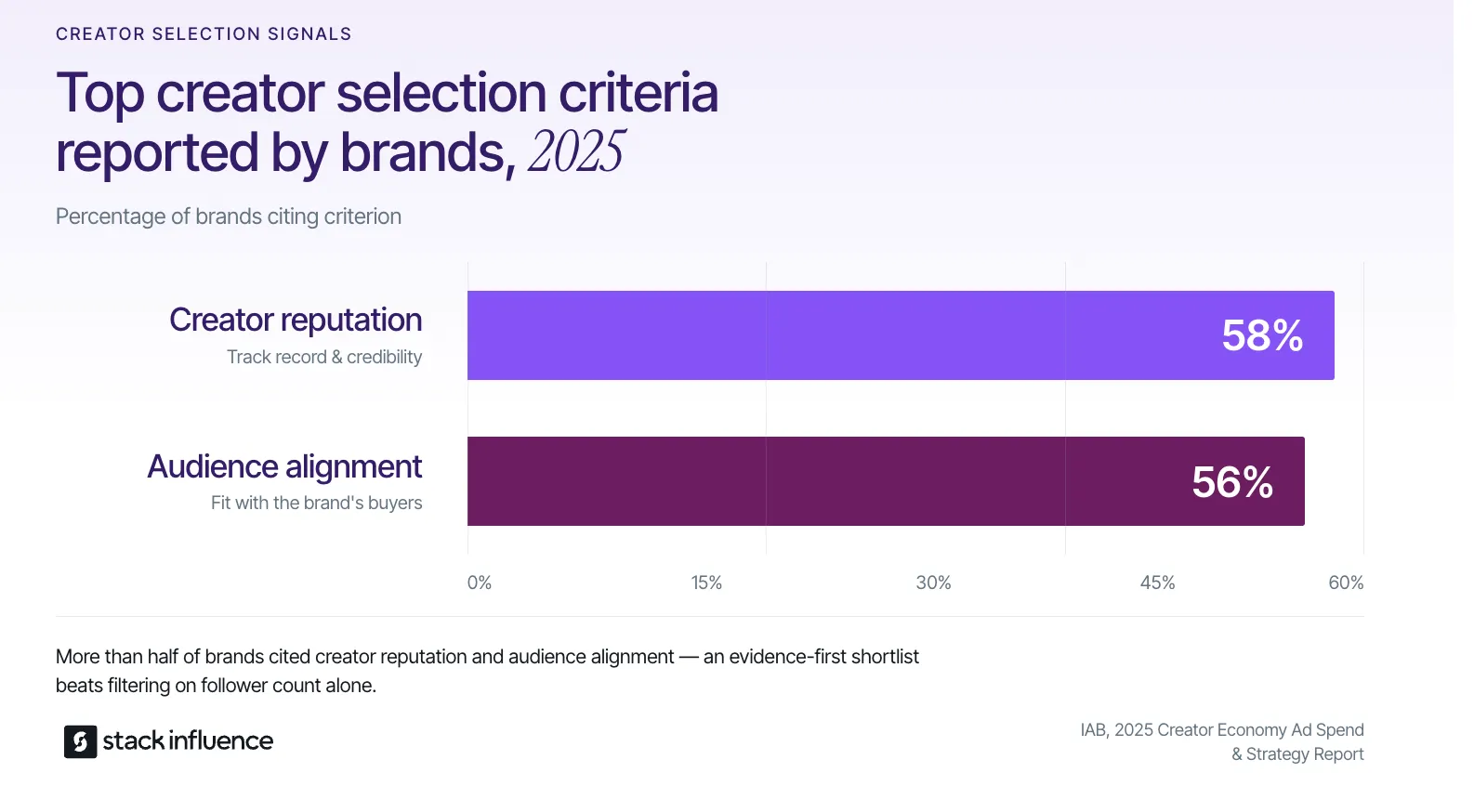
The Storefront-to-Sale Method is a five-stage workflow for moving from scattered creator discovery to a measurable Amazon campaign. It prevents sellers from confusing a visible profile with a qualified partner and gives the team a repeatable way to source, test, and retain creators.
Define the exact decision the content should help a shopper make. "Promote our listing" is too vague; "show parents how the leakproof lid works in a school-lunch routine" gives the creator a real content problem to solve.
Write down:
This step determines which creators, platforms, and formats deserve attention.
Build queries around the product's job, customer vocabulary, and content format. Combine category phrases with words such as review, comparison, routine, tutorial, haul, setup, favorites, before and after, and mistakes.
A creator who ranks or repeatedly publishes around the buying problem may be more relevant than someone whose bio contains "Amazon finds." Search results should produce evidence of expertise, not merely a self-assigned title.
Verify the storefront or affiliate path, posting recency, product categories, disclosure habits, and link behavior. Then check whether the creator can send shoppers to the intended ASIN or Brand Store with the tracking setup your campaign requires.
Amazon readiness also includes operational details. Confirm marketplace, shipping location, product eligibility, variant selection, expected publishing date, and whether the creator can follow the brief without reading from a script.
Start with a cohort large enough to compare patterns but small enough to supervise. Use one product, one buying moment, a consistent brief, and a defined measurement window so differences between creators remain interpretable.
The first activation should test:
Do not call the first cohort a failure merely because one post did not drive immediate sales. Its job is to identify repeatable creator-product combinations.
Promote creators into repeat collaborations when they produce useful content, credible audience response, reliable delivery, and measurable commerce signals. The next step may be another seeded product, an affiliate relationship, a brand ambassador program, a paid UGC package, or licensed creative for ads.
Record why each creator advances, pauses, or exits. Over time, the Storefront-to-Sale Method turns a one-time search into a brand-owned creator partnership system.
Vet an Amazon influencer by checking product relevance, content skill, audience behavior, Amazon activity, operational reliability, disclosure practices, and content rights. Follower count is only a scale indicator. A smaller creator with repeated category proof and strong buyer questions can be more useful than a larger account with broad, passive reach.
Use a Creator Evidence Card for every serious candidate.
Stack Influence's guide on how to collaborate with Amazon influencers covers goal setting and partnership structure, while its practical influencer outreach guide provides a broader mutual-fit test for brands and creators.
Red flags deserve context rather than automatic rejection. A sudden follower spike, repetitive comments, mismatched audience geography, long inactivity, undisclosed promotions, or dozens of competing products in one week should trigger deeper review.

An Amazon storefront proves that a creator has an Amazon recommendation surface. It does not prove that the creator is active, reaches your buyers, converts traffic, delivers brand work reliably, or grants reusable content rights.
This distinction corrects a common weakness in guides about finding Amazon influencers. Many workflows stop once the seller locates an amazon.com/shop/handle URL, even though the storefront is only the beginning of qualification.
Check the creator's most recent social posts and storefront updates side by side. Look for continuity between what the creator discusses publicly, what they curate on Amazon, and what their audience asks about.
Also check product saturation. A creator can be highly active yet provide little value if every post promotes a different competing item with no clear point of view. Category depth, believable use, and selective recommendations usually create stronger evidence than sheer posting volume.
Sellers should send a short, personalized outreach message that names the product fit, proposed content outcome, compensation model, timeline, disclosure requirement, and next step. The first activation should clearly separate no-obligation gifting from an agreed product-for-content collaboration, because the two models create different expectations and completion risk.
A useful message contains five parts:
The offer may use gifted product, a flat fee, affiliate commission, a hybrid arrangement, or a longer ambassador relationship. Amazon Creator Connections supports bonus commissions tied to qualifying sales, while a direct collaboration can include product, cash, usage rights, or another agreed exchange.
Review the distinction between open-ended gifting and defined deliverables in Stack Influence's product-seeding guide. Whatever model you choose, confirm the product variant, deadline, posting surface, required disclosures, approval boundaries, content files, usage term, and reporting responsibilities before fulfillment.
A gifted product, payment, commission, or other material connection generally requires clear disclosure. The FTC's Endorsement Guides also make clear that advertisers should not assume a platform tool alone always communicates the relationship adequately.
Stack Influence is designed for ecommerce brands that want discovery to lead directly into vetted micro-influencer activation, gifted-first product seeding, creator coordination, UGC generation, and completed-post accountability. The platform works with roughly 600,000 vetted creators, approximately 78% of whom are female, and its completions-only workflow is intended to reduce budget loss from unfinished collaborations.
That workflow is explained on the automated product-seeding page. It is particularly practical when the seller needs a repeatable campaign process rather than another spreadsheet of creator profiles.
Measure creator value in four layers: delivery, content, traffic, and commerce. A creator can be valuable without winning every layer, but the campaign should identify which job each creator performed. The correct evaluation window and metric mix depend on whether the goal was UGC, awareness, consideration, external traffic, or Amazon sales.
Use the Amazon Creator Evidence Stack:
Amazon Attribution is a free measurement solution for eligible sellers, vendors, registered brand owners, and other supported advertisers. Amazon says its reports use a 14-day attribution window and can include clicks, detailed page views, add-to-cart activity, purchases, units sold, product sales, and new-to-brand metrics.
Create separate tags by creator or tactic before content goes live. Stack Influence's Amazon Attribution guide provides a seller-focused walkthrough, while its guide to measuring ROI for micro-influencer campaigns explains how to combine traffic, content, and commerce measures.
Attribution is not perfect proof of causation. A 14-day window can miss delayed purchases, shoppers who later search organically, cross-device behavior, and content value that appears through reused assets. Compare creator-level tags with listing conversion, rank movement, sales trends, content output, and a pre-campaign baseline.
Eligible U.S. brand owners should also account for Amazon's Brand Referral Bonus, which Amazon says credits brands an average of 10% of qualifying sales from traffic they drive to Amazon. Eligibility, rates, and terms should be checked in Seller Central before building the bonus into campaign economics.
Impressions also need context. In verified Stack Influence customer stories, Targus recorded 4,323 engagements across 275,560 impressions during a three-month campaign, equal to 15.7 engagements per 1,000 impressions. Snow recorded 6,596 engagements across 168,510 impressions during a three-month launch, equal to 39.1 per 1,000, about 2.5 times the Targus ratio.
These are campaign-level observations, not category benchmarks or forecasts. The comparison shows why sellers should not rank creators or cohorts by impressions alone; content context, audience response, category, product, and execution can change the value of each thousand views.
Finding Amazon influencers becomes more reliable when every step produces evidence. Start with the buying moment, search across Amazon and social platforms, verify creator readiness, activate a controlled cohort, and retain the partners who deliver useful content, credible audience response, and measurable commerce signals.
The next practical step is to build a shortlist around one product and one shopper problem, then decide whether your team will manage the workflow manually or use a managed product-seeding process. Either route should end with a repeatable creator system, not a one-time collection of storefront links.
A Facebook login can protect far more than a personal profile. For content creators, it may control a Page, audience history, Messenger conversations, linked Instagram assets, advertising permissions, and active brand partnerships. Losing access can therefore interrupt publishing while exposing collaborators, followers, and campaign information.
This guide explains how to change Facebook password settings on iPhone, Android, and desktop. It also covers forgotten-password recovery, suspected account takeovers, and a creator-specific security process for protecting everything connected to the account.
The central lesson is simple: changing the password is the first step, not the entire security fix.
The correct Facebook password workflow depends on what access you still have. Before tapping through settings, identify which of these three situations applies:
When you are already signed in, Meta’s current password instructions direct you through Accounts Center, Password and security, and Change password. The same help flow also explains how to start a reset when the current password is unknown.
Use this quick decision test:
A “yes” to all three usually means a normal password change is appropriate. A missing password points to reset. An unexpected login, changed recovery method, unauthorized post, or lockout points to account recovery.
This distinction matters for anyone using Facebook professionally. A creator may have Professional Mode, a Facebook Page, linked Instagram assets, or brand communications connected to the underlying profile. The guide to becoming a digital creator on Facebook explains how those creator features build on the account itself.
A replacement password should be long, unique, and unrelated to information followers or brand contacts can discover. Avoid recycling a password used for Instagram, email, editing software, affiliate dashboards, UGC platforms, or another social account.
The National Institute of Standards and Technology’s password guidance recommends using multifactor authentication, a password manager, and passwords of at least 15 characters when passwords are required. NIST emphasizes length because each additional character expands the number of possible combinations.
The effect is exponential. Using NIST’s illustrative assumption of 26 randomly selected lowercase letters and 100 billion guesses per second, an exhaustive search would take approximately:
These figures are a mathematical illustration, not a real-world prediction. Human-created passwords often contain names, phrases, dates, or predictable patterns that attackers test before random combinations. Online login systems can also limit attempts, while stolen password databases create a different attack environment.
Use these practical rules when creating the new password:
Creators managing several profiles also need separate credentials. The guide to managing multiple Instagram accounts covers the related challenge of keeping account access organized without reusing passwords.
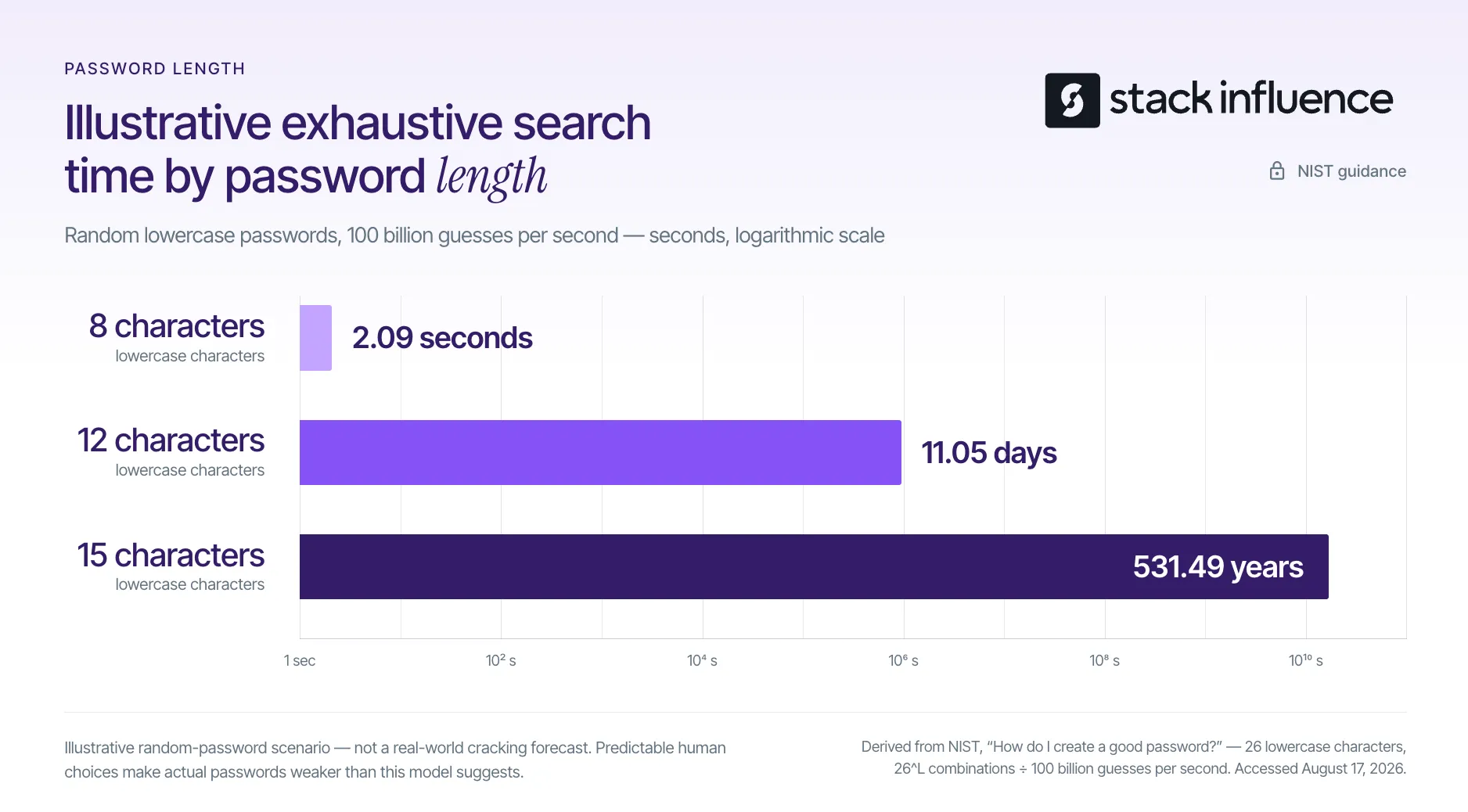
To change your Facebook password in the mobile app, open Menu, choose Settings and privacy, select Settings, open Accounts Center, and tap Password and security. Choose Change password, select the correct Facebook account, enter the current password and new password, then save the change. Menu placement can vary by device and app version.
Follow these steps:
On some versions of the app, Accounts Center appears near the top of Settings. On others, Facebook may show Password and security more prominently. Follow the visible security path rather than assuming every screen will match an older tutorial exactly.
Confirm that you selected the Facebook account, especially when Facebook and Instagram appear together in Accounts Center. Connected accounts can make the screen look unified even though you are changing a credential for a specific account.
If you manage a Facebook Page, secure the personal profile that has access to it. The Page itself is managed through assigned Facebook access rather than a separate public-facing Page password. Creators establishing a new presence can review the full Facebook business Page setup process.
To change your Facebook password on a computer, select your profile picture, open Settings and privacy, choose Settings, and enter Accounts Center. Select Password and security, click Change password, choose the correct Facebook account, and enter the existing and replacement passwords. Save the update after checking that the intended account is selected.
The desktop process is:
Do not let a password manager overwrite the wrong saved credential when several Meta accounts appear in the browser. Confirm the username associated with the saved entry before accepting an automatic update.
Creators who connect Meta properties should also understand which assets are linked. The guide to linking Instagram to Facebook explains how account connections support cross-platform publishing and management.
To reset a forgotten Facebook password, start at the Facebook login screen and select Forgot password. Search using the email address, phone number, full name, or username associated with the account. Choose the correct account, receive a recovery code through an available method, and create a new password after Facebook verifies access.
Use this sequence:
Use a device and network you have previously used for Facebook when possible. Familiar login signals may help Facebook recognize the recovery attempt.
Never send the verification code to a person claiming to be Meta support, a brand representative, a manager, or a recovery specialist. A code that proves account ownership should be entered only into the official Facebook recovery flow.
Losing access to the listed email address or phone number moves the problem from a normal reset to account recovery. Meta recommends opening its recovery process for unavailable contact information from a device or browser previously used with the account.
Facebook may ask you to identify the account, confirm previous information, or provide another reachable contact method. Follow the prompts shown for the specific account rather than using unofficial recovery services.
When a code or reset email does not arrive:
According to Meta’s password-reset troubleshooting guidance, users who reach the daily reset-request limit may need to wait 24 hours before trying again.
The 5R Creator Account Security Reset turns a password update into a complete security review. The five actions are Replace, Revoke, Recover, Reinforce, and Review. Complete them after a routine password change and immediately after any suspicious activity.
Create a password that is long, unique, and stored safely. Do not make a minor variation of the previous password, such as adding a new number or changing one symbol.
A reused password creates a chain reaction. If a separate app, email service, or creator tool exposes the same credential, an attacker can test it against Facebook and other services.
A changed password should not be treated as proof that every existing session has disappeared. Review the account’s device history and explicitly remove sessions you do not recognize or no longer need.
Meta places this control under Accounts Center, Password and security, and Where you’re logged in. Its session-management instructions explain how to select an account, inspect active sessions, and log out individual or multiple devices.
Review:
An unfamiliar location does not always prove an intrusion because internet routing can affect location estimates. An unfamiliar device combined with unknown messages, changed details, or new Page access deserves immediate investigation.
Confirm that the email address and phone number attached to Facebook belong to you and remain accessible. Remove unfamiliar contact information and replace old school, work, agency, or temporary addresses before they become a lockout problem.
Secure the recovery email account with its own unique password and two-factor authentication. Anyone who controls that inbox may be able to request password resets for Facebook and other creator tools.
Creators should also document which private email address owns the account. A brand partnership inbox can receive business inquiries, but the core recovery address should remain under the creator’s control.
Enable two-factor authentication so a password alone is not enough to sign in. Facebook’s two-factor authentication settings are available through Accounts Center, Password and security, and Two-factor authentication. Available methods can include an authentication app, text-message codes, or a security key.
The evidence for adding a second factor is strong, although it should not be misrepresented as Facebook-specific research. A Microsoft Research study of commercial accounts found that MFA was associated with a 99.22% reduction in compromise risk across the measured population and a 98.56% reduction among accounts with leaked credentials. The overall population covered suspicious activity reviewed from April 22 through September 22, 2022.
Dedicated authentication apps outperformed SMS in the Microsoft study, but both methods provided substantially more protection than using no MFA. The Cybersecurity and Infrastructure Security Agency’s MFA guidance also recommends enabling MFA on social media, email, and other important accounts.
Store any recovery codes somewhere separate from the Facebook account and primary phone. A password manager or another secured offline location is more useful than an unprotected screenshot in the same device’s photo library.
Inspect everything the Facebook profile can control, not only the profile timeline. A compromised creator account can affect Pages, advertising access, linked Instagram accounts, messages, saved payment methods, and brand communications.
Review:
Third-party apps deserve particular attention. The Stack Influence guide to Instagram unfollower apps explains why creators should avoid services that request a social-platform password instead of using an official authorization method.
The 5R sequence corrects a common mistake: treating the password as the whole account. The password protects one entrance, while sessions, recovery channels, permissions, and connected assets determine whether the creator has actually regained control.

If you suspect a Facebook account takeover, use Facebook’s hacked-account recovery flow from a familiar device, secure the connected email account, change the password, revoke unknown sessions, restore recovery information, and enable two-factor authentication. Then inspect Pages, ads, posts, messages, and linked accounts for unauthorized activity. A password change alone may leave altered permissions behind.
Start with Facebook’s hacked-account process, not a link sent through an unexpected email, direct message, or comment. Type the address yourself or navigate through Facebook’s official Help Center.
Then complete this containment sequence:
The Federal Trade Commission’s hacked social-account guidance similarly recommends changing the password, signing out other devices, enabling two-factor authentication, checking recovery information, reviewing unauthorized activity, and notifying contacts.
Be cautious with anyone promising guaranteed account recovery for an upfront payment. Do not share passwords, authentication codes, identity documents, or remote device access through an unsolicited message.
Role-based access lets creators collaborate without turning one password into a team credential. Managers, editors, agencies, and brand partners should receive only the permissions needed for their work, with access removed when the assignment ends.
Facebook Pages are managed through people who have Facebook access or task access. Meta’s Page access documentation explains that different access levels can permit content management, messages, ads, insights, or full Page control.
Use these operating rules:
The same principle applies to influencer marketing permissions. Influencer whitelisting on Instagram and Facebook and Meta Partnership Ads use controlled permissions and platform workflows rather than informal password sharing.
Brands should document these rules in a broader social media policy. That policy can define who owns accounts, who may approve access, how credentials are stored, and how incidents are escalated.
For content creators participating in brand deals, UGC production, ambassador programs, or product seeding, secure access protects both creative work and campaign continuity. Stack Influence’s creator campaign workflow connects creators with gifted-first product-seeding opportunities, making reliable account access and communication part of completing creator partnerships professionally.
Learning how to change Facebook password settings takes only a few minutes when you still know the current credential. The more important work begins immediately afterward: remove old sessions, confirm recovery information, enable two-factor authentication, and review every Page or connected asset the profile controls.
For content creators, account security is part of protecting the business behind the content. Complete the 5R Creator Account Security Reset now, document who has access, and return to publishing with fewer hidden risks around your audience, brand deals, and creator partnerships.
The moment a brand asks for a Spark authorization code, your TikTok has entered paid media. The video may still look like an ordinary post, but an advertiser can now put budget behind it, target new audiences, and measure actions beyond the reach you earned organically.
For content creators, answering “what are TikTok ads?” requires more than naming ad formats. You need to know whether you are buying reach yourself, lending your identity to a Spark Ad, or supplying user-generated content (UGC) that a brand will publish from its own account. Those paths create different responsibilities, rights, fees, and reporting needs.
This guide explains how TikTok advertising works, which options matter to creators, how to protect your content rights, and how to judge whether paid distribution actually increased your value.
TikTok ads are paid messages distributed through TikTok’s advertising systems to reach selected audiences or pursue goals such as video views, traffic, leads, app activity, and sales. An ad may use newly uploaded creative, a brand’s existing post, a creator-authorized Spark post, or commerce content connected to TikTok Shop.
TikTok Ads Manager organizes advertising into three levels. A campaign contains the main objective and certain budget decisions. An ad group controls elements such as audience, placement, schedule, bidding, and optimization. The individual ad contains the creative, identity, copy, call to action, and destination.
TikTok currently groups objectives into awareness, consideration, and conversion. Its official objective guide lists Reach under awareness; Traffic, Video Views, Community Interaction, and Branded Mission under consideration; and App Promotion, Lead Generation, and Sales under conversion. Creators do not need to memorize every objective, but they should ask which one a brand is using because “successful creative” means something different in a reach campaign than in a sales campaign.
A paid ad is also different from a sponsored organic post. A sponsored post is content created because of a commercial relationship, such as payment, free product, or another benefit. It becomes paid media when someone buys additional distribution through Promote, Ads Manager, or another TikTok advertising product. One video can be both a disclosed sponsored post and a paid Spark Ad.
For creators who want the brand-side mechanics, Stack Influence’s TikTok Ads Manager guide explains campaign structure, creative testing, and attribution from an ecommerce advertiser’s perspective. This article focuses on the creator’s role inside that system.
TikTok ads work by matching an advertiser’s objective, audience settings, budget, bid strategy, and creative with available ad opportunities. The platform then delivers ads, records eligible interactions, and optimizes toward the selected event. Creators influence performance mainly through the message, identity, proof, pacing, and call to action contained in the creative.
A practical campaign workflow has five parts:
TikTok’s current budget documentation states that campaign-level daily and lifetime budgets must exceed $50, while an ad group’s daily budget must exceed $20. For a lifetime ad group budget, the documented minimum is $20 multiplied by the number of scheduled days. That produces minimum calculations of $140 for seven days, $280 for 14 days, and $600 for 30 days. These are platform delivery thresholds, not recommended test budgets or promises of meaningful results.
The distinction matters for creators because a brand’s media budget is separate from the creator’s compensation. A $600 ad budget does not tell you what the content, organic post, Spark authorization, raw footage, or renewal rights are worth. It only describes money available for TikTok to distribute the ad.

Creators can participate in TikTok advertising as advertisers, ad identities, or creative suppliers. Separating these roles clarifies who controls delivery, where the video appears, and what the creator is selling.
Promote is TikTok’s in-app tool for putting paid reach behind your own eligible video or LIVE. TikTok says available goals can include views, followers, profile activity, messages, leads, website visits, and sales. It also states that users must be at least 18 years old to use Promote.
Promote offers a simpler entry point than a full Ads Manager campaign, but the creator should still define the intended outcome. More views do not automatically become engaged followers, brand inquiries, affiliate sales, or repeat viewers. Stack Influence’s creator guide to TikTok marketing provides context for combining organic publishing, UGC, partnerships, and paid reach.
Spark Ads let an advertiser use an existing organic post from its own account or an authorized creator account. TikTok’s official Spark Ads documentation says engagement generated during promotion is attributed to the original post. The creator’s account identity and public social proof therefore remain part of the paid experience.
A creator can instead produce a video that a brand uploads under an advertiser identity. The asset may never appear on the creator’s profile. In this content-only workflow, the brand is buying production and agreed usage rights rather than organic distribution through the creator’s audience.
This content-only path is accessible to UGC creators, micro influencers, and nano influencers whose production skill may matter more than follower count. The distinction is central to UGC marketing for content creators: influencer work sells some combination of content and distribution, while UGC work can sell production alone. A creator can offer both, but the deliverables should be itemized.
Spark Ads matter to creators because the post, account identity, and commercial permission remain connected. An advertiser needs an approved authorization path before using another creator’s public video in this format.
TikTok’s current process lets a creator enable ad authorization for a selected post, choose a duration, generate a code, and provide it to the advertiser. The standard duration options are 7, 30, 60, or 365 days. TikTok also notes that the caption cannot be edited after authorization, and a private video may become public when used unless the relevant private delivery option applies.
Before sharing a code:
The Stack Influence Spark Ads guide explains authorization basics, while its TikTok Spark Ads campaign workflow connects creator recruitment, UGC generation, code collection, and campaign execution for ecommerce brands.
Across creator campaigns, the overlooked work is often the handoff. The approved post, authorization code, usage period, advertiser identity, and reporting plan must align before organic content can move cleanly into paid media.
The Four P Creator Ad-Rights Check separates a code request into four decisions: Post, Placement, Period, and Payment. Use it before sending an authorization code, raw file, or ad-ready edit so the permission is clear without making the collaboration unnecessarily complicated.
Identify exactly what the advertiser may use. Name the public post, final file, caption, voiceover, music, raw footage, alternate hooks, still frames, and cutdowns included in the deal.
A Spark authorization normally points to a specific post. A broader UGC agreement may include source files and permission to create derivatives. Those are different assets and should not be bundled silently as “content.”
Define every approved location, such as a Spark Ad, brand-account TikTok ad, TikTok Shop, website, marketplace listing, Meta ad, email, or retail media.
Under U.S. copyright law, copyright generally begins with the author once an original work is fixed, although work-made-for-hire rules and written transfers can change ownership. The U.S. Copyright Office’s copyright overview distinguishes ownership from permission to authorize particular uses.
Material terms should be written, with professional advice used when a deal carries significant legal or financial consequences.
Stack Influence’s guide to UGC licensing rights makes the operational distinction clear: a platform authorization path and a commercial license solve related, but separate, permission problems.
Specify the first and last day of paid use. TikTok currently offers Spark authorization windows of 7, 30, 60, or 365 days. Relative to seven days, those periods are 1.0, 4.3, 8.6, and 52.1 times as long.
The technical authorization period and contractual license period should be recorded separately, with a defined renewal process. A one-year code should not become perpetual or cross-channel permission by assumption.
Separate the purchased services. A deal can include production, organic posting, paid-media usage, exclusivity, renewal, affiliate commission, or a performance bonus.
Creator ad-rights deals do not have one universal rate. SAG-AFTRA’s Influencer Agreement fact sheet says compensation under its agreement is freely bargained and does not use set rates. The broader lesson is useful: payment should reflect the actual bundle of labor, distribution, identity, rights, duration, and restrictions.
Before approving a deal, check that every P can be answered in one sentence. A vague answer usually means the scope is unfinished.
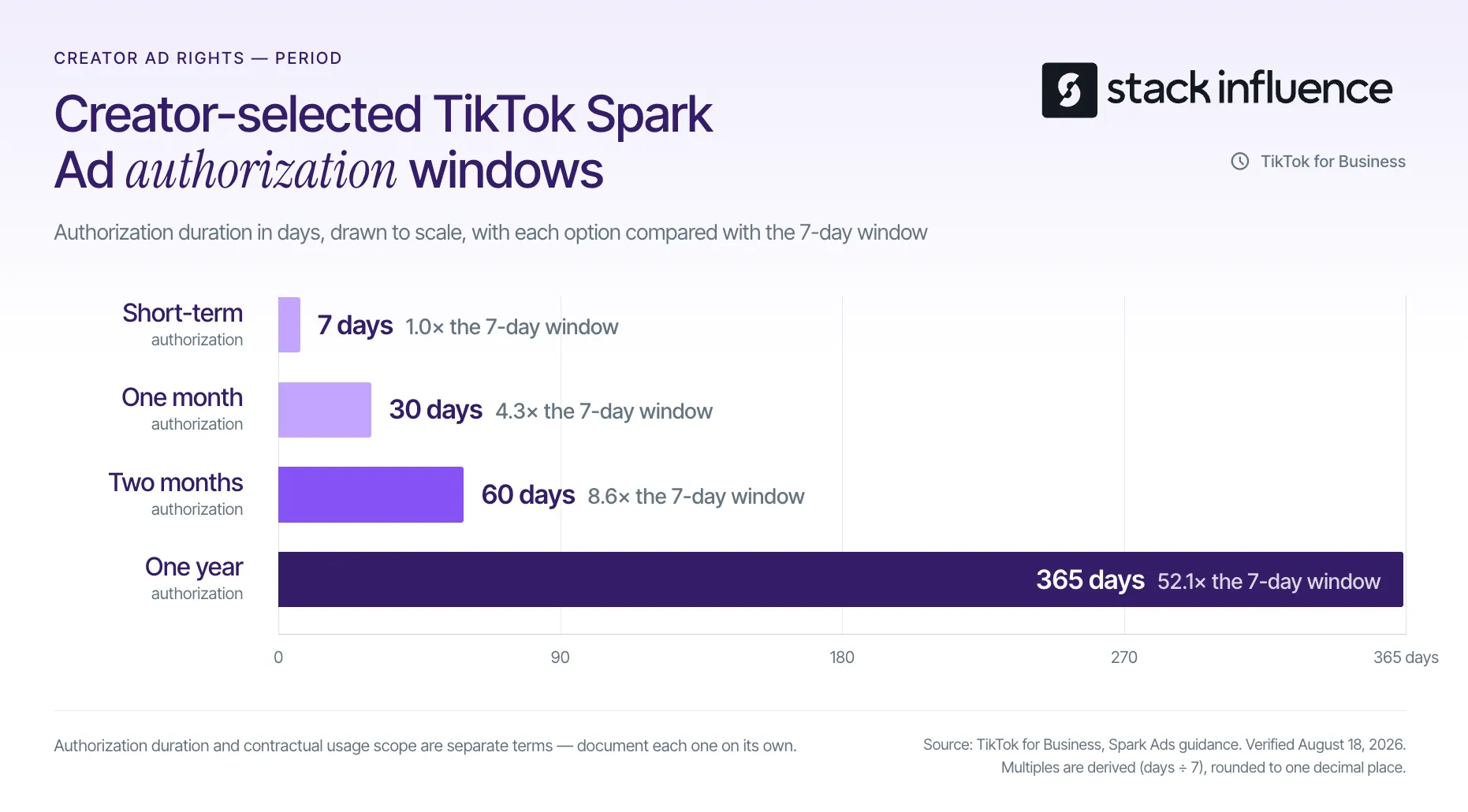
Ad-ready content begins before filming. The creator should understand the objective, approved claims, commercial restrictions, deliverables, and reporting plan before choosing the hook or soundtrack.
TikTok recommends its Commercial Music Library for promotional content because its music is pre-cleared for commercial use. A sound available for ordinary posting is not automatically cleared for advertising.
Product seeding can feed this creative pipeline. A creator gains product experience, produces an agreed post or asset, and separately authorizes paid use when appropriate. Stack Influence’s resources on influencer seeding and creator opportunities show how product-based collaborations can build portfolio proof without making every usage right automatic.
Creators should measure TikTok ad performance through four layers: attention, action, business outcomes, and creator value. The best metric depends on the campaign objective, and no single number explains the result. Views show delivery, while deeper metrics reveal whether people watched, acted, converted, or created durable value for the creator.
Track impressions, reach, two-second views, six-second views, average play time, and completion rate. TikTok defines a six-second focused view as at least six seconds watched, a full view of a shorter video, or an eligible early interaction for supported focused-view products.
High impressions with weak six-second retention usually point to a hook, audience-match, or first-frame problem.
Track clicks, click-through rate, profile visits, follows, comments, shares, and other actions relevant to the objective. For Spark Ads, save the organic baseline because public engagement can grow while paid delivery is active.
Stack Influence’s reach versus impressions guide helps distinguish unique exposure from repeated delivery. Neither number proves conversion by itself.
For conversion campaigns, review purchases, leads, cost per acquisition, conversion rate, revenue, return on ad spend, or affiliate commission. Always request the attribution window.
Google Analytics explains that UTM parameters, including utm_source, utm_medium, and utm_campaign, help identify campaigns that referred clicked website traffic. They do not capture every view-through, cross-device, or offline outcome, so use them with platform reporting.
Measure follower growth, profile visits, organic engagement added to the Spark post, inbound brand inquiries, renewal requests, affiliate earnings, and requests for new variations.
A campaign may miss a sales target while revealing that a creator earns strong attention or efficient clicks. It may also produce sales without giving the creator durable value. Compare the paid period with a reasonable baseline, preserve the settings and dates, and avoid claiming that every later follower, sale, or partnership came from one ad.
The most expensive creator mistakes usually come from unclear permissions, not weak camera work. Each mistake below can reduce the value of a deal or create avoidable compliance and reporting problems.
Clear disclosure protects audience trust and makes a post easier for brands to reuse through compliant advertising workflows.
Creators preparing for paid collaborations can use Stack Influence’s guide to getting brand deals on TikTok and Instagram to strengthen their portfolio, positioning, outreach, and partnership process before negotiating ad rights.
The question “what are TikTok ads?” leads to a more valuable creator question: what exactly is the advertiser buying from me? The answer may include production, organic distribution, creator identity, paid-media permission, derivatives, exclusivity, or performance. Treating those elements as one vague deliverable makes both pricing and measurement harder.
A stronger creator offer names the ad path, applies the Four P check, preserves baseline data, and requests a useful performance report. Start by turning one strong product demonstration into an ad-ready portfolio example with clearly defined rights. That gives brands a cleaner buying decision and gives you a more defensible creator service.
Instagram is easy to open but hard to use with purpose. A content creator is not merely posting. The real job is to build a recognizable profile, publish work people remember, turn attention into relationships, and learn which ideas deserve another version.
This guide explains how to use Instagram as a creator. It covers setup, formats, audience growth, analytics, partnerships, disclosure, and security. The goal is a repeatable system in which every post teaches you something.
Instagram gives content creators a connected set of publishing, discovery, communication, measurement, and partnership tools. Creators can use Reels and Explore for discovery, feed posts for a portfolio, Stories and DMs for relationships, and Insights to learn what earns attention or action.
The main surfaces serve different purposes:
A strong creator connects these surfaces. Reels can introduce the work, carousels can earn saves, Stories can build familiarity, and DMs can turn interest into collaboration.
Set up Instagram as a creator by making the account easy to recognize, understand, trust, and contact. Use a clear username, a recognizable profile image, a public-facing niche statement, a professional Creator account, one useful link destination, and strong account security before you begin publishing consistently.
Start with these decisions:
Instagram’s professional account setup gives creators access to tools for growth, monetization, advertising, and performance analysis. For an individual, the Creator option is usually the clearest starting point because the account represents a person and their work.
A bio becomes easier to write after the niche is defined. The creator niche selection guide explains how to connect subject expertise, audience demand, and repeatable content instead of choosing a category that is either too broad or too restrictive.
Secure the account before it becomes valuable. The Cybersecurity and Infrastructure Security Agency recommends multifactor authentication because it adds another identity check beyond a password. Turn it on, store recovery codes safely, and avoid reusing the password connected to your creator email.
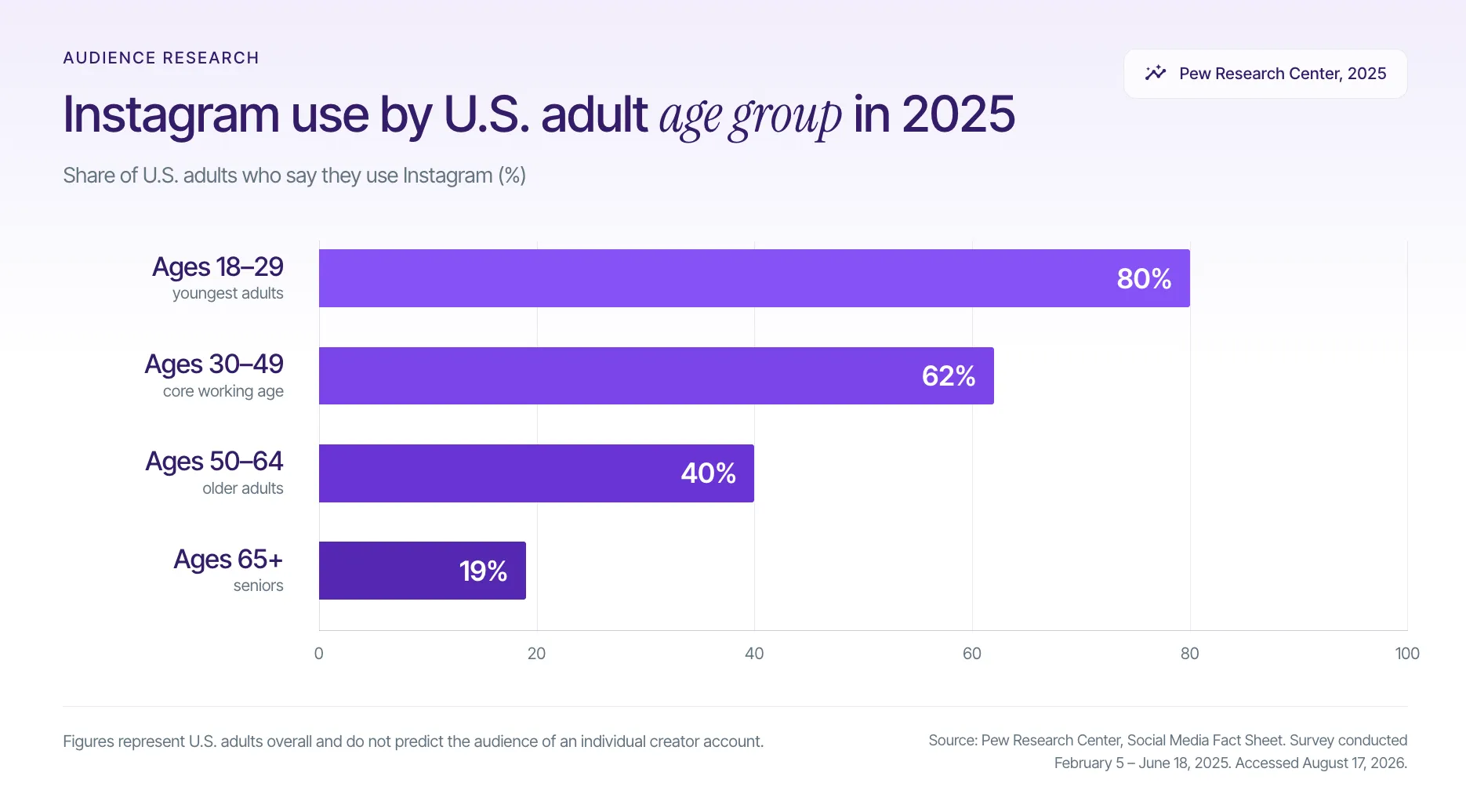
A content plan becomes clearer when it starts with a specific audience problem, desire, or identity. “Lifestyle content” describes almost anything. “Fast vegetarian lunches for college students” gives a creator a subject, viewer, constraint, and reason to return.
Audience selection should use evidence without turning people into stereotypes. The Pew Research Center Social Media Fact Sheet found that Instagram use varied substantially by age: 80% of adults ages 18 to 29 used Instagram, compared with 62% of adults ages 30 to 49, 40% of adults ages 50 to 64, and 19% of adults ages 65 and older. These are U.S. adoption figures, not a guarantee about the audience for any individual account.
Translate the audience choice into three content pillars:
Three pillars create consistency without forcing every post into one format. The Instagram post ideas guide can help turn each pillar into recurring series rather than disconnected concepts.
The Instagram Creator Loop is a five-stage operating system: Promise, Publish, Participate, Parse, and Progress. It prevents creators from confusing activity with improvement because every publishing cycle begins with a clear audience promise and ends with a decision about what to repeat, revise, or stop.
Define the recurring value of the account in one sentence. A useful promise contains an audience, a subject, and an outcome or experience.
For example, “I help first-time apartment renters make small spaces feel intentional” is stronger than “home and lifestyle creator.” It naturally supports tutorials, demonstrations, room breakdowns, budget challenges, and partnership ideas.
Give every post one primary job. A Reel might introduce the account to non-followers, a carousel might explain a method, and a Story might collect questions.
Trying to maximize reach, comments, saves, clicks, follows, and sales in one post usually weakens the creative. One primary job creates a cleaner hook and call to action.
Instagram growth is not only a broadcasting task. Reply to substantive comments, use Stories to ask focused questions, and send thoughtful messages when a conversation genuinely belongs in private.
Comments and DMs also reveal objections, follow-up questions, and language for future hooks.
Review results by topic, format, hook, and intended job. Instagram’s Insights documentation explains that professional accounts can examine performance for posts, Stories, Reels, and Live content. Look for patterns across comparable posts rather than treating one spike as a permanent rule.
Turn a strong idea into a series, not a victory lap. Change one meaningful variable at a time, such as the opening, example, format, or level of detail, so the next result teaches you something.
The loop restarts with a sharper promise, creating a recognizable body of work and a personal dataset more useful than a generic posting rule.
Creators do not need to choose one permanent winning format. They need to match the format to the communication job and then test how their own audience responds.
Originality matters across formats. Instagram’s original content guidelines define original work as content a creator made or content that reflects a unique perspective. In April 2026, Instagram reported that original creators were receiving greater recommendation priority, with 75% of U.S. recommendations coming from original posts, reinforcing the value of creating rather than merely aggregating.
Use the Instagram Reels hashtag guide to categorize content without making hashtags the strategy. The Instagram image size guide can help prevent avoidable cropping and readability problems when preparing feed and vertical assets.
Publish an Instagram post or Reel by selecting the creation control, choosing the format, adding media, editing the asset, writing the caption, adding relevant tags or collaborators, reviewing accessibility and disclosure, and publishing or scheduling. Interface labels can change, but the creator decision sequence remains stable.
Use this pre-publish sequence:
Batching can reduce production friction without replacing real-time participation. The Instagram scheduling guide explains scheduling options, while the desktop posting guide is useful for creators who edit captions and assets on a computer.

Reach matters only when it leads to a useful next behavior. A high-view Reel that attracts the wrong audience, creates no profile curiosity, and does not strengthen the creator’s positioning may be less valuable than a smaller post that earns saves, follows, qualified DMs, or repeat viewers.
Think of the journey as four connected transitions:
Recommendation eligibility is a prerequisite, not a growth guarantee. Instagram says professional accounts can review recommendation eligibility in Account Status, which can show whether content may be recommended to non-followers. Check it when distribution changes sharply, but continue evaluating the creative and audience fit rather than blaming every weak result on the algorithm.
The Creator Decision Ladder separates leading indicators from business outcomes. Review the ladder every four weeks and compare groups of similar posts, preferably at least three executions of an idea, before making a major strategy change.
Track reach, views or plays, and the share of attention coming from non-followers when that metric is available. Delivery shows whether Instagram distributed the content, not whether the content created value.
Track watch time, completion patterns, saves, shares, meaningful comments, and Story interactions. Choose the metric that matches the post’s job rather than adding every interaction into one score.
Track profile activity, follows, link taps, email sign-ups, and qualified DMs. Divide the desired action by the relevant exposure metric when possible, such as follows divided by profile visits, so account size does not hide improvement.
Track collaboration inquiries, accepted brand deals, affiliate actions, portfolio assets created, repeat partners, and content licensing opportunities. A creator economy business needs evidence that attention can produce useful outcomes, not only larger public counts.
Attribution breaks down when several posts, Stories, search results, recommendations, and outside channels influence the same person. Use tagged links, campaign-specific codes, saved inquiry notes, and consistent reporting windows, but describe a post as associated with an outcome rather than automatically causing it.
Creators get brand deals by building a clear niche, publishing repeatable proof of their creative ability, making contact information visible, presenting useful performance evidence, and approaching brands with a specific collaboration idea. Follower count can matter, but relevance, content quality, audience response, reliability, and usage rights also shape the opportunity.
Prepare four assets before outreach:
The Instagram sponsorship guide, creator media kit guide, and influencer outreach guide cover those steps in greater depth.
Eligible professional accounts can also explore Meta’s Creator Marketplace onboarding, which connects Instagram creators and brands through platform partnership tools. Availability and eligibility vary, so treat it as one relationship channel rather than the only route to work.
Stack Influence supports a different but complementary workflow built around gifted-first product seeding, vetted micro-influencer activation, creator coordination, UGC generation, and completed-post accountability. Creators can explore the Stack Influence creator community when they are ready to build campaign experience with ecommerce products.
Disclose every material brand connection clearly. The Federal Trade Commission’s Disclosures 101 guidance says free or discounted products count as a material connection, disclosures should be hard to miss and placed with the endorsement, and video disclosures should appear in the video rather than only in the caption. The FTC also cautions creators not to assume that a platform disclosure tool is sufficient by itself.
A longitudinal study of more than one million posts from 400 Instagram creators across four countries found major differences in use of Instagram’s paid partnership feature among disclosed posts: 31% in Brazil, 27% in the Netherlands, 10% in the United States, and 3% in Germany. The dataset covered 2010 to 2022, so it is historical rather than a current adoption benchmark, but it illustrates why creators should use clear disclosure language instead of assuming one platform label is understood or used consistently everywhere.
A creator account becomes a business asset as it accumulates content, contacts, trust, and partnership history. Build security and verification habits early.
Use a simple protection routine:
Learning how to use Instagram as a content creator is less about mastering every button and more about connecting the right decisions. Set up a trustworthy profile, choose a specific audience, give each format a job, publish through the Instagram Creator Loop, and use the Creator Decision Ladder to improve from evidence.
The next step is practical: define one audience promise, choose three content pillars, and publish one useful idea in two different formats. That small cycle will teach you more than waiting for a perfect strategy. Once the profile contains clear proof of your work, you can begin evaluating creator partnerships and product-seeding opportunities that match the audience you are building.
Social platforms rewrite their rules almost weekly, and for creators those changes land directly on reach, monetization, and what actually performs. Knowing about a feature or a policy shift before your peers do is a real edge.
This guide is updated every week with the latest social media news, feature releases, and creator economy trends, pulled from primary sources and verified before anything goes live. Think of it as a running log you can bookmark and check back on.
Want it earlier? Our Creator Chronicle newsletter delivers the same creator economy news and influencer marketing news to your inbox every Thursday, before it hits this page. Subscribe here.
Social media news moves fast, and this page is refreshed every Thursday with the newest platform updates, algorithm changes, and creator economy trends. Bookmark it and check back weekly so you are never the last to know.
If part of your creator workflow is landing brand partnerships, Stack Influence matches creators with brands through gifted product campaigns. It is a gifted, product-seeding model, so creators receive products rather than cash payments. 🎁
Want these updates before they hit the page?
Shopify stores rarely have a single conversion problem. A low purchase rate can come from weak traffic intent, a confusing product page, slow mobile performance, unexpected costs, limited payment options, or a mismatch between the promise in an ad and the page a shopper reaches.
For ecommerce founders and marketing teams, learning how to increase conversion rate on Shopify means finding the exact stage where buyer confidence breaks down, then fixing that stage without damaging margin or attracting lower-quality orders. This guide provides a diagnostic framework, eleven practical improvements, a measurement model, and a 30-day implementation plan.
A Shopify conversion rate is the percentage of online-store sessions that result in a completed purchase. Shopify calculates the metric from sessions, not unique customers, so one shopper can create multiple sessions. The basic formula is completed-purchase sessions divided by total online-store sessions, multiplied by 100.
Shopify’s conversion-rate reporting documentation separates sessions into cart additions, checkout reaches, and completed checkouts. That breakdown is more actionable than the headline percentage because it shows whether the problem begins before the cart, inside the cart, or during checkout.
A universal target is misleading. Shopify’s current ecommerce conversion-rate guide explains that category, price point, device mix, purchase type, and traffic source can produce very different baselines. A premium furniture store with mostly new mobile visitors should not expect the same rate as a replenishable consumer product sold to returning email subscribers.
Use external benchmarks only for orientation. Your real benchmark is the store’s own rate for comparable traffic, products, devices, offers, and periods. Sellers who need a broader foundation can review how Shopify works for ecommerce sellers.
The fastest way to improve Shopify conversion is to locate the largest measurable drop-off, identify the buyer question behind it, and make the smallest change capable of answering that question. The Shopify Conversion Leak Map connects each funnel stage to a likely cause, diagnostic evidence, and appropriate fix.
The map has five layers:
A practical ecommerce user-flow map connects off-site discovery, product evaluation, checkout, and post-purchase behavior. Do not redesign the theme until the data shows which layer is failing.
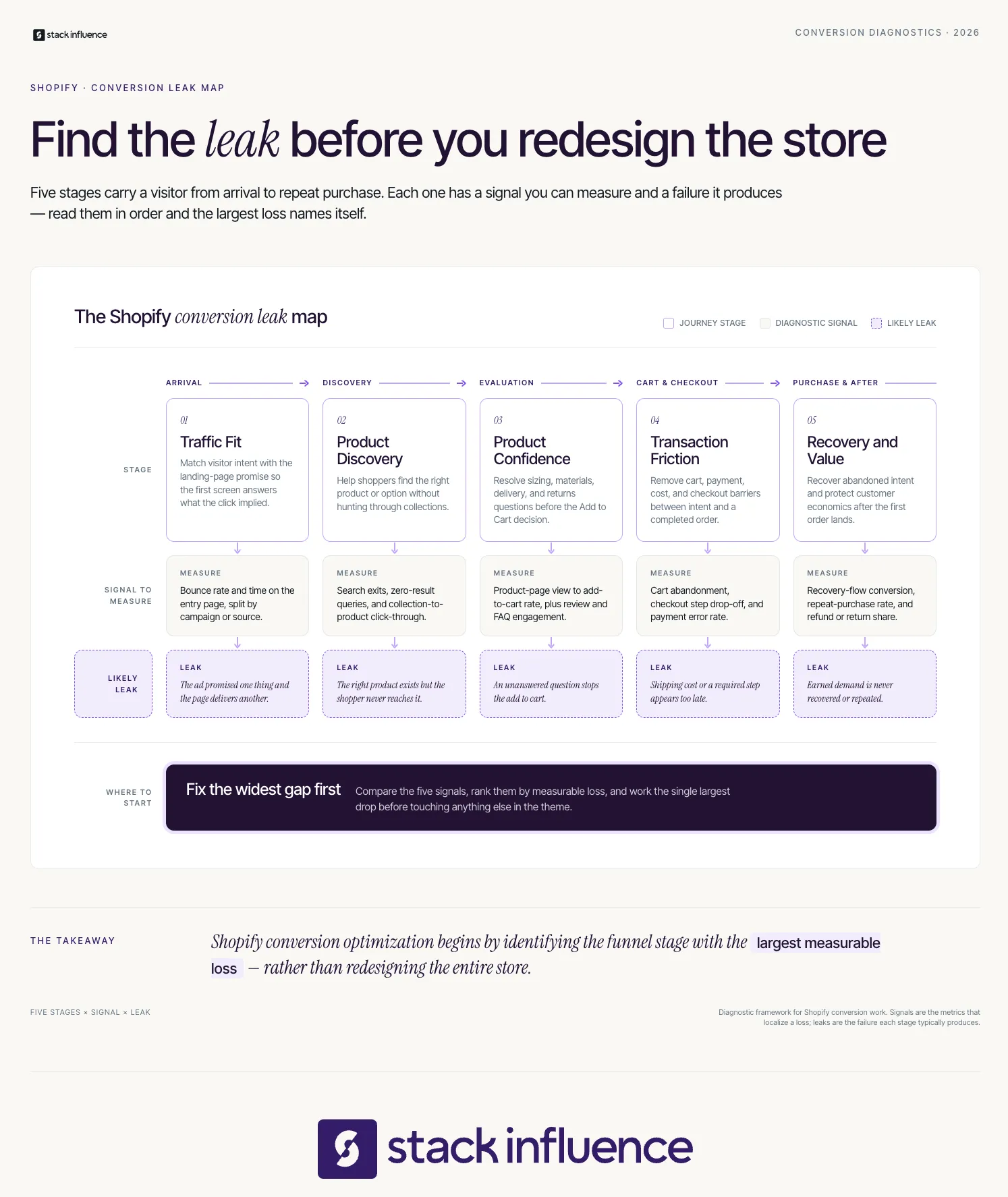
A visitor should immediately see continuity between the message that earned the click and the page that receives it. Carry the same product, benefit, creator, offer, imagery, and audience language from the ad, email, search result, or social post into the landing page.
For paid and creator campaigns, route traffic to the relevant product or collection, preserve campaign context with UTM parameters, and answer the objections raised by that creative. Stack Influence’s Shopify influencer marketing playbook connects creator selection, offers, tracking, content rights, and contribution margin.
A product page should help the shopper decide. Lead with the primary outcome, identify who the product is for, explain why it differs, show it in use, simplify variant selection, and place essential purchase information near the call to action.
Baymard Institute’s 2026 product-page UX benchmark found that only 48% of leading desktop ecommerce sites, 38% of mobile sites, and 36% of apps achieved a decent or good product-page experience. The research suggests that accumulated usability problems, not one dramatic defect, often push shoppers away.
Audit the page for six decision questions:
Add demonstrations, dimensions, ingredients, compatibility details, comparison images, FAQs, and return terms where relevant. When the product page is the leak, a focused custom website development pass on the product template often surfaces structural wins faster than copy edits can. Remove brand language that does not help the shopper choose.
Do not make shoppers begin checkout to discover the real cost or delivery timeline. Put shipping thresholds, estimated delivery ranges, return windows, subscription terms, and major exclusions on the product page or cart.
Baymard’s cart-abandonment research reports that 40% of surveyed abandonments involved extra costs being too high, while 20% involved slow delivery and 12% involved an inability to calculate the total cost in advance. Those findings make cost transparency a product-page issue, not merely a checkout issue.
Before defaulting to free shipping, test an attainable, clearly stated threshold. Measure conversion, average order value, shipping expense, margin, and carts just below the threshold.
Generic praise is weak social proof. Strong proof shows a believable customer or creator using the product in the situation the buyer cares about, then addresses a concrete concern such as fit, setup, taste, texture, durability, sizing, or results.
Useful proof formats include:
A UGC creator produces customer-style photos or videos that brands can use across product pages, ads, email, and social channels when the necessary rights are secured. Stack Influence’s UGC workflow for ecommerce is built around vetted creator activation, content collection, rights management, and reuse.
Stack Influence works with roughly 600,000 vetted creators through a gifted-first product-seeding model. Its completions-only workflow connects creator participation with finished content. From Stack Influence’s campaign experience, the most reusable product-page assets demonstrate the product and answer a buyer question, rather than simply show attractive packaging.
Keep endorsements truthful and disclose material brand relationships. The Federal Trade Commission’s endorsement guidance for influencers and reviews explains the disclosure and truth-in-advertising principles brands and creators should follow.
A feature that slows or destabilizes the product page can cost more conversions than it creates. Audit heavy scripts, oversized media, duplicate tracking, app embeds, pop-ups, review widgets, personalization tools, and theme code before installing another conversion app.
Shopify’s Web Performance reports measure loading speed, responsiveness, and visual stability by device, page type, and URL. Google’s Core Web Vitals thresholds define good performance as LCP at 2.5 seconds or less, INP at 200 milliseconds or less, and CLS at 0.1 or less at the 75th percentile.
Prioritize high-traffic commercial pages. Compress media, reserve space for images and widgets, remove unused apps, delay nonessential scripts, and retest after theme or app changes.
Stores with several products, variants, or use cases need navigation that reflects how customers shop. Organize collections around meaningful needs, use plain category labels, expose relevant filters, improve search synonyms, and prevent out-of-stock items from dominating results.
Use search terms to find weak relevance, missing synonyms, unclear naming, and assortment gaps. Related or complementary recommendations should help shoppers complete a task, not distract from a strong purchase decision.
A good offer reduces decision difficulty while preserving perceived value. Bundles, subscriptions, samples, guarantees, free-shipping thresholds, and first-order incentives can improve conversion when they solve a real buying concern.
Avoid stacking countdowns, welcome discounts, spin wheels, bundle popups, and exit offers. Test one offer architecture at a time, then compare conversion, discount rate, order value, margin, returns, and repeat purchases.
The cart should confirm the shopper’s decision and make the next step obvious. Show selected variants, quantities, item prices, discounts, delivery expectations, and total costs as early as possible. Remove unrelated navigation or upsells that compete with checkout.
Shopify describes Shop Pay as an accelerated checkout that saves customer contact, payment, shipping, and billing information. Also review Apple Pay, Google Pay, local payment methods, guest checkout behavior, address entry, error messages, and mobile keyboard types.
Baymard’s abandonment findings show that 19% of surveyed abandonments involved distrust about sharing credit-card information, 18% involved required account creation, 17% involved a long or complicated checkout, 17% involved errors or crashes, and 9% involved insufficient payment methods. Test the complete purchase journey on common phones, browsers, locations, discount conditions, and product combinations.
Not every abandonment is a rejection. Shoppers compare products, switch devices, wait for payday, look for a delivery answer, or become distracted. Recovery works best when it restores context instead of immediately increasing the discount.
Shopify’s abandoned-checkout automation can send a customer back to the saved cart. Build the sequence around the likely obstacle:
Separate browse, cart, and checkout abandonment because each stage represents a different level of intent.
Trust is created by consistency across the store. Use a recognizable domain, clear contact information, accurate inventory, visible policies, realistic delivery language, secure payment options, and product claims that the evidence supports.
Check for broken links, inconsistent pricing, outdated banners, missing variant images, poor media, contradictory return terms, and hard-to-find support pages. Preserve creator context and never present compensated content as an independent customer review.
A useful CRO test connects a customer problem, a proposed change, a funnel metric, and a business outcome. “Change the button color” is not a strategy. “Make delivery timing visible beside Add to Cart to reduce shipping uncertainty and improve add-to-cart rate” is a testable hypothesis.
Use quantitative data to find where the leak occurs, then qualitative evidence to understand why. Microsoft Clarity’s Shopify funnel guidance explains how heatmaps and session replays can expose hesitation, missed elements, and drop-offs across the customer journey.
Document the audience, page, evidence, hypothesis, primary metric, guardrails, dates, concurrent changes, result, and next action. Do not run several major changes together and assign the result to one. Low-traffic stores should prioritize high-confidence usability fixes and customer research before small split tests.
Conversion rate is an outcome metric, not a complete operating system. The Shopify CRO Metric Stack connects acquisition quality, funnel behavior, purchase outcomes, unit economics, and retention so a local improvement does not hide a broader business problem.
Track sessions by source, campaign, landing page, device, location, and new versus returning visitor. These dimensions explain who entered the funnel and what promise brought them there.
A source can add orders while lowering the blended rate. That can still be healthy when revenue per session, acquisition cost, contribution margin, and new-customer volume remain strong. Shopify similarly recommends evaluating conversion by device, traffic source, visitor type, product, and category instead of relying only on a blended rate.
Track product views, collection-to-product clicks, onsite searches, zero-result searches, add-to-cart rate, cart-to-checkout rate, and checkout completion. Shopify’s funnel reporting lets sellers compare cart additions, reached checkouts, and completed checkouts over time.
A product-page improvement may first raise add-to-cart rate while a separate checkout problem limits purchases.
Measure purchase conversion rate, orders, units per order, average order value, revenue per session, payment failures, and discount usage. Compare the result by product and customer segment rather than relying only on a storewide average.
Revenue per session is a useful companion. A lower conversion rate with a higher order value can produce more revenue, while an aggressive discount may raise conversion and reduce profit.
Track gross margin, shipping cost, payment fees, discount cost, returns, refunds, customer acquisition cost, and contribution margin. A test fails commercially when it produces more low-margin orders, more returns, or customers who never buy again.
For creator campaigns, Stack Influence’s Shopify campaign workflow connects creator status, content assets, social metrics, and store-side measurement. Evaluate traffic by campaign, landing page, first-order margin, and customer quality.
Track repeat purchase rate, time to second order, subscription continuation, lifetime value, and post-purchase performance. CRO should acquire customers the brand wants to keep.
Use one source of truth and comparable windows. Monitor weekly for breakage, review monthly for optimization, and assess strategic changes over longer periods that account for promotions, seasonality, inventory, and campaign mix. Shopify’s conversion guidance recommends frequent monitoring for major anomalies and a regular optimization cadence for deeper changes.
A falling conversion rate does not always mean the store became worse. Shopify notes that traffic source, device mix, price point, category, and purchase type change the expected rate. Expanding from loyal email subscribers into colder paid, organic, or creator audiences can reduce the blended percentage while still adding profitable customers.
This is why sitewide conversion should never be the only score for a campaign. Segment creator, paid social, search, email, and direct traffic. Compare each source’s landing-page match, add-to-cart rate, checkout completion, average order value, new-customer share, contribution margin, and assisted conversions.
Creator traffic needs context because shoppers may discover through a post and purchase later through search or another device. Use consistent UTMs, creator-specific pages or codes, campaign comparisons, and customer surveys without claiming perfect attribution.
Product seeding can support both acquisition and onsite conversion when the resulting assets are reused strategically. The guide to influencer product-seeding strategies covers creator activation, while the resource on micro-influencers and UGC in ecommerce explains how creator content can become reusable social proof.
A focused month should produce a diagnosis, several low-risk fixes, and one controlled test, not a rushed redesign.
Learning how to increase conversion rate on Shopify is not about collecting tricks. It is about matching traffic to the right page, making the product easier to understand and trust, removing transaction friction, and measuring whether the resulting orders are economically valuable.
Start with the Shopify Conversion Leak Map, fix the largest evidence-backed problem, and protect margin with the Shopify CRO Metric Stack. When the missing ingredient is credible product demonstration, evaluate a managed product-seeding workflow that can supply reusable creator content for product pages, ads, and retention campaigns.