




Customer acquisition cost can look healthy in an advertising dashboard while the business behind it loses money. A platform may divide media spend by purchases even when some purchases came from returning customers and the reported cost excludes creative production, software, agency fees, creator products, or internal labor.
For ecommerce sellers, useful CAC starts with a stricter question: how much did the business spend to acquire one genuinely new customer, and when did contribution profit repay that spending?
This guide explains how to calculate customer acquisition cost, establish a profit-based CAC ceiling, compare acquisition channels fairly, and measure paid advertising, product seeding, affiliate programs, and influencer campaigns without hiding important costs.
Key Takeaways
- Customer acquisition cost equals total acquisition spending divided by genuinely new customers acquired during the matching period.
- Media CAC, channel CAC, and fully loaded CAC should be reported separately because each includes a different set of costs.
- A profitable CAC target should be based on contribution margin and payback timing, not a universal ecommerce benchmark.
- Product-seeding campaigns require separate records for creator purchases, audience purchases, campaign costs, and reusable content.
Calculate CAC With the Four-Boundary Test
Customer acquisition cost is the average amount a business spends to acquire one new paying customer during a defined period.
The basic formula is:
Customer acquisition cost = total customer acquisition spending ÷ new customers acquired
Shopify’s ecommerce customer acquisition guide uses the same core formula and explains that acquisition spending may include advertising, content production, contractors, software, and internal team time.
The arithmetic is simple. The difficult part is defining what belongs in the numerator and denominator. Before accepting any CAC figure, apply the Four-Boundary Test.
1. Customer Boundary
The denominator should contain genuinely new paying customers.
Do not use all orders, all website visitors, every customer who clicked an ad, or every conversion reported by an advertising platform. Returning customers remain valuable, but the business did not acquire them again.
When a reporting system cannot distinguish first-time customers from returning buyers, label the result cost per purchase or CPA rather than CAC.
2. Cost Boundary
Every CAC report should state which cost layer it uses.
- Media CAC: Direct advertising spend divided by attributed new customers.
- Channel CAC: Media spend plus the creative, creator, product-seeding, shipping, platform, agency, usage-rights, discount, and labor costs required to operate the channel.
- Fully loaded CAC: Total acquisition spending, including allocated payroll, software, contractors, and shared marketing expenses, divided by all new customers.
Media CAC helps marketers optimize campaigns quickly. Channel CAC helps ecommerce teams decide which acquisition channels deserve more budget. Fully loaded CAC shows whether the complete acquisition system can support profitable growth.
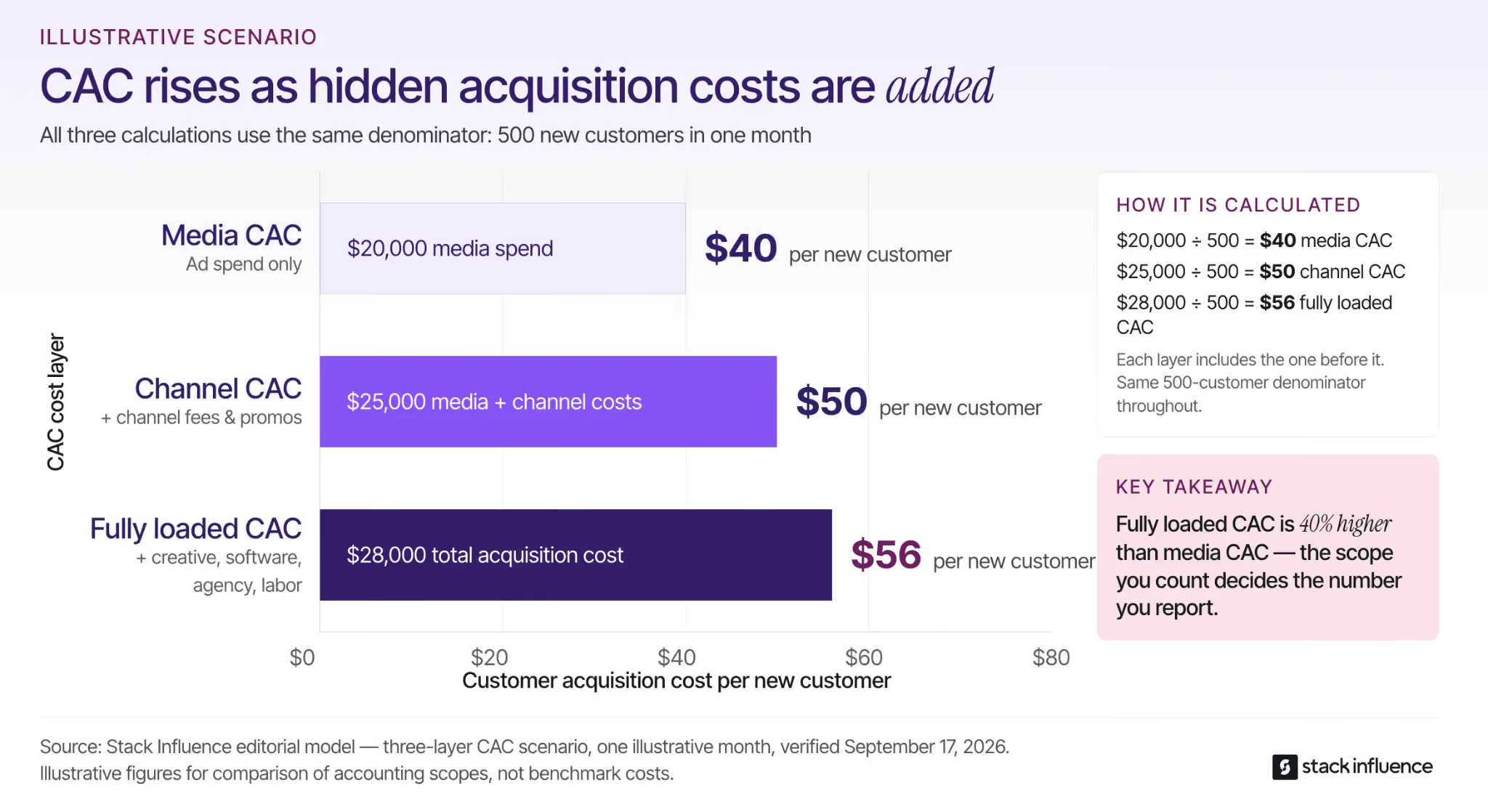
Consider an illustrative month in which an ecommerce brand acquires 500 new customers.
Direct media spending is $20,000. Creative production and channel-specific costs add $5,000. Allocated software, agency fees, and acquisition labor add another $3,000.
The three calculations are:
- Media CAC: $20,000 ÷ 500 = $40
- Channel CAC: $25,000 ÷ 500 = $50
- Fully loaded CAC: $28,000 ÷ 500 = $56
The advertising dashboard may show a $40 CAC while the business must recover $56 for every new customer. Fully loaded CAC is therefore 40% higher than media CAC in this illustrative scenario.
This is not an industry benchmark. It demonstrates why every reported CAC should include a clear cost-scope label.
3. Time Boundary
Acquisition spending and acquired customers must cover comparable periods.
If January advertising continues generating customers in February, dividing January spending only by January customers creates a timing mismatch. The same problem occurs when one channel uses a seven-day attribution window and another uses 30 days.
Use a mature attribution window, cohort-based reporting, or a documented lag adjustment. Apply the same timing rule when comparing channels.
4. Profit Boundary
CAC measures acquisition efficiency, not profitability.
A $30 CAC can be unaffordable for a low-margin product. A $100 CAC may be sustainable for a high-contribution product with verified repeat purchasing and a manageable payback period.
Normal product cost, marketplace fees, fulfillment, and returns on customer orders usually belong in the contribution-margin calculation. Products and reimbursements provided to creators are campaign inputs, so their net economic cost belongs in acquisition spending.
A structured ecommerce marketing plan should define the customer boundary, cost boundary, time boundary, and profit boundary before the budget is launched.
How Is CAC Different From CPA and ROAS?
CAC measures the cost of acquiring a new customer, while CPA measures the cost of generating a defined action and ROAS compares attributed revenue with advertising spend.
These metrics answer different questions.
The Stack Influence cost per acquisition glossary explains that CPA may be tied to a purchase, lead, registration, download, or another campaign action. A purchase CPA can include returning customers, so it should not automatically be treated as CAC.
Return on ad spend divides attributed revenue by advertising spend. ROAS does not show whether the buyers were new, whether the orders were profitable, or whether creative, creator, software, and labor expenses consumed the apparent return.
A campaign can therefore report strong ROAS but weak customer acquisition economics when many attributed orders come from existing buyers. Another campaign may produce a higher first-order CAC while acquiring a cohort that generates stronger contribution through repeat purchases.
Use CPA for action-level campaign optimization, ROAS for attributed revenue efficiency, and CAC for evaluating the cost of adding new customers to the business.
What Is a Good Customer Acquisition Cost?
A good customer acquisition cost is lower than the contribution an acquired customer produces within a payback period the business can finance.
There is no universal target because margins, refund rates, repeat-purchase behavior, inventory cycles, and cash reserves differ across products and brands. Category averages may provide context, but they cannot determine whether a specific campaign is profitable.
Set a Profit-First CAC Ceiling
Begin with first-order contribution before marketing:
Net sales
minus landed product cost
minus payment or marketplace fees
minus fulfillment and outbound shipping
minus discounts
minus expected returns, refunds, and damage
equals first-order contribution before marketing
First-order break-even CAC equals the remaining contribution.
A target CAC should sit below break-even by enough to cover overhead, profit, forecasting error, and the cash needed to purchase or manufacture more inventory. The Stack Influence guide to starting an ecommerce business applies the same contribution-first logic before a seller scales demand.
Revenue-based lifetime value is not a safe CAC ceiling unless the calculation has been converted to contribution, adjusted for realistic retention, and assigned to a specific timeline.
Consider an illustrative cohort of 100 newly acquired customers.
Assume every first order produces $30 in contribution before acquisition costs. By day 60, 30% of the cohort places a second order that produces $26 in contribution. By day 120, 12% of the original cohort places a third order that produces another $26 in contribution.
The cumulative contribution per acquired customer is:
- Day 0: $30.00
- Day 60: $30.00 + $7.80 = $37.80
- Day 120: $37.80 + $3.12 = $40.92
A $36 CAC loses $6 on the first order but is recovered by day 60. A $42 CAC remains unrecovered by day 120.
These numbers are illustrative rather than ecommerce benchmarks. Sellers should replace them with their own order-level contribution and retention data.
Payback Timing Matters as Much as Total Value
A customer may eventually produce enough contribution to justify the acquisition cost, but the business must survive until that contribution arrives.
An inventory-based ecommerce brand may need to fund supplier deposits, production, freight, marketplace fees, refunds, and another purchase order before the customer places a second order. A long theoretical payback period can create a cash problem even when projected lifetime value looks attractive.
Track both the expected value of the customer and the number of days required to recover CAC.
How Should Shopify Sellers Measure CAC?
Shopify sellers should use customer records to verify who is new, analytics tools to understand acquisition source, and the finance ledger to calculate the complete acquisition cost.
No single dashboard normally contains the entire numerator, denominator, and cash timeline.
Start with customer IDs and first-order dates. A customer who returns through an ad, affiliate link, creator code, or email campaign should not increase the new-customer denominator.
The Google Analytics 4 User Acquisition report focuses on how new users first found a website or app. A new user is not automatically a new paying customer, so GA4 data should be reconciled with completed commerce orders.
Shopify’s customer cohort analysis documentation explains how merchants can group customers by first-order date and follow their purchasing behavior over time. Cohorts help sellers measure contribution recovery rather than relying only on revenue retention.
A practical monthly acquisition file should include:
- Customer ID
- First-order date
- Acquisition source
- Campaign
- First-order net revenue
- Variable costs
- First-order contribution
- Repeat-order contribution
- Refund status
- Days to CAC payback
Lock the customer and cost definitions before comparing campaigns. Otherwise, one channel may appear more efficient simply because its report excludes expenses counted elsewhere.
How Should Amazon Sellers Measure CAC?
Amazon sellers should use Amazon Attribution for eligible off-Amazon campaigns while keeping the metric label precise.
Amazon Attribution measures how non-Amazon channels such as search, social media, video, email, affiliates, and influencer campaigns contribute to shopping activity on Amazon.
An attributed purchase is not automatically proof of a first-time customer or an incremental sale. Unless the reporting available to the seller confirms the customer distinction, the metric should be called cost per attributed purchase rather than CAC.
Eligible sellers may also use the Amazon Brand Referral Bonus with qualifying tagged traffic. A confirmed bonus can improve contribution economics, but it should not be used to make advertising spend appear lower than it was.
Amazon FBA fees, referral fees, fulfillment, refunds, and landed product cost belong in the contribution calculation. Creator reimbursements, product seeding, external media, campaign management, and content production belong in the acquisition-cost numerator when they support customer acquisition.
The Amazon PPC versus external traffic guide explains how sellers can compare their next advertising dollar across marketplace and off-Amazon channels. The related Amazon external traffic strategy separates attributed purchases, marketplace effects, and reusable content so one result does not disguise another.
Amazon influencers add another measurement distinction. A creator’s Amazon storefront may support discovery and affiliate revenue, while a brand-managed influencer campaign may use separate product seeding, briefs, content rights, and Amazon Attribution tags.
Count new customers only when the available evidence supports that classification. Do not treat every creator purchase, storefront visit, or attributed order as a newly acquired customer.
How Product Seeding Changes CAC Economics
Product seeding changes CAC economics because one campaign can produce creator participation, social distribution, reusable UGC, and customer purchases.
These outcomes have different values and should not be compressed into one sales figure.
The most important rule is to separate funded creator purchases from audience demand. If a creator buys a product and the campaign reimburses that purchase, the transaction may support marketplace execution and content production, but it is not independently funded customer demand.
For purchase-and-reimbursement workflows, reconcile the reimbursement, marketplace proceeds, product cost, fees, and related taxes so the transaction is recorded once.
Keep four separate records:
- Funded creator activity: Purchases or shipments required to complete the campaign.
- Audience demand: Tracked, non-funded customer purchases and their contribution.
- Content value: Completed assets, approved usage rights, deployment, and replacement production cost.
- Campaign cost: Products, shipping, reimbursements, platform costs, management, rights, and paid amplification.
Stack Influence’s automated product-seeding workflow connects creator activation, product coordination, UGC generation, and completed-post accountability within one campaign process.
That workflow makes creator delivery measurable. CAC still requires a verified new-customer denominator and the complete acquisition cost.
A verified Stack Influence case study for Blueland recorded 211 creator promotions, 247,000 social impressions, 11,000 engagements, and 13x ROI during a three-month campaign. That campaign-specific ROI does not reconstruct CAC by itself because CAC requires the number of new customers and a defined cost scope.
Results vary by product, category, pricing, marketplace conditions, creator relevance, content quality, and campaign execution.
Product seeding also creates compliance and licensing responsibilities. The FTC’s influencer disclosure guidance explains that free or discounted products can create a material connection that should be disclosed clearly.
Brands should also define whether creator content can be reused on product pages, email, organic social media, or paid advertising before assigning content value to the campaign.
How to Reduce CAC Without Hiding Costs

Lower CAC by improving the acquisition system, not by removing expenses from the numerator or adding repeat orders to the denominator.
Repair Conversion Before Buying More Traffic
Improve the offer, product page, marketplace listing, mobile experience, shipping information, social proof, and checkout flow before increasing media spend.
A small conversion-rate improvement can reduce CAC without changing the cost of traffic.
Concentrate Spend on Contribution-Rich Products
Bundles, subscriptions, higher-value offers, and products with strong repeat-purchase behavior can support a higher CAC when they produce more contribution.
Higher revenue alone is not enough. Sellers must compare contribution after product costs, fees, fulfillment, discounts, and returns.
Produce More Usable Creative Per Campaign
Plan product demonstrations, comparisons, objection handling, use cases, hooks, and content rights before creators begin producing content.
One creator asset may support an organic post, product page, email campaign, Amazon listing, Shopify landing page, or paid advertisement. Reusable content can improve the economics of the campaign, but it should not be recorded as a new customer.
Test Creators in Cohorts
Compare groups of creators based on product relevance, content completion, content quality, tracked traffic, audience purchases, and asset reuse.
Do not scale a brand ambassador, sponsorship, or affiliate relationship only because one post generated high engagement.
Move Proven Creators Into Longer-Term Relationships
Creators who consistently produce usable content or profitable customer demand may become candidates for affiliate programs, brand deals, brand partnerships, or ambassador programs.
The relationship should be expanded based on measurable performance and workflow reliability, not follower count alone.
Improve Retention Without Rewriting CAC
Repeat purchasing does not lower the original acquisition cost.
Retention increases the contribution generated by the acquired customer and may shorten the payback period. Keep the historical CAC unchanged, then update cumulative contribution as the cohort matures.
Remove Operational Waste
Broken tracking links, delayed approvals, stockouts, inconsistent discounts, duplicate software, weak reporting, and unused content can all increase fully loaded CAC.
When creator content is ready for paid distribution, Meta’s partnership ads documentation explains how brands can run ads with creator or partner identities. The Stack Influence Meta partnership ads guide explains why media spend, permissions, usage rights, and creator production costs should be evaluated together.
Affiliate programs can diversify acquisition economics, but commissions do not make the channel free. The benefits of affiliate marketing for ecommerce sellers should be evaluated alongside platform fees, recruitment, creator support, discounts, commissions, and customer quality.
Use a CAC Measurement Stack
A useful CAC report connects campaign delivery, attribution, customer status, contribution, and payback.
Each layer answers a different question.
- Delivery metrics: Spend launched, creators activated, content completed, ads delivered, tracking links working, and inventory available.
- Leading indicators: Qualified traffic, product-page engagement, add-to-cart rate, checkout initiation, and creator-content utilization.
- Acquisition outcomes: First-time customers, media CAC, channel CAC, fully loaded CAC, and new-customer conversion rate.
- Economic outcomes: First-order contribution, target CAC variance, refund-adjusted contribution, and payback period.
- Cohort outcomes: Repeat-purchase rate, time to second order, cumulative contribution, and customer concentration by source.
Attribution assigns credit among observed touchpoints. Google Ads’ data-driven attribution documentation explains that its model assigns conversion credit based on advertising interactions and account data.
Attributed credit is not the same as a controlled estimate of what would have happened without the campaign. Sellers should not treat attributed sales as automatic proof of incrementality.
Use the commerce platform as the authority for customer status. Use the finance ledger as the authority for costs. Use advertising and analytics platforms as diagnostic views that explain where customers interacted with the brand.
Review media and execution metrics weekly. Make budget decisions through monthly or cohort-based economic reviews after conversions, refunds, discounts, credits, and repeat purchases have had time to mature.
Common Customer Acquisition Cost Mistakes
Most CAC errors come from inconsistent definitions rather than difficult mathematics.
- Using orders instead of new customers: Repeat purchases make the denominator too large.
- Reporting media spend as total CAC: Creative, creators, agencies, software, and labor disappear.
- Mixing calendar periods: Current spending is divided by customers generated through earlier spending.
- Counting funded creator purchases as customer demand: Campaign execution is mislabeled as independent acquisition.
- Using revenue-based LTV as spendable margin: Product cost, fulfillment, fees, refunds, and timing are ignored.
- Treating attribution as incrementality: Credited sales are assumed to be sales the campaign created.
- Chasing an industry benchmark: A category average replaces the brand’s actual contribution and cash constraints.
- Lowering CAC by excluding costs: The report improves while the underlying economics remain unchanged.
Write four items above every recurring CAC report: customer definition, cost scope, reporting window, and profit hurdle.
That one line prevents a media CPA from quietly being presented as companywide customer acquisition cost.
Build a CAC System You Can Scale
Customer acquisition cost becomes useful when every team agrees on which expenses are included, which buyers qualify as new, and how quickly each customer returns contribution to the business.
Start with one product, one customer cohort, and one reporting window. Calculate a profit-first CAC ceiling, reconcile Shopify or Amazon data with the finance ledger, and scale only when the channel remains acceptable after creative, creator, technology, labor, refunds, and cash timing are included.
For product-seeding campaigns, define creator completion, customer acquisition, reusable content, and long-term creator development as separate outcomes. A managed micro-influencer workflow can then be evaluated against clear delivery and CAC rules instead of impressions or attributed revenue alone.
The goal is not simply to report a lower customer acquisition cost. The goal is to acquire customers at a cost the business can recover, finance, and scale profitably.