




Consider an office manager buying supplies for twelve workstations. The lowest unit price may not be the easiest purchase to approve, store, receive, or repeat.
For ecommerce sellers, an Amazon B2B ecommerce strategy should solve that entire buying problem. Business pricing is one part of the offer, not the strategy itself.
This guide explains how to select business-use products, design quantity tiers, remove purchasing friction, protect delivery reliability, and measure whether larger baskets are becoming a durable business channel. The platform details below focus on the U.S. marketplace.
Key Takeaways
- Build offers around a specific business use, purchasing quantity, approval requirement, and replenishment cycle.
- Evaluate quantity discounts against both seller contribution and the buyer’s total purchase commitment.
- Treat business-hour delivery and accurate product information as prerequisites for promotion.
- Measure B2B orders, quantities, and contribution separately; more units per session do not necessarily mean more buyers.
An Amazon B2B Ecommerce Strategy Starts With a Reorder-Ready Offerr
An Amazon B2B ecommerce strategy is a plan for selling products to organizations through Amazon Business. It differs from buying wholesale inventory to resell on Amazon: the focus here is the business customer purchasing your offer.
Start with a Reorder-Ready Offer, a five-part planning framework:
- Business job: Name the task the product supports, such as equipping workstations or replenishing shipping supplies.
- Buying unit: Specify whether the customer needs an individual unit, a multipack, or a case.
- Approval evidence: Identify the specifications and purchasing information needed to authorize the order.
- Order economics: Confirm what remains after discounts and all variable costs.
- Replenishment promise: Establish how the buyer can reliably purchase the same item again.
A product that fails one of these checks is not automatically a bad business product. It needs a specific repair before you pay to generate more demand.
According to Amazon’s Business seller documentation, sellers access B2B tools through a Professional selling account, currently $39.99 per month plus selling fees in the U.S. Existing Professional sellers can open B2B, then B2B Central, in Seller Central.
Amazon also provides B2B Product Opportunities and Case Pack Product Opportunities for assortment research. Use these as inputs to a shortlist, not as substitutes for checking sourcing costs and supply reliability.
Begin with products already attracting business purchases or with an obvious organizational use. A replacement supply with a clear specification offers a more testable starting point than a broad claim that an entire consumer catalog is suitable for businesses.
Why the Largest Discount Can Be Harder to Approve
A larger quantity discount can reduce the price per unit while increasing the amount the buyer must authorize and store. Design offers around practical purchasing quantities, not the assumption that every business wants the largest case.
Purchasing controls are real, although they vary by organization. For example, Iowa State University’s Amazon purchasing guidance requires Amazon purchases to pass through cyBUY and procurement review before submission. That is one institution’s policy, not a universal Amazon requirement.
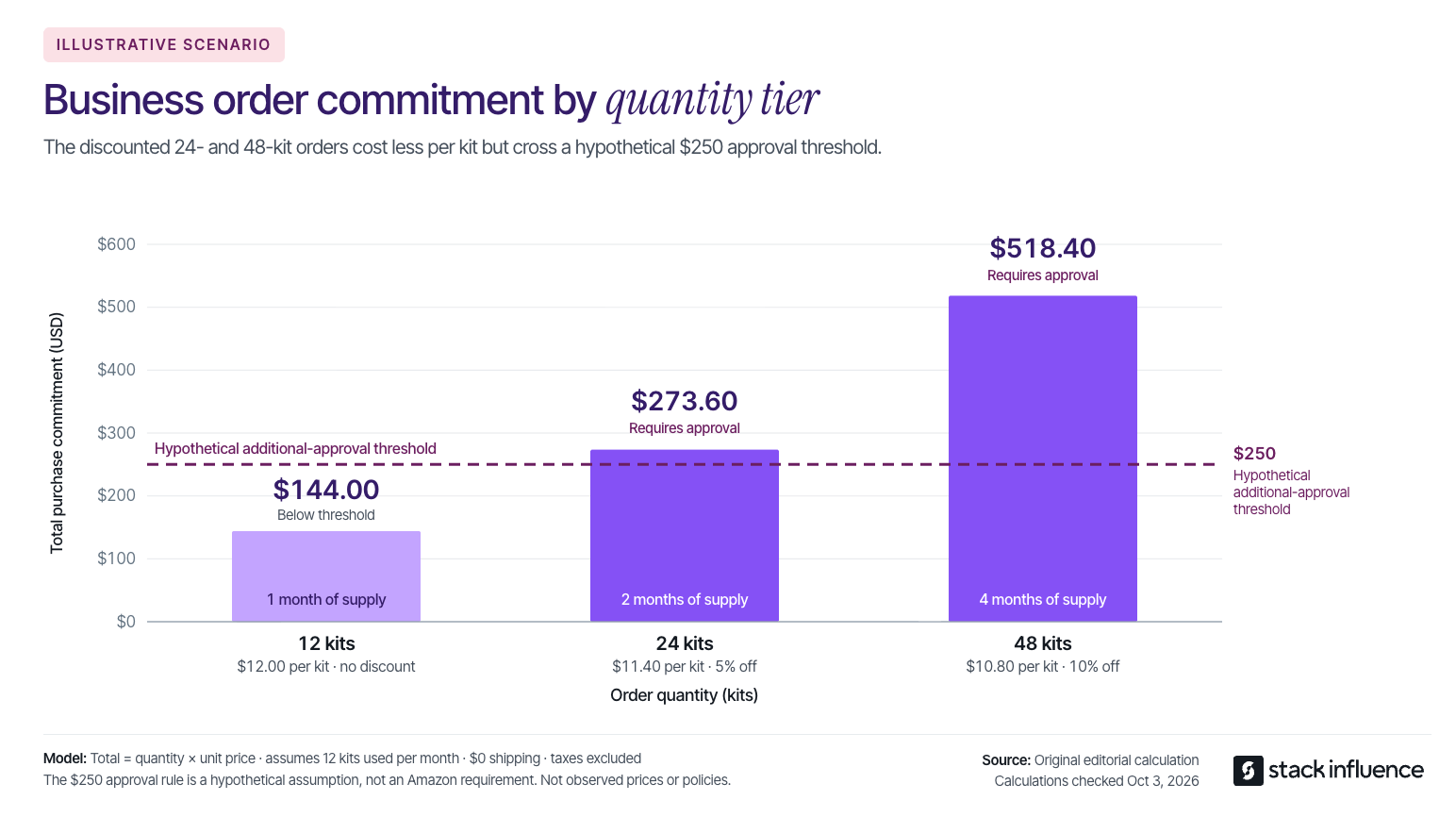
Consider an illustrative office-supply offer. Assume a buyer consumes 12 identical kits per month, the undiscounted price is $12 per kit, shipping is free, and taxes are excluded from the model. Suppose this buyer’s internal policy requires additional approval for purchases above $250.
Three possible order quantities produce different commitments:
- 12 kits at $12 each: $144 total, no discount, and one month of supply.
- 24 kits at $11.40 each: $273.60 total, a 5% discount, and two months of supply.
- 48 kits at $10.80 each: $518.40 total, a 10% discount, and four months of supply.
Order commitment equals quantity multiplied by unit price. Months of supply equal quantity divided by monthly consumption.
The larger orders cross the hypothetical approval threshold even though each kit costs less. These figures are planning assumptions, not Amazon rules, industry benchmarks, or results from a Stack Influence campaign.
The practical response is to preserve a genuinely useful smaller purchase option alongside bulk tiers, provided its economics work. Do not encourage buyers to split transactions to evade purchasing controls; make each offer appropriate for a legitimate replenishment need.
Protect Seller Contribution Before Publishing Quantity Tiers
Set quantity discounts only after calculating the economics of the completed order. A discount that increases revenue can still reduce the money available to cover overhead.
Use this operating calculation:
Order contribution = product revenue after discounts − product cost − marketplace fees − fulfillment and packaging − allocated inbound and storage costs − expected returns and concessions − variable acquisition costs.
Keep taxes collected for remittance outside revenue. Include buyer-paid shipping and its associated costs consistently, and use actual category and fulfillment fees rather than a universal percentage.
Amazon’s B2B pricing guide describes business prices and quantity discounts, including percentage-off and fixed-price tiers. Choose thresholds that match how customers actually buy, then check the effective price during other promotions and automated price changes.
Amazon’s Business Discount Insights documentation provides suggested pricing opportunities and describes conditional fulfillment and referral-fee discounts. Treat recommendations as candidates for testing, and verify eligibility before including any savings in your cost model.
Evaluate at least the smallest qualifying order at each tier and the largest order your current stock can support. For seller-fulfilled products, price the actual carton and shipping service; do not assume shipping costs rise evenly with unit count.
Use margin-aware Amazon repricing controls when business prices interact with automated rules. A profitable manual offer can become unprofitable when another promotion changes its effective price.
Keep contribution separate from cash availability. Inventory may need to be purchased and delivered before the marketplace proceeds become available, so an attractive order can still create a funding gap.
Make the Listing Usable for an Approver
Give the person authorizing the purchase enough information to evaluate the product without reconstructing the offer from photographs.
For a workplace accessory, specify dimensions, compatibility, included components, and the exact quantity received. For replenishment products, make the unit of measure and pack count unmistakable. Describe what is included rather than relying on a label such as “commercial quality.”
Amazon supports package hierarchies for units, case packs, and pallets. Distinguish ordering several units of an existing offer from creating a different packaged product; the listing structure must accurately represent what is delivered.
Apply the same discipline to images. One image can show the complete pack contents, while another demonstrates scale or compatibility. The principles in the Amazon product listing optimization guide are useful here, but the questions should come from a business purchasing decision.
Maintain accurate seller-profile information and substantiate any certifications you claim. Assign responsibility for incoming quote requests, product questions, and invoice-related issues rather than leaving them between sales and operations.
Set a response workflow for quotes: confirm the requested quantity, available stock, delivered cost, and acceptable contribution before responding through the available Amazon tools. A quote should be an executable offer, not a discount invented before fulfillment checks.
A persuasive demonstration cannot replace a missing specification. Return to the approval-evidence component of the Reorder-Ready Offer whenever a buyer asks a question that the listing should already answer.
Protect Availability and Business-Hour Delivery
Choose fulfillment by the product’s economics and the receiving conditions it must satisfy. Compare Amazon FBA and seller fulfillment for storage, handling, delivery reliability, and the quantities business buyers are likely to order.
For U.S. seller-fulfilled Amazon Business shipments, Amazon’s business-hour delivery requirement took effect on September 30, 2026. It requires a Business Hour Delivery Rate of at least 90%, measured over a rolling 14-day period.
Amazon’s announcement says sellers below the threshold will receive notification and recommendations. If performance has not improved by October 30, 2026, affected seller-fulfilled offers may be deactivated for Amazon Business customers; FBA and retail-offer eligibility are not affected by that action.
Review the metric in Account Health and investigate carrier and shipping-setting issues before increasing order volume. A delivery arriving by its promised date and a delivery arriving while the business is open are different operational questions.
Plan stock for business and consumer demand together. Use a cross-marketplace inventory plan when the same supply also supports Shopify or other marketplaces, and account separately for campaign inventory commitments.
Do not size the replenishment buffer from average order quantity alone. A small number of legitimate bulk orders can consume stock that normally covers many consumer purchases, so test the largest plausible order against available inventory before promoting the offer.
Use Ads and Creators to Answer Business Buying Questions
Promote the offer only after the purchasing and fulfillment requirements are workable. Separate advertising intended to reach business buyers from content intended to explain the product.
Give Business Advertising Its Own Test
Eligible advertisers can use Amazon Business exclusive Sponsored Products campaigns to advertise only on Amazon Business. These campaigns support their own budgets, selected products, keywords, and bidding settings.
Start with a narrow product group and purchase-relevant search terms. A seller of desk organizers might test terms tied to office supplies, workstation organization, and the actual pack size rather than adding “wholesale” to every keyword.
Keep the test budget and success criterion explicit. Business-only placement identifies the advertising environment; it does not establish that every resulting order is incremental or profitable.
Commission Demonstrations, Not Generic Praise
Creator content is most useful when it resolves a concrete product question. Ask a relevant creator to demonstrate assembly, show the full pack, or explain compatibility accurately rather than simply calling the product suitable for businesses.
When finding influencers for an Amazon product, examine evidence of relevant content and audiences. Micro influencers and nano influencers may be candidates, but follower count alone does not establish access to purchasing decision-makers.
Through Stack Influence’s automated product-seeding workflow, sellers can coordinate gifted-first campaigns and track completed creator posts. A business-use assignment should make its acceptance criteria specific: visible pack quantities, a truthful setup demonstration, and delivery of any contracted content files. Keep that production record separate from Amazon Business sales reporting.
Distinguish the social-post deliverable from the licensed UGC file. Specify permitted placements, edits, duration, and any separate advertising permissions before repurposing content.
The FTC’s influencer disclosure guidance explains that free products and other benefits can create a relationship that requires disclosure. Commission an honest product demonstration, not a customer review in exchange for a benefit.
Measure Repeat Demand Only After the Reorder Window

Use a B2B-specific readout rather than treating overall Amazon sales growth as business-channel growth.
Amazon’s business reporting guide describes B2B and non-B2B comparisons, customer-segment views, quantity-discount reporting, and B2B traffic and sales metrics. Record the exact report, period, product level, and metric definition before comparing results.
Organize the readout around three questions: are qualified shoppers reaching the offer, what orders are they placing, and what contribution remains? Page visits and Featured Offer visibility are leading indicators; fulfilled orders and contribution are commercial outcomes.
Separate Order Size From Customer Retention
More units per session can reflect larger baskets rather than more shoppers buying. Pair quantity metrics with actual order counts, units per order, and contribution per order.
Do not assume every report’s “order items” field represents distinct customer orders. Likewise, recurring sales of an item do not establish that the same customers are returning.
Give Each Cohort a Complete Reorder Window
Evaluate repeat buying only after customers have had enough time to make the repeat purchase being measured.
Consider a separate illustrative dataset of 100 first-time business customers. Assume reliable, permitted customer-level records, no cancellations or returns, and a 60-day repeat-purchase window measured from each customer’s first order.
At the reporting cutoff, 40 customers have at least 60 days of follow-up, 35 have 30 to 59 days, and 25 have fewer than 30 days. Twelve of the fully observed customers reordered within their first 60 days, and they are the only customers with any repeat order by the cutoff.
Dividing 12 by all 100 customers gives a 12% mixed-age, observed-to-date repeat share. Dividing those 12 by the 40 with complete follow-up gives a 30% 60-day repeat rate for the fully observed cohort.
Both calculations are reproducible, but they answer different questions. Labeling the 12% figure a 60-day repeat rate treats customers who have not completed the window as though they have.
This is an illustrative measurement example, not a retention benchmark. The older cohort’s 30% result does not predict the newer cohorts, and 60 days is an assumed evaluation window, not a suitable reorder cycle for every product.
Use this calculation only where authorized data supports customer-level analysis. Where it does not, report recurring product-level demand as a proxy and state the limitation.
Keep Attribution in Its Own Role
The official Amazon Attribution methodology uses a 14-day, last-touch model for qualifying off-Amazon activity. Apply tags before launch, but do not assume a tagged purchase proves the buyer was a business customer.
Use the external-traffic measurement guide to keep campaign reporting separate from incremental-demand claims. Do not add attributed sales to Seller Central sales as though they were additional transactions.
Where eligible, Amazon Brand Referral Bonus can provide referral-fee credits for qualifying external traffic. Include earned credits appropriately in the financial readout rather than assuming every B2B order receives a bonus.
A short advertising attribution window and a longer replenishment cycle serve different purposes. Maintain both views without assuming they can be joined into a complete customer journey.
Run a Pilot That Can Earn a Second Order
Start with a small group of products rather than adding discounts across the entire catalog.
During the first month, complete the Reorder-Ready Offer checks, preserve the existing prices and baseline performance, and assign ownership of stock, questions, and delivery exceptions.
During the next month, test a defined quantity offer or business advertising campaign while keeping unrelated changes limited. Compare similar periods and record stockouts, promotions, and changes in delivery performance.
Use subsequent replenishment windows to evaluate recurring demand and contribution. A before-and-after improvement is useful evidence for the next decision, but it does not isolate causation when several conditions changed.
Expand only when the offer works operationally and the financial result supports it. A larger initial basket is not enough reason to roll the same discount across unrelated products.
Make the Next Purchase Easier Than the First
A durable Amazon B2B ecommerce strategy gives customers an offer they can understand, approve, receive, and buy again without unnecessary work.
The strongest next step is not a bigger campaign. Put one repeat-use product through the Reorder-Ready Offer checks, repair the weakest part, and test whether business demand produces contribution worth repeating.