




A price change can produce more orders and less money to run your business. The mistake is treating the selling price as the decision, instead of calculating what remains after the order is fulfilled.
For ecommerce sellers, repricing on Amazon should start with a permitted range of economically acceptable prices, not a rule that follows every competitor downward. This guide explains how to calculate that range, choose an automation approach, avoid fee thresholds that undermine your margin, and judge whether the resulting sales are worth having.
Key Takeaways
- Set repricing limits from contribution per order, including fulfillment, expected returns, and marketing costs, rather than product cost alone.
- Compare genuinely comparable offers and total delivered prices; a lower price does not guarantee Featured Offer placement.
- Check category fee thresholds because a small price increase can reduce the amount retained after referral fees.
- Evaluate contribution over the whole test period, not just revenue, order volume, or Featured Offer percentage.
Start Repricing on Amazon With a Permitted-Price Map
Repricing means adjusting an offer’s selling price manually or automatically as pricing conditions change. The useful question is not how often the price moves, but which movements your economics can support.
Build a Permitted-Price Map for each SKU, your stock-keeping unit, before connecting it to an automated rule. Give the map four controls:
- Contribution floor: The minimum dollars each order should retain after its variable costs.
- Reference boundaries: The comparable offers and delivery conditions that should influence your price.
- Excluded price bands: Prices that fail your economics because of fee changes or overlapping discounts.
- Stop conditions: Inventory, data, or pricing problems that require a human decision.
This is a planning framework, not a claim that every repricing tool supports each control directly. Translate the map into available settings and retain manual approval where necessary.
Calculate the Floor From the Money You Keep
Start with current product and fulfillment costs. Amazon’s Revenue Calculator and fee-estimation tools help estimate selling and fulfillment costs, including comparisons between Amazon FBA and merchant fulfillment; add business-specific costs the estimate does not capture.
For a simplified situation with one percentage-based referral fee and otherwise constant per-unit costs:
Minimum price = (other per-unit costs + required contribution) ÷ (1 − referral fee rate).
Consider an illustrative scenario with $18 in other per-unit costs, including product, fulfillment, expected returns, and a marketing allowance. Assume a flat 15% referral fee, no separate buyer-paid shipping or gift wrapping, no discounts or credits, and no taxes in revenue; fixed overhead is excluded. The 15% rate is an assumption for this example, not a universal Amazon fee.
Contribution per unit therefore equals price × 0.85 − $18. A $30 price leaves $7.50; $29 leaves $6.65; $28 leaves $5.80; and $27 leaves $4.95.
To retain at least 5perunit,thecalculatedflooris(18 + $5) ÷ 0.85 = $27.0588, rounded upward to $27.06. Rounding downward would miss the stated target.
The 30-to-28 reduction cuts price by 6.7% but contribution per unit by 22.7%. Maintaining the original total contribution would require 29.3% more units, calculated as $7.50 ÷ $5.80 − 1, assuming the same per-unit costs.
That is the hurdle a discount must clear in this scenario. Higher sales are not sufficient evidence that the change worked.
Keep an order-level marketing allowance distinct from customer acquisition cost, which measures spending against genuinely new customers. Recalculate the floor when fulfillment costs, promotional spending, or return expectations change, rather than assuming yesterday’s allowance remains accurate.
Which Price Are You Actually Competing With?
Compare the total delivered price of genuinely comparable offers, not the lowest number anywhere on the site. Amazon’s Featured Offer guidance explains that the Offer Display, often called the Buy Box, can contain one or more Featured Offers and that price, delivery, order experience, and stock availability matter.
Start with the same product and condition. A used item, different pack size, or slower delivery promise should not automatically become the reference for a new, promptly delivered offer.
Do not assume Amazon FBA alone resolves the comparison. Amazon’s guidance also recognizes merchant fulfillment as a viable route to Featured Offer placement; evaluate the actual customer offer rather than treating the fulfillment label as a guaranteed advantage.
Shared Listings and Private Brands Need Different Triggers
For a reseller sharing an Amazon Standard Identification Number, or ASIN, the immediate decision concerns competing offers on the same product detail page. A rule might respond to a comparable offer while staying inside the Permitted-Price Map.
For a private brand, automatically copying a different product’s price can erase differences in quantity, materials, warranty, or positioning. Treat comparable products as context for a deliberate price test, not as interchangeable offers.
Separate a pricing problem from a communication problem. Review Amazon product listing optimization before assuming a discount is the only way to address unanswered questions about fit, use, or product value.
Choose the Simplest Tool That Can Enforce Your Rules
Choose manual repricing while the catalog and frequency of decisions remain manageable. It keeps unusual pricing decisions visible, although the seller must perform the monitoring and updates.
A rule-based approach suits explicit instructions, such as matching a defined reference subject to a floor. An algorithmic approach delegates more of the price selection, making the quality of cost inputs and safeguards especially important.
Amazon’s Automate Pricing tool is included without an additional tool charge for Professional sellers with active offers. It supports competitive and sales-based rules, including pricing above, at, or below a reference price.
Specialist products expose different controls. BQool’s repricing features include rule-based and AI approaches with inventory-related conditional strategies, while Repricer’s strategy options include cost-based limits and rules differentiated by fulfillment type.
Treat those as feature examples, not a tested ranking. Confirm which subscription includes the controls you need, how costs are updated, and whether price histories and exceptions can be exported.
The purchasing test is practical: can the tool reproduce your Permitted-Price Map without silently relaxing it? A faster repricer does not solve an incorrect cost model, and a profit-protection label does not establish that every business expense has been entered.
Configure a Small, Reversible Repricing Pilot
Start with a small group of products whose costs, inventory, and recent sales you understand. Keep launch products, clearance inventory, and stable replenishment products in separate groups because they have different objectives.
Amazon’s native setup instructions direct sellers to Seller Central → Pricing → Automate Pricing, then to choose a rule, select SKUs, set a minimum and optional maximum, and start repricing.
The settings are only part of the launch. Preserve the current price, rule, cost assumptions, and permitted boundaries before activation so you can reconstruct what changed.
Give Each Price One System of Record
Designate one system to control a SKU’s active price. Before activation, inspect other repricers, inventory integrations, scheduled uploads, and manual routines that could overwrite the same field.
Assign a named person to exceptions. That person should be able to pause the rule, inspect the live offer, and restore an approved price when appropriate; pausing alone is not evidence that the displayed price has returned to its previous value.
Check the actual customer-facing offer after changes. A saved setting and a verified live price are different checkpoints.
Test the Price After Promotions
Calculate what the customer pays and what the seller retains when a coupon, business discount, or other eligible promotion overlaps with repricing. Do not assume the repricer’s minimum automatically protects the final promotional transaction.
Use a realistic maximum supported by your commercial offer and pricing history. Amazon’s pricing-policy explanation describes potential action against misleading or unfair pricing, including excessive shipping charges; a software ceiling is not permission to ignore marketplace requirements.
Decide When Not to Follow the Market
Hold the approved floor when the competing price falls below it. Investigate whether the gap comes from different costs, liquidation, a different offer, or your own incorrect inputs before authorizing a loss.
Set stop conditions for missing cost data, unexpected fee changes, overlapping discounts, and inventory discrepancies. A deliberate clearance decision can use different economics, but it should have an explicit budget and end condition rather than emerge accidentally from a competitive rule.
When an offer loses visibility, inspect Pricing Health and your Amazon sales-readiness checks before repeatedly lowering the price. Repricing should respond to a diagnosed problem, not substitute for diagnosis.
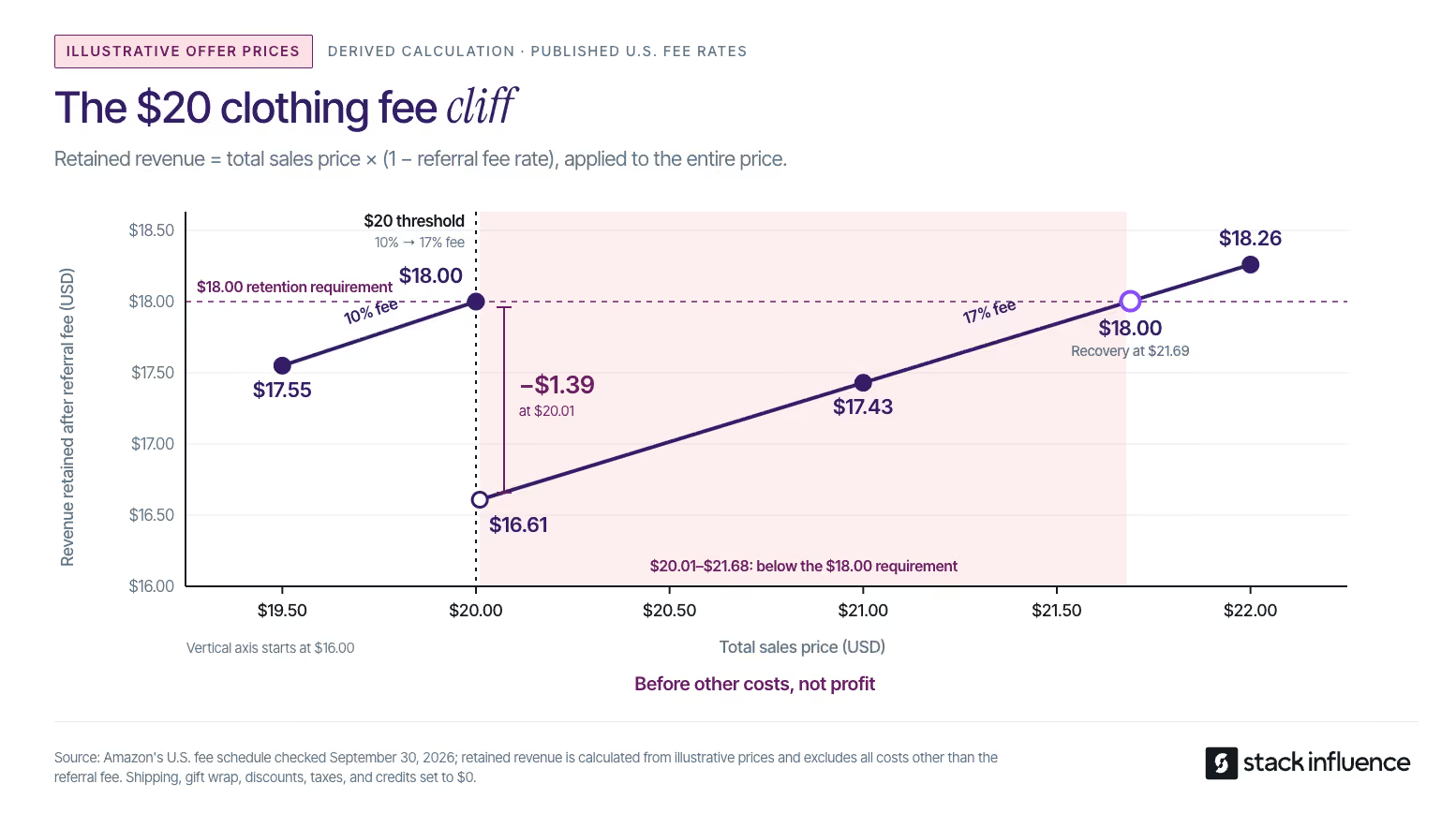
The Fee Cliff That Can Make a Higher Price Worse
A higher selling price can leave less money after referral fees when it crosses a category threshold. This is why a minimum and maximum may not adequately describe your permitted prices.
Amazon’s U.S. referral-fee schedule, checked September 30, 2026, lists Clothing and Accessories at 10% for total sales prices above $15 and up to $20, and 17% above $20. The higher rate applies to the total sales price, not just the amount exceeding the threshold.
Here is a derived example using illustrative offer prices and those published rates. Assume no buyer-paid shipping, gift wrapping, discounts, or taxes in the price; exclude all other costs and credits so the calculation isolates the referral fee.
At $19.50, the amount retained after the referral fee is $17.55. At $20.00, it is $18.00; at $20.01, it falls to $16.61; and at $21.00, it is $17.43.
A $21.69 offer retains approximately $18.00, while $22.00 retains $18.26. These amounts are revenue after the referral fee, not profit.
The one-cent increase from $20.00 to $20.01 therefore reduces the retained amount by approximately $1.39. To recover the $18 retained at a $20 price, solve $18 ÷ 0.83 = $21.6867 and round upward to $21.69.
For a policy requiring at least $18 after referral fees, the prices from $20.01 through $21.68 would fail that requirement. They are not universally wrong prices, but they do not satisfy this particular policy.
Evaluate candidate prices within each applicable fee band, then exclude those that miss your contribution target. Where a tool cannot represent excluded bands, constrain the automated range and require approval for crossing the threshold.
Check the product’s assigned fee category and current estimates before applying this example. Do not transplant clothing economics into another category, marketplace, or promotional situation.
How Do You Know Whether Repricing Is Working?

Repricing is working when it improves the financial outcome you chose without violating your operating constraints. For a replenishment product, contribution over the whole period is a more useful primary measure than revenue or Featured Offer percentage alone.
Calculate contribution from revenue excluding taxes and adjusted for discounts and refunds, less the associated product, fulfillment, platform, and marketing costs. Reconcile credits and return-related adjustments consistently, and avoid subtracting the same cost twice through both an allowance and an actual expense.
Use three layers of measurement:
- Warnings: Time at the price floor, failed updates, missing cost inputs, and inventory discrepancies.
- Diagnostics: Featured Offer percentage, units, sessions, conversion measures, and average selling price.
- Outcomes: Total contribution, contribution per calendar day, contribution per unit, and inventory sold.
A possible operating comparison is a 14-day baseline followed by a 14-day pilot, provided sales volume is sufficient to make the comparison useful. That captures repeated weekdays, but it is not a guarantee of statistical reliability or a randomized experiment.
Keep stockouts in the whole-period financial result, while also examining in-stock performance to diagnose the cause. Removing unprofitable days from one period would make the comparison misleading.
Record changes in advertising, promotions, delivery promises, and competitor availability alongside the price history. The same discipline used to compare Amazon PPC and external traffic applies here: evaluate the money retained, not merely sales attributed to an activity.
Return to the original economic hurdle. In the 30-to-28 scenario, an order increase below 29.3% would not preserve total contribution under the stated assumptions, even if the sales dashboard looked busier.
Keep Demand Tests Separate From Price Tests
Do not launch a new content campaign and a price experiment simultaneously, then attribute the entire sales change to the repricer. Separate their timing when feasible, or clearly record that the result combines multiple changes.
For brands using micro influencers or nano influencers, record creator posting dates and campaign costs. Stack Influence’s gifted-first product-seeding workflow coordinates creator participation and completed content; those campaign activities need their own records alongside the pricing test.
Where campaign records identify funded creator purchases, keep them separate from independent customer demand in the evaluation. Gifted or reimbursed endorsements also need clear disclosure under the FTC’s influencer disclosure guidance.
Treat Amazon listing split testing with UGC as a separate way to investigate product communication. A UGC video test and a selling-price test answer different questions.
Eligible brands can use Amazon Attribution to measure tagged off-Amazon activity; its reports use a 14-day attribution window. Allow comparable conversion windows to mature, and remember that attribution does not isolate the causal effect of a price change.
Keep conditional incentives separate as well. The Amazon Brand Referral Bonus provides referral-fee credits on qualifying activity, so do not lower an entire SKU’s price floor as though every future order will earn that credit.
Make the Next Price Change Earn Its Place
Effective repricing on Amazon is a controlled economic decision, not a competition to move prices fastest. Define the contribution target, compare the right offers, inspect fee thresholds, and preserve a way to stop or reverse the rule.
Begin with one product whose costs you can reconcile. Build its Permitted-Price Map and write down the contribution result that would justify keeping the new rule, so the next price change has to earn its place in your business.