




Before adding more keywords or increasing your advertising budget, identify where a shopper's journey breaks. Is your listing unavailable, poorly matched to the search, overlooked in the results, or unconvincing after the click?
For ecommerce sellers, useful Amazon keyword ranking tips should connect a search term to a specific action, not another round of keyword stuffing. This guide shows how to choose relevant queries, improve the listing that serves them, use advertising and creator content deliberately, and measure progress without confusing visibility with sales.
Key Takeaways
- Diagnose availability, relevance, clicks, and purchases before spending more to attract traffic.
- Prioritize accurate product matches with buying evidence, not search volume alone.
- Track the same organic keyword set over time, separating branded queries, advertising placements, and category sales rank.
- Measure creator campaigns through content delivery and attributable customer activity, without treating either as proof of organic ranking causation.
Amazon Keyword Ranking Tips Start With a Query-to-Order Audit
Audit one product and a defined group of search terms before changing the listing. The Query-to-Order Audit is a practical decision sequence, not a description of Amazon's algorithm or a formula for guaranteed rankings.
Amazon keyword ranking means a product's position for a particular search query. Organic position excludes sponsored placements, while Best Sellers Rank measures category sales performance; Amazon's explanation of BSR versus search ranking makes clear that one does not guarantee the other.
Work through five checkpoints:
- Availability: Confirm the correct product variant is active, buyable, and available for the marketplace you are evaluating.
- Relevance: Check whether the product genuinely satisfies the query and whether its catalog information describes that match.
- Selection: Examine whether shoppers click when the product appears, then inspect the competing offers they see.
- Conversion: Identify unanswered questions, price objections, or delivery concerns that might explain lost purchases.
- Persistence: Check whether progress survives beyond a promotion and appears in a consistent set of keyword measurements.
Address the earliest unresolved checkpoint first. Rewriting a title is not a remedy for unavailable inventory, and more impressions do not resolve an unclear product offer.
Also distinguish keyword breadth from keyword position. Stack Influence's four-month Happy Viking case study recorded 171 new ranking keywords and 222 creator promotions. Those figures describe expanded keyword coverage and campaign activity, not a uniform position improvement across every search term or proof that creator activity alone caused the changes.
That distinction matters when a campaign report looks impressive but your highest-priority query has barely moved.
Which Keywords Should You Prioritize?
Prioritize queries that accurately describe your product and show evidence of relevant customer demand. Use search volume to estimate the size of an opportunity, then examine whether the shoppers behind that query want what you sell.
Start with customer language, not an exported list of every imaginable variation. Amazon's keyword research guide identifies autocomplete suggestions, competing listings, and customer feedback as useful research inputs. Review the products appearing for each candidate term and note the expected material, size, pack quantity, use case, and price range.
For a compartmented lunch container, “bento lunch box” might describe the product accurately, while “insulated lunch bag” would describe a different purchase. A high-volume mismatch does not become a sensible target simply because it offers more potential impressions.
Keep branded queries separate from non-branded product queries. Within the non-branded group, distinguish broad category terms from specific feature or use-case terms. This makes it easier to decide whether you are defending existing demand, expanding discovery, or improving a narrowly defined match.
For additional demand research, Product Opportunity Explorer provides Amazon customer-search and product-demand insights. Treat research estimates and autocomplete suggestions as inputs to validate, not promises of traffic.
Read Query Shares Before Buying More Reach
Compare your share of impressions, clicks, and purchases for the same query and reporting period. Amazon Brand Analytics requires a Professional selling account and the Brand Representative role for an enrolled brand; eligible sellers can use its search dashboards to investigate customer behavior.
Amazon's Search Query Performance metric definitions distinguish total query counts from an individual ASIN's counts and shares. An ASIN is Amazon's product identifier. Use the ASIN-level view when diagnosing a particular product rather than substituting an entire brand's results.
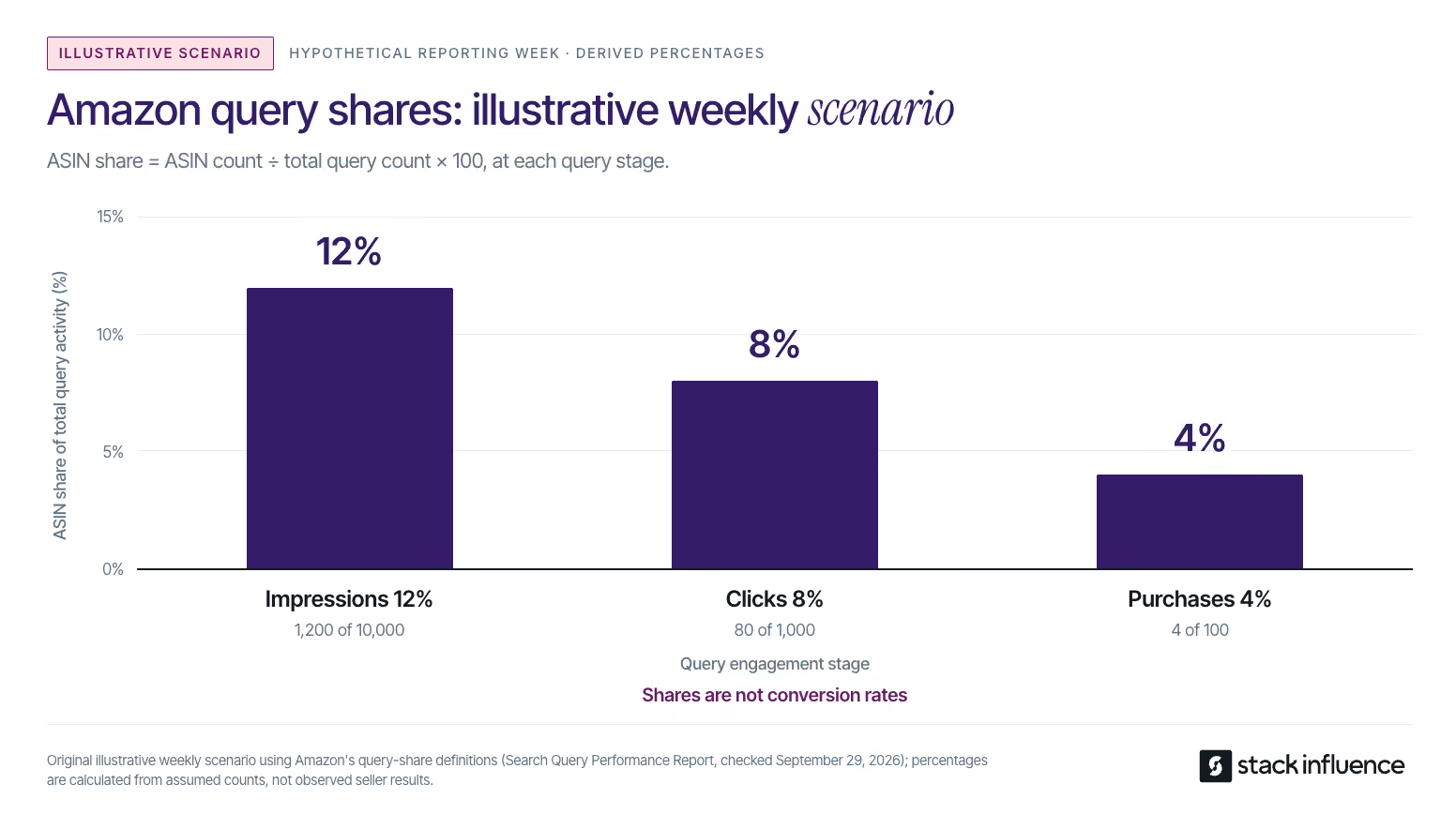
Consider an illustrative weekly query dataset, not an Amazon benchmark or client result. Across all products, assume 10,000 impressions, 1,000 clicks, and 100 purchases; your ASIN receives 1,200 impressions, 80 clicks, and four purchases.
Your impression share is 12%, click share is 8%, and purchase share is 4%. Each share equals your ASIN's count divided by the corresponding total query count, multiplied by 100.
That pattern warrants investigating both selection and conversion before simply increasing reach. It does not prove that the title, imagery, or price caused the difference, and four purchases are too few to support a confident performance verdict by themselves.
Importantly, 4% purchase share means four of the query's 100 purchases. It does not mean that 4% of visitors to your listing purchased. Never substitute a share metric for a conversion rate or an organic position.
Make the Listing Demonstrate the Search Intent
Give each important query a clear product fact behind it. The phrase should help a customer understand the offer, not merely occupy a field.
For the hypothetical lunch container, a shopper searching for compartments needs to understand the internal layout. A shopper searching for a work lunch container may need capacity, external dimensions, and cleaning instructions. Translate the query into the information required to make a purchase decision.
Write a Readable Title and Complete the Product Attributes
Build the title around the real brand, recognizable product type, and the few attributes that distinguish the specific item. Move supporting details into the appropriate attributes, bullets, and description instead of repeating several near-identical phrases in the title.
For example, “Bento Lunch Box, 3 Compartments, 1.2 L” illustrates a product description, not a complete category-approved title template. Add the actual brand and any required category information, and use those dimensions only for a product that truly has them.
Check the current marketplace and product-type requirements in Seller Central before publishing. Treat the allowed title length as a limit, not a goal, and verify the customer-facing result after saving.
Make important attributes consistent across the listing. A capacity stated one way in the title and another way in an image creates uncertainty; adding another keyword cannot resolve that contradiction.
Use Backend Keywords for Additional Relevant Coverage
Use backend search terms for accurate synonyms, abbreviations, and alternative names that are not already covered naturally. Amazon's SEO guidance describes editing the Generic keyword field under Product details and advises avoiding redundant or irrelevant terms.
Use spaces between terms and respect the field's current limits. Do not assume repeating a word across every available field gives it extra ranking weight. Keep a record of the previous version so you can identify what changed if the edit produces an unexpected result.
The objective is broader accurate coverage, not maximum keyword density.
Resolve the Objections That Keywords Cannot Answer
Inspect the listing as a buyer comparing several alternatives. Can someone understand the quantity, dimensions, compatibility, and included accessories without guessing? Is the delivery promise acceptable for the intended use?
For the lunch-container example, an overhead secondary image could show the compartments, while a properly licensed demonstration could explain the closure and cleaning process. Use assets only in placements that permit them, and never claim properties such as leak resistance without substantiation.
A+ Content and UGC video should clarify the product. Do not treat additional content modules as substitutes for accurate catalog information or assume that adding them guarantees indexing or higher rankings.
Can PPC Improve Organic Keyword Rankings?
PPC buys advertising exposure, not a guaranteed organic position. Amazon's Sponsored Products documentation describes cost-per-click ads that can appear within shopping results and direct customers to product detail pages, so sponsored visibility must be measured separately from organic ranking.
Use advertising to investigate which customer searches produce economically useful orders. A campaign's target keyword is not necessarily the phrase a shopper typed; Amazon's targeting guide distinguishes customer shopping queries from advertiser-selected keywords and explains automatic, manual, and negative targeting.
Start with a bounded discovery test. Review actual search terms, identify relevant queries that generate purchases, and test those terms in a more focused campaign. Exclude clearly mismatched searches rather than trying to make the listing fit them.
Exact match narrows targeting, but Amazon also includes plural forms. Inspect the resulting search-term data rather than assuming a match-type label isolates one literal string.
Set spending limits using the product's economics. Record advertising costs alongside product cost, marketplace fees, fulfillment, and promotions; an improved rank screenshot does not establish that an advertising test was profitable.
Validate Listing Changes With Controlled Content Tests
Test a clear hypothesis, such as whether explaining compartment capacity reduces buyer uncertainty. Manage Your Experiments supports randomized tests of eligible listing content, including titles, images, bullets, descriptions, and A+ Content, and requires sufficient product traffic.
Amazon recommends eight to ten weeks when sellers choose their own experiment duration, while its significance-based setting runs until sufficient evidence is available. That is guidance for content experiments, not a promised timetable for keyword ranking improvement.
Use the experiment's sales and conversion results to evaluate the content. Monitor organic positions separately, and avoid attributing every subsequent ranking change to the winning version.
Where Do Micro Influencers and UGC Fit?
Use micro influencers and nano influencers to demonstrate relevant product use and reach potential customers, while treating organic ranking as a separate outcome to observe. For a keyword-focused plan, creator content should answer the same practical questions that appear in the search-term research.
A lunch-container demonstration could show what fits inside, how the compartments work, and what a customer receives. The useful connection is between the searcher's need and the demonstrated product, not between follower count and a promised ranking increase.
Stack Influence supports this execution layer through gifted-first product seeding, creator sourcing, campaign coordination, UGC generation, and completed-post accountability. Define the content deliverables and usage rights before activation, then evaluate completed content separately from customer purchases and keyword movement.
Keep social-content compensation separate from Amazon customer reviews. Do not use fabricated orders, scripted searches, or reimbursements intended to manufacture rank. The FTC's influencer disclosure guidance also explains that free or discounted products can create a material connection that should be disclosed clearly.
Tag External Traffic Before the Campaign Starts
Create distinct tracking links for the creator or campaign groups you need to evaluate. Amazon Attribution measures eligible non-Amazon marketing activity using metrics such as detail-page views, cart additions, purchases, and product sales.
Amazon's attribution methodology uses a 14-day, last-touch model. An attributed purchase is therefore a purchase credited under that measurement rule, not proof that the campaign created an incremental order or caused a particular organic ranking change.
Some exposure will not produce a measurable tagged click. Keep content delivery, tracked customer activity, and marketplace outcomes in separate reporting categories, and do not add overlapping attribution totals together as though every reported sale were unique.
Measure Progress Without Changing the Keyword Set

Freeze a priority keyword cohort before making changes. Record the ASIN, marketplace, query, observed organic position, delivery location, device, and observation time, keeping the comparison conditions as consistent as practical.
Maintain separate groups for branded terms, broad non-branded terms, and specific non-branded terms. A newly discovered keyword belongs in an expansion report until you deliberately revise the baseline, not silently in the original comparison.
An Average Rank Can Improve Without Any Query Moving
Consider a second illustrative scenario using four priority non-branded keywords. Their organic positions are 12, 18, 24, and 30 at both the baseline check and the follow-up check, giving the unchanged cohort an average position of 21 at both checks.
At follow-up, suppose the tracker adds four branded queries occupying positions 1, 2, 3, and 4. The expanded eight-query average becomes 11.75, calculated as (12 + 18 + 24 + 30 + 1 + 2 + 3 + 4) divided by eight.
The dashboard appears to improve from 21 to 11.75 even though none of the original priority keywords improved. This is a measurement example, not an observed campaign result or a recommendation to average unlike keywords.
Compare the same terms, inspect individual positions, and explain changes to the tracking universe. Otherwise, broader keyword discovery can be mistaken for stronger performance on existing targets.
What Should You Track Each Week?
Track availability and search engagement as diagnostic signals, then evaluate purchases and product economics as business outcomes. Keep organic positions alongside those measures rather than using rank as the sole success criterion.
For each priority query, review position, impressions, clicks, purchases, and the relevant shares. At the product level, review revenue, advertising spend, returns, and contribution after variable costs. For creator campaigns, separately review completed deliverables and tagged customer activity.
Use complete reporting periods. As a practical starting point, collect two full weeks of baseline data for an active listing and extend the baseline for low-volume or seasonal products; this is a planning recommendation, not an Amazon requirement.
Maintain a dated change log covering listing edits, prices, promotions, inventory interruptions, advertising changes, and creator launches. Compare subsequent complete periods, and remember that a before-and-after comparison cannot isolate causation when several factors change together.
What Should You Check When Keyword Rankings Fall?
Start by determining whether the decline affects one query, a group of similar queries, or most tracked queries. That pattern helps decide whether to investigate a query-specific problem or a broader product and measurement issue.
For a widespread decline, check listing status, buyable inventory, delivery promises, product-variant changes, and the tracking setup before rewriting the copy. For a narrower decline, inspect the live search results, competing offers, and recent edits affecting the relevant product attributes.
Treat “not found within the monitored results” as an observation with a search-depth limit, not conclusive proof that Amazon has stopped indexing the product. Record the limit and investigate rather than assigning an invented exact position.
Correct a known factual error immediately. For uncertain optimization ideas, avoid changing the title, images, price, and advertising structure simultaneously unless you are deliberately testing a combined package.
Choose One Query and One Defensible Next Step
The most useful Amazon keyword ranking tips connect a specific customer query to a measurable improvement. Establish availability, confirm relevance, improve the purchase decision, and keep the measurement consistent.
Start with one product and a fixed group of priority terms. Use the Query-to-Order Audit to identify the next unresolved problem, document the change, and evaluate the evidence before expanding the test.
When product demonstration is the missing piece, plan a focused creator-content brief and assess a managed product-seeding workflow such as Stack Influence to turn that brief into completed, usable content.