



TikTok Shop vs Amazon is a choice about how your product earns an order and what it costs to deliver it. Start with TikTok Shop when a clear demonstration and a workable creator program can explain why someone should buy. Start with Amazon when shoppers already search for the problem your product solves and you can compete with a convincing listing, price, and delivery offer.
For ecommerce sellers, the next step is to compare one product across both channels. Calculate the costs attached to its orders, check the fulfillment options available to your account, and estimate how much cash you must advance before receiving payouts.
Key Takeaways
- Choose your first channel around product demand and your team's operating strengths.
- Compare referral fees alongside creator commissions, advertising, fulfillment, returns, and selling-plan costs.
- Apply affiliate commissions to the orders that actually incur them; the mix of affiliate and other sales changes your average cost.
- Plan for the gap between paying expenses and receiving usable proceeds before increasing order volume.
Which Platform Should You Start With?
Start with the platform where you have the clearest path to both a purchase and a profitable delivery. A product that is easy to demonstrate may justify a TikTok Shop test, while a product with identifiable search demand may justify an Amazon test. These are selection criteria, not predictions about which marketplace will produce more sales.
TikTok Shop
TikTok's seller platform supports selling through creators, shoppable videos, and LIVE. That gives sellers several ways to show a product being used and answer questions through content.
Consider a home organizer with an unusual adjustable design. A demonstration could show the problem it solves, how it fits into a cabinet, and what it holds. Your first test would establish whether those demonstrations lead to purchases at an acquisition cost your margin can support.
- Best starting point: You can show a meaningful product benefit and produce or commission several credible demonstrations.
- Work to budget: Creator coordination, samples, content production, commissions where applicable, and customer support.
- Decision test: Can you repeat the process after the first successful post without depending on one creator or one unusually strong video?
TikTok also has product search. Its Shop Tab and search documentation describes search, recommendations, and other shopping surfaces. A content strategy should therefore sit alongside accurate product information and available inventory.
Amazon
Amazon is a practical starting point when you can identify what buyers would search for and explain why your offer deserves consideration.
For that same organizer, investigate the products shown for relevant cabinet-storage searches. Compare dimensions, materials, customer questions, price, and delivery promises. Your opportunity needs to be more specific than listing another organizer.
- Best starting point: Buyers can describe the product or problem, and your offer has a defensible reason to be chosen.
- Work to budget: Listing creation, merchandising, inventory planning, fulfillment, customer service, and any advertising you use.
- Decision test: After realistic selling and acquisition costs, does each order leave enough contribution to support the business?
A small team should choose the workload it can execute consistently. Existing content skills favor a content-led experiment; existing marketplace operations favor a listing-led experiment. Either channel still needs a viable product and reliable delivery.
Compare TikTok Shop and Amazon Fees on the Same Product
Compare the same item, selling price, and order definition before comparing percentages. Separate the marketplace's referral fee from the cost of acquiring and fulfilling an order.
Referral Fees and Selling Plans
TikTok Shop's U.S. category referral-fee schedule, checked November 3, 2026, lists 6% for Home Supplies: Home Organizers. Its calculation includes customer-paid shipping and adds back platform-funded discounts before excluding tax. Categories and special terms can differ, so confirm the applicable rate in your account.
Amazon's U.S. selling-fee schedule lists 15% for Home and Kitchen, with a $0.30 minimum. It also lists an Individual plan at $0.99 per item sold and a Professional plan at $39.99 per month, each with referral fees in addition. Amazon's fee base includes shipping and gift wrapping, and its fee category can differ from the customer-facing category.
When allocating plan costs, use the plan you actually buy. Divide a monthly subscription across the relevant sales volume; do not add the Individual per-item charge to the Professional subscription.
How Your Affiliate Sales Mix Changes the Comparison
TikTok's standard affiliate commission guidance distinguishes sales through creator content from merchant self-selling. Creator commissions apply to qualifying affiliate purchases, while merchant self-selling through its own videos or LIVE does not incur that affiliate commission.
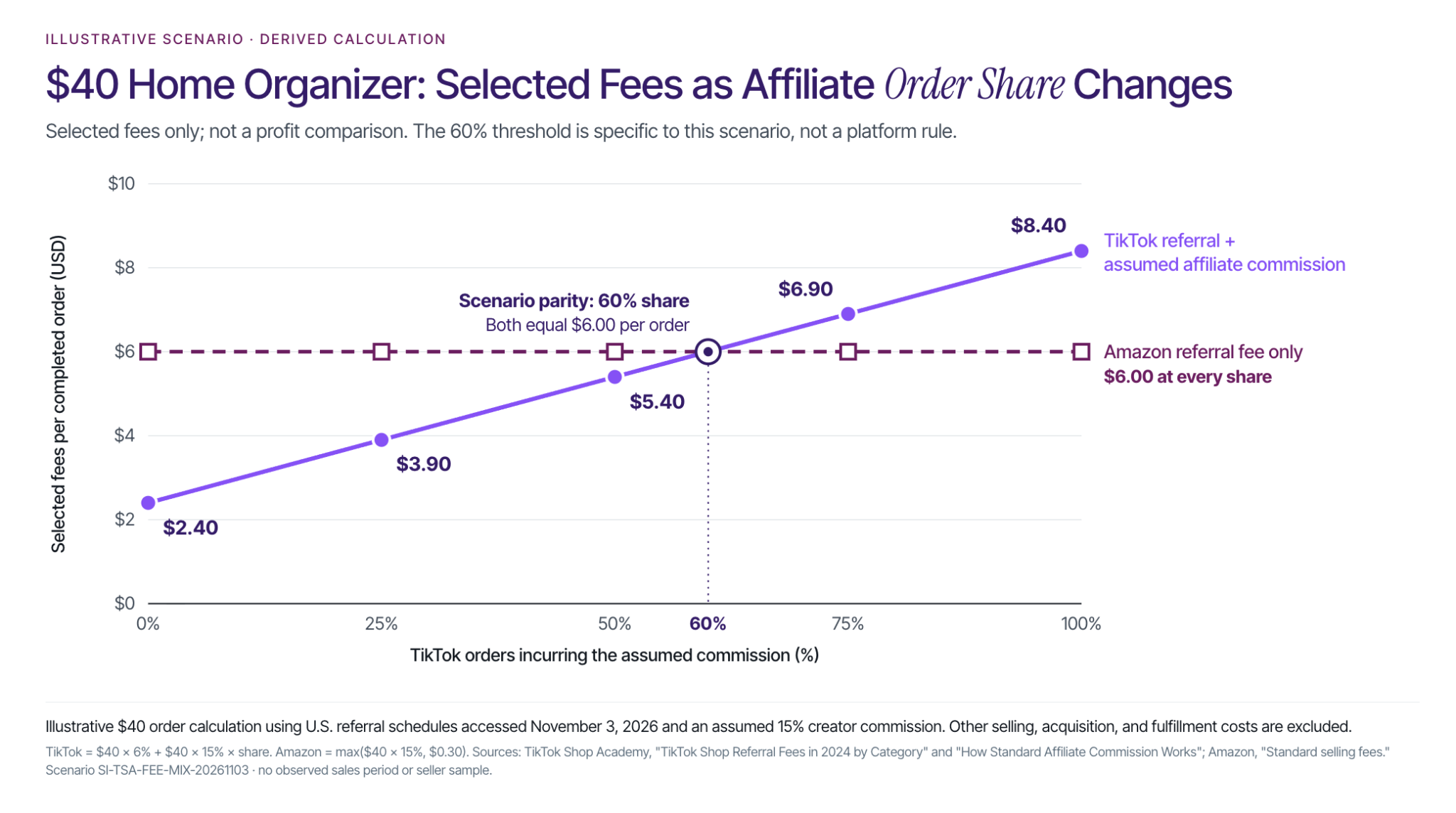
Consider an illustrative $40 home organizer classified in the categories above. Assume one item per completed order, no discounts, refunds, buyer-paid shipping, gift wrapping, or tax in the modeled fee bases, and no special incentives. Use a hypothetical 15% creator commission on the TikTok orders that incur it.
The TikTok referral fee is $2.40 on every modeled order. The assumed creator commission is another $6.00 on each commission-bearing order. Averaged across all completed TikTok orders:
- At 0% commission-bearing orders, selected fees average $2.40 per order.
- At 25%, they average $3.90 per order.
- At 50%, they average $5.40 per order.
- At 75%, they average $6.90 per order.
- At 100%, they average $8.40 per order.
Amazon's referral fee alone is $6.00 per modeled order. These selected fees reach parity when 60% of TikTok orders incur the assumed commission: 2.40+(6.00 × 60%) = $6.00.
This is a comparison of referral fees and one assumed affiliate expense. Add selling-plan charges, advertising, content, fulfillment, storage, returns, and other costs before comparing profit. Orders without affiliate commissions can still require marketing spend.
The practical lesson is to measure the share of orders that actually incur commission. Applying your headline affiliate rate to every order can overstate that expense; ignoring affiliate charges understates it.
Calculate Contribution Before Scaling
For a chosen period, start with sales revenue after seller-funded discounts and refunds. Subtract product costs, marketplace charges, fulfillment, return-related losses, creator commissions, advertising, and other variable costs, using consistent treatment on both channels.
Allocate samples and content-production costs separately across the test. Subtract fixed channel costs to evaluate the overall result, and keep company overhead visible before calling it profit. If a refund already reduced revenue, do not subtract the same refund again as an expense.
This calculation tells you how much room remains to acquire another order. A lower referral rate is useful only in the context of the rest of that order's economics.
Build a Content and Customer Acquisition Plan
Choose what you want creator activity to accomplish before choosing how to pay for it. Producing reusable content, generating social exposure, and driving commission-attributed purchases are different objectives, even when one collaboration supports several.
For TikTok Shop, plan the demonstrations you need and how you will assess them. Useful briefs might ask a creator to show installation, compare sizes, or explain the product's limitations. Avoid requiring an experience or result that the creator cannot honestly report.
For Amazon, start by addressing the questions that could prevent a purchase. Product photography, dimensions, use cases, and clear explanations can help a shopper assess the offer. If you also commission external creator content, give that activity its own budget and measurement plan.
Keep Product Seeding and Affiliate Costs Separate
Stack Influence publishes this guide and provides automated product seeding, coordinating creator purchases, social posts, verification, and campaign tracking. Its described workflow reimburses creators after verified social posts.
That campaign cost belongs in your acquisition or content budget. It is separate from the marketplace referral fee and any later affiliate commission. Stack Influence's TikTok campaign workflow distinguishes initial product-compensated collaborations from subsequently inviting selected creators into TikTok Shop's affiliate program.
Before starting, document deliverables, product costs, service fees, usage rights, and any paid-ad permissions. This lets you assess what the campaign purchased and prevents an assumed content license from becoming part of your business case.
The FTC's influencer disclosure guidance explains that free products and payments can create a relationship that must be disclosed with an endorsement. Keep social deliverables separate from Amazon customer reviews: Amazon's Community Guidelines prohibit exchanging compensation, including refunds or free products, for customer reviews.
Check Eligibility and Fulfillment Before Committing Inventory
Confirm the registration route for your business and the requirements for the actual product. Passing account verification does not establish that every planned item or fulfillment method is eligible.
TikTok's U.S. corporation and partnership registration guide asks for business, owner, representative, tax, and banking information for that route. Amazon's seller registration guide likewise covers identity and payment details and explains that an LLC is not universally required.
Once you choose TikTok Shop, Stack Influence's seller setup guide provides a walkthrough of the onboarding work. Confirm the current requirements in Seller Center as you proceed.
Amazon
With Fulfillment by Amazon, Amazon can store, pick, pack, and ship eligible products and handle customer service and returns. Estimate fulfillment, storage, and any applicable inbound, aged-inventory, or return charges for the actual product.
You can also use Fulfilled by Merchant, either across your catalog or alongside FBA. That keeps inventory and delivery work with your operation and its providers.
TikTok Shop
TikTok's customer order shipping requirements describe Seller Shipping, TikTok Shipping, and Fulfilled by TikTok. Seller Shipping may be available only to selected sellers, so check the options enabled for your account before assuming an existing warehouse arrangement will work.
For either marketplace, price the service you can actually use. Then confirm who handles tracking, cancellations, returns, damaged parcels, and inventory reconciliation. A fulfillment quote is incomplete if it leaves those responsibilities unresolved.
Budget Cash Until Payouts Reach Your Bank
A profitable order can still require cash before its proceeds are available. Your funding plan needs the dates when suppliers and fulfillment providers get paid, as well as the dates when marketplace proceeds reach your bank.
TikTok's settlement and reserve policy makes payout timing and reserve levels dependent on seller evaluations and account status. Amazon's seller payments guide also describes reserves and scheduled disbursements. Neither recorded sales nor an account balance automatically equals money available for replenishment.
An Illustrative Cash-Gap Calculation
Assume you fulfill 20 orders per day and pay $12 for replacement inventory plus $6 for fulfillment when each order occurs. That is $18 per order and $360 of cash outlay per day.
Define the funding gap as the time between paying those expenses and receiving usable proceeds. Assume steady order volume, no supplier credit, no proceeds from these orders during the gap, and sufficient proceeds arriving afterward to cover those modeled costs.
- A 5-day funding gap requires $1,800 for these expenses.
- A 10-day funding gap requires $3,600.
- A 15-day funding gap requires $5,400.
The calculation is 20 orders × $18 × gap in days. Every additional day adds $360 to this modeled cash requirement.
These are hypothetical funding gaps, not TikTok or Amazon payout schedules. The estimate excludes initial inventory, supplier lead time, advertising, marketplace fees, returns, additional reserves, and other commitments. Model partial reserves and those other cash flows separately to estimate your full funding requirement.
Use your own payment terms and observed payout timing. If your supplier requires payment weeks before inventory arrives, begin the forecast at that earlier payment date.
Run a Small Test Before Adding a Second Channel

Use a limited product test to replace assumptions with your own order data. Keep the inventory exposure and spending commitment small enough that you can investigate an unexpected result.
- Define the offer. Start with one product and record its price, discounts, shipping promise, and cost assumptions. If testing both channels, document differences that could affect the comparison.
- Set spending and operating limits. Establish a budget for content, samples, commissions, advertising, and fulfillment. Decide what contribution per order and available cash would justify additional spend.
- Separate where orders happen from what influences them. Reconcile TikTok Shop orders, Amazon orders, and marketing reports before adding revenue together.
- Review completed outcomes. Evaluate the same order cohort after enough time has passed to observe returns, fee adjustments, and payouts. Compare contribution, cash requirements, and staff time alongside sales.
For eligible brands, Amazon Attribution can measure external marketing activity that leads to shopping activity on Amazon. It is available to eligible Professional sellers enrolled in Brand Registry, among other advertiser groups.
An attributed Amazon purchase is still an Amazon order. A rise in Amazon sales during a TikTok campaign is a signal to investigate, not proof that the campaign caused every additional purchase. Keep reimbursed creator purchases identifiable so campaign participation is not mistaken for independent customer demand.
Add a second channel when the first test gives you an economic and operational reason to do so. Stack Influence's guide to coordinating TikTok Shop and Amazon can help organize the combined workflow once you have made that decision.
Choose the Channel You Can Operate Profitably
Choose TikTok Shop when you can demonstrate the product convincingly, fund creator or content activity, and fulfill the demand your test produces. Choose Amazon when you have a credible offer for identifiable shopping demand and an operating plan that leaves room for acquisition costs.
Start with one product, one clear budget, and a cash forecast. Expand when completed orders show that the channel deserves more inventory and attention.