




TikTok Shop creation is no longer a single signup task. U.S. sellers must verify the business, configure tax and fulfillment, publish compliant products, and connect a content account. Content creators follow a different path through TikTok Shop for Creator. This guide separates those workflows and shows how to prepare the catalog, creator program, and unit economics before traffic arrives.
Key Takeaways
- Sellers and creators use different TikTok Shop account paths.
- Independent Affiliate Creators generally need at least 1,000 followers, while seller-bound Official and Marketing Creator accounts have no follower minimum under current U.S. rules.
- Legal names, addresses, tax records, bank details, and uploaded documents should match before verification begins.
- Launching one operationally ready product is usually more useful than uploading an entire catalog before fulfillment and content systems are tested.
- Gross merchandise value is not enough. Sellers should track contribution margin after discounts, referral fees, commissions, product cost, fulfillment, returns, and advertising.
What Does TikTok Shop Creation Actually Include?
TikTok Shop creation includes building the commerce account, proving who owns it, setting tax and payout information, configuring fulfillment and returns, creating compliant product listings, and connecting the TikTok account that will publish shoppable content. For creators, it means gaining product-promotion access rather than opening a seller storefront.
TikTok's current U.S. shop setup guide organizes seller onboarding around business verification, warehouse setup, products, tax information, and an Official TikTok Account. Products remain unavailable for sale until required tax information is complete and listings pass review.
That distinction matters because a verified shop is only the commerce foundation. A scalable launch also needs inventory controls, content supply, creator coordination, customer service, and margin tracking. The TikTok Shop seller revenue playbook covers channel operations after setup.
The TikTok Shop Role Map
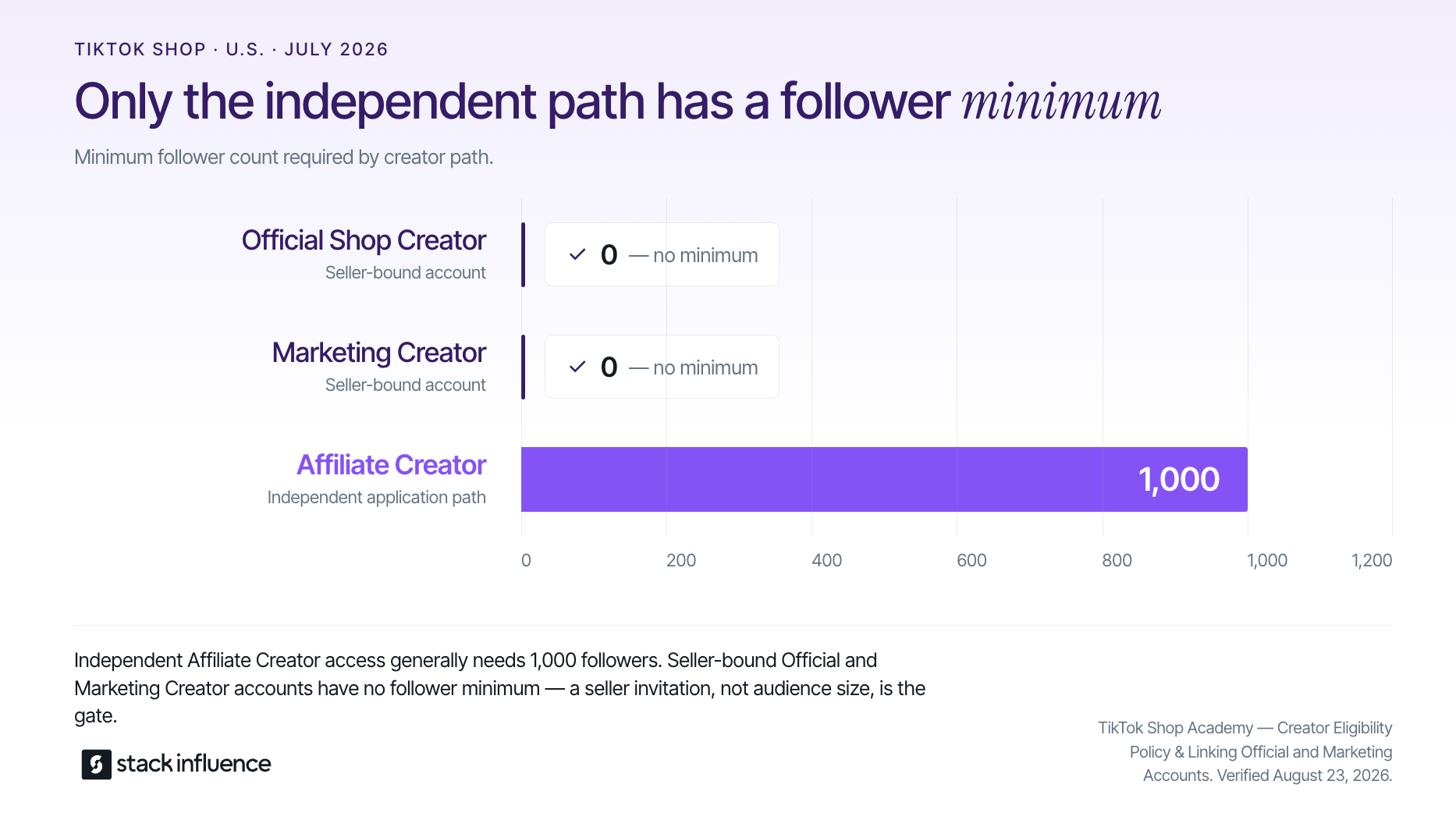
Choose the TikTok Shop role before uploading products. The correct role prevents sellers from opening unnecessary creator accounts and creators from attempting to register as merchants.
Seller Account
A Seller Account owns the shop, publishes products, receives orders, manages fulfillment and returns, and pays platform or creator-related costs. Registration may use an individual or business identity.
Official Shop Creator
An Official Shop Creator is the account formally linked to the store. It receives an automatic Showcase and can promote only that shop's products. Current U.S. rules allow one Official Account per shop with no follower minimum.
Marketing Creator
A Marketing Creator is another account linked to promote the shop. A shop can currently connect up to four Marketing Accounts, and each can add products to its Showcase. The account region must match the shop region.
Affiliate Creator
An Affiliate Creator independently applies to find and promote products from the TikTok Shop marketplace. Under the TikTok Shop Creator Eligibility Policy, U.S. Affiliate Creators must generally be at least 18, be based in the United States, maintain an account in good standing, pass applicable identity or risk checks, and have at least 1,000 followers.
Minimum follower thresholds are:
- Official Shop Creator: 0 followers
- Marketing Creator: 0 followers
- Affiliate Creator: 1,000 followers
Creators who want commissions from multiple sellers usually follow the Affiliate Creator path. Sellers can use linked staff, founder, or brand accounts without waiting for 1,000 followers. The TikTok affiliate program guide explains the independent workflow.
What Do U.S. Sellers Need Before Creating a TikTok Shop?
U.S. sellers need a qualifying legal identity or business, matching registration records, an eligible phone number and email address, tax information, a bank account, and valid pickup and return addresses. Branded or restricted products may require additional authorization, certifications, or category approval before a listing can be sold.
Prepare four evidence groups before opening Seller Center:
- Identity or entity records: Government identification for an individual seller, or business registration and representative information for a company.
- Tax and payout records: The correct taxpayer name, taxpayer identification number, completed tax forms, and a bank account whose ownership details match the seller record.
- Operational addresses: A physical pickup warehouse and return address that can support the selected shipping method.
- Product authority: Supplier invoices, brand authorization, safety documentation, or category approvals when the product or category requires them.
Branded sellers can use the USPTO trademark search to confirm public registration details, but a search result does not replace authorization or documentation TikTok requests.
TikTok's individual seller registration requirements emphasize that uploaded documents must be valid, legible, and consistent with the information entered during registration. TikTok's setup flow also requires a W-9, and the IRS Form W-9 guidance explains the taxpayer information that the form supplies to a payer.
Create one master record containing the exact legal name, address, entity type, taxpayer details, representative, bank owner, and supporting documents. Copy from that record throughout onboarding.
The Seven-Step Seller Activation Sequence

The Seven-Step Seller Activation Sequence orders setup around dependencies, reducing the risk of building listings or creator plans before the shop can receive payouts and fulfill orders.
- Choose the legal account owner. Use the individual or business that will receive revenue, file taxes, own the bank account, and hold product rights.
- Build a verification source of truth. Assemble identity, formation, tax, address, and bank records in one file. Check spelling and address details before submission.
- Register and verify in Seller Center. Use a unique phone number and email, select the correct business type, and submit complete, current documents.
- Configure tax, payouts, pickup, and returns. Complete the W-9, bind the bank account, and enter usable warehouse and return information.
- Choose the catalog system. Sellers can manage products directly in Seller Center or connect an ecommerce platform. The TikTok for Shopify setup instructions explain how Shopify merchants install the sales channel, connect the shop, and sync products. TikTok currently supports one TikTok Shop connection per Shopify store, so the catalog owner should be decided before duplicate records appear.
- Launch one hero product first. Build a complete title, description, image set, variant structure, price, inventory level, and fulfillment promise that follow the TikTok Shop Product Listing Policy. One well-controlled SKU exposes catalog, shipping, support, content, and margin problems faster than a rushed full-catalog upload.
- Link the publishing account and run an end-to-end test. Follow TikTok's Official Account linking rules, confirm the Showcase displays correctly, publish a test piece of shoppable content, and validate the order path. A shop without a linked account can still sell through the Shop Tab, but it cannot use that shop account for shoppable videos or LIVE selling.
Amazon sellers should also decide whether TikTok Shop will use separate inventory, a shared inventory system, or an eligible multichannel fulfillment arrangement. The TikTok Shop and Amazon strategy guide explains why the two marketplaces need coordinated stock and separate channel-level margin reporting.
How Do Content Creators Create TikTok Shop Access?
Content creators apply inside the TikTok app rather than opening a seller storefront. In the United States, an independent Affiliate Creator generally needs to be at least 18, have at least 1,000 followers, reside in the country, maintain an account in good standing, and complete TikTok's identity and risk-review steps.
The current application path is TikTok Studio, Monetization, TikTok Shop for Creator, then Join now. TikTok's creator application guide notes that new creators may enter a 30-day pilot with posting limits, and some features may have higher follower requirements.
After approval, complete four setup tasks:
- Choose a product category that matches the audience's established interests.
- Add only products the creator can demonstrate or compare credibly.
- Confirm commission, sample terms, deadlines, and return expectations.
- Disclose commissions, free products, discounts, and other material relationships clearly.
The FTC's disclosure guidance for social media influencers treats free or discounted products as material connections that may require disclosure. The relationship should be immediately understandable to viewers.
The UGC marketing guide for content creators helps creators separate polished brand assets from conversion-oriented demonstrations. A shoppable video should still help the viewer decide.
Build Listings and Fulfillment Before Traffic
A TikTok Shop should be operationally boring before it becomes visible. The product page, inventory, shipping promise, return path, and support process must work without manual rescue.
Before publishing launch content, confirm:
- Product titles and descriptions identify the actual item without unsupported claims.
- Images show the correct product, quantity, size, color, and included accessories.
- Variants map to real inventory rather than placeholder combinations.
- Restricted or prohibited-product policies have been checked for the current category.
- Pickup and return addresses are active, staffed, and able to process exceptions.
- Customer questions, cancellations, refunds, and damaged-order procedures have owners.
TikTok Shipping is the default shipping method for new U.S. sellers under the current TikTok Shipping setup guide. Sellers still need correct pickup and return warehouses, package data, inventory, and handling processes before sending traffic.
The overlooked risk is promotion outrunning operations. A strong creator post can expose inaccurate stock, weak packaging, slow support, or an unprofitable offer faster than a low-traffic launch would.
Turn Creator Access Into a Product-Seeding System
Creator access becomes valuable when sellers can repeatedly move from product selection to creator activation, completed content, and measurable orders. A product-seeding system creates a controlled learning loop.
TikTok's Affiliate Collaboration guide gives sellers two main routes. Open Collaboration makes selected products available to a broader creator pool, while Target Collaboration lets the seller invite specific creators and set the terms for those relationships.
Use this operating sequence:
- Set the economic ceiling. Calculate the commission and sample cost the product can support.
- Define creator relevance. Set audience, product-use, content-quality, and brand-safety criteria.
- Seed selectively. Prioritize believable product use over follower count alone.
- Brief for proof. Ask creators to demonstrate the product and answer likely objections without identical scripts.
- Track completion and reuse rights. Record samples, posts, links, commissions, disclosures, and usage terms.
- Scale what converts. Increase volume after the listing, inventory, fulfillment, and margin model survive the first wave.
The practical guide to influencer seeding explains why relevance and follow-through matter more than indiscriminate gifting. Sellers can also use a structured process to find TikTok influencers who fit the product before sending invitations.
Stack Influence supports this execution layer through gifted-first product seeding, vetted creator activation, campaign coordination, UGC generation, and completed-post accountability. The platform works with roughly 600,000 vetted creators and is designed to help ecommerce brands move from creator sourcing to completed content through one managed workflow.
For brands building a larger TikTok creator program, the TikTok marketplace solutions workflow connects product seeding with campaign execution rather than treating creator discovery as the finish line. Results still vary by product, pricing, creative quality, inventory, creator participation, and marketplace conditions.
What Does TikTok Shop Creation Cost?
TikTok Shop creation costs extend beyond account registration. Sellers should model category referral fees, discounts, affiliate commissions, samples, product cost, fulfillment, returns, advertising, and operating labor. The correct question is not whether opening the account is inexpensive, but whether each fulfilled order leaves enough contribution margin to support growth.
As of August 23, 2026, TikTok's U.S. referral fee policy lists a 6% referral fee for most categories and 5% for several categories. TikTok calculates the fee from the applicable customer payment and platform-discount basis defined in the policy, so sellers should confirm the current category rate before publishing a forecast.
Consider an illustrative $40 product launch:
- List price: $40.00
- Seller-funded discount: $4.00, assuming 10%
- Revenue after seller discount: $36.00
- TikTok referral fee: $2.16, assuming a 6% category rate applied to $36.00
- Affiliate commission: $5.40, assuming an illustrative 15% commission applied to $36.00
- Cost of goods: $10.00, illustrative assumption
- Fulfillment: $5.00, illustrative assumption
- Contribution before advertising, returns, overhead, and taxes: $13.44, or 33.6% of the $40 list price
TikTok's settlement report guide describes affiliate commission as the commission rate multiplied by the product price excluding tax and seller discounts. The 15% rate, $10 cost of goods, and $5 fulfillment cost above are assumptions, not platform benchmarks or Stack Influence performance data.
A commission can look affordable while discounts, fulfillment, and returns consume the remaining margin.
Measure the First 30 Days With the Activation-to-Margin Stack
The Activation-to-Margin Stack separates leading indicators from business outcomes. It prevents sellers from mistaking account approval, creator views, or gross sales for a healthy TikTok Shop.
Track five layers:
- Setup integrity: Verification status, listing approvals, linked-account status, payout readiness, and policy warnings.
- Operational health: In-stock rate, cancellation rate, handling time, delivery performance, return rate, refund reasons, and support response time.
- Content supply: Active creators, samples delivered, posts completed, shoppable videos published, LIVE sessions, and usable UGC assets.
- Commerce performance: Product-page visits, add-to-cart activity, orders, conversion rate, average order value, and gross merchandise value.
- Unit economics: Net revenue, referral fees, affiliate commissions, discounts, product cost, fulfillment, returns, advertising, and contribution margin.
TikTok's Affiliate analytics guide lets sellers review creator and product performance across selectable periods, including data extending up to six months. Use consistent comparison windows and annotate stockouts, price changes, promotions, and major creator activations so the numbers retain context.
Read the measurement chain from left to right. Content can create traffic, traffic can create orders, and orders can create contribution, but each step has separate failure conditions. Because viewers may buy later through another channel, interpret platform reporting alongside inventory, web analytics, marketplace sales, and creator-level evidence rather than as complete proof of causation.
The broader influencer marketing strategy guide explains how campaign goals, creator selection, content rights, and attribution should connect before spend scales.
Account Approval Is Not Market Validation
Approval proves that TikTok accepted the account and listing information. It does not prove that the product, offer, creative, or margin model will work. Sellers should treat the first 30 days as a controlled validation period rather than a victory lap.
The most expensive setup mistakes are usually operational:
- Registering under an entity that does not match the bank or tax record
- Linking the wrong account type, region, or shop identity
- Uploading a large catalog before one product survives the complete order cycle
- Recruiting creators before commission, samples, and inventory have economic limits
- Measuring gross merchandise value while ignoring discounts, fees, returns, and fulfillment
- Scaling a viral post before customer support and replenishment can absorb the demand
The Seven-Step Seller Activation Sequence solves these problems by delaying traffic until verification, catalog ownership, fulfillment, content access, and unit economics are connected. Creation is complete only when commerce can process the attention content generates.
Build the Shop Around the Operating Model
Successful TikTok Shop creation starts with the right role, consistent verification records, one controlled product, reliable fulfillment, and a creator plan grounded in margin. Sellers should validate the complete order and content loop before expanding the catalog. Creators should choose products they can explain credibly and disclose material relationships clearly.
The next practical step is to map one launch product from verification through listing, fulfillment, creator activation, measurement, and contribution margin. Ecommerce teams that want creator sourcing, product seeding, coordination, and completed content managed together can evaluate a structured micro-influencer workflow around that launch.