




Sending a product to a creator looks simple. The difficult part is deciding whether the package is a genuine gift, a product-for-content exchange, or the first step toward a longer creator partnership.
For ecommerce brands, the question “what is influencer seeding?” is really about turning inventory into product experience, authentic content, and useful market feedback without confusing hope with a guaranteed deliverable. For content creators, it is about understanding what the brand expects, what rights are being requested, and whether the product genuinely fits the audience.
This guide explains the models, workflow, compliance rules, measurement stack, and practical decisions both sides should make before a product ships.
Key Takeaways
- Influencer seeding places products with selected creators to test fit, generate awareness, and develop future partnerships.
- Traditional seeding has no guaranteed post; product-for-content programs add defined deliverables and completion requirements.
- Creator-product fit, clear terms, frictionless fulfillment, disclosure, and content rights matter more than a large mailing list.
- Brands should measure delivery, content, audience response, commerce, and relationship value as separate evidence layers.
- Creators should confirm compensation, deadlines, usage rights, disclosure expectations, and freedom to express an honest opinion.
What Is Influencer Seeding?
Influencer seeding is a marketing practice in which a brand places free or reimbursed products with selected creators so they can experience the product and potentially share it with their audiences. Traditional seeding carries no posting obligation; structured product-for-content programs add agreed deliverables, deadlines, and completion tracking.
The word “seeding” reflects the strategy’s purpose. A brand places products within relevant communities, then observes which creators use them naturally, make credible content, attract meaningful audience response, or show potential for a deeper partnership.
For ecommerce sellers, influencer seeding for ecommerce can support launches, UGC, external traffic, creator discovery, and affiliate recruitment. For content creators, it can provide product experience, portfolio material, and a path toward paid work.
How Is Influencer Seeding Different From Gifting and Sponsorships?
Influencer gifting is the broad act of giving a creator a product, while influencer seeding is the planned use of gifting to test fit, generate awareness, or build a creator pipeline. A sponsorship is different because compensation is tied to defined deliverables. Industry usage overlaps, so the agreement matters more than the label.
A gift may carry no expectation. A seeding campaign is more intentional, with a target creator profile, product selection, timing, follow-up, and measurement. A sponsorship or structured product-for-content activation states what the creator must produce and receive.
The decisive question is: “What has each side actually agreed to do?”
The Commitment Ladder Clarifies What Each Side Owes
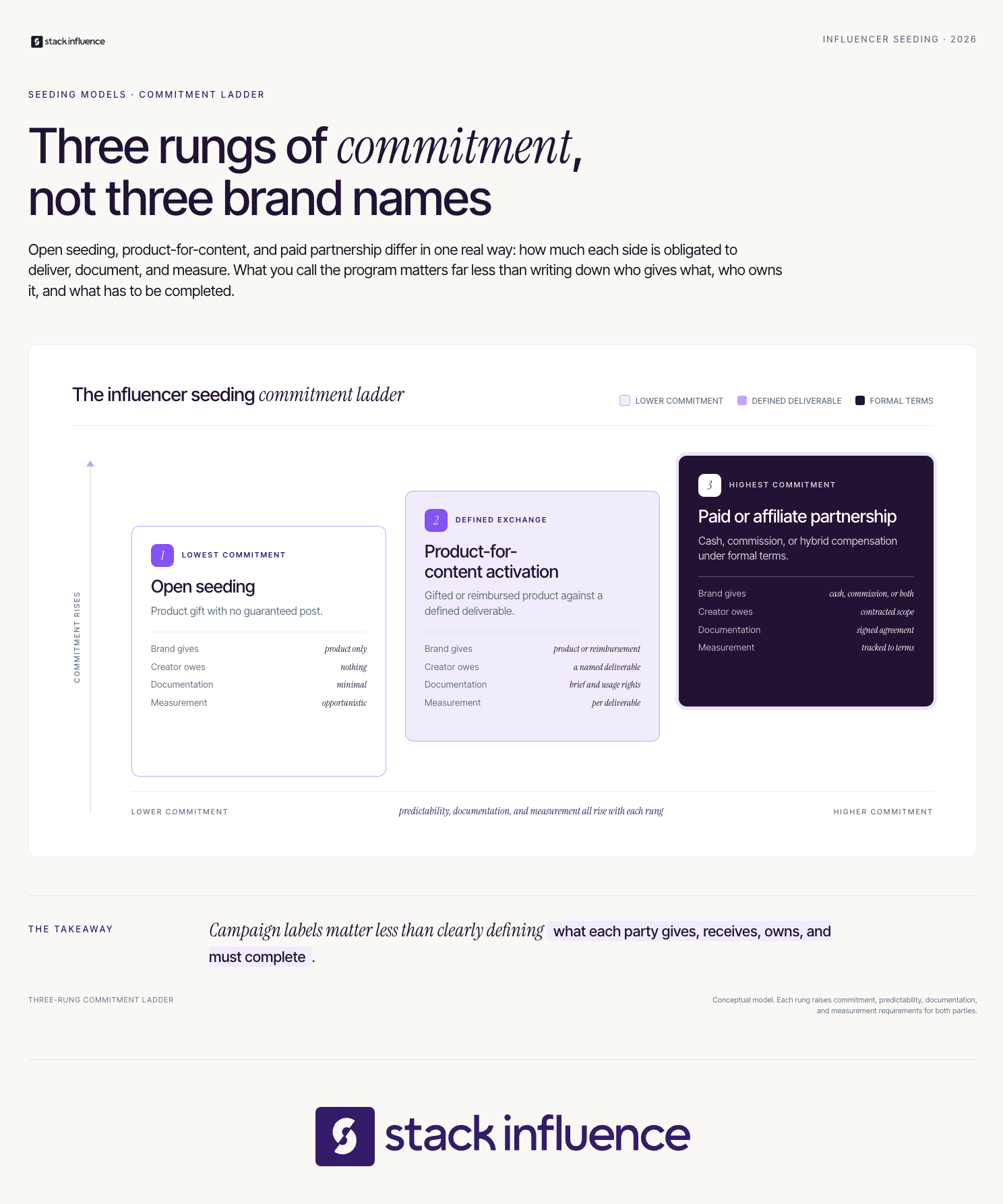
Influencer seeding becomes easier to manage when brands and creators identify the commitment level before discussing content. The Commitment Ladder separates three arrangements that are often blended together.
- Open seeding: The brand sends a product with no posting requirement. The creator may post, provide private feedback, or do nothing. The brand accepts that the product cost may produce no public content.
- Product-for-content activation: The creator receives a gifted or reimbursed product in exchange for a defined post, video, photo set, or other deliverable. The agreement should cover timing, platform, revisions, disclosure, and usage rights.
- Paid or affiliate partnership: The creator receives cash, commission, or a hybrid package in addition to product. The relationship normally includes formal deliverables, tracking links or codes, content rights, and performance expectations.
This ladder protects both sides. Brands can choose the predictability they need, while creators can judge whether compensation matches the work and rights requested. Running an influencer seeding campaign should begin with this exchange, not a shipping list.
Why Do Ecommerce Brands and Creators Use Influencer Seeding?
Ecommerce brands use influencer seeding to let relevant creators experience a product, generate authentic discussion, produce UGC, and identify promising partners before making larger commitments. Creators use seeding to discover products, demonstrate content skills, serve their audiences, and build relationships that may develop into affiliate, ambassador, UGC, or paid brand deals.
The quality of the match matters more than simply maximizing reach. A 2021 Journal of Business Research study on influencer, product, and consumer congruence, involving 372 followers, found that stronger congruence supported more favorable product attitudes and higher purchase and recommendation intentions.
Brands commonly use seeding for:
- Product discovery: Introduce products to niche audiences through relevant creators.
- UGC development: Generate demonstrations, routines, unboxings, tutorials, and testimonials.
- Creator qualification: Learn who communicates well, follows instructions, and earns relevant response.
- Partnership development: Move strong participants into affiliate, ambassador, UGC, or paid campaigns.
Creators can gain brand access, portfolio examples, audience-relevant content, and evidence that may support repeat campaigns, licensing, affiliate income, or sponsorships.
The tradeoff is predictability. Open seeding cannot guarantee content. Structured product-for-content campaigns improve accountability but must be treated as real commercial exchanges.
The Seed-to-Scale Loop: A Five-Step Framework
The Seed-to-Scale Loop turns packages into a repeatable learning system. Its five stages are Select, Evaluate, Establish, Deliver, and Diagnose.
1. Select an Outcome and a Seedable Product
Choose one primary campaign outcome before choosing creators. Awareness, content production, product feedback, affiliate recruitment, external traffic, and attributed sales require different briefs and measurement.
The product should be easy to demonstrate, sufficiently stocked, safe for the intended audience, and valuable enough to justify a creator’s time. Include unit cost, fulfillment, shipping, replacements, reimbursements, and inventory opportunity cost in the budget.
“Get buzz” is difficult to evaluate. “Identify creators who can produce credible demonstrations for this category” creates a usable decision.
2. Evaluate Creator-Product Fit
Creator selection should begin with relevance, not follower count. Review recent topics, visual style, audience conversations, posting consistency, prior brand work, and the ability to show the product credibly.
Nano influencers and micro influencers let brands test multiple niche communities without depending on one large account. A focused process for finding micro influencers can score five dimensions:
- Topic and product-category relevance
- Audience location and likely customer fit
- Content quality and format capability
- Genuine engagement in comments
- Brand safety and history of disclosure
Creator fit works in both directions. Creators should examine the product, brand values, claims, deliverable, and audience relevance before accepting.
3. Establish the Exchange, Disclosure, and Rights
Write down whether the product is an unconditional gift or compensation for a required deliverable. For structured campaigns, specify the platform, format, deadline, talking points, prohibited claims, revision process, reimbursement method, exclusivity, and what counts as completion.
Free product can create a material connection. The FTC’s Endorsement Guides Q&A says brands that send free products should tell creators how to disclose the gift clearly and should monitor resulting tagged posts.
Platform tools add another compliance layer. Meta’s branded content guidance says branded content should use the paid partnership label. TikTok’s commercial content disclosure setting is required when a post promotes a brand, product, or service, and YouTube’s paid promotion disclosure controls require creators to identify videos containing paid product placements, sponsorships, endorsements, or other commercial relationships. Legal obligations can vary by jurisdiction, so platform labels should supplement, not replace, clear disclosure.
Content rights need the same precision. The U.S. Copyright Office explains that the creator of original expression is generally the author and copyright owner unless ownership changes through a written agreement or a valid work-made-for-hire arrangement. A product gift does not automatically grant a brand perpetual ad, website, email, or marketplace rights. Brands should define UGC licensing rights before reuse begins.
4. Deliver a Friction-Free Product Experience
Fulfillment is part of campaign strategy. Confirm the creator’s address, preferred variant, size, shade, or flavor; send tracking; explain what is inside; and provide a real contact for delivery problems.
A useful brief reduces uncertainty without scripting a false opinion. Include intended use, verified claims, filming suggestions, disclosure language, brand handles, deadlines, and support. A thoughtful influencer seeding kit can make the product easier to demonstrate.
The follow-up must match the agreement. For open seeding, thank the creator and invite honest feedback without implying that a post is owed. For a structured activation, remind the creator of the documented deadline and resolve product or fulfillment problems before evaluating completion.
5. Diagnose Results and Deepen the Best Relationships
Record outreach, acceptance, delivery, product experience, completion, content quality, audience response, traffic, sales, and follow-up. Excellent content can remain valuable UGC even when immediate sales are limited.
Place creators into clear next steps:
- Seed another product
- Invite them into an affiliate or ambassador program
- Offer a paid post or UGC project
- License strong assets for approved channels
- Pause the relationship and record why
Each cohort should improve creator criteria, the brief, product choice, fulfillment, and measurement for the next cohort.
What Do Brands Commonly Get Wrong About Influencer Seeding?
Brands most often fail at influencer seeding by sending products before defining the exchange, creator fit, rights, and measurement plan. The resulting problem looks like creator underperformance, but it is usually an expectation and operations failure. Better outcomes begin with fewer assumptions, clearer terms, and a campaign design that matches the desired level of predictability.
Common mistakes include:
- Treating a gift as a silent contract: A brand cannot reasonably guarantee content from a no-obligation package. Require a deliverable only through a clear product-for-content or paid agreement.
- Selecting by follower count alone: A broad audience cannot compensate for weak product relevance, low content quality, or an audience that rarely buys the category.
- Shipping before confirming interest: Unsolicited packages create waste, privacy concerns, and poor creator experiences. Confirm participation and the correct product variant first.
- Assuming the post transfers ownership: Publishing content does not automatically give the brand unlimited reuse rights.
- Over-scripting the creator: A rigid script can weaken credibility and may pressure a creator to make claims they cannot honestly support.
- Calling every metric ROI: Impressions, posts, clicks, sales, usable assets, and long-term creator value answer different questions.
- Ignoring inventory economics: Product cost, shipping, reimbursement, returns, and staff time belong in the campaign cost, even when no cash sponsorship fee is paid.
The corrective insight is simple: influencer seeding is partly a creator strategy, but it is equally an inventory, rights, fulfillment, and evidence system.
How Should Content Creators Evaluate Seeding Offers?
Content creators should evaluate a seeding offer as a business agreement, even when the only compensation is product. Before accepting, confirm whether posting is optional or required, what the product is worth to the creator, what content is expected, when it is due, how the brand may reuse it, and whether the creator can remain honest.
A creator checklist should cover:
- Audience fit: Would the product genuinely interest or help the audience?
- Exact exchange: Is this an unconditional gift, product-for-content deal, affiliate offer, or paid campaign?
- Workload: How many assets, platforms, revisions, raw files, and posting days are required?
- Compensation: Does the product, reimbursement, commission, or fee fairly reflect the work and requested rights?
- Usage rights: Can the brand repost organically, edit the asset, run it in ads, use it on product pages, or keep it indefinitely?
- Exclusivity: Does accepting prevent work with similar brands, and for how long?
- Honesty: Can the creator decline to post or state a genuine opinion if the product does not work as expected?
- Disclosure: What clear wording and platform label are required?
The FTC’s Disclosures 101 guidance says free or discounted products are material connections and that disclosures should be hard to miss, placed with the endorsement, and expressed in clear language. Creators remain responsible for their own disclosures, even when a brand provides instructions.
Creators should save the agreement, final brief, rights terms, approvals, and proof of delivery. Clear records protect the relationship and simplify repeat partnerships.
How Do You Measure Influencer Seeding?

Influencer seeding should be measured as a sequence of evidence, not with one headline KPI. Brands need to separate operational delivery, content output, audience response, commerce, and relationship value. Leading indicators show whether the campaign is functioning; outcome metrics show whether it created business value; attribution determines how confidently the two can be connected.
The Seeding Evidence Stack contains five layers:
- Delivery metrics: Invitations, acceptance rate, products shipped, delivery rate, product issues, and completed activations.
- Content metrics: Posts created, on-time completion, format mix, content quality, approval rate, usable UGC, and rights-cleared assets.
- Audience metrics: Reach, views, watch time, saves, shares, relevant comments, profile visits, and sentiment.
- Commerce metrics: Link clicks, code use, add-to-carts, attributed orders, units, revenue, contribution margin, and marketplace movement.
- Relationship metrics: Repeat creator rate, affiliate activation, ambassador progression, content reuse, and performance across later campaigns.
A brand’s influencer marketing tracking should be configured before outreach. For a DTC site, Google Analytics URL builder guidance explains how UTM parameters identify campaign traffic by source, medium, campaign, and creative. Creator-specific codes can add another signal, especially when links are not clickable.
Shopify brands can combine UTMs, codes, checkout data, and affiliate reporting. The Shopify influencer marketing playbook provides the ecommerce workflow, while Shopify Collabs documentation confirms that merchants can send gifts or discount codes, track affiliate sales, recruit creators, and manage payments.
Amazon sellers need marketplace-specific tracking. The Stack Influence Amazon Attribution guide explains the setup context, while Amazon’s official Amazon Attribution guide states that attribution tags measure non-Amazon traffic using a 14-day, last-touch model. Eligible U.S. seller brand owners can also enroll in the Brand Referral Bonus, which Amazon describes as averaging 10% of qualifying product sales driven and measured through non-Amazon marketing.
No attribution method captures everything. Followers may view a post, search the brand later, buy on another device, purchase from a retailer, or convert outside the tracked window. Report directly attributed results separately from directional evidence such as branded search, product-page traffic, conversion-rate movement, marketplace rank, and content reuse.
A practical review cadence is to inspect fulfillment and completion weekly, evaluate commerce within the relevant attribution window, and compare longer pre-campaign and post-campaign trends without claiming that correlation proves causation.
Managing Product Seeding at Scale Without Losing Accountability
Scaling requires a workflow that connects creator selection, product movement, communication, content collection, rights, and completion status. Spreadsheets can support a small pilot, but manual follow-up becomes fragile when a brand activates many micro influencers across products or marketplaces.
Stack Influence is a micro-influencer marketing platform built around gifted-first product seeding, creator coordination, UGC generation, and completed-post accountability. The platform works with roughly 600,000 vetted creators, and its completions-only model ties brand platform spend to completed creator posts rather than uncompleted activations.
That model is a structured product-for-content workflow, not no-obligation PR gifting. Brands define campaign requirements, creators opt into participation, and the automated product seeding workflow supports activation through completion. This is especially practical for ecommerce teams that want authentic creator content without manually coordinating every participant.
A verified Stack Influence case study provides one measured example. During a three-month new-product campaign for Targus, the campaign included 120 creator promotions. Average monthly unit sales increased from 56 to 221 during the measured period, while Amazon Best Seller Rank moved from #151,547 to #47,811. The case study does not isolate seeding as the sole cause, and results vary by product, category, pricing, marketplace conditions, creative quality, creator participation, and execution.
The operational lesson is more important than any single result: scale becomes useful only when the brand can distinguish product sent, content completed, assets cleared for use, traffic measured, and creators worth activating again.
Influencer Seeding Works Best as a Learning System
The practical answer to what is influencer seeding is not simply “sending free products.” Influencer seeding is a controlled way to place products with relevant creators, learn who fits, produce credible content, and decide which relationships deserve more investment.
Brands should choose the commitment level first, document disclosure and usage rights, make fulfillment easy, and measure the campaign from delivery through commerce. Creators should accept offers that match their audiences, make the exchange explicit, and protect the right to communicate honestly.
For ecommerce teams ready to act, the next step is to map one product, one creator profile, one content goal, and one attribution method before the first package ships. A managed product-seeding workflow can then turn that pilot into repeatable creator activation and a growing library of useful UGC.