




A product costs $12 from a supplier and sells for $32 on Amazon. That looks like a strong opportunity, until fulfillment, selling fees, returns, and a lower selling price consume the difference.
Amazon reselling starts with finding products, but the buying decision needs more than a price comparison. For ecommerce sellers, the practical questions are whether the inventory is eligible, whether the numbers survive competition, and how much stock your own offer can realistically sell.
This guide focuses on the U.S. Amazon marketplace, with a worked margin calculation, current sourcing and labeling requirements, and a method for limiting each purchase.
Key Takeaways
- Check your account’s approval requirements and supplier documentation before committing to inventory.
- Calculate contribution after variable costs at a lower selling price, not just today’s advertised price.
- Limit orders using your expected sales, available cash, and maximum exposure to one product.
- Treat creator marketing as a separate investment that needs eligible products, measurable sales, and enough margin to support it.
What Is Amazon Reselling?
Amazon reselling means sourcing existing products and offering them for sale through an Amazon selling account. Rather than manufacturing a new product, a reseller typically purchases inventory from another business and earns the difference between sales revenue and the costs of acquiring and selling it.
Amazon’s guide to reselling describes a process of sourcing products, listing offers, fulfilling orders, and managing the business. Where an exact product already exists in the catalog, sellers can generally match an offer to that product page, subject to applicable approvals.
The product identifier, or ASIN, stands for Amazon Standard Identification Number. A product page describes the item; your offer adds seller-specific details such as price, condition, availability, and delivery.
That distinction should shape your buying decisions. Demand for a product is not a commitment to purchase from your business, and buying inventory does not mean you own the brand or its product page.
Will a Resale Purchase Survive a Lower Price?
A resale purchase can remain profitable after a price reduction only if the remaining revenue still covers its costs. Start with unit contribution, then account separately for fixed overhead and taxes before calling the result net profit.
Unit contribution equals selling price minus acquisition cost, referral fees, fulfillment, preparation and inbound costs, expected storage and return losses, and any other variable selling expenses.
Work Through One Unit Before Buying a Case
Consider an illustrative Home and Kitchen product. Amazon’s U.S. selling-fee schedule lists a 15% referral fee for that category, subject to its minimum fee; other categories can have different rates and thresholds.
For this example, assume a $12 acquisition cost, $1.50 for preparation and inbound costs including any allocated placement expense, $5 for fulfillment, and $1.50 for expected storage and return losses. Those non-referral costs total $20 per unit.
The $5 fulfillment figure and both $1.50 allowances are assumptions, not Amazon fee quotes or observed averages. Assume the Professional plan and no advertising, separately charged shipping, gift wrapping, discounts, or referral-bonus credits. The monthly plan charge, owner labor, overhead, and income tax are excluded.
With those assumptions, contribution equals selling price multiplied by 85%, minus $20:
- At $32: Contribution is $7.20 per unit.
- At $29: Contribution is $4.65 per unit.
- At $26: Contribution is $2.10 per unit.
- At $23: Contribution is negative $0.45 per unit.
The break-even price is approximately $23.53. To retain at least $3 in contribution, the selling price needs to be approximately $27.06 or higher under the same assumptions.
This is the practical difference between a markup and a buying decision. The gap between $12 and $32 looks generous, but it does not establish how far you can reduce the price safely.
Convert the Calculation Into a Buying Limit
Calculate a maximum acquisition cost as well as a minimum selling price. At a conservative $26 selling price, the same $8 in non-acquisition costs and a $3 contribution target leave a maximum purchase price of $11.10: $26 × 85% − $8 − $3.
A supplier asking $12 has not necessarily offered a bad product. The offer simply misses this particular purchasing threshold.
Use the Amazon selling-cost breakdown as a checklist for expenses, then replace every illustrative allowance with current product-specific estimates. Repeat the calculation whenever size, weight, sourcing costs, or fulfillment arrangements change.
Choose a Sourcing Route You Can Document
Choose suppliers based on authenticity, usable documentation, replenishment terms, and economics together. A low purchase price cannot compensate for an inventory source you cannot substantiate.
Wholesale From Manufacturers or Distributors
Wholesale can support repeat purchasing when the supplier has reliable stock and terms that permit your intended sales channel. Before accepting a minimum order, establish who supplies the goods, what documentation will accompany them, and whether the brand or Amazon requires authorization for your proposed activity.
Ask about lead times, damaged goods, shortages, and returns before paying. Those terms belong in the buying calculation because an attractive unit price can require an uncomfortable amount of inventory or leave little recourse for problems.
Retail and Online Arbitrage
Retail arbitrage involves buying products from retail stores for resale; online arbitrage uses online retailers as the purchasing channel. Amazon’s reselling guidance on retail arbitrage allows for this model within its requirements and notes that additional documentation may be needed.
Do not assume a checkout receipt will satisfy a particular approval request. Check what your account is being asked to provide before purchasing, and retain the original records rather than treating documentation as something to reconstruct later.
Used Products With Verifiable Condition
Used inventory requires a separate condition assessment, not merely a lower price. Amazon’s condition guidelines distinguish condition grades and include category-specific requirements, including separate guidance for books.
Inspect each unit rather than assigning one grade to an entire batch. An item that looks unused is not automatically eligible to be listed as New, and a familiar brand name does not establish authenticity or completeness.
Check Permissions and Product Identity Before Payment
Check the exact product through your own selling account before placing an order. Under Amazon’s branded-product listing process, sellers search through Catalog, select Add Products, choose the condition, and follow an Apply to sell prompt when approval is required.
For brand approval, Amazon says the application can require a manufacturer or distributor invoice, or a brand authorization letter. Follow the actual request for your account rather than relying on a universal invoice-age, quantity, or documentation rule from a third-party checklist.
Keep the supplier’s identity, transaction records, product identifiers, and quantities together. A document should describe the inventory you actually purchased, not simply establish that you have bought something from the supplier before.
Next, match the physical item to the intended ASIN: brand, model, size, color, pack count, edition, and included accessories. A two-pack is not interchangeable with a single unit, even when the product photographs look similar.
Use the product-listing accuracy checks to review how the item is represented, but distinguish checking a shared page from having permission to create or change one. Amazon’s approval to match an offer does not automatically confer brand-owner privileges.
Safety checks also belong before purchase. The U.S. Consumer Product Safety Commission’s reseller guidance advises inspecting inventory for safety and compliance and checking recalled products before taking them into inventory or selling them.
Set Up Fulfillment and Apply the Current Barcode Rules
Prepare the selling account and fulfillment process before committing to a large shipment. Amazon’s seller registration guide explains the business, identity, banking, and verification information involved in setting up an account.
The current selling-plan comparison lists the Individual plan at $0.99 per item sold and the Professional plan at $39.99 per month, with additional selling fees under both. Choose based on required features and expected activity, not the subscription fee alone.
Compare FBA With Your Own Fulfillment Costs
With Fulfillment by Amazon, Amazon handles storage, picking, packing, shipping, customer service, and returns for enrolled inventory. Fulfilled by Merchant means you retain responsibility for fulfillment, either directly or through a service provider.
Use the Revenue Calculator on Amazon’s pricing page to compare the same product under both arrangements. Include storage, packaging, shipping, preparation, and the work involved in handling returns rather than comparing an FBA estimate with postage alone.
FBA is a fulfillment service, not product approval or a sales guarantee. You still need an eligible, accurately described product and economics that work after its actual fees.
Check the March 31, 2026 Barcode Requirements
Amazon’s announcement ending commingling introduced new requirements for inventory shipped on or after March 31, 2026. Resellers without the Brand Representative selling role in Amazon Brand Registry must use Amazon barcode stickers even when products already carry manufacturer barcodes.
Qualifying brand owners with that role can use manufacturer barcodes for eligible products. Products without a manufacturer barcode require Amazon barcode stickers under the announcement.
Do not equate a supplier’s authorization letter with the specific Brand Registry role. Confirm the barcode requirements for the inventory before arranging preparation and shipment.
Size Orders With the Three-Ceiling Buying Rule
Limit each order to the smallest of three quantities: what your offer can reasonably sell, what your available cash can fund, and how much capital you are willing to expose to one product. This proposed buying rule turns a promising product into a bounded inventory decision.
Eligibility, authenticity, and acceptable unit economics come first. A product that fails those checks should not become eligible merely because you can afford it.
Ceiling One: Your Expected Demand
Estimate your own sales during the coverage period, then subtract sellable inventory and confirmed inbound stock. Use a period that reflects the supplier’s replenishment lead time and your planned reorder cycle.
Amazon’s Featured Offer guidance now describes an Offer Display containing one or more Featured Offers. Price, delivery, customer experience, and stock availability matter; total product-page demand should not be treated as your forecast.
Start with your actual sales where available. Do not divide estimated ASIN sales equally by the number of sellers or assume a Featured Offer visibility percentage is identical to an order-share percentage.
Ceiling Two: Available Purchasing Cash
Divide cash available for this purchase by its landed unit cost, rounding down to whole units. First reserve money for expected charges, returns, operating expenses, and existing commitments.
Define landed cost consistently. Include acquisition and the upfront costs required to make the unit ready for sale, while separately reserving cash for later expenses.
Ceiling Three: Product-Level Exposure
Set a maximum amount of inventory capital you are prepared to have tied up in this product. Subtract existing exposure, then divide the remainder by the same landed unit cost.
The smallest ceiling controls the order. Round down further for case-pack requirements; when a supplier’s minimum exceeds your limit, negotiate the order rather than quietly removing the limit.
Illustrative Scenario: A Busy ASIN, a Smaller Order
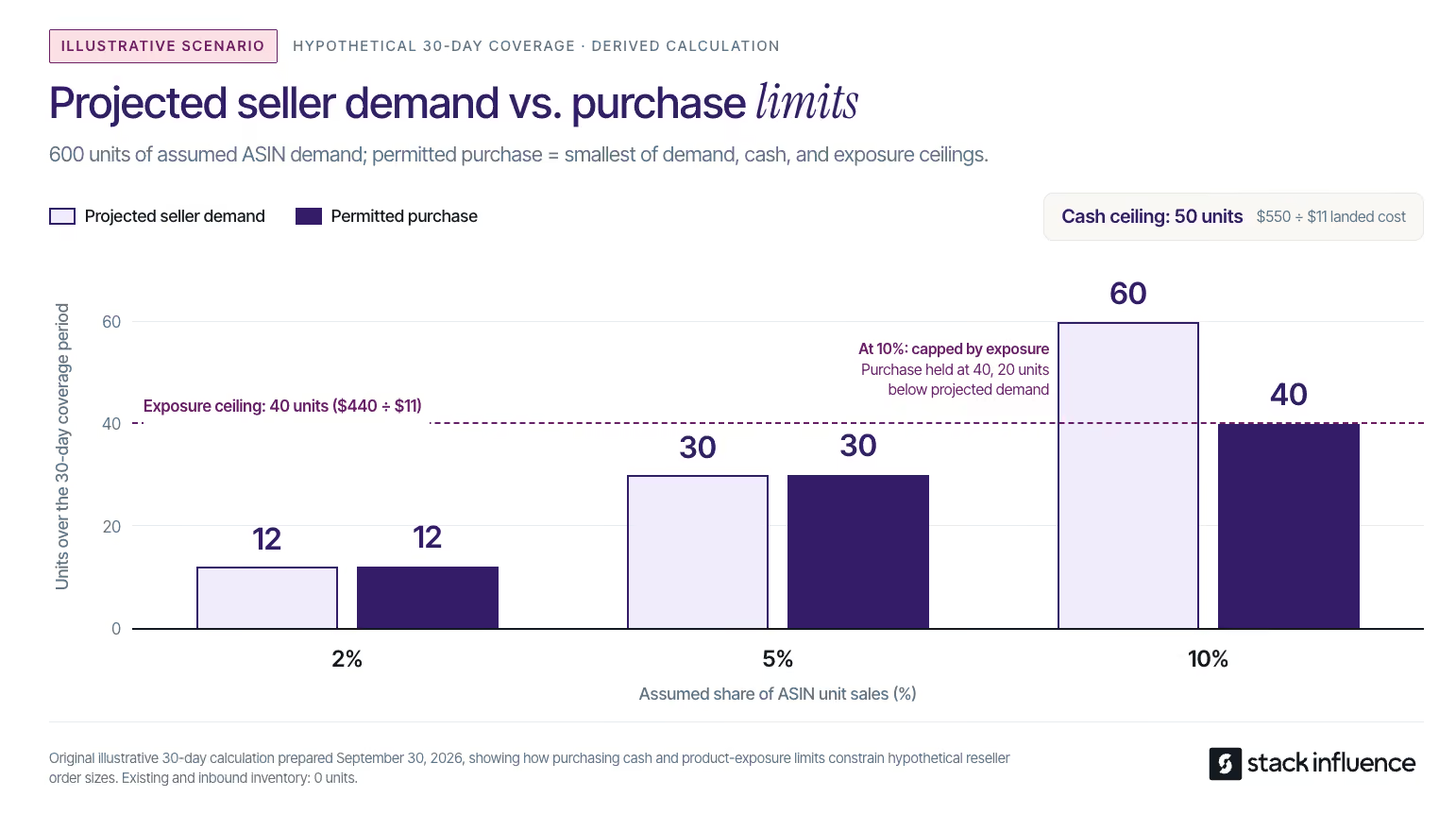
For a separate example, assume a product sells 600 units across all sellers in 30 days. Your hypothetical sales shares of 2%, 5%, and 10% would represent 12, 30, and 60 units respectively.
Assume a 30-day coverage period, no existing or inbound inventory, and an $11 landed unit cost. A $550 purchasing budget after reserves creates a 50-unit cash ceiling, while a $440 product-exposure limit creates a 40-unit exposure ceiling.
The permitted purchases are therefore 12 units at the 2% share assumption, 30 units at 5%, and 40 units at 10%. The last scenario is capped below its 60-unit demand estimate because the exposure limit is tighter.
These are illustrative assumptions, not observed Amazon sales or recommended market-share benchmarks. Without your own demand evidence, use a smaller test and replace the assumptions with actual order data before expanding.
Measure Your Offer, Not Just the Product Page
Measure the first purchase as an inventory batch, not simply as part of a growing revenue total. Record when cash leaves, when units become available, what sells, and what remains unsold.
Review availability, competitive delivered price, and delivery performance weekly as early indicators. Track your own units sold after returns, realized contribution, inventory capital still tied up, and cash received as outcome measures.
Reconcile the batch after 30, 60, and 90 days as a suggested operating cadence, extending the review where returns or inventory remain unresolved. Replace estimated return and storage allowances with actual costs as information matures; do not deduct both the full allowance and the same realized cost.
Reorder when the evidence supports another purchase under the Three-Ceiling Buying Rule. Revenue growth alone does not show that the inventory is producing acceptable returns on the cash and work it requires.
When Does Creator Marketing Make Sense for a Reseller?
Creator marketing becomes worth testing when the reseller has reliable supply, appropriate brand and content permissions, and enough contribution to fund customer acquisition. It should not be used to rescue a purchase that only works at an unrealistic selling price.
A further complication follows from Amazon’s shared product pages: generating interest in an ASIN does not guarantee that every resulting order goes to your offer. Account for that possibility when deciding how much to spend on external traffic.
For brand-supported campaigns, Stack Influence’s automated product-seeding workflow coordinates gifted-first creator participation and content completion. The operational output is completed creator content; evaluate sales outcomes separately rather than treating posts as proof of profitable demand.
Confirm Measurement Eligibility Before Funding Traffic
According to Amazon Attribution’s eligibility documentation, eligible users include Professional sellers enrolled in Amazon Brand Registry. An ordinary resale account should not assume it has access merely because it sells on Amazon.
The Amazon Brand Referral Bonus also has enrollment requirements and provides credits against future referral fees on qualifying sales. Do not build an assumed bonus into every resale unit’s margin; use the bonus rates and credit-reconciliation guide to separate potential credits from applied credits.
Measure tagged purchases alongside your own orders, campaign costs, and inventory movement. Separate any reimbursed creator transactions from non-incentivized customer demand, and avoid treating a sales increase during a campaign as proof that the campaign caused it.
For DTC brands combining resale with an owned storefront, Shopify influencer marketing involves a different checkout and measurement environment. Keep the channels’ economics separate, and confirm content usage rights before reusing creator assets.
The FTC’s influencer disclosure guidance explains that free products and other material connections can require clear disclosure. Product gifting does not remove that responsibility.
Make the Next Purchase Easier to Defend
Amazon reselling works as a repeatable business only when sourcing, eligibility, unit economics, and inventory decisions hold together. A discounted product is a lead to investigate, not a completed business case.
Before the next purchase, document the supplier, verify the exact offer, calculate the lowest acceptable selling price, and set a maximum order quantity. Use the first batch to test those assumptions, then expand only when actual sales and costs support the decision.
Build that buying record for one product before increasing your inventory budget. The benefit is not just avoiding a weak purchase; it is knowing why a sound purchase deserves more capital.