



The top brand ambassador software for your business depends on what ambassadors will do: create product content, earn sales commissions, or participate in recurring community activities. Start with the work and reward rules, then choose software that can carry those rules from enrollment through completion and payment.
This guide compares Stack Influence, Shopify Collabs, UpPromote, Club, SocialLadder, and Aspire for ecommerce sellers. Content creators can use the same criteria to understand how a program recruits participants, approves work, and pays rewards.
Key Takeaways
- Match the software to the program: product collaborations, affiliate sales, and ongoing community participation require different workflows.
- Compare fees using their actual calculation bases. A percentage of creator commissions and a percentage of referred sales can produce very different bills.
- Check the creator's application, approval, reward, and payment experience alongside the brand dashboard.
- Before buying, test a completed task, a refunded order, and a payout, then check whether the program remains affordable after its variable costs.
Six Options to Shortlist by Program Type
Start with the part of your ambassador program that needs the most support:
- Stack Influence: Evaluate potential repeat partners through managed micro-influencer product collaborations.
- Shopify Collabs: Recruit creators and administer affiliate relationships within an eligible Shopify store.
- UpPromote: Configure Shopify affiliate programs, links, coupons, and commission administration.
- Club, formerly Brandbassador: Organize recurring missions, rewards, and a branded ambassador community.
- SocialLadder: Coordinate community participation, ambassador tasks, communication, and rewards.
- Aspire: Manage ambassador relationships within a broader creator campaign operation.
Stack Influence publishes this comparison and appears first because of that publisher relationship. The remaining options are grouped by workflow. These are conditional recommendations based on official product and support documentation, with no hands-on testing or independent performance scores.
The selection covers tools for recruiting potential ambassadors and tools for managing their continuing participation. Compare each against the same requirements: how people join, what they must complete, how rewards are calculated, what creators can see, and what the brand pays. If your program spans several systems, specify the handoff between them.
Compare Fee Bases Before Monthly Prices
A percentage fee is useful only when you know what it multiplies. Subscription charges, creator compensation, payment processing, and product costs belong on separate lines of the budget.
As checked on November 12, 2026, Shopify Collabs is free to install, while its automatic payment documentation specifies a 2.9% fee on commission payments. UpPromote's monthly Growth pricing lists a $29.99 subscription plus 2% of approved referral sales.
Consider an illustrative billing period with 100 approved, non-refunded orders of $100 each. That produces $10,000 in eligible referral sales. Assume creators earn 10%, or $1,000, and all those commissions are paid during the modeled period.
- Shopify Collabs: $0 app subscription plus 2.9% of $1,000, producing $29 in modeled app and processing charges.
- UpPromote Growth: $29.99 subscription plus 2% of $10,000, producing $200 in performance fees and $229.99 in modeled app charges.
The example's 100 orders fit within Growth's published allowance of 300 referral reviews per month. It assumes no other referrals consume that allowance. Both totals exclude the shared $1,000 creator commission, the Shopify store subscription, merchandise, fulfillment, optional add-ons, and separate payout-provider fees.
The lesson is to calculate the actual bill before comparing plans. These totals do not establish equivalent features, creator access, or overall value. Your application workflow, required automation, and reward rules still determine which option deserves a trial.
Compare the Six Platforms
Stack Influence
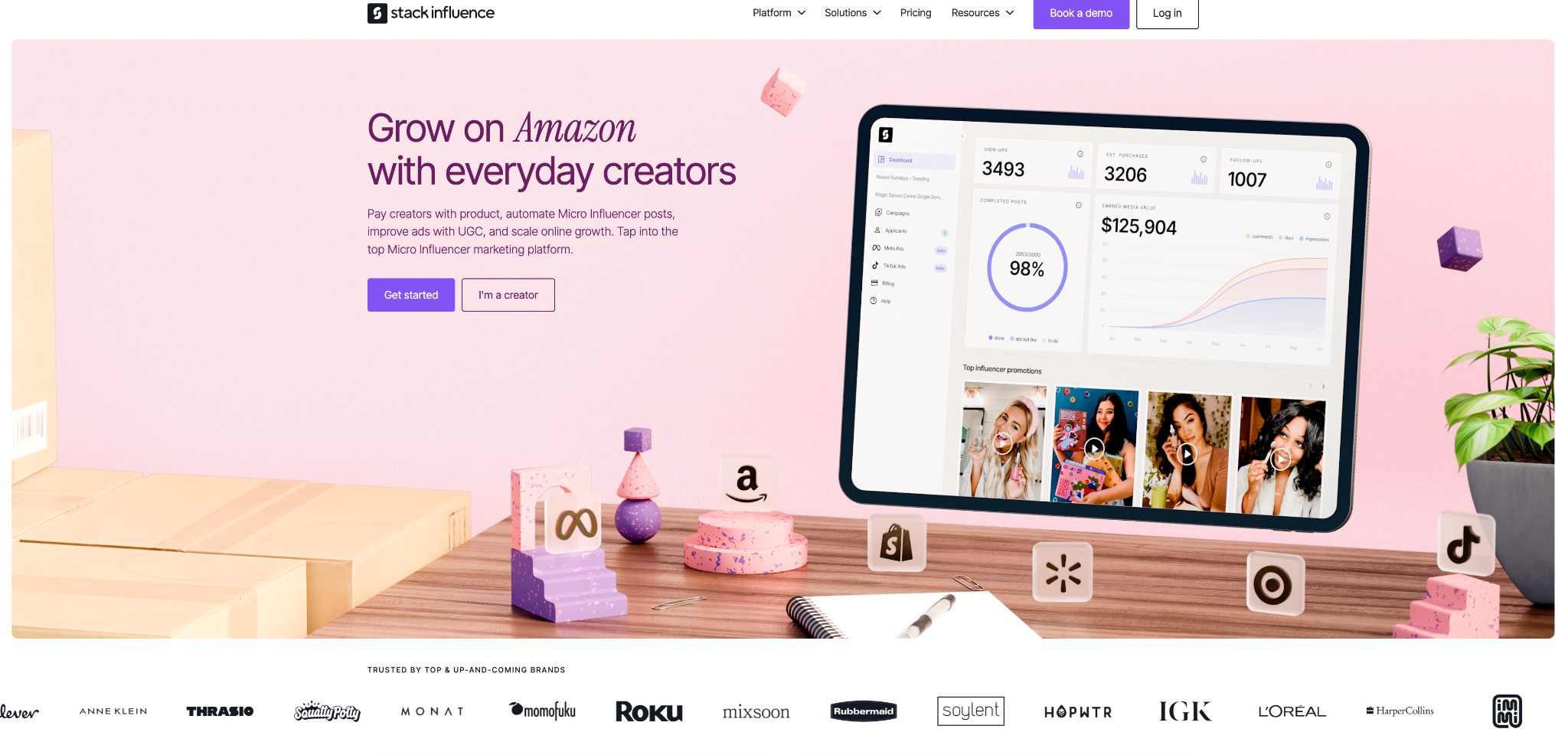
Stack Influence is relevant when you want product collaborations to help identify candidates for recurring ambassador work. Its platform overview describes campaign coordination, performance visibility, and downloadable content. That initial collaboration gives you material to assess product fit, content quality, and how the creator completes the agreed work.
Stack Influence's ambassador recruitment workflow lets brands review participants, export creator information and performance, and invite selected people into their chosen ambassador or affiliate program.
- Program fit: Build a pool of potential repeat partners through completed product collaborations, then define the ongoing relationship.
- Creator experience: The documented purchase and reimbursement process involves buying the product, submitting the social promotion, and receiving reimbursement after approval.
- Commercial check: Itemize campaign charges, reimbursements, and content permissions. Identify which system will handle the continuing program's commissions and payments after the creator export.
Shopify Collabs
Shopify Collabs for merchants supports direct invitations, affiliate applications, gifts, discount codes, sales tracking, and creator payments. Shopify lists it as available on plans other than Starter and Retail. It is a logical option to evaluate when your main requirement is administering creator-driven sales through Shopify.
Creator access needs a specific check. On November 12, 2026, Shopify's creator guidance says it is not accepting new general creator signups, while merchants can still send direct invitations and accept creator applications.
- Program fit: A Shopify affiliate program whose recruitment path and commission rules match Collabs' documented workflow.
- Creator experience: Partners can access gifts or codes, track affiliate sales, and receive payments. Confirm the actual invitation or application route you will use.
- Commercial check: Budget creator commissions and processing separately. Demonstrate the payment hold and cancellation of commissions for canceled or fully refunded orders during that hold.
UpPromote
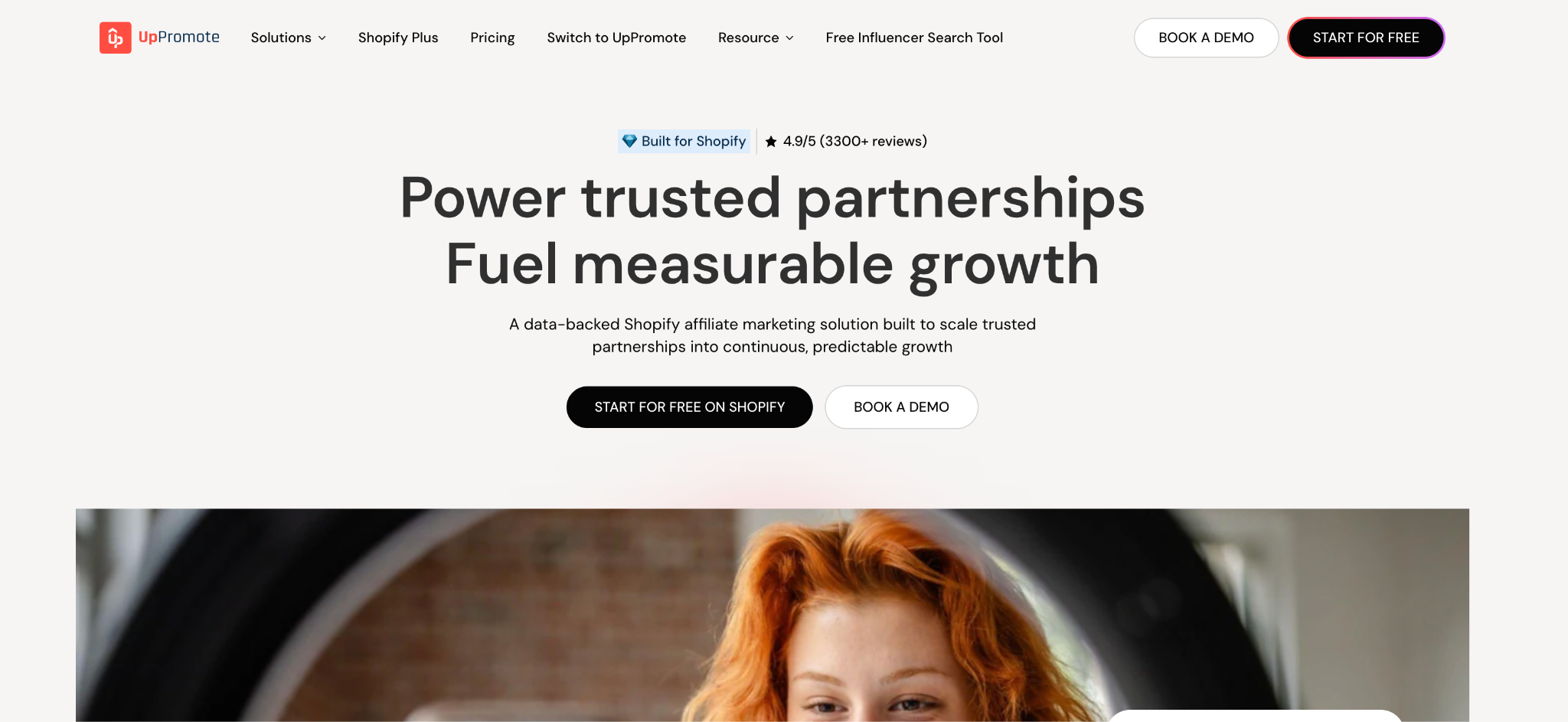
UpPromote merits evaluation when you want to configure and administer a Shopify affiliate program. Its affiliate account documentation shows how approved participants obtain links or coupons, create product-specific links, and review commission and payment information.
Refund handling is a useful demo item. UpPromote's refunded-order documentation describes a negative referral record that the merchant approves to offset commission. Check how this affects both your records and the affiliate's account.
- Program fit: Sales-led ambassador relationships requiring configurable affiliate administration.
- Creator experience: Approved affiliates can see pending, approved, denied, and paid commission states in their account.
- Commercial check: The Growth example above uses monthly billing. Match the actual plan to referral limits and required features; confirm whether discovery, payment automation, or other desired functions carry separate costs.
Club, Formerly Brandbassador
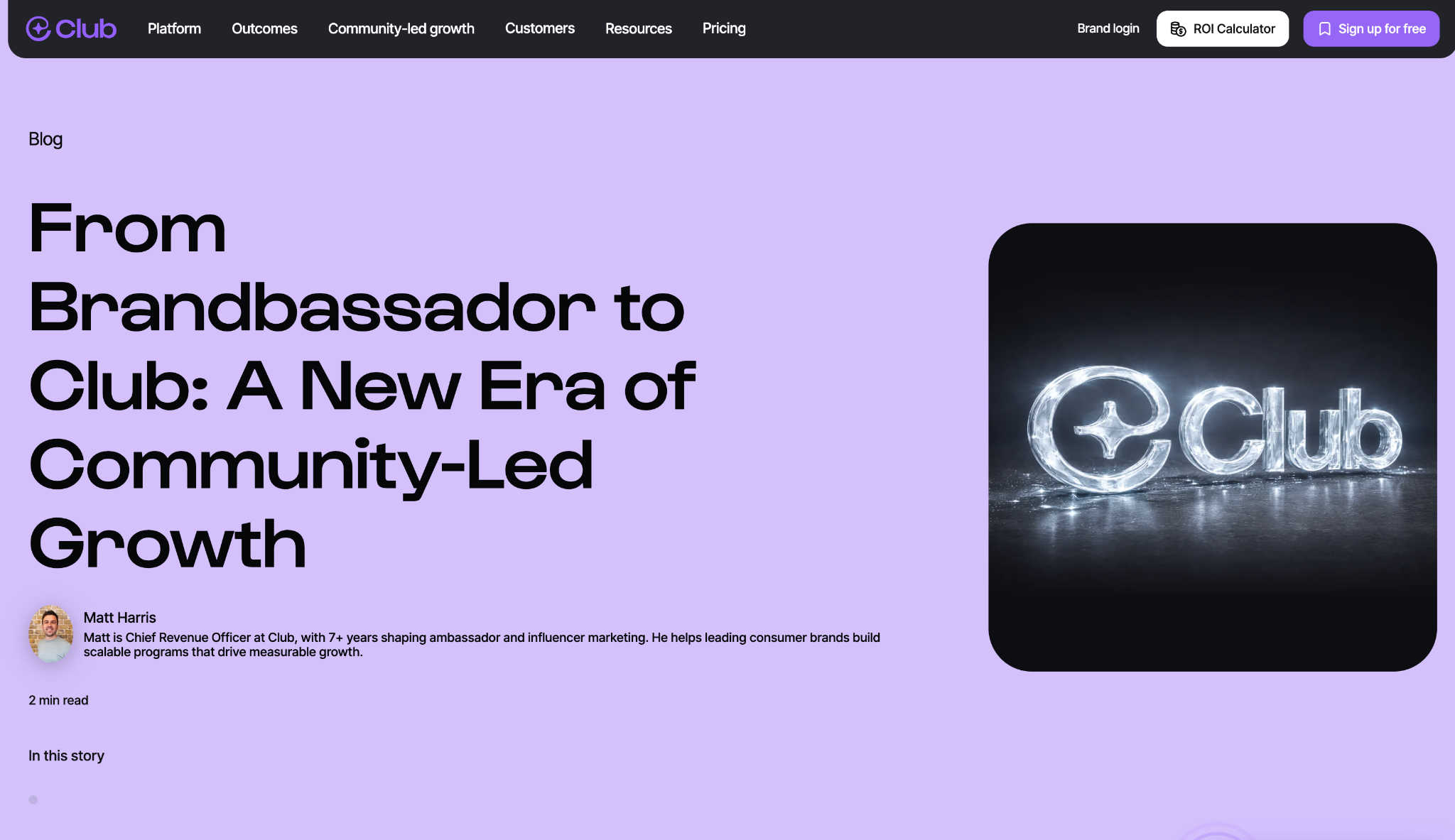
Brandbassador now operates as Club, as explained in its rebrand announcement. Treat it as one product when building your shortlist.
Club's platform documents missions, Shopify integration, affiliate discount codes, product rewards, and automated reward payments. Its combination of activities and rewards makes it relevant when an ambassador relationship extends beyond sharing a sales link.
- Program fit: A brand planning recurring community activities and several types of ambassador rewards.
- Creator experience: Ambassadors can use an app or web experience to participate in missions and earn rewards. Check how an earned reward becomes a redeemable or payable balance.
- Commercial check: Club's plan descriptions list prices upon request and different module bundles. Ask which recruitment, reporting, loyalty, and community functions the proposal includes.
SocialLadder
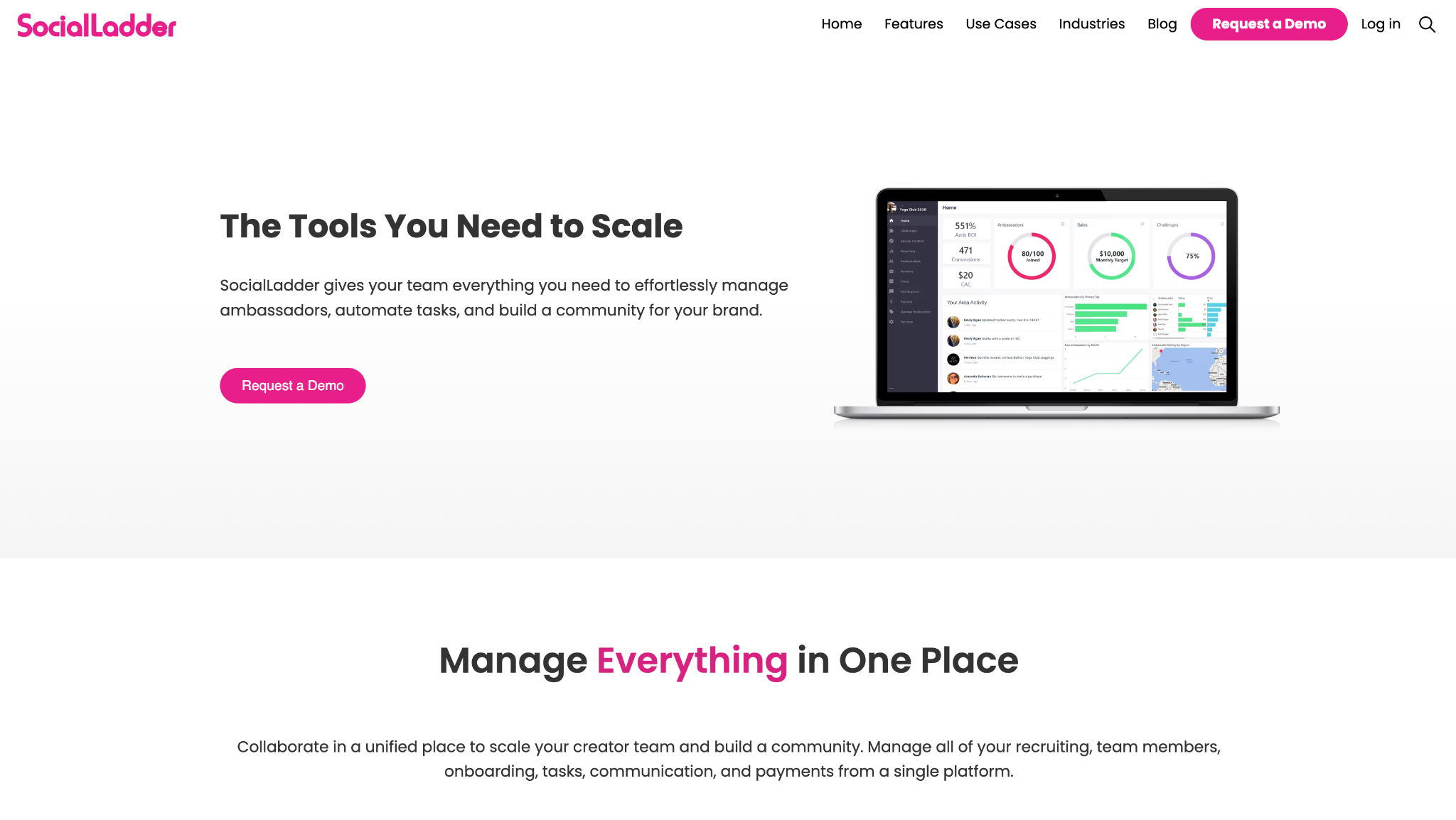
SocialLadder's documented features cover applications, onboarding, segmentation, communication, tasks, and rewards. It deserves consideration when a brand wants to coordinate continuing participation from a community of ambassadors.
For ecommerce reward fulfillment, its Shopify integration guide describes an order being created when an ambassador redeems a configured reward. Shopify must be connected, the reward product must be available in the store, and AutoFulfillment must be enabled for the account.
- Program fit: Community programs with recurring activities, participant groups, and merchandise rewards.
- Creator experience: Web and mobile participation are documented. Ask to see the task instructions, completion status, reward balance, and redemption process in the proposed configuration.
- Commercial check: The SocialLadder pricing FAQ identifies setup, base monthly subscription, and applicable seat fees. Request an itemized quote and a demonstration of any external creator discovery you require.
Aspire
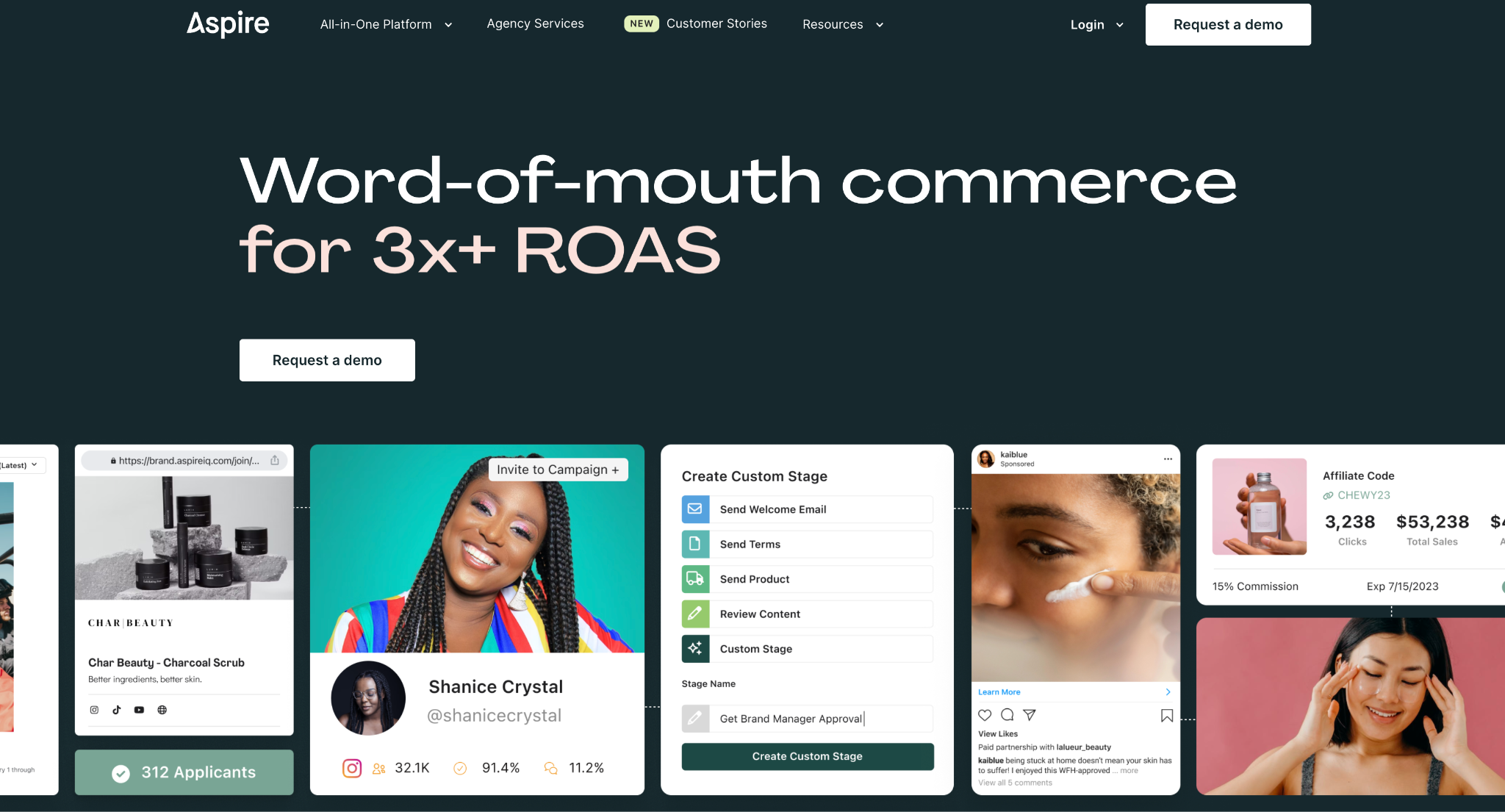
Aspire's ambassador tools document creator recruitment, customer invitations, contracts, follow-ups, a creator CRM, and performance reporting. This makes Aspire relevant when continuing ambassador relationships sit within a larger creator operation.
Its creator marketplace and portal let creators build profiles, apply to campaigns, review agreements, select products, and submit deliverables. Aspire states that joining, applying, and collaborating are free for creators; that statement concerns creator access.
- Program fit: Ambassador programs that need relationship management alongside structured creator campaigns.
- Creator experience: Campaign applications and an organized deliverable workflow, with the actual compensation defined by the agreement.
- Commercial check: Confirm the brand subscription, payment fees, creator budgets, and required integrations in writing. Ask the vendor to demonstrate how a returning ambassador progresses from one agreed collaboration to the next.
Calculate What You Can Afford to Pay Ambassadors
Software pricing is only one part of the decision. A commission that looks attractive to creators must also fit the economics of the orders your business keeps.
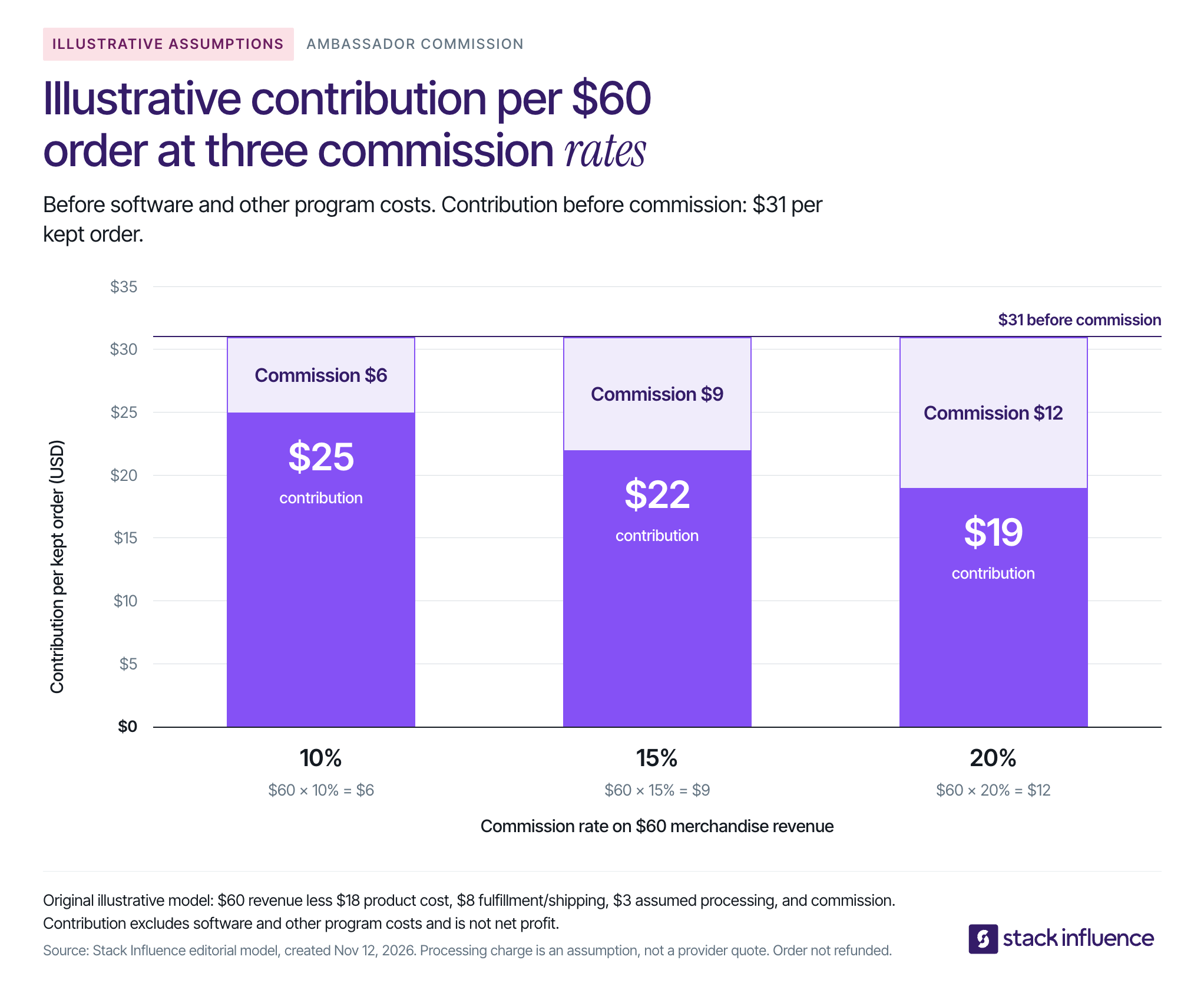
Use this clearly illustrative example for one completed, non-refunded order:
- Merchandise revenue after discounts, excluding sales tax: $60.
- Product cost: $18.
- Merchant-paid fulfillment and shipping: $8.
- Payment processing: $3, assumed for this example rather than quoted from a provider.
- Commission base: the full $60 of merchandise revenue.
Before commission, that leaves $31. Changing the commission rate produces these results:
- At 10%, the creator earns $6 and the merchant retains $25 in contribution.
- At 15%, the creator earns $9 and the merchant retains $22 in contribution.
- At 20%, the creator earns $12 and the merchant retains $19 in contribution.
Here, contribution means revenue remaining after the specified variable costs. It excludes ambassador software fees, samples or reimbursements, fixed creator fees, content licensing, staff time, advertising, returns handling, taxes, and overhead. It is not net profit or a benchmark for your store.
Add the platform's applicable charges before deciding whether the program is affordable. Keep a participant's reimbursed product purchase separate from downstream customer orders when evaluating campaign results. Also distinguish sales attributed to an ambassador from sales proven to be incremental; a tracked referral does not establish what would have happened without the program.
Run a Practical Demo Before Choosing
Give each shortlisted vendor the same test program. Include one ambassador owed a reward for an approved content task and one affiliate whose attributed order is later refunded. These are proposed test cases, not claims that every product manages every stage.
Use the cases relevant to your program and demonstrate any handoff to another system. Ask to see the following sequence in both the merchant and participant views:
- Join and approve: Submit an application or invitation, approve the person, and show where their accepted terms are recorded.
- Complete a task: Assign a content requirement, submit work, request a correction, and approve the final deliverable. Confirm who handles disclosure checks.
- Earn a reward: Show how the system records cash, commission, store credit, or a product reward. Identify any approval requirement before it becomes payable or redeemable.
- Handle an exception: Process a full refund and a partial refund in the demonstration. Show the resulting order value, commission adjustment, and creator-facing explanation.
- Settle the reward: Show payment eligibility, holds, payout status, and what happens if payment setup is incomplete. Trace any external payment step to its responsible system.
- Export the record: Export the participant, completed work, reward history, and available agreement or permission records. Confirm what you can retain if you change providers.
Choose your pass conditions before the demo. For example, every approved reward should have an identifiable recipient, calculation, status, and responsible owner. If the workflow crosses systems, require a demonstrated handoff and a way to reconcile the result.
After selection, use a defined pilot to review active participation, accepted content, approved commissions, payout exceptions, and contribution. Define an active ambassador using the behavior your program requires, such as completing an agreed activity during the measurement period. The broader guide to building a brand ambassador community can help turn the chosen software into a continuing program.
What Creators Should Check Before Joining
Look at the brand's offer as closely as the software. Confirm whether compensation is cash, commission, product reimbursement, merchandise, or store credit, and what action makes it earned. Ask when it becomes payable, what can reverse it, and where to resolve a disagreement.
Review the actual deliverables, revision expectations, exclusivity, and content-use permissions before accepting. Stack Influence's guide to ambassador and influencer agreements explains why the relationship label alone does not settle those terms.
For US-facing endorsements, the FTC's influencer disclosure guidance explains that payments, free products, and other material connections can require clear disclosure. Put the disclosure with the endorsement where people can notice it; a profile description alone may be missed. Treat disclosure instructions and review as part of the program's everyday workflow.
Choose the Platform That Can Run Your Program
Shortlist software around the work you need completed, the rewards you can afford, and the experience you want creators to have. Then confirm the fees and run the same practical demo with each candidate. The strongest choice for your business is the one whose documented workflow, tested configuration, and commercial terms support your actual ambassador program.