




One offer says “influencer campaign.” Another says “brand ambassador.” Neither label tells you whether the compensation is cash, which competing brands are off limits, or how long your video can run as an advertisement.
For content creators, the useful ambassador vs influencer comparison is about the relationship and the agreement. An influencer can also be a brand ambassador. A recurring ambassador role can offer continuity, but a well-scoped campaign can provide clearer compensation and more flexibility.
Here is how to separate the roles, compare the money, and recognize commitments that continue after your final post.
Key Takeaways
- A brand ambassador represents a brand through an ongoing relationship; an influencer can hold that role while continuing to create for an established audience.
- Compare fixed fees, conditional commissions, and product compensation separately because an ambassador title does not establish a minimum income.
- Delivery deadlines, payment dates, content-use permissions, and exclusivity periods can end at different times.
- Choose recurring partnerships when the product, workload, compensation, and restrictions support work you can sustain.
Ambassador vs Influencer: What Actually Changes?
A brand ambassador represents a brand in an ongoing capacity, while an influencer creates content that can shape an audience’s opinions or purchasing decisions. These roles overlap rather than form separate career levels. As Shopify’s guide to brand ambassadorship explains, ambassadors can include loyal customers, employees, and community voices, not only creators with large social followings.
For a creator evaluating an offer, compare three practical differences:
- Relationship: An influencer campaign typically centers on an agreed set of deliverables. An ambassador arrangement emphasizes recurring representation, although either agreement can cover multiple months.
- Responsibilities: Ask whether the work includes only content and publishing or also community participation, product feedback, appearances, and ongoing availability.
- Continuity: An ambassador invitation suggests an ongoing connection, but only the agreement establishes renewal, termination, and minimum compensation.
Neither title proves greater authenticity. A thoughtful one-off product demonstration can be credible, and a recurring partnership still needs honest opinions and relevant content.
Keep two other labels separate. Affiliate describes a commission arrangement, not necessarily a long-term relationship. A user-generated content (UGC) assignment can cover asset creation without requiring a post to the creator’s own audience. An agreement can combine UGC production, influencer distribution, affiliate earnings, and ambassador responsibilities.
Stack Influence, a micro-influencer marketing platform for ecommerce brands, connects these stages through its ambassador and affiliate workflow. Brands can review participants’ content and campaign performance, export creator details, and invite selected creators into their own ongoing programs.
The operational distinction matters: a completed gifted-first product-seeding campaign can help a brand evaluate a creator relationship, but it is not itself a promise of a recurring ambassador contract.
Do Ambassadors or Influencers Get Paid More?

Neither role has a universal pay advantage. Compare offers with equivalent deliverables, content rights, and restrictions, then separate what the contract promises from what depends on future sales.
A fixed fee compensates agreed work once its conditions are met. A commission depends on qualifying transactions. Products and purchase reimbursements provide a different kind of value: reimbursement restores money spent on the product rather than creating a separate production fee.
Stack Influence’s creator campaign FAQ describes product compensation, with additional monetary compensation offered in some campaigns. Read the specific brief to distinguish product reimbursement from any cash fee instead of assuming every creator partnership follows the same payment model.
Compare the Same Work Under Three Payment Models
Consider an illustrative three-month offer, not an industry rate benchmark. Each contract requires three posts, one per month, with identical organic-reposting permission for that term, no paid-ad rights, and no category exclusivity. The brand covers product and fulfillment costs; the comparison excludes taxes, production expenses, and platform or processing fees.
Assume all posting requirements are satisfied. Eligible sales mean attributed merchandise revenue after returns, excluding tax and shipping, and the same sales total applies to each offer.
- Fixed-fee influencer campaign: $900 total, regardless of eligible sales.
- Ambassador with a base fee: $250 per month for three months, totaling $750, plus 10% of eligible sales.
- Commission-only ambassador: 15% of eligible sales, with no fixed fee.
At $0 in eligible sales, compensation is $900, $750, and $0, respectively. At $1,500 in sales, the three amounts are $900, $900, and $225. At $3,000, they are $900, $1,050, and $450. At $6,000, they are $900, $1,350, and $900.
The base-plus-commission offer matches the fixed campaign fee at $1,500 in eligible sales. The commission-only offer needs $6,000 to match it. Those thresholds come from the illustrative contract terms, not from typical creator performance.
The important question is not which title sounds more established. It is whether the offer compensates your work when sales are low, and whether any potential upside justifies the uncertainty.
Distinguish Earned Compensation From Money Received
An approved commission is not necessarily an immediate payout. Shopify Collabs’ payment documentation explains that commissions pass through a holding period, canceled or fully refunded orders can cancel commissions during that period, and payout follows the merchant’s payment of the applicable bill.
Ask what counts as an eligible sale, which returns can reverse earnings, and when payment becomes due. For fixed fees, specify the invoice trigger and payment deadline rather than accepting “after the campaign.”
Use a separate estimate for production effort and licensed use when pricing UGC content. The comparison above holds those terms constant; real offers may not.
Choose the Relationship You Can Sustain
Choose a campaign-based arrangement when you need room to test the product, the creative relationship, or your audience’s interest. Pursue an ambassador arrangement when you can see a credible reason to keep representing the brand and the agreement supports that continuing work.
Keep a Campaign Scoped When the Relationship Is Unproven
A finite project creates a defined decision point. You can evaluate how the brand handles feedback, approvals, and payment before discussing a longer commitment.
The tradeoff is that separate campaigns require fresh proposals and scheduling. That can still be preferable to reserving months of availability before you know whether the product belongs in your content.
For example, a home-organization creator could test one storage-product demonstration before agreeing to recurring tutorials. Audience questions and the working relationship can then inform the next brief instead of forcing a long series around an untested idea.
Build Recurring Work Around More Than Repeated Mentions
An ambassador relationship needs a repeatable editorial purpose. Think product setup, everyday use, care, troubleshooting, and relevant audience questions, rather than the same recommendation posted on a schedule.
Before accepting, ask whether you can continue sharing useful information without crowding out your own content. Also consider how closely you are comfortable connecting your public identity to that business.
Continuity is valuable when it reduces uncertainty. It is less meaningful when the agreement promises no minimum work or compensation but still restricts competing opportunities.
Propose the Next Project, Not Just a New Title
After a successful collaboration, send a proposal that defines the next deliverables, payment structure, and review date. Do not rely on “we would love to keep working together” as a work commitment.
Support the proposal with a focused UGC portfolio: relevant examples, your contribution, and results you have permission to share. Clearly label self-directed sample work rather than presenting it as commissioned brand work.
A useful proposal could read: “I propose a three-part follow-up series covering setup, everyday use, and audience questions, with an agreed production fee and separately defined advertising rights.”
Whether the introduction comes directly from a brand, through influencer marketing platforms, or from an influencer marketing agency, confirm which business approves the work and which business owes payment. Check program eligibility before applying, and involve a parent or guardian when required for participation or agreements.
Use the Four-Clock Check Before Signing
Write down four timelines before accepting either kind of deal: when the work ends, when payment is due, when content use expires, and when competitor restrictions end. The Four-Clock Check helps uncover commitments that an attractive campaign title can obscure.
1. The Delivery Clock
Define the number of assets, formats, publication dates, and included revision rounds. Separate content delivery from posting obligations and from the time a post must remain live.
Also specify what happens when products arrive late or the brand misses its approval deadline. A delayed approval should not quietly turn a limited project into open-ended availability.
2. The Payment Clock
Identify the paying entity, invoice trigger, due date, and conditions for any commission. Discuss compensation for work already completed if the brand cancels.
“Monthly ambassador” does not answer whether payment is owed at the start of the month, after approval, or after sales clear a return period. Resolve that question before committing time.
3. The Content-Use Clock
Specify which content the brand may use, on which channels, for how long, and whether paid advertising is included. Treat permission to advertise through your creator identity as a separate question from permission to repost a file.
The U.S. Copyright Office’s copyright overview explains that original work generally receives protection when it is created and fixed, while ownership can differ in work-made-for-hire and transfer situations. Delivering a video, licensing its use, and transferring ownership are different arrangements.
Ask about edits, raw footage, sublicensing, and use of your name or likeness. For broad rights transfers or complicated restrictions, have a qualified legal adviser review the agreement rather than relying on a general guide.
4. The Exclusivity Clock
Specify the restricted product category or named competitors and the restriction’s start and end dates. Ask whether it covers paid collaborations, affiliate links, unpaid mentions, or all of them.
Narrow wording can preserve unrelated opportunities. A restriction on competing insulated bottles, for example, is different from a restriction on every outdoor or lifestyle brand.
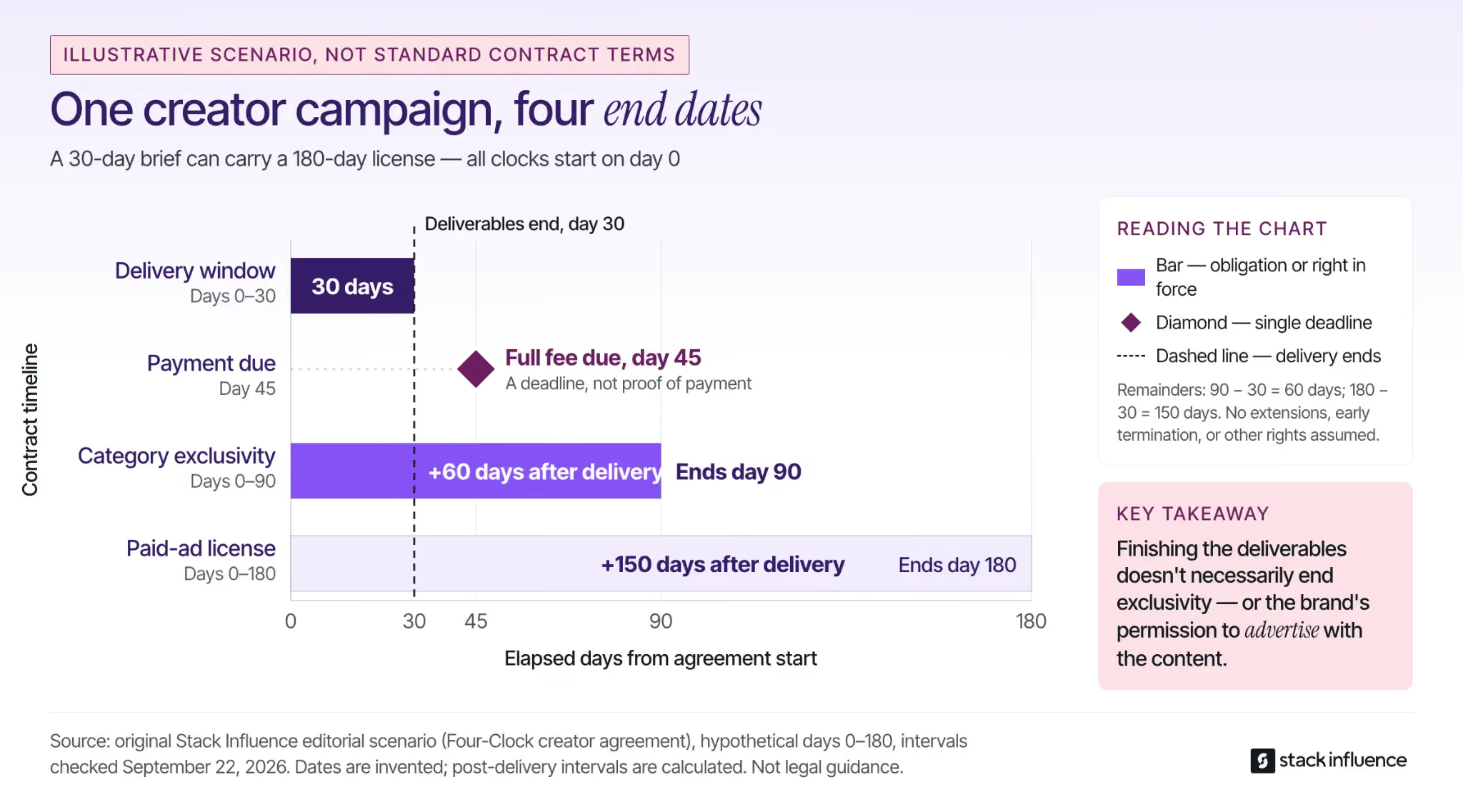
A 30-Day Brief Can Carry a 180-Day License
Consider a separate illustrative agreement starting on day 0. Deliverables end on day 30, the full fee is due on day 45, category exclusivity ends on day 90, and the brand’s paid-ad license expires on day 180.
Assume delivery, exclusivity, and advertising permission all begin on day 0, with no extensions or early termination. Payment is a deadline, not a work period. After delivery ends, the creator still faces 60 days of exclusivity and the content remains licensed for another 150 days.
These are invented contract terms for comparison, not standard legal periods. The lesson is that “the campaign is over” can describe completed work without describing the end of every obligation.
Keep those dates in your UGC rights-management records, alongside the approved assets and agreement. Apply the Four-Clock Check again at renewal rather than assuming a new brief preserves the old terms.
Disclose the Relationship, Not Just the Title
For endorsements directed at U.S. consumers, disclose a material connection that viewers would not reasonably expect. The FTC’s endorsement guidance covers financial relationships and benefits such as free products, not just traditional cash sponsorships.
The FTC considers “ambassador” or “partner” alone ambiguous; naming the brand can make the relationship clearer. Use understandable language that accurately describes the arrangement, such as stating that the brand paid for the post or supplied the product for free.
Keep disclosure close to the endorsement, not only in a profile biography. For video endorsements communicated through both pictures and speech, use both visible and audible disclosure rather than relying solely on the description.
Follow platform requirements too. YouTube’s branded-content disclosure instructions require creators to identify qualifying commercial relationships through its disclosure setting, while explaining that creators and brands remain responsible for other applicable obligations.
Finally, recurring representation is not permission to overstate your experience. Give an honest account of the product and do not make claims you cannot support.
Measure Results You Can Use at Renewal
A useful renewal report connects completed work, audience response, business outcomes, and your own compensation. Agree on the report before posting so you know which information the brand will share.
Record delivery dates, accepted assets, and revision rounds first. These show whether the collaboration worked operationally, independently of whether a post attracted unusually high reach.
Watch time, saves, relevant questions, and link clicks can be leading indicators of interest. When reporting an engagement rate, state whether the denominator is reach, views, or followers; those calculations are not interchangeable.
For ecommerce traffic, Google Analytics’ campaign URL guidance explains how UTM parameters identify referring campaigns. Ask the brand to assign consistent links or codes and confirm the purchase-attribution window, return treatment, and rules for overlapping referrals.
For a practical reporting schedule, compare posts at the same age, such as seven and 30 days after publication. These are suggested reporting checkpoints, not universal attribution windows. An ambassador campaign also needs a term-level review so one unusually strong post does not stand in for the entire relationship.
Treat attributed purchases and approved commissions as outcomes, but not proof that every tracked purchase was incremental. Shared discount codes, purchases on another device, advertising, price changes, and product availability can complicate interpretation. Separate organic results from paid amplification where the reporting allows it.
For your own decision, also record cash received, unpaid invoices, unreimbursed costs, and actual hours worked. A partnership can meet the brand’s goals while still needing a different scope or fee to become sustainable for the creator.
Choose the Agreement, Not the More Impressive Title
The ambassador vs influencer decision is not a choice between a beginner role and an advanced one. It is a choice about how you want to work with a brand, supported by clear compensation and limits.
Use a scoped campaign to test a relationship. Consider recurring representation when there is enough useful work, audience relevance, and contractual clarity to justify it.
Before accepting your next offer, write down its fixed compensation and apply the Four-Clock Check. You will have a clearer basis for protecting your time, negotiating permissions, and building brand partnerships you can sustain.