




A brand asks for “one quick video.” Then the brief adds extra openings, paid advertising, raw footage, and category exclusivity. Pricing that assignment as a single video leaves several different commitments inside one fee.
Learning how to price UGC content as a creator means separating the work you deliver from the permissions you sell. This guide gives content creators a production-floor calculation, a worked quote, and a way to check whether bundles and revisions actually leave enough money for the time involved.
Key Takeaways
- Price production, content usage, and posting to your audience as separate commitments, even when you sell them together.
- Calculate your minimum quote from all project hours, expenses, and transaction fees, not just filming time.
- Define revisions, additional versions, exclusivity, and license expiry before accepting the assignment.
- Evaluate cash earnings separately from product compensation, and review your realized hourly earnings after delivery.
How Much Should You Charge for UGC Content?
Charge enough to cover the complete production assignment, then price any additional licensing, audience distribution, or restrictions. There is no universal per-video rate that fits every brief. The worked example below starts with a $300 production package and reaches $550 after additional versions and paid usage, but those are illustrative quotes, not market averages.
For market context, Collabstr’s 2026 Influencer Marketing Report reports an average UGC asking price of $180 and an average final collaboration cost of $154. Its broader pricing analysis covers more than 472,000 packages and 21,000 collaborations across categories. Those figures describe its marketplace, not a standardized 30-second video with identical rights or a creator’s after-expense income.
Compare a benchmark with your own offer only after checking deliverables, usage, fees, and location. A low marketplace average does not make an unprofitable project sustainable, and a high advertised rate does not prove anyone paid it.
Separate Content Production From Influence
In commercial briefs, commissioned UGC means creator-made content produced for a brand, rather than an unsolicited customer contribution. Producing the asset and publishing it to an audience are separate assignments.
Micro influencers and nano influencers can sell both, but follower count should not substitute for estimating production work. When a brand also wants a post on your account, discuss audience relevance, likely distribution, and posting obligations separately.
Stack Influence’s creator campaign process illustrates another compensation model: gifted-first product seeding, where creators complete agreed requirements in exchange for product gifting or reimbursement. Evaluate that product-based collaboration separately from a cash UGC production quote. A reimbursed product purchase is not the same as an additional cash fee for your work.
How to Price UGC Content as a Creator With the Five-Line Quote
Use the Five-Line Quote to identify everything the client is buying before calculating a total. Keeping the components visible makes it easier to change the scope without accidentally giving away additional work or permissions.
- Production: Concepts, scripting, filming, editing, captions, and the agreed finished files.
- Licensing: Where, how, and for how long the client may use those files.
- Publishing: Posts to your accounts, required live periods, and any audience-facing obligations.
- Exclusivity: Specific competing work you agree not to accept during a defined period.
- Project Extras: Additional versions, raw-file preparation, rush work, and approved expenses not already included elsewhere.
A line can be included in another line’s price, but it still needs a written scope. Mark publishing or exclusivity as “not included” when the client has not purchased it. Check transaction fees against the resulting total rather than hiding them inside an unexplained markup.
Calculate Your Production Floor
Start with the time required to finish the job, including communication and delivery. Use an internal hourly target that accounts for your business overhead and time you cannot bill directly, rather than treating every working hour as a paid client hour.
Consider an illustrative assignment requiring 45 minutes for briefing and scripting, one hour for filming, 90 minutes for editing, and 45 minutes for administration and the included revision. That is four hours. At an assumed internal target of $50 per project hour, plus $20 in direct expenses, the production floor is $220 before transaction fees.
The calculation is:
Production floor = project hours × internal hourly target + direct project expenses.
When a percentage-based fee applies to the entire payment, divide the required amount by the share you retain. For example, Fiverr’s earnings documentation says freelancers receive 80% of the purchase amount. Retaining $220 therefore requires a $275 order before any other applicable costs, calculated as $220 ÷ 0.80.
Your floor is a private decision threshold, not necessarily your selling price. A quote can also reflect creative expertise, a difficult demonstration, or a valuable permission package. Do not double-count overhead already built into your hourly target.
Build a Quote the Brand Can Actually Approve
Here is an illustrative direct-booking quote in U.S. dollars, with no platform fees and taxes excluded. Assume the brand supplies the product at its own expense.
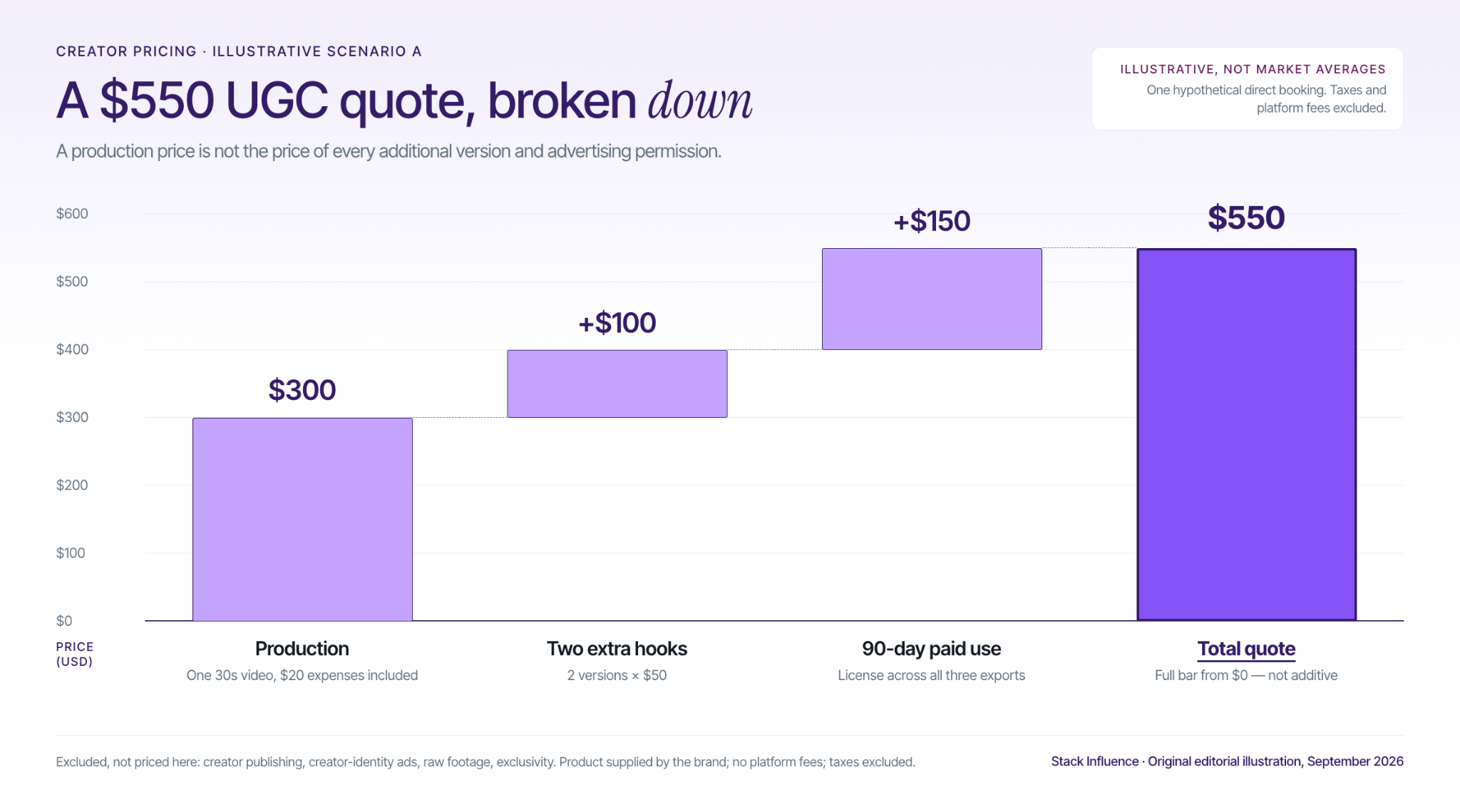
The production package costs $300, including the $20 project expense already described. It covers one 30-second vertical product demonstration, one concept, one opening hook, one call to action, captions, one consolidated minor revision round, and 90 days of organic use on named brand-owned social accounts.
Two additional opening-hook versions cost $50 each, adding $100, bringing production and version charges to $400, and bringing delivery to three finished exports. A separate $150 license covers 90 days of paid use of those three exports through the named brand-owned social accounts, with the territory and start date recorded in the agreement.
The total is $550: $300 production, $100 additional versions, and $150 paid usage. Creator-account posting, creator-identity advertising, raw footage, and exclusivity are not included, so there are no charges for those items in this example.
These amounts are assumptions for a worked proposal, not standard UGC rates or Stack Influence creator payouts. The useful result is the structure: the client can see why the complete assignment costs more than the original production package.
What Should Usage Rights, Raw Footage, and Exclusivity Cost?
Price each item against its actual scope and the commitment it creates, rather than applying an automatic percentage to every deal. The $150 paid-use license in the example is one proposed price for a defined term, not evidence that every creator should charge that amount.
Define the License Before Pricing It
The U.S. Copyright Office’s ownership guidance explains that creators generally own original works when they create and record them, with important exceptions such as qualifying works made for hire and ownership transfers. Delivering a file, granting permission to use it, and transferring copyright are different arrangements.
A perpetual license concerns duration; an ownership assignment concerns who owns the rights. Do not treat “buyout,” “full rights,” and “work made for hire” as interchangeable shortcuts. Ask the client to identify the actual arrangement, and obtain qualified legal advice before accepting a broad transfer or unusually restrictive agreement.
For an ordinary license, specify the permitted accounts and channels, organic versus paid use, territory, duration, start date, and editing permissions. Stack Influence’s guide to UGC licensing rights explains why these details matter when content moves between social posts, advertising, and commerce placements.
Offer a narrower license and a broader alternative when both could meet the brief. Set renewal pricing or a renewal process before delivery, and decide what happens to existing organic posts after expiry. Avoid a vague term that starts “when the brand eventually uses it” without an activation deadline.
Separate Raw Files From Unlimited Reuse
Quote raw footage by the work required to select, organize, and transfer usable clips, plus the editing and usage permissions being granted. “Raw footage included” should identify the clips or footage quantity, not silently promise every recording from the shoot.
Decide whether the client may create new advertisements, change the meaning of your statements, sublicense the footage, or use it beyond the original campaign. Put AI training and synthetic use of your face or voice outside the standard offer unless separately and explicitly agreed. Those are negotiation boundaries, not assumptions to leave inside a generic delivery clause.
Price Identity Use and Exclusivity Separately
Advertising through a creator’s identity involves more than handing over a video. TikTok’s Spark Ads creation guide describes authorized identities and creator-provided post codes as routes for using content in Spark Ads. Agree on the commercial terms before enabling the corresponding platform permission.
For a creator-identity advertising quote, define the account, approved content, duration, and permitted edits. Do not assume a content license automatically supplies every platform authorization, or that an active authorization extends the agreed commercial term.
For category exclusivity, ask which competitors are restricted, what work is prohibited, and when the restriction ends. Estimate the contribution you might reasonably lose from conflicting work, using your actual pipeline rather than imagined bookings. A narrow restriction on a few named competitors is a different commitment from avoiding an entire industry for a year.
Package Discounts Must Come From Saved Work
Discount repeatable efficiencies, not every component of the deal. A shared briefing call or a single filming setup may reduce production time across several videos; separate scripts, difficult demonstrations, and additional licenses may not become cheaper just because they appear on one invoice.
For a bundle, estimate shared setup hours once, add the work for each distinct concept and export, then check the total against your production floor. Present the discount as a saving on the specified production scope. Keep broader licensing and exclusivity visible rather than quietly discounting them too.
Count finished versions before agreeing to a package. Three hooks combined with two calls to action and two aspect ratios can mean 12 exports, not three videos. Clarify whether the brand wants interchangeable components or every finished combination, since those are different editing assignments.
Apply the same discipline to photos. A frame pulled from an existing video, a separately lit product photograph, and a new lifestyle shoot require different work. Estimate the assignment rather than assuming every image should cost a fixed fraction of a video.
For retainers, specify the number of concepts, delivery batches, revisions, reserved production time, and treatment of unused capacity. A recurring payment should buy a defined service, not an unlimited queue of requests.
The Revision Cost Hidden in a Flat Fee
An unchanged project price can produce very different hourly earnings when feedback expands. The most useful check is what remains after project expenses divided by every hour spent completing the assignment.
Consider a separate illustrative three-video package paying $600, with $60 in direct expenses and six hours of planned work, including the agreed revision allowance. Assume no platform fees and no changes to the license. That leaves $540 before general business overhead and taxes, or $90 per project hour.
Now assume each additional, unpaid revision round takes 1.5 hours. One extra round increases total time to 7.5 hours and reduces the effective rate to $72. Two extra rounds mean nine hours and $60 per hour; three mean 10.5 hours and approximately $51.43 per hour.
These are scenario calculations, not observed creator earnings. They show why a package can look attractive on a rate card while becoming much less rewarding during delivery.
Define a revision round as one consolidated set of feedback within the approved brief. Agree on charges for a new concept, a changed product claim, an extra format, or a reshoot requested after script approval. Correct your own failure to meet the agreed brief rather than presenting that correction as a client-requested upgrade.
Keep the approved script, feedback, and final versions together. Alongside those files, maintain a UGC rights-management record showing what was licensed and when it expires, so a revision request does not quietly become a new usage agreement.
How Do You Send and Negotiate a UGC Quote?

Send a total price with specific inclusions, exclusions, payment terms, and a lower-scope alternative when appropriate. Negotiate what changes in the assignment before discounting the same work.
For example, the illustrative $550 quote can become $450 by removing the $100 in extra hook versions while retaining the original production package and paid-use license. The client receives fewer assets, not the same package for less money.
Attach a relevant sample and explain the production problem it demonstrates: clear product instruction, an effective comparison, or an understandable objection response. Use the creator guide to UGC marketing to connect your portfolio to the ways brands use commissioned content, rather than relying on follower count alone.
Agree on any deposit or milestone payments, the balance due date, cancellation treatment, feedback deadlines, and when production starts after product receipt and brief approval. Name the paying entity when an influencer marketing agency or micro influencer agency is acting for a client. Follow the payment and communication rules of any UGC platforms involved.
Do not promise sales, virality, or a positive personal experience you have not had. The FTC’s social media disclosure guidance requires clear disclosure of material brand relationships, including paid and gifted endorsements. Include the appropriate disclosure requirements in the brief rather than treating them as optional copy changes.
Know When Your UGC Rates Need to Increase
Review pricing after a small batch of completed jobs, not after one rejection or one unusually successful video. A practical starting point is to examine your next five assignments and repeat the review monthly as your workload grows.
Track quoted versus actual hours, collected cash, transaction fees, direct expenses, and revision rounds. These reveal whether the problem is an inaccurate estimate, an underpriced service, or uncontrolled scope. Track booking acceptance, repeat work, and paid license renewals separately to understand demand for your offer.
Calculate effective project earnings as collected cash minus transaction fees and direct expenses, divided by actual project hours. This is a before-overhead, before-tax measure unless you explicitly deduct those costs too. Do not count a gifted product’s retail price as spendable cash.
For published influencer campaigns, identify the denominator used for engagement rate, since rates based on reach, views, or followers answer different questions. For content-only jobs, ask the brand for results tied to the actual creative, placement, test period, and advertising spend when available.
Use those results as evidence with context, not as proof that your video alone caused every sale. The offer, audience, budget, and destination can change outcomes. A performance bonus can supplement a fixed creation fee, but it should not obscure what you are guaranteed for completing the production work.
For U.S. creators, the IRS Gig Economy Tax Center notes that gig income can be reportable even when paid in goods rather than cash or not reported on an information return. Keep product-compensation records as well as payment records, and check your own tax obligations with an appropriate professional.
Turn the Next Brief Into a Priced Scope
Knowing how to price UGC content as a creator means being able to explain what the fee covers, what changes the price, and what the work leaves you after delivery. A larger headline rate is not progress when it buys unlimited revisions or permissions you never meant to grant.
Before replying to your next brand inquiry, write the Five-Line Quote, calculate your production floor, and define the revision boundary. Use that scope to build creator partnerships that pay for the work you actually perform and the rights you consciously agree to sell.