




Brands are moving budget away from polished studio ads faster than most content creators realize. The global UGC platform market reached $7.6 billion in 2025, up 69% from $4.5 billion in 2024, signaling explosive adoption by brands across sectors. That growth represents a direct opportunity for creators who know how to position themselves as strategic partners, not just posting machines. This guide gives you the frameworks, metrics, and tactical moves to turn your UGC marketing capability into a sustainable, high-value revenue stream.
Key Takeaways
- UGC marketing is one of the highest-converting content formats available to brands, and creators who understand that conversion data negotiate better deals.
- The Content-to-Conversion Framework (C2C) gives creators a four-stage process for producing UGC that brands can immediately deploy across paid, organic, and on-platform channels.
- Measuring UGC performance goes beyond views and likes; the Creator Revenue Stack model defines the exact metrics brands and creators should track together.
- Micro influencers and nano influencers consistently outperform larger accounts on cost-per-conversion and content reuse rates, making them the most sought-after tier for UGC campaigns in 2026.
- Amazon sellers, DTC brands, and Shopify merchants are the fastest-growing buyer segments for UGC creators, each with distinct attribution needs you must understand before pitching.
How Creators Can Position Themselves as a UGC Marketing Asset
Most creators treat UGC as a transaction. A brand sends a product, you make a video, and the deal ends. The creators building serious income in the creator economy treat it as a strategic capability with a documented track record.
Your positioning starts with understanding why brands actually pay for UGC. They are not buying your audience; they are buying content that performs in their paid and organic channels. According to eMarketer's analysis of Collabstr's 2026 influencer marketing report, authenticity (35%) and track record (32%) are the two top factors US adults consider when deciding which online product reviewers to trust. Brands know this and choose creators accordingly.
To position yourself effectively as a UGC creator, build evidence across these four dimensions:
- Content track record: Screenshot high-performing posts, UGC video watch times, and save rates from past brand partnerships.
- Format versatility: Document your ability to produce reviews, unboxings, tutorials, lifestyle clips, and before/after formats.
- Repurposing rights: Clearly state that your UGC comes with usage rights for paid ads, product pages, and email campaigns.
- Platform fluency: Show brands you understand the native style of TikTok, Instagram Reels, and YouTube Shorts, since content that fits each platform's feed consistently outperforms content repurposed without adaptation.
Creators who lead with performance proof rather than follower count consistently close better brand deals. The shift from "influencer" to "UGC creator" is largely a positioning shift; it reframes what you are selling from audience reach to content performance.
What Is UGC Marketing?
UGC marketing is the practice of sourcing, activating, and distributing content created by real people, including customers, micro influencers, nano influencers, and dedicated UGC creators, to achieve measurable business outcomes for brands. It encompasses photo reviews, video testimonials, unboxings, tutorials, and social proof formats deployed across paid ads, organic feeds, product pages, and email campaigns. This growth reflects both increased marketer sophistication and consumer demand for authentic content.
The category has two distinct operating models that every creator should understand. Organic UGC is content a customer creates voluntarily without compensation, such as an unboxing posted spontaneously. Commissioned UGC is content created by paid creators specifically for brand use, produced in a native, authentic style but contracted and licensed by the brand. Most brand deals in 2026 involve commissioned UGC, and the entire landscape of UGC platforms has organized itself around this model.
What makes UGC marketing distinct from traditional influencer campaigns is the primary use case. In a traditional influencer campaign, the brand is paying for distribution through your audience. In a UGC campaign, the brand is paying for content assets it will distribute itself, often in channels where you as a creator have no presence at all. This distinction matters enormously when you are pricing your work and negotiating usage rights.
The Content-to-Conversion Framework (C2C)
The Content-to-Conversion Framework, or C2C, is the primary framework for producing UGC that brands can deploy directly without reshoots or heavy editing. It gives you a four-stage production logic that aligns your creative process with how brands actually use UGC across their channels. The C2C framework is referenced throughout this guide because it applies at every stage of a brand partnership.
The four stages of the C2C Framework are:
- Stage 1 — Hook (0 to 3 seconds): Lead with the outcome, not the product. Show the result before you explain the product. Brands run split tests on hooks constantly, and your ability to produce multiple hook variations from a single shoot is a major differentiator.
- Stage 2 — Context (3 to 15 seconds): Establish relatability by showing the authentic problem or desire the product addresses. This is where niche micro influencers outperform generalist creators because their context already resonates with a specific audience.
- Stage 3 — Demonstration (15 to 45 seconds): Show the product working in a real environment. Avoid studio-style shots; phone lighting and natural settings outperform polished production for UGC video formats.
- Stage 4 — Conviction (final 5 to 10 seconds): Close with a specific outcome statement, not a generic "I love this." Brands running TikTok Spark Ads or Meta partnership ads need a clear conviction moment that holds up without sound.
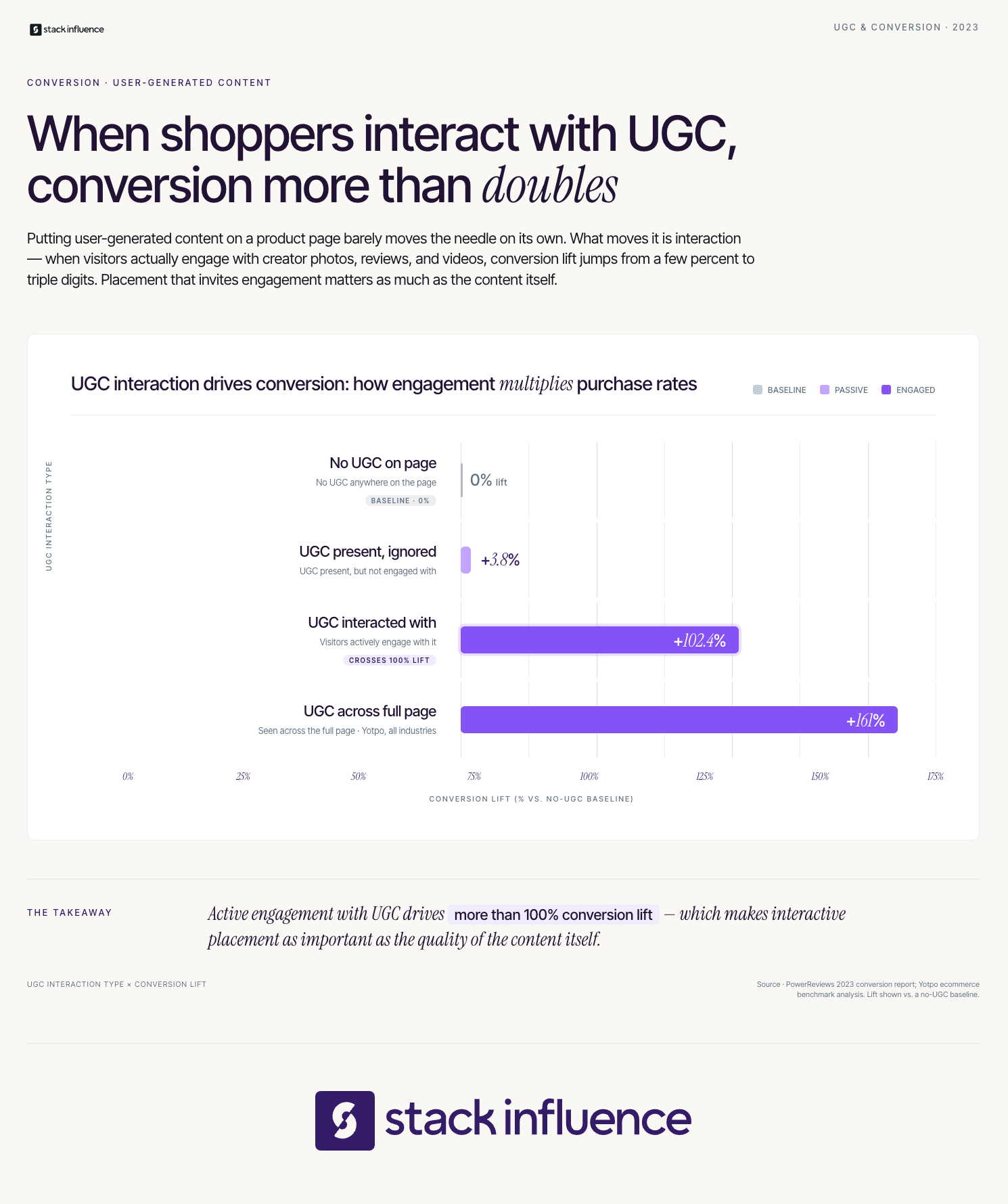
According to Yotpo's analysis of 200,000 ecommerce businesses, people who view UGC on a site are converting 161% more than those who see no UGC at all. That number is driven almost entirely by content that clears all four C2C stages. Content that stalls at Stage 2 generates awareness but not conversion lift.
Though the presence of UGC impacts conversion, the real magic happens when visitors interact with content; in 2022, there was a 102.4% lift in conversion among UGC interactors. Brands know interaction is the goal, and the C2C framework is designed to produce content that earns it. Refer back to the C2C framework whenever you are structuring a brief for a new creator partnership, because each stage maps directly to a measurable audience behavior.
Stack Influence has observed that micro influencer UGC produced with a clear four-stage narrative structure generates significantly higher content reuse rates among eCommerce brands, particularly in beauty, personal care, and CPG categories where before-and-after conviction moments drive purchase intent at the product page level.
Where UGC Video Changes the Performance Equation
UGC video is the highest-value deliverable in most brand deals right now, and creators who optimize for video performance rather than static content command meaningfully higher rates. The reason is simple: brands running performance media need native-feeling video creative at a volume that no internal team can produce alone.
TikTok For Business data shows that TikTok One creator content boosted with Spark Ads drove a 159% higher engagement rate than non-creator content posted directly in TikTok Ads Manager. That performance gap is the business case brands use to justify paid UGC creator programs. Understanding this number puts you in a stronger position when quoting rates for content with paid amplification rights.
The most in-demand UGC video formats for brands in 2026 follow a clear pattern:
- Unboxing and first-impression videos: These perform across TikTok, Instagram Reels, and Amazon product pages, making them exceptionally reusable.
- Tutorial and how-to formats: Brands running Shopify influencer marketing and DTC campaigns use tutorial UGC to reduce return rates by addressing common use-case questions before purchase.
- Before/after and results content: High-performing format for beauty, fitness, and home categories; brands frequently convert these into TikTok Spark Ads and Meta partnership ads.
- Honest review formats: Short, direct testimonial videos with no obvious scripting consistently earn higher trust scores and lower cost-per-click in paid campaigns.
Across campaigns managed on the Stack Influence platform, UGC video content produced by micro influencers in the beauty and personal care category consistently achieves content reuse rates above 60%, compared to roughly 40% in general lifestyle categories, because product demonstration formats translate directly into paid creative without post-production adjustment.
Product seeding is the most common mechanism brands use to initiate a UGC video relationship. Understanding how influencer seeding works for eCommerce lets you set expectations about timelines, posting requirements, and repurposing terms before you accept a product shipment.
The Creator Revenue Stack: A Named Metric Model for UGC Campaigns
The Creator Revenue Stack is the measurement model every UGC creator should use when reporting campaign performance to a brand and when evaluating which partnerships to prioritize. It has four labeled components, and you should reference the Creator Revenue Stack with every brand report you send.
The four components of the Creator Revenue Stack are:
- Content Performance Rate (CPR): The average engagement rate across all UGC deliverables in a campaign, measured as interactions divided by reach. This is your baseline proof of content quality and the first metric brand deals teams look at during creator review.
- Reuse Conversion Score (RCS): The number of times a brand deploys your UGC outside the original platform (in ads, emails, product pages, or Amazon listings) divided by the total content pieces you delivered. A high RCS demonstrates that your content is versatile enough to perform across channels, which justifies higher usage-rights fees.
- Cost-Per-Trusted-View (CPTV): Total campaign cost divided by the number of views that lasted beyond the average threshold for your platform, typically three seconds for TikTok and two seconds for Instagram Stories. 71% of TikTok users decide whether to keep watching or scroll away within just three seconds, making CPTV the most honest efficiency metric for UGC video budgets.
- Attribution Lift Index (ALI): For Amazon sellers and DTC brands using Amazon Attribution or unique UTM links, the ALI measures the conversion rate lift on pages or campaigns where your UGC appeared versus a baseline period without it. This is the metric that directly justifies the Amazon Brand Referral Bonus calculation for sellers running off-Amazon traffic.
According to Kantar's 2025 analysis, influencer content in ads captures attention for 2.2x longer than standard digital ads, making attention duration a meaningful proxy for content quality that brands increasingly track. The Creator Revenue Stack gives you a structured way to present that data in a format brand partnerships teams can act on immediately.
Industry data shows influencer campaigns average $5 to $6.50 in revenue per $1 spent, and micro-influencers often outperform this baseline. When you present the Creator Revenue Stack in a post-campaign report alongside that benchmark, you make your ROI case in the brand's language rather than your own.
The UGC Creator Activation Checklist
The UGC Creator Activation Checklist is the secondary framework in this guide. It gives you a practical audit to run before accepting any new brand partnership, and it is distinct from the C2C content production framework because it operates at the deal-structure level, not the content-execution level. Reference this checklist every time you are evaluating a new brief.
The eight items in the UGC Creator Activation Checklist are:
- Brief clarity check: Does the brand brief specify format, platform, and end use? Briefs that do not define paid usage upfront create rights disputes after content is delivered.
- Usage rights scope: Confirm whether the brand wants organic posting only, paid dark posts, Amazon product page placement, or all three. Each use case carries a different fee structure.
- Exclusivity terms: Identify whether the brand is requesting category exclusivity and for how long. Exclusivity during a campaign window is standard; multi-year category locks should command a significant premium.
- FTC disclosure requirements: Confirm which disclosure language is required before production. Amazon Influencer Program content requires explicit disclosure language per Amazon's terms.
- Deliverable count and format specs: Match the number of hooks, raw cuts, and final edits expected against your production capacity before committing.
- Revision policy: Establish the number of revision rounds included in the base rate. Two rounds is standard; open-ended revision requests devalue your time without increasing income.
- Payment terms: Confirm net payment window (net 15 or net 30 is standard for most brand deals), and clarify whether payment is triggered by content delivery or by brand approval.
- Performance reporting window: Agree on when and how you will share performance data. Brands running Amazon influencer storefronts and Amazon Attribution campaigns need data within a specific lookback window to attribute correctly.
Data from Stack Influence's micro influencer campaigns suggests that creators who complete all eight checklist items before a campaign kickoff experience fewer post-delivery disputes, faster payment cycles, and significantly higher rates of repeat brand partnerships than those who begin production before deal terms are fully confirmed.
Should You Prioritize Amazon Sellers and DTC Brands as UGC Clients?

Amazon FBA sellers and DTC brands on Shopify have become the most active buyers of commissioned UGC content in the creator economy. The reason is structural: both platform types have direct conversion data that lets them calculate the ROI of each UGC asset within days of deployment. That measurement capability makes them faster to scale budgets when your content performs.
For Amazon sellers, the UGC value chain starts at the product detail page. On-Amazon creator content consistently outperforms external social posts because it reaches shoppers already primed to evaluate products. The Amazon Influencer Program allows approved creators to upload shoppable video content directly to product listings, earning a commission on every conversion driven by that content. This creates a dual income structure: a flat fee from the brand for content production, plus ongoing commission revenue tied to product page performance.
For DTC brands and Shopify sellers, the UGC use case extends into paid media. Brands running Meta partnership ads need creator content with native rights, and many of the fastest-growing brands that work with micro influencers build their entire paid media creative library from commissioned UGC. Understanding the Amazon Brand Referral Bonus structure and how Amazon Attribution tracks external traffic helps you pitch a complete UGC strategy to Amazon sellers, not just a social post.
The most effective creator partnerships for both seller types involve product seeding via automated workflows, where the brand ships product directly in exchange for content rights, and the creator uses the C2C framework to produce video that works both as organic social content and as a paid creative asset. That dual-use positioning consistently commands higher rates than single-platform deals.
What Most UGC Marketing Guides Get Wrong About Follower Count
Here is the specific belief most creators hold right now that is worth challenging directly: more followers means more brand deals and higher UGC rates. The data does not support it.
Research found that nano and micro-influencers achieved roughly double the sales conversion rate of macro influencers in one analysis, with about 7% of engagements converting to sales for small influencers versus 3% for large influencers. Brands running performance-focused influencer campaigns have known this for years. What changed in 2026 is that the measurement infrastructure has become mainstream enough that even early-stage DTC brands can see the per-asset conversion data that makes nano and micro creators the obvious choice for UGC programs.
The specific alternative metric you should lead with in every pitch is content reuse rate, which is the Reuse Conversion Score from the Creator Revenue Stack. A creator with 8,000 followers whose content is reused across 12 paid ad placements, three product pages, and two email campaigns generates far more measurable value than a creator with 120,000 followers whose content is posted once and archived. The hidden ROI layer is creative velocity: a traditional photo or video shoot with an agency can cost $50,000 and yield 10 to 15 usable assets, while a micro-influencer campaign of the same budget might yield 200+ pieces of authentic UGC.
This week, update your creator media kit to replace your follower count headline with a content reuse rate metric. Pull the number from your last three brand partnerships by counting how many times each brand redeployed your content in new placements. Even a reuse rate of 3 to 4 deployments per piece is enough to differentiate you from creators who only report engagement metrics. Brands looking for niche micro influencers to anchor their UGC programs are actively screening for this kind of performance signal.
Conclusion
UGC marketing is the most durable opportunity in the creator economy right now because it aligns creator income with brand performance rather than audience size. Creators who master the Content-to-Conversion Framework, apply the UGC Creator Activation Checklist before every deal, and report results through the Creator Revenue Stack model will consistently outperform peers who treat content creation as a one-sided transaction. The brands investing in influencer marketing platforms, product seeding programs, and commissioning UGC video at scale are not slowing down; they are building the infrastructure to do this at volume. Your role in that system becomes more valuable every time you produce a piece of content that a brand deploys in five different channels instead of one.