




Launching an ecommerce store once required separate hosting, shopping-cart software, payment integration, security work, and ongoing technical maintenance. Shopify combines much of that infrastructure into one hosted platform, which is why the question “what is Shopify?” matters to new sellers, established DTC brands, and retailers moving online.
But Shopify is not a product supplier, a marketplace that automatically brings buyers, or a guarantee of sales. This guide explains what Shopify does, how the platform works, what it costs in 2026, how it differs from Amazon, and how to turn a finished storefront into a measurable growth system.
Key Takeaways
- Shopify is a hosted commerce platform that combines a storefront, checkout, payments, order management, inventory tools, analytics, and sales-channel integrations.
- A Shopify subscription provides infrastructure, but the seller remains responsible for products, fulfillment, customer service, compliance, and customer acquisition.
- The subscription is only one part of total cost; apps, payment processing, fulfillment, marketing, returns, and labor shape the real operating expense.
- Shopify and Amazon solve different problems. Shopify supports a brand-controlled storefront, while Amazon provides marketplace demand and optional fulfillment through Amazon FBA.
- The most useful Shopify measurement system connects traffic, onsite behavior, conversion, contribution margin, and repeat purchasing instead of judging success by revenue alone.
What Is Shopify?
Shopify is a hosted commerce platform that lets businesses create an online store, accept payments, manage products and inventory, fulfill orders, analyze performance, and sell across online and in-person channels. Because Shopify provides the software, hosting, checkout, and administrative dashboard, sellers can operate an ecommerce business without building the underlying technology from scratch.
Shopify’s own platform overview describes the product as a unified system for selling online and in person. In practical terms, Shopify is software as a service: the merchant pays for access to a maintained commerce system rather than purchasing and maintaining a custom ecommerce stack independently.
The category matters because ecommerce remains a large and growing part of retail. The U.S. Census Bureau’s first-quarter 2026 report estimated seasonally adjusted U.S. retail ecommerce sales at $326.7 billion, up 9.8% from the first quarter of 2025, and equal to 16.9% of total retail sales.
Shopify can support physical goods, digital products, subscriptions, memberships, ticketed experiences, and services, subject to applicable laws and platform policies. It provides the store infrastructure, but it does not choose a winning offer, create demand, or operate the business for you.
Sellers still control:
- Product selection and pricing
- Branding, merchandising, and creative
- Inventory and fulfillment decisions
- Customer support and returns
- Tax, privacy, product, and advertising compliance
- Marketing strategy and acquisition spending
For a practical launch sequence, Stack Influence’s guide to setting up a Shopify store covers the major configuration steps from account creation through optimization.
The Five-Layer Shopify Stack
The clearest way to understand Shopify is as a five-layer operating stack. Each layer solves a different ecommerce problem, and a store becomes harder to scale when one layer is missing or disconnected from the others.
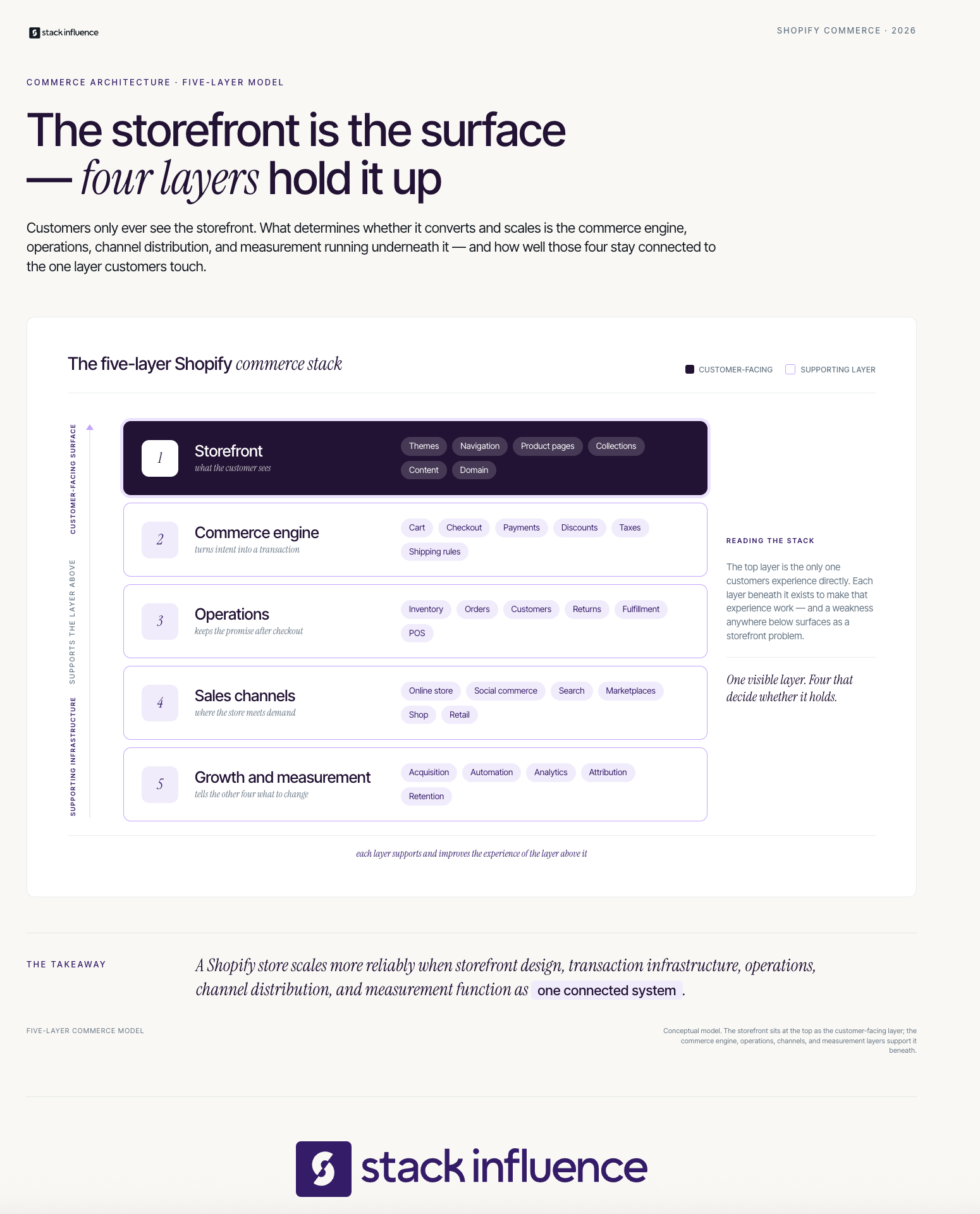
Layer 1: Storefront
The storefront is the customer-facing website. Shopify gives sellers themes, page templates, product pages, collection pages, navigation, a blog, domain connections, and mobile-responsive design tools.
The storefront should answer four questions quickly: What is the product, who is it for, why should the shopper trust it, and what should the shopper do next? A polished theme cannot compensate for unclear positioning or missing purchase information.
Layer 2: Commerce Engine
The commerce engine turns browsing into an order. It includes the cart, checkout, discounts, payment processing, tax settings, shipping options, fraud tools, and order confirmation flow.
Shopify includes hosted commerce infrastructure, an SSL certificate, and PCI-compliant checkout support. The PCI Security Standards Council’s merchant guidance emphasizes that secure commerce still depends on people, processes, and technology, so merchants need strong account controls and careful app permissions.
Layer 3: Operations
The operations layer covers products, variants, inventory, customer records, orders, returns, shipping labels, fulfillment status, and in-person selling through Shopify POS. Sellers can fulfill internally, connect a third-party logistics provider, use dropshipping or print-on-demand apps, or coordinate inventory across several locations.
Choose the operating model before the app stack. Defining fulfillment, support, and returns first makes it easier to select only the software the business needs.
Layer 4: Sales Channels
Shopify can function as the central catalog and order hub for more than the brand’s website. According to Shopify’s sales-channel documentation, merchants can connect social commerce channels, Google, marketplaces such as Amazon, the Shop channel, and other supported destinations while managing products and orders from the Shopify admin.
Give every channel a defined role. The website can develop direct customer relationships, marketplaces can capture high-intent demand, and social channels can connect discovery with purchase. Stack Influence’s Instagram Shopping guide explores that social-commerce connection.
Layer 5: Growth and Measurement
The final layer includes customer acquisition, email and SMS, discounts, automation, analytics, attribution, and retention. Shopify supplies useful tools, but the seller must still decide which audience to target, which offer to make, and how much can be spent to acquire a customer profitably.
This is the layer that converts a functioning website into an operating growth system. Without it, a Shopify store may be technically complete but commercially invisible. Many sellers benefit from the use of various tools like this one to enhance their operations and drive growth in their ecommerce business.
How Does Shopify Work From Setup to Sale?
Shopify works by storing a merchant’s catalog, storefront settings, checkout configuration, customer records, and order data in one cloud-based admin. A seller configures the store, publishes products, connects payments and fulfillment, attracts shoppers, and then uses Shopify to process orders and monitor performance as customers move from discovery to purchase.
A practical setup sequence is:
- Validate the offer: Define the product, target buyer, price, margin, and reason to choose the brand.
- Choose the operating model: Decide whether inventory will be held internally, sent to a 3PL, dropshipped, produced on demand, or shared across retail locations.
- Build the storefront: Connect a domain, choose a theme, create navigation, and write product and policy pages.
- Configure commerce: Set up payments, taxes, shipping, discounts, notification emails, and returns.
- Load and test the catalog: Add products, variants, SKUs, inventory, images, descriptions, and search metadata.
- Install measurement: Configure Shopify Analytics, campaign naming, UTM parameters, and any required Google Analytics events before launch.
- Run a complete test order: Check the mobile experience, payment flow, taxes, shipping, notifications, fulfillment handoff, refund process, and reporting.
- Launch one acquisition loop: Start with a controlled channel, measure the economics, fix bottlenecks, and then expand.
The sequence matters. Validate economics and workflows before buying apps, then change one major variable at a time so the team can identify what improves conversion or creates a problem.
How Much Does Shopify Cost?
Shopify’s total cost combines the platform subscription with payment processing, optional transaction fees, apps, themes, development, fulfillment, marketing, and operating labor. The subscription is only the visible starting point, so sellers should calculate expected monthly platform cost and per-order economics before choosing a plan or installing paid software.
As of August 2, 2026, Shopify’s U.S. pricing page lists these standard plans:
- Basic: $39 per month, or $29 per month when billed yearly
- Grow: $105 per month, or $79 per month when billed yearly
- Advanced: $399 per month, or $299 per month when billed yearly
- Plus: Starting at $2,300 per month for eligible contract structures
Pricing, payment rates, offers, and feature availability can vary by country, billing term, payment provider, and future platform updates. Shopify also states that third-party transaction fees may apply when a merchant uses an outside payment provider instead of Shopify Payments.
A more useful cost equation is:
- Platform subscription
- Payment-processing and transaction costs
- Paid apps
- Theme, design, and development costs
- Warehousing, packaging, shipping, and returns
- Customer support and operational labor
- Advertising, content, affiliates, and creator partnerships
Evaluate an app by the process it replaces or the profit it creates, not only by its monthly fee. Overlapping apps can increase cost while fragmenting reporting.
Shopify Strengths and Tradeoffs
Shopify’s main strength is operational consolidation. It provides a maintained commerce foundation while preserving control over branding, merchandising, customer experience, and channel strategy.
Core Strengths
- Fast deployment: A seller can assemble a functional store without building hosting, checkout, and order-management systems independently.
- Unified commerce: Products, orders, customers, inventory, online sales, and in-person selling can be managed through a connected admin.
- Expandable functionality: Themes, apps, APIs, and service partners let a business add capabilities as its needs become more complex.
- Multichannel reach: A merchant can connect the Shopify catalog to social, search, marketplace, retail, and emerging commerce channels.
- Scalable operating choices: The same platform category can support a first product launch, a growing DTC brand, or a more complex retail operation.
Tradeoffs to Plan For
- Traffic is not included: A published store does not automatically receive qualified visitors.
- App complexity can accumulate: Each new app adds cost, permissions, data dependencies, and another possible failure point.
- Customization has a ceiling: Advanced requirements may need custom development, headless architecture, or a higher-tier plan.
- Migration requires discipline: URL changes, redirects, product data, analytics, and integrations must be managed carefully when moving platforms.
- Ownership creates responsibility: The brand must manage customer service, compliance, merchandising, retention, and fulfillment quality.
Planning for these tradeoffs helps keep Shopify a coherent operating system rather than a collection of disconnected tools.
Shopify vs. Amazon: What Is the Difference?

Shopify is primarily a brand-controlled commerce platform, while Amazon is primarily a marketplace with existing shopper demand and standardized marketplace rules. Shopify gives sellers more control over the storefront and customer journey; Amazon gives sellers access to marketplace discovery, with Amazon FBA available as an optional inventory and fulfillment service.
The practical difference is where the customer relationship begins:
- Shopify: The brand attracts the shopper to its own site, controls the merchandising experience, and manages the customer relationship within its store.
- Amazon: The shopper begins inside Amazon, compares marketplace listings, and purchases through Amazon’s checkout.
- Hybrid model: A brand uses Shopify for direct-to-consumer sales and customer retention while using Amazon for marketplace reach and Amazon FBA for selected fulfillment needs.
Many ecommerce brands use both. A creator campaign, paid ad, or email may route shoppers to a Shopify product page in one case and an Amazon listing in another.
Measurement also differs. Amazon’s official Amazon Attribution guide explains that eligible sellers can measure non-Amazon marketing activity and may earn a Brand Referral Bonus averaging 10% of qualifying product sales measured through Amazon Attribution. Stack Influence’s Amazon Attribution guide explains the campaign-link workflow from the seller’s perspective.
The Storefront Is Infrastructure, Not Demand
The most important Shopify misconception is that launching a store creates a customer-acquisition engine. Shopify makes the transaction possible, but demand must come from search, advertising, social content, email, partnerships, marketplaces, referrals, or an existing audience.
A balanced acquisition mix may include:
- Search engine optimization and educational content
- Paid search and paid social advertising
- Email and SMS retention
- Affiliate and ambassador programs
- Organic social and community building
- Micro-influencer campaigns and product seeding
- Marketplace and retail distribution
For creator-led acquisition, the goal should be more specific than “get influencers to post.” A connected Shopify influencer marketing playbook links creator selection, offer design, tracking, content rights, and contribution margin. The guide to influencer product seeding strategies explains how product gifting can support content and awareness.
Creator operations become more demanding as volume grows. Brands need qualification criteria, product logistics, communication, approvals, content tracking, disclosure rules, and a reuse plan. The guides to micro-influencer marketing campaigns and finding ecommerce content creators cover those decisions.
Stack Influence is designed for Shopify brands that want vetted micro-influencer activation, gifted-first product seeding, creator coordination, UGC generation, and completed-post accountability managed through one workflow. The platform works with roughly 600,000 vetted creators and uses a completions-only model, which ties platform spending to completed creator posts rather than simple creator outreach. Stack Influence’s Shopify solution focuses on that execution layer. Results still vary by product, offer, audience, content, margin, and campaign execution.
Gifted products and paid creator relationships also require transparent disclosure. The Federal Trade Commission’s endorsement guidance says influencers and brands should clearly disclose material relationships and follow applicable rules for endorsements and reviews.
How Should Shopify Sellers Measure Performance?
Shopify sellers should measure performance as a connected funnel: acquisition creates visits, onsite behavior reveals intent, conversion produces orders, unit economics determines whether those orders are profitable, and retention determines long-term value. No single metric, including revenue or return on ad spend, can explain whether the store is becoming healthier.
Use the Shopify Commerce Metric Stack:
- Acquisition metrics: Sessions by channel, qualified traffic, new visitors, customer acquisition cost, and creator or campaign clicks
- Behavior metrics: Product views, add-to-cart rate, checkout starts, landing-page engagement, and onsite search behavior
- Conversion metrics: Store conversion rate, checkout completion, units per order, sales by channel, and discount-code use
- Economics metrics: Average order value, gross margin, contribution margin, payment costs, fulfillment costs, refunds, and returns
- Retention metrics: Repeat customer rate, purchase frequency, cohort revenue, email contribution, and estimated customer lifetime value
Shopify Analytics documentation explains that the platform combines store activity, visitor, transaction, and report data in one reporting environment. For deeper cross-channel analysis, Google’s ecommerce event setup guidance explains that events such as product views, add-to-cart actions, checkout activity, and purchases must be configured to populate ecommerce reporting in Google Analytics.
Attribution will never be perfect. Cross-device behavior, privacy restrictions, private sharing, delayed purchases, shared codes, and refunds can separate the real journey from the report.
Combine tagged links, platform analytics, codes, post-purchase surveys, blended acquisition cost, contribution margin, and controlled tests where possible. A tracked sale supports a decision, but it does not prove that one touchpoint caused the purchase.
The Shopify Readiness Checklist
A Shopify store is ready to launch when the business can operate the customer promise, not merely publish a theme. Use this checklist before increasing traffic:
- Product: Is the product differentiated, permitted, accurately described, and ready to sell?
- Economics: Does the price cover product cost, payment costs, fulfillment, returns, acquisition, and overhead?
- Fulfillment: Can the business ship accurately and handle a demand spike?
- Trust: Are product details, policies, contact information, reviews, and claims clear and supportable?
- Acquisition: Is at least one repeatable traffic source ready to test?
- Measurement: Are analytics, campaign naming, and unit-economics reporting configured before launch?
- Ownership: Does a named person own merchandising, operations, customer support, and weekly performance review?
Six or seven “yes” answers indicate strong readiness, four or five reveal gaps to close, and three or fewer suggest validating the offer and operating model before heavy design or traffic spending.
Building a Store You Can Actually Grow
The practical answer to “what is Shopify?” is that Shopify is the commerce infrastructure behind an online business, not the entire business itself. It can unify the storefront, checkout, orders, inventory, channels, and reporting, but product quality, customer demand, fulfillment, economics, and execution still determine the outcome.
Before choosing a theme or adding apps, write down one product promise, one target customer, one fulfillment path, one acquisition loop, and one measurement model. That turns Shopify from a website project into an operating system that the team can test and improve.
For Shopify brands using creator-led acquisition, the logical next step is to evaluate a managed product-seeding workflow that connects qualified creator participation, completed content, store traffic, and contribution-margin measurement before campaign volume increases.