




An Amazon creator can recommend your product and earn a commission without becoming your employee or joining a brand-funded sponsorship campaign. That distinction matters when you are deciding what to pay for, what a creator should deliver, and how to measure the result.
For ecommerce sellers asking “how does Amazon affiliate work,” the useful answer goes beyond getting a tracking link. You need to understand who pays the commission, which purchases qualify, and how affiliate referrals differ from product seeding and reusable creator content.
This guide covers the U.S. Amazon.com program, with policy details checked on October 3, 2026. Other marketplaces and account-specific offers can have different terms.
Key Takeaways
- Amazon Associates pays publishers for qualifying purchases and certain eligible actions, not ordinary link clicks.
- Standard commission rates depend on product category; brand-funded incentives and creator-content agreements are separate arrangements.
- The standard offsite referral session can last up to 24 hours, but it can end earlier, and eligible cart purchases have additional rules.
- Sellers should verify the tracking link, payment responsibility, and promised deliverable before measuring a creator partnership’s profitability.
How Does Amazon Affiliate Work for Ecommerce Sellers?

Amazon affiliate marketing works through Amazon Associates: a publisher shares a tagged Amazon link, a shopper follows it, and Amazon pays the publisher when a qualifying purchase or eligible action occurs. The publisher might be a blogger, a product educator, or a social media creator.
The basic sequence is straightforward. A participant creates a link associated with their account, places it in eligible content, and directs shoppers to Amazon. Amazon then determines whether the resulting activity qualifies for commission under the program’s rules.
The Amazon Associates program is therefore a referral-income system, not a guarantee of payment for posting content. A creator can publish an excellent product demonstration and earn nothing when the referred traffic does not produce qualifying activity.
For a seller, joining Associates yourself is also different from recruiting creators to recommend your products. In the standard arrangement, Amazon sets and pays the affiliate commission. Any additional payment you negotiate with the creator belongs in a separate campaign budget.
An Amazon affiliate versus influencer comparison also helps distinguish external referral links from creator content that may appear within Amazon’s own shopping experience. Do not assume those placements use identical eligibility or commission rules.
A Completed Post Is Not a Completed Sale
Stack Influence’s gifted-first product-seeding workflow illustrates a different commitment: vetted creator activation, campaign coordination, UGC generation, and completed-post accountability. Its completions-only campaign model connects platform payment to completed creator posts rather than a promised number of affiliate purchases.
That distinction should shape the brief. When buying content, define the content. When funding sales incentives, define the qualifying sale. When combining the two, keep both commitments visible instead of treating “an influencer campaign” as one undifferentiated purchase.
How Much Does Amazon Pay Affiliates?
Amazon pays standard product commissions as a percentage of qualifying revenue, with the percentage determined by product category. There is no single commission rate that applies to every Amazon product.
Amazon’s current U.S. standard commission schedule lists Grocery at 1%, Home at 3%, Kitchen at 4.5%, and Luxury Beauty at 10%. These are selected standard rates, not a complete rate card or a promise that every item marketed with those descriptions receives that classification.
The basic calculation is:
Commission = qualifying revenue × applicable commission rate.
For an illustrative purchase producing exactly $40 in qualifying revenue, the corresponding commissions would be $0.40 for Grocery, $1.20 for Home, $1.80 for Kitchen, and $4.00 for Luxury Beauty. The purchase value stays constant; only the category rate changes.
Amazon’s qualifying-revenue definition excludes charges such as shipping and taxes. A tax-inclusive checkout total is therefore not necessarily the amount used to calculate commission.
For sellers, the practical implication is that the same product price can create very different affiliate incentives. Before asking a creator to produce a detailed demonstration purely for commission, consider the actual earning opportunity rather than the product’s retail price alone.
When Are Affiliate Commissions Paid?
Amazon generally pays approximately 60 days after the end of the month in which commissions were earned, subject to payment requirements. Its payment guidance also requires the relevant tax information and payment setup.
The U.S. payment terms specify minimum balances of $10 for direct deposit or Amazon gift card and $100 for payment by check.
This delay matters when discussing creator expectations. A shopper placing an order, a commission appearing in a report, and money reaching the creator are different events.
The Tracking Window Has More Than One Clock
The familiar “24-hour cookie” description leaves out important conditions. Amazon’s referral-session guidance explains that the session can close before 24 hours when the shopper places an order or follows another Associate’s link; the full policy distinguishes non-digital orders for this purpose.
An eligible cart purchase can follow a longer timetable. Under Amazon’s cart and fulfillment rules, a physical product added during the qualifying session can qualify if ordered no later than 89 days after the initial click. The product must also be shipped and paid for within 180 days of purchase.
These are different deadlines, not interchangeable descriptions of one attribution window. The cart provision concerns qualifying items added during the session; it does not mean every future purchase by that shopper belongs to the original creator.
Cancellations, returns, and refunds can also disqualify purchases. Treat an order report as an intermediate signal rather than final commission income.
For campaign planning, separate the click date, order date, shipment status, and eventual earnings. That prevents a common reporting mistake: declaring a creator ineffective before eligible orders mature, or declaring the campaign profitable before reversals are accounted for.
What Does Joining Amazon Associates Require?
Joining Amazon Associates requires an eligible content property, an accurate application, and compliance with Amazon’s program conditions. Registration is free, but creating an account does not guarantee final approval.
Amazon’s application review process requires at least three qualifying sales within the first 180 days before the application review. Personal orders do not count, and the submitted properties must contain substantive original content that is publicly accessible.
Applicants must also be legally able to enter contracts under the Associates Operating Agreement. A business plan should not depend on bypassing eligibility requirements.
Create the Link From the Correct Account
Start by listing the exact websites or social profiles that will carry the links. Complete the account, tax, and payment information, and keep the list of publishing properties accurate.
Amazon’s SiteStripe link-creation tool lets an Associate create tagged links while browsing Amazon through the account associated with their membership. Check the product variant and selected tracking ID before copying the link.
Then test the customer-facing destination without placing a personal order to generate commission. For social placements, the published experience matters as much as the copied URL; the workflow for adding an Amazon link to an Instagram Story should include checking the live link after publication.
Confirm the Creator’s Actual Program Access
Amazon’s Influencer Program eligibility rules add qualification conditions and separate requirements for onsite commission income. A creator’s account features should match the placement being discussed.
For example, a commitment to publish an external social post is not the same as a commitment involving content displayed on Amazon. Use the Amazon Influencer Program approval guide to frame qualification questions, then confirm the creator’s actual access before promising a placement.
The Link-Payer-Deliverable Check
Before activating a creator partnership, write down three things: which link will be used, who pays each cost, and what the creator must deliver. This Link-Payer-Deliverable Check prevents the affiliate arrangement from becoming confused with the content agreement.
1. Link: Decide Which Program Gets Credit
An Associate’s link is designed to support that Associate’s qualifying referral income. A brand’s measurement link serves a different reporting purpose.
According to Amazon’s Attribution guide, Amazon Attribution uses a 14-day, last-touch model. Eligible conversions must occur within that window, and credit goes to the most recent qualifying click. That is not the same rule as an Associates referral session.
The Amazon Brand Referral Bonus is another distinct mechanism. Eligible U.S. brands can receive a credit averaging 10% of qualifying sales attributed to their external marketing, subject to the program’s conditions; it is not a universal cash commission.
Amazon’s rules against combining attribution links prohibit manipulating tags to claim commissions across programs using the same traffic. Do not combine an Associates tag with an Attribution link in an attempt to collect both affiliate commission and a Brand Referral Bonus.
Agree on the supported tracking arrangement before publication. Do not silently replace a creator’s earning link with a different link after negotiating the partnership.
2. Payer: Separate Amazon’s Commission From Your Budget
The standard Associates commission is paid by Amazon. Your campaign may separately include product costs, shipping, creator fees, content production, or a brand-funded sales incentive.
For eligible brand campaigns, Amazon Creator Connections provides a way to select products, set a commission rate, and define a campaign period. Confirm the account-specific eligibility, budget requirements, and settlement conditions before treating an offer as available.
Keep these amounts separate in your campaign estimate. Otherwise, you can accidentally deduct Amazon’s standard affiliate commission as though it were an additional invoice to your brand, or forget a genuine brand-funded incentive that reduces your margin.
3. Deliverable: Specify the Content and Its Intended Use
A commission opportunity does not define a posting deadline, video length, content license, or reporting obligation. Put those expectations into the creator brief rather than assuming they follow from an affiliate link.
When finding influencers for an Amazon product, evaluate whether the creator can demonstrate the product’s actual use. Micro influencers and nano influencers should be assessed on relevance, communication, and the proposed content, not follower count alone.
For UGC creators, specify the required files, editing permissions, channels, and usage period. A brief for Amazon UGC services should distinguish a social post from a reusable video asset.
The Link-Payer-Deliverable Check gives both sides a concrete agreement: one defined tracking arrangement, an understandable cost structure, and a deliverable that can be verified.
Measure Incremental Profit, Not Reported Sales Alone
Start with delivery and traffic, then move to commercial outcomes. Completed posts and functioning links show that the campaign launched; clicks show activity; qualifying purchases and contribution margin help determine economic value.
Amazon’s Associates reporting documentation distinguishes metrics such as clicks, ordered items, shipped items, and commission income. A seller should also isolate the promoted product’s results instead of interpreting an affiliate’s total earnings as sales of the seller’s own catalog.
Keep reimbursed creator purchases separate from independent customer demand. A purchase made to obtain a campaign sample belongs in the campaign-cost assessment, not automatically in the count of customers acquired through the creator’s recommendation.
An Illustrative Campaign Break-Even Calculation
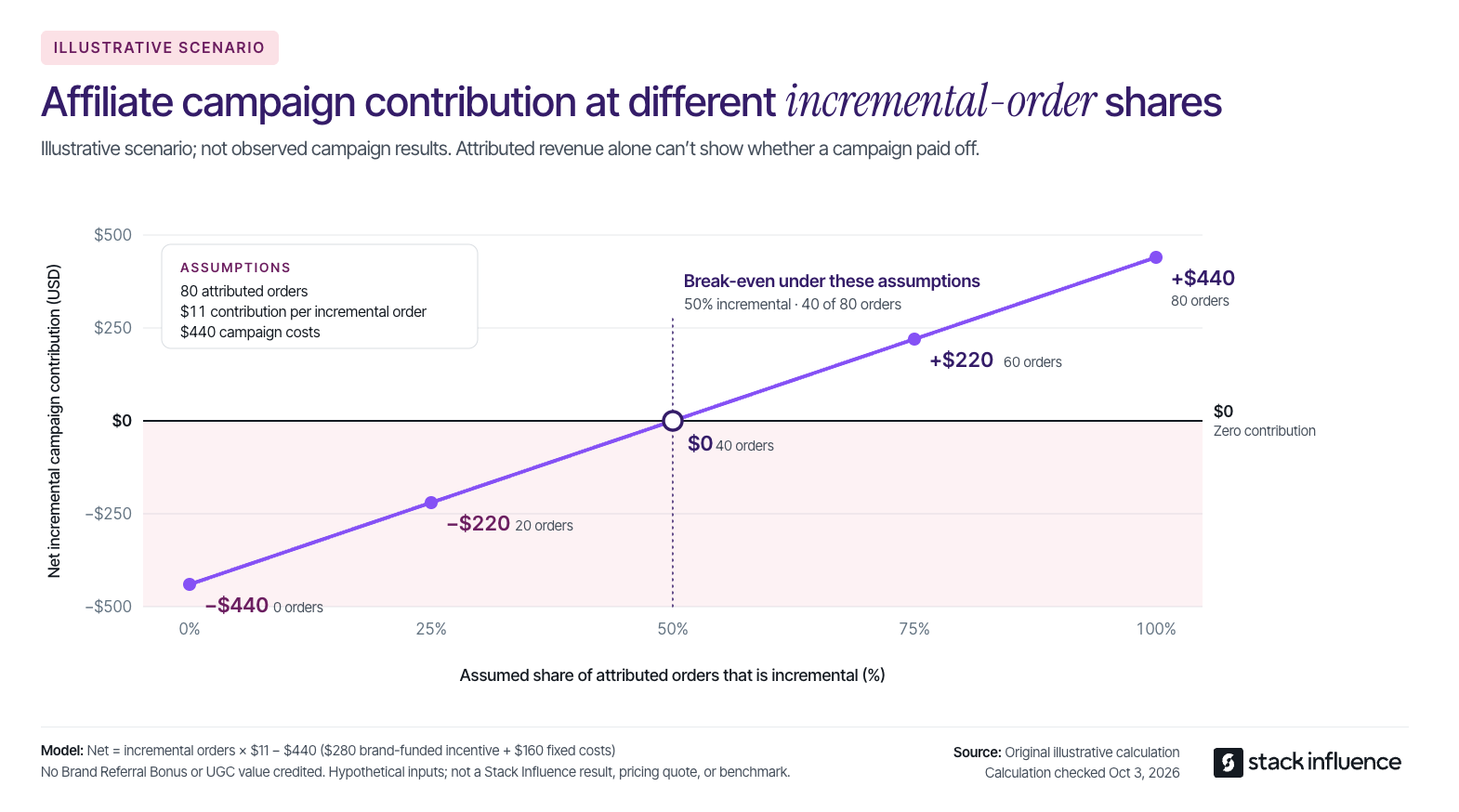
Consider a hypothetical brand-funded affiliate pilot with 80 attributed orders from independent customers at $35 per order. Attributed sales total $2,800. Assume each order contributes $11 after product costs, ordinary selling and fulfillment charges, and a return allowance, but before campaign costs.
The brand also pays an assumed 10% incentive on all 80 attributed orders, costing $280, plus $160 in combined fixed campaign costs. Total campaign cost is therefore $440. These figures are illustrative assumptions, not Stack Influence pricing, Creator Connections minimums, or observed campaign results.
Assume no Brand Referral Bonus credit and assign no financial value to later UGC reuse. The remaining question is how many of those attributed orders were genuinely additional purchases that would not have happened without the campaign.
The calculation is:
Net incremental contribution = incremental orders × $11 − $440.
At incremental-order shares of 0%, 25%, 50%, 75%, and 100%, the campaign adds 0, 20, 40, 60, and 80 orders respectively. The corresponding net incremental contributions are −440,-220, $0, $220, and $440.
Under these assumptions, the campaign breaks even when 40 of the 80 attributed orders are incremental, a 50% share. That threshold changes when margins, incentives, or fixed costs change; it is not an industry benchmark.
Give the Results Time to Mature
For an Amazon Attribution campaign, allow the relevant conversion window to mature before comparing complete reporting cohorts. For affiliate income, distinguish orders from shipped and ultimately payable activity.
Attribution assigns credit according to rules. It does not prove that every credited customer would have stayed away without the creator’s content.
Where feasible, use a credible holdout or comparison design to estimate additional demand. A simple before-and-after sales increase can also reflect pricing, seasonality, advertising, or stock availability.
The practical reporting goal is not one impressive revenue number. It is a defensible explanation of what was delivered, what was credited, what it cost, and what additional contribution the campaign plausibly created.
Keep Disclosures and Paid Distribution Compliant
Disclose the commercial relationship where the recommendation appears. The FTC’s Disclosures 101 for Social Media Influencers explains that material connections include free or discounted products, not just cash payments, and that disclosures should be clear and difficult to miss.
Amazon’s Associate-identification guidance also requires clear affiliate-link disclosure and the statement: “As an Amazon Associate I earn from qualifying purchases.” Do not assume a profile statement alone explains every individual endorsement.
Paid distribution requires another check. Amazon’s April 14, 2026 policy update expanded disqualified purchases to include referrals through paid or boosted advertisements linking to Amazon, with limited exceptions. Verify an applicable exception before funding that distribution, even when you have permission to reuse the creator’s UGC.
Finally, keep promotional content separate from marketplace customer reviews. Amazon’s customer-review policy explanation describes its restriction on incentivized reviews outside authorized arrangements. Do not make an Amazon customer review a condition of product reimbursement.
Turn the Affiliate Explanation Into a Clear Campaign Brief
How does Amazon affiliate work? Amazon connects eligible referral activity to commission income through tagged links, qualification rules, and a payment schedule. For sellers, the additional task is deciding whether that referral arrangement supports a profitable, well-defined creator partnership.
Apply the Link-Payer-Deliverable Check to one product before expanding the campaign. Confirm the tracking route, calculate the costs you actually fund, and distinguish completed content from incremental customer orders.
When your immediate goal is product demonstrations and reusable UGC, evaluate a Stack Influence product-seeding campaign around a defined content brief and completed-post accountability. Build the sales measurement alongside that workflow so the next campaign decision rests on usable content and understandable economics.