




Before asking a micro influencer to promise Amazon placements, an ecommerce seller should establish what “approved” actually means. A creator’s application, storefront, individual videos, and onsite earnings do not all share one approval status.
Learning how to get approved for the Amazon Influencer Program as a micro influencer starts with a credible social account and a complete application, not a follower-count shortcut. This guide explains what creators should prepare, how to submit, what to do when an application stalls, and which evidence sellers should request before planning a campaign.
Key Takeaways
- Amazon’s Influencer policy does not publish a universal follower cutoff or guaranteed engagement-rate target.
- Apply with an eligible account you control, accessible original content, and the social-data permissions Amazon requests.
- Storefront enrollment, video moderation, and onsite commission enrollment are separate statuses.
- Sellers should contract for controllable creator deliverables, not guaranteed Amazon acceptance or product-page placement.
How to Get Approved: The Five-Part Application Check
To pursue approval, establish an eligible social presence, prepare original content and genuine audience evidence, connect the correct account, and complete Amazon’s application. Amazon’s Influencer Program Policy requires qualitative and quantitative thresholds, registration, and policy compliance, but does not disclose a universal acceptance formula.
The program gives qualifying creators an Amazon recommendation storefront where they can curate products and earn commissions on qualifying purchases. It is a creator program, not a substitute for a seller’s inventory or fulfillment setup.
Use the Five-Part Application Check below as an editorial preparation tool, not an Amazon scoring system. Its five parts are eligibility, audience evidence, content evidence, submission accuracy, and status verification.
1. Confirm Eligibility and Account Access
Start with the account requirements before changing your content strategy. Amazon’s Influencer signup materials name YouTube, Instagram, Facebook, and TikTok; the signup FAQ requires a business account when applying through Instagram or Facebook. Follow the supported options and account instructions presented in your live application.
This guide follows Amazon.com documentation checked on September 22, 2026. Other marketplaces can have different availability and account requirements, so use the application for the marketplace you intend to serve.
The applicant must also be legally able to enter the agreement. Amazon’s Operating Agreement specifically excludes minors and people otherwise unable to contract.
Verify ownership, the exact profile URL, public visibility, and access to the account’s settings. A seller helping a creator prepare should never need the creator’s password or authentication codes.
2. Choose an Account With Verifiable Audience Activity
Compare the accounts you actually maintain rather than automatically submitting the largest one. Review recent original posts, the consistency of audience responses, and whether commenters ask relevant questions or describe using the information.
For a practical self-audit, examine 12 recent, comparable posts from each candidate account. Twelve is an editorial sample for this exercise, not an Amazon requirement; avoid mixing a giveaway, a paid promotion, and an ordinary tutorial as though they were equivalent observations.
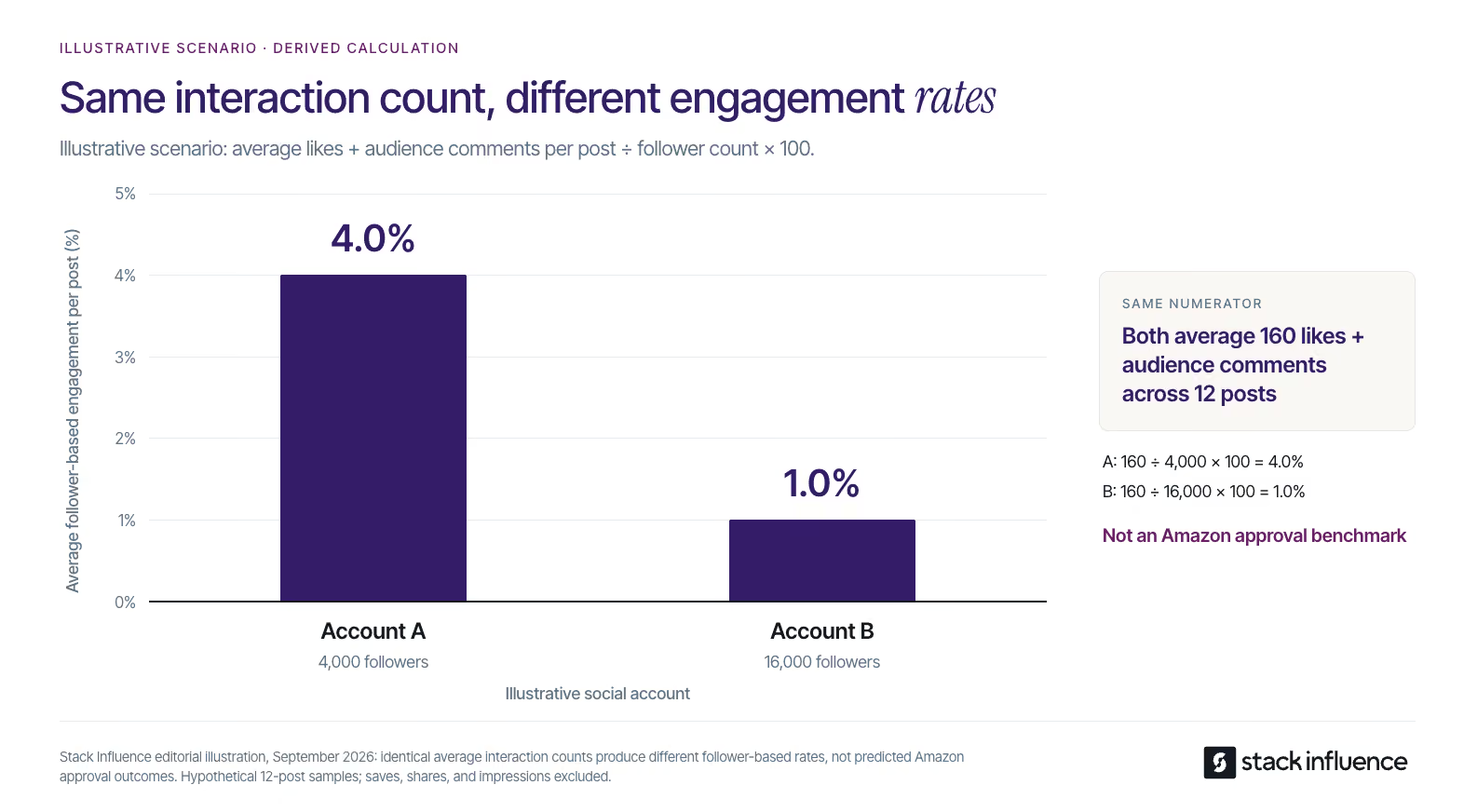
Consider an illustrative scenario in which two accounts each average 160 likes plus audience comments per post across that sample. Account A has 4,000 followers, giving it a follower-based engagement rate of 4%; Account B has 16,000 followers, giving it a rate of 1%.
The calculation is average likes plus audience comments per post, divided by followers, multiplied by 100. These invented inputs demonstrate the denominator effect only: neither rate is an Amazon benchmark, and the comparison cannot predict which applicant Amazon would approve.
Also inspect the underlying interactions. Repeated generic comments are not equivalent to specific questions, and follower-based engagement is not the percentage of viewers who responded. Use several pieces of evidence rather than replacing a follower-count shortcut with an engagement-rate shortcut.
Sellers building an evidence-first creator shortlist should maintain a separate field for campaign suitability. Stack Influence, a micro-influencer marketing platform, uses a gifted-first product-seeding workflow that coordinates vetted creator participation, purchases, completed social posts, and reimbursement after verification. Those campaign checks serve a different purpose from Amazon’s enrollment decision.
3. Build Original Content That Answers Buying Questions
Prepare a profile that demonstrates useful judgment rather than a collection of product advertisements. Choose a subject you genuinely understand and make the practical value visible in the content itself.
For example, a travel creator could demonstrate how a packing cube handles a bulky sweater, show the zipper under normal use, and explain which items fit together. A second post could compare packing methods, while another answers a real audience question about carrying delicate clothing.
Each example should show something the creator actually tested or observed. Use your own footage, explain relevant limitations, and avoid copying a manufacturer’s description into a supposedly personal recommendation.
Do not manufacture a narrow niche because someone claims that Amazon approves it more easily. A coherent body of work is useful preparation, but the cited Influencer policy does not promise preferential acceptance for a particular product category.
Before applying, review the profile as a first-time visitor. Can someone identify what you cover, find recent original work, and understand why people follow you without reading a separate pitch?
4. Submit the Intended Account and Required Permissions
Open the official application, sign in to the Amazon account you intend to use, select an available social provider, and authenticate the correct social profile. Check the displayed handle carefully when you manage multiple accounts.
Complete the requested information and social-data authorization. Do not treat a connection error as a content rejection; first confirm that the correct account was selected and that the requested permissions were granted.
Keep a simple application record containing the date, marketplace, connected profile, and exact status message. Save the information privately so a later support request can describe the actual problem rather than “my account did not work.”
Avoid buying followers, arranging artificial engagement, or borrowing someone else’s account to present a stronger application. Those tactics do not establish the genuine audience or ownership your creator business needs.
5. Verify the Result Before Promising Deliverables
Record what Amazon has actually confirmed. An application submission is not an acceptance notice, and access to a storefront does not mean that every uploaded video has passed moderation.
For a seller collaboration, verify the live storefront URL and the specific status relevant to the proposed work. Ask the creator to share only the necessary confirmation, with payment, tax, and unrelated account information removed.
The Five-Part Application Check ends with verified access, not a promise of future reach. That distinction should carry into the campaign brief and publishing schedule.
What Should You Do After a Rejection or Pending Decision?
Start with the exact message and the stage it concerns. A pending application, an account-connection failure, a rejected application, and a declined video require different responses.
For an access problem, check the selected account, visibility, account type, and authorization. For an explicit content or policy notice, address the named issue rather than deleting unrelated posts or switching niches at random.
When Amazon provides no detailed reason, use the Five-Part Application Check to identify weaknesses you can substantiate. Improve original content, make the account easier to evaluate, and document what changed; do not claim to have reverse-engineered a hidden score.
Reapply only when the current application flow permits it and there is a meaningful reason to submit again. The official material reviewed for this guide does not establish one universal waiting period or turnaround time for every Influencer applicant.
Keep broader Associates account review separate from initial Influencer screening. Amazon’s Associates application review guidance describes at least three qualifying sales within the first 180 days and excludes personal orders. That is not a three-video rule or a guarantee of Influencer acceptance.
For launch planning, give the creator work that matches confirmed access while another status remains unresolved. A product demonstration for the brand’s own channels can be scoped separately from creator-published Amazon content.
What Does Storefront Approval Unlock, and What Still Needs Review?
An active Influencer storefront enables creators to upload content, but video moderation and onsite commission enrollment remain separate. Amazon’s current storefront video guidance says product-page discovery may become available after 10 videos have been approved by moderation and onsite signup is complete; placement is not guaranteed.
The same guidance directs creators to Creator Hub, accessible from the storefront owner view through “Add to your storefront” and then “Videos.” Follow the current instructions and any account-specific notices rather than assuming an older tutorial still describes the process.
Consider an illustrative account with 12 uploaded videos: eight moderation-approved, two pending, and two declined. It has eight approved videos, not 12, and remains two approved videos short of the documented 10-video milestone; pending and declined uploads do not close that gap.
These counts are an invented planning example, not an observed approval rate. The example isolates moderation status and does not assume that onsite signup is complete or that any video will receive a product-page placement.
Amazon’s onsite commissions explanation also describes a separate onsite Store ID, which may begin with “onamz,” and tax and payment information needed for that ID. Maintain the distinction between commissions from traffic the creator sends to Amazon and earnings from content Amazon selects for onsite discovery.
For sellers, a storefront link answers only part of the qualification question. Verify the status needed for the proposed placement, and avoid converting an eligibility milestone into a contractual promise of distribution.
Protect the Account With Clear Disclosures

Build disclosure habits into the content workflow before publishing affiliate promotions. Amazon’s affiliate disclosure requirements call for a compliant disclosure with affiliate links and the account-level statement: “As an Amazon Associate I earn from qualifying purchases.”
The account statement does not replace disclosure near an individual affiliate recommendation. Readers should be able to understand the commercial relationship without searching a profile or expanding a long caption.
Product gifting creates another disclosure consideration. The FTC’s guidance for social media influencers covers material connections such as payment and free products, and says video disclosures belong in the video rather than only in its description.
Make the relationship visible, preserve the creator’s genuine opinion, and avoid requiring a positive endorsement in a product-seeding brief. A useful demonstration should remain accurate even when it includes a product limitation.
How Should Ecommerce Sellers Use Approval Status?
Use approval status to match a creator to a specific deliverable, not as a universal quality rating. A social post, licensed UGC video, creator storefront recommendation, and possible onsite placement are different campaign outputs.
When finding influencers for an Amazon product, start by naming the output you need. A brief for a creator’s social audience should emphasize audience relevance, content quality, disclosure, and completion; a brief requiring an Influencer storefront also needs confirmed program access.
For brand-owned marketing, document the content license and intended publishing destination. Stack Influence’s UGC production workflow supports collecting creator photos and videos for ecommerce marketing, while Amazon enrollment governs access to Amazon’s creator-specific features.
Before repurposing UGC across platforms, confirm the agreed channels, usage period, editing permissions, and any separate advertising authorization. An Amazon acceptance notice is not a substitute for those permissions.
A practical contingency is to separate the content deadline from any unresolved Amazon-access milestone. Agree on what can be delivered through existing channels, what depends on a later status, and how the scope changes when that status is not achieved.
For an Amazon-focused creator campaign, this prevents a completed social post from being reported as an Amazon placement. It also lets sellers work with relevant micro influencers and nano influencers without pretending every collaboration needs identical credentials.
Measure Readiness Separately From Campaign Performance
Track application readiness, publishing progress, and commercial outcomes in separate records. A creator can complete the application correctly without receiving a positive decision, and an approved creator can publish content without generating sales.
For preparation, review the account and content sample before submission, then update the record when a real status change occurs. For a seller campaign, review completed deliverables and usable assets weekly; a 30-day initial reporting period can be a practical planning choice, not a universal performance benchmark.
For eligible off-Amazon campaigns, Amazon Attribution reports clicks, detail-page views, add-to-carts, purchases, and sales, with a 14-day attribution window. Agree on the tracking setup before publication and allow the relevant conversion window to mature before comparing results.
Keep creator affiliate reporting, onsite earnings, and seller attribution reports distinct. Do not overwrite a creator’s tracking arrangements without agreement or add potentially overlapping conversion totals together as though they represent different purchases.
Separate reimbursement-funded creator orders from other customer orders when assessing demand. Likewise, record any qualifying Amazon Brand Referral Bonus credits in the seller’s economics rather than describing them as the creator’s commission.
Attributed sales show how a reporting model assigns credit. They do not, by themselves, prove that program acceptance or a creator campaign caused incremental sales.
Apply With Evidence and Plan Around Confirmed Access
Understanding how to get approved for the Amazon Influencer Program as a micro influencer means separating preparation from prediction. Build a credible public presence, submit the correct account, address actual notices, and verify what Amazon has enabled.
For ecommerce sellers, the next step is to qualify the deliverable rather than rely on the label “Amazon influencer.” Review the creator’s work, confirm the required access, and put content, rights, tracking, and contingencies into the brief so the campaign can proceed without depending on an unconfirmed placement.