




A Walmart listing can make sales and still have almost no useful product feedback. For ecommerce sellers, learning how to get more product reviews on Walmart starts with choosing an approved collection route, not sending a stronger follow-up message.
This guide covers U.S. Walmart Marketplace programs, their different eligibility and billing rules, and a method for measuring review growth without confusing older imported feedback with newly written reviews.
Key Takeaways
- Use Walmart's approved review programs rather than directly soliciting Walmart reviews through your own messages or incentives.
- Match the route to the item: Post-Purchase Reviews for eligible items receiving orders, Recognized Reviewer for eligible low-review products, or syndication for qualifying existing reviews.
- Budget against the actual billing trigger: a published review and a claimed product sample are not equivalent outcomes.
- Separate newly written reviews from syndicated reviews when reporting progress, and keep creator-content campaigns separate from retailer-review requirements.
How to Get More Product Reviews on Walmart: A Three-Route Plan

Start by identifying whether your product needs feedback from existing purchasers, an approved sampling opportunity, or distribution of reviews your brand already owns. These are different problems, and they require different workflows.
Walmart's Review Accelerator overview prohibits directly soliciting reviews outside its Review Accelerator programs. Do not build your plan around seller-written review emails, review-request package inserts, or private reimbursement offers that bypass those programs.
Use this Three-Route Review Plan to choose the next action:
- Orders Without Feedback: Check Post-Purchase Reviews eligibility and fund a controlled review target.
- A Low-Review Product Needing Trial: Check Recognized Reviewer eligibility and allocate sample inventory through Walmart's program.
- Existing Reviews on Your Own Website: Check authorized syndication before paying to collect additional feedback.
Product reviews also differ from seller reviews. Walmart's seller-review guidance distinguishes seller-service feedback and explains that Walmart sends customers invitations for seller and item reviews after purchase. Improving shipping performance matters, but a new seller rating is not a new product review.
Before enrolling anything, record the Walmart item ID, UPC, review count, recent review dates, available inventory, and recent sales. Add the recurring product complaints you need to address. This becomes the baseline against which you judge both program eligibility and actual progress.
Make Walmart product listing optimization part of that baseline work: check dimensions, included components, compatibility, instructions, and photographs against the product customers receive. Paying to collect more feedback before correcting an inaccurate description risks gathering more evidence of the same unresolved problem.
Keep creator activity in a separate column. Stack Influence's gifted-first product-seeding workflow supports creator participation and completed social content. A completed creator post is a campaign deliverable, not evidence that a Walmart product review was submitted or published.
Set a Post-Purchase Reviews Budget Before Enrolling
Post-Purchase Reviews is the route to examine when an item has sales but too little recent feedback. The current eligibility criteria include fewer than 15 reviews or no reviews in the past 90 days, at least one sale during that period, and a published, transactable, in-stock item.
The current eligibility requirements also include Walmart's internal demand assessment and category restrictions. Meeting the visible criteria does not guarantee admission, so the eligible-item list in Seller Center is your practical starting point.
Enroll the Item and Confirm the Billing Trigger
Follow Walmart's Post-Purchase Reviews enrollment guide: open Growth, select Review Accelerator, choose Enroll items, and select Post-Purchase Reviews. Pick eligible items, set the review target and incentive, then review and submit the enrollment.
Only one seller can enroll an item at a time. An absent item might already be enrolled by another seller, rather than being permanently ineligible.
Charges occur after a review is submitted, moderated, and published, with billing capped at the selected target. That makes published reviews the appropriate output to reconcile against charges, rather than invitations, purchases, or pending submissions.
Calculate the Full Cost, Not Just the Customer Reward
Walmart's published Post-Purchase Reviews pricing lists a target of 5 to 20 reviews, a $5 service fee per review, and a customer incentive starting at $5. The maximum incentive is the lower of $25 or 25% of the item's current price. Walmart labels program reviews as incentivized and discloses the reward to customers only after purchase.
Your planned program charge is:
Target published reviews × (customer incentive + $5 service fee).
Consider an illustrative eligible item priced at $40. The incentive ceiling is $10 because 25% of $40 equals $10; a $5 incentive creates a $10 total cost per published review, while a $10 incentive creates a $15 total cost.
For targets of 5, 10, and 20 published reviews, the corresponding budgets are $50, $100, and $200 with the $5 incentive. With the $10 incentive, the same targets cost $75, $150, and $300.
These are calculated examples, not campaign results or a promise that the target will be reached. They assume every target review is published and exclude credits, taxes, and any other applicable charges; confirm the actual enrollment summary before committing.
Choose a target that answers a business question. A modest test might show whether customers consistently misunderstand setup or package contents, while a larger target should have a clear reason beyond making the review count look better.
Do not assume the higher incentive buys faster feedback or better ratings. The arithmetic establishes a larger budget, not a verified improvement in response speed or customer sentiment.
When Should You Use Recognized Reviewer?
Consider Recognized Reviewer when an eligible product has few reviews and you need Walmart's approved sampling route rather than a program built around existing customer purchases. The Recognized Reviewer eligibility criteria include fewer than 10 reviews, new condition, online availability, and a content quality score of at least 70%, alongside stock, listing, and category requirements.
The Recognized Reviewer enrollment guide describes enrolling 5 to 30 sample units per item group. Sellers provide the product and cover shipping and applicable program costs; confirm the charges shown for your enrollment rather than importing another program's per-review price.
The crucial distinction is that charges are triggered when a reviewer claims a unit, not when a review is published. A claimed sample does not guarantee a published review, and a Completed enrollment status means all enrolled units have been claimed.
Plan the inventory and cash commitment around that distinction. Track samples claimed, samples delivered, and reviews published as separate stages; otherwise, a dashboard can look finished while your intended customer-feedback outcome remains incomplete.
The sampling orders appear as $0 orders. Keep them separate from ordinary paid customer demand when assessing whether the product is gaining sales traction.
Before submitting, assign responsibility for sample fulfillment and exception handling. A review initiative should not become an unmanaged shipping queue, particularly when your regular customers and sample recipients depend on the same inventory.
Can Reviews From Your Own Website Appear on Walmart?
Yes, qualifying customer reviews collected on your own website can appear on Walmart for the same item through an authorized syndication route. Syndication distributes existing feedback; it does not necessarily mean a new Walmart purchaser has written a new review.
Walmart's review syndication guidance describes a free Walmart service for sellers who own their reviews and are not already using another syndication service. It also lists authorized providers and specifies that sellers may use only one authorized syndication partner.
Start with catalog matching. Confirm that the item ID and UPC are present in the relevant catalogs and that product-family and variant relationships identify the same product. Investigate mapping problems before interpreting missing reviews as a content-collection failure.
Confirm the Connection Before Replacing Your Reviews Platform
An existing reviews platform does not automatically establish a direct Walmart syndication relationship. Ask who transmits the content, which agreement authorizes the connection, and how the provider reports accepted and rejected records.
PowerReviews' Walmart offering includes standalone syndication as well as its broader reviews platform. That distinction matters when your existing collection system works and you only need an authorized distribution connection.
Bazaarvoice's Walmart program information describes distributing existing review content collected through other providers. Compare that route with collecting entirely new reviews before assuming a technology migration is necessary.
Meanwhile, Yotpo's Walmart syndication documentation describes a connection through a third-party integration partner. Confirm the authorized partner and matching requirements rather than assuming the name of your Shopify reviews app tells you how Walmart receives the feed.
Preserve an audit trail showing each review's original date, product association, and syndication status. Do not report an older review's first appearance on Walmart as a newly written review, and do not copy reviews from another retailer as a substitute for an authorized feed.
Use Creator Content to Answer Questions, Not Buy Ratings
Build creator partnerships around product education and social content, while keeping Walmart review collection inside approved routes. Micro influencers and nano influencers can demonstrate a product without being recruited to leave a retailer star rating.
For example, brief a creator to show whether a storage organizer fits the advertised space, what arrives in the package, and how it assembles. Those demonstrations address buying questions. Requiring the creator to submit a Walmart review in order to receive reimbursement would introduce a different, restricted activity.
The FTC's consumer-review rule guidance prohibits incentives conditioned on positive or negative review sentiment. Calling a payment an incentive for an “honest review” does not override Walmart's separate solicitation restrictions, and disclosing a payment does not make a required five-star review acceptable.
Stack Influence's Walmart creator-campaign workflow supports creator coordination, product seeding, and social content. Its completions-only campaign model concerns completed creator posts, not guaranteed Walmart reviews or a particular star rating.
Use a separate content brief and review-program tracker. The creator brief should identify the product demonstration, disclosure, posting deliverable, and agreed content rights; the review tracker should identify the authorized Walmart program and its actual published outputs.
Gifted products and reimbursements can create material connections that require clear disclosure under the FTC's influencer disclosure guidance. When repurposing UGC across platforms, verify the permitted channels and advertising rights instead of assuming a social post can be reused everywhere.
Use the resulting content to improve product understanding in the marketing placements your agreements and platform rules permit. Do not present commissioned creator content as independent customer feedback in a retailer's reviews section.
Measure Published Reviews Without Misreading Growth
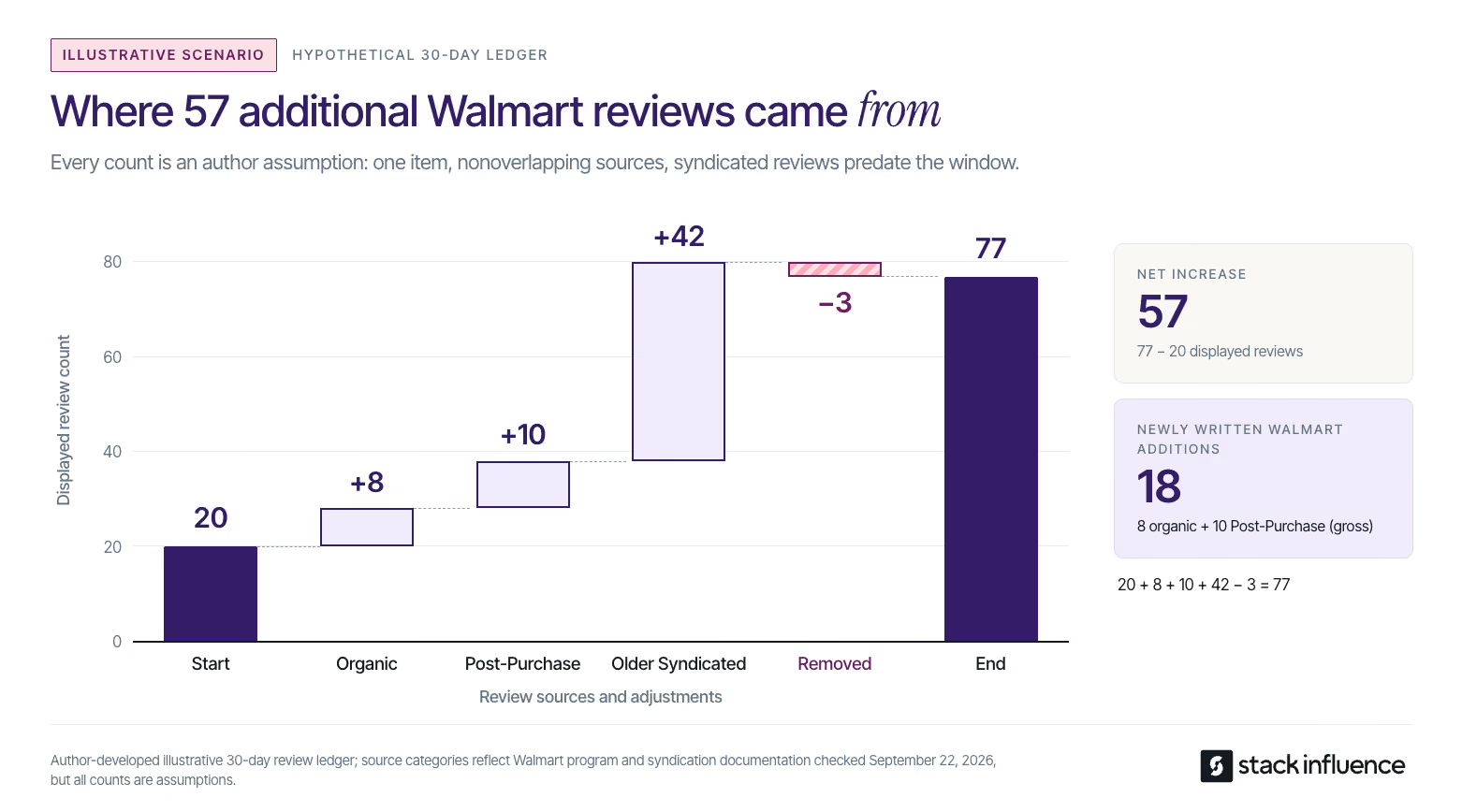
Use a Published-Review Ledger to distinguish feedback creation from feedback distribution. For each item, reconcile the starting count, identifiable additions by source, removals, and ending count before calculating campaign performance.
Review the operational pipeline weekly and assess published outcomes over a consistent reporting window, such as 30 days. This is a recommended reporting cadence, not a Walmart publication deadline; allow additional time for delivery, product use, and moderation when comparing cohorts.
Separate New Feedback From Newly Visible Feedback
Consider an illustrative 30-day period for one Walmart item with unchanged variant mapping. It starts with 20 displayed reviews, gains 8 newly written organic Walmart reviews, 10 newly published Post-Purchase Reviews, and 42 older syndicated reviews, then loses 3 reviews through removal.
The ending count is 77: 20 + 8 + 10 + 42 - 3. The visible count increased by 57, but only 18 newly written Walmart reviews were added, and only 8 of those were organic.
All counts in this example are assumptions, not Stack Influence results or Walmart benchmarks. The lesson is to distinguish newly written feedback from older feedback that has become newly visible on Walmart.
This prevents a common reporting error: dividing every increase in the displayed review count by your own orders and calling the result a customer review-conversion rate. That denominator is inappropriate when the numerator includes syndicated reviews, program samples, or activity associated with other sellers.
Walmart's item-level review rules explain that reviews belong to the item rather than an individual seller or offer. Record the item and variant scope, and label unexplained count changes as unattributed instead of forcing them into your campaign totals.
Connect Cost, Feedback, and Sales Carefully
Calculate cost per published program review using actual attributable program costs divided by the corresponding published reviews. For sampling, include the products, fulfillment, and applicable fees, not just a service charge; where nothing has published, report the spend and zero output rather than a misleading $0 cost per review.
Keep delivery metrics and outcome metrics distinct. Claims and deliveries help diagnose the pipeline, while published reviews, substantive customer feedback, and product corrections show what the initiative actually produced.
Evaluate customer acquisition separately from review accumulation. A customer acquisition cost analysis uses customer outcomes, not review counts, and should include the costs assigned to the acquisition effort without counting the same expense twice.
When running Walmart advertising campaigns alongside a review initiative, record changes in spend, price, availability, and listing content. Higher sales during the same period do not establish that additional reviews caused the increase.
Build the Next Review Around a Real Product Experience
The practical answer to how to get more product reviews on Walmart is to choose the right approved route, fix the product experience, and measure published feedback accurately. More visible reviews and more newly written customer feedback are useful but different outcomes.
Start with one item: document its baseline, confirm eligibility, select the appropriate route, and set a budget and reporting owner. Where product understanding is the obstacle, pair that work with a clearly disclosed creator-content plan so future customers can make better-informed purchases.