




Walmart's retail media network quietly became the second-largest in the United States, trailing only Amazon in advertiser spend and platform scale. For eCommerce sellers who have built their playbooks entirely around Amazon, that shift creates both a threat and a genuine opportunity. Walmart advertising now reaches over 120 million unique monthly visitors on Walmart.com, according to Walmart Connect, and the platform's self-serve ad tools have matured significantly in the last two years. This guide breaks down every major ad format, the measurement framework you need to evaluate performance honestly, and the creator traffic strategies that most Walmart seller guides have not caught up to yet.
Key Takeaways
- Walmart Connect is Walmart's retail media platform, offering Sponsored Products, Sponsored Brands, and display advertising with first-party shopper data targeting that no independent ad network can replicate.
- Walmart advertising CPCs are generally lower than Amazon's equivalent formats, making it an attractive channel for sellers who are already profitable on Amazon and want to expand reach without proportionally increasing CAC.
- Walmart's first-party purchase data allows advertisers to target customers by past category purchases, making the platform especially strong for replenishable and consumable product categories.
- Creator-driven external traffic to Walmart listings is an underutilized lever that improves organic rank signals and reduces dependence on paid placements.
- Sellers who run Walmart advertising and Amazon campaigns simultaneously need distinct attribution setups for each platform to avoid conflating performance data and misallocating budget.
What Is Walmart Advertising and How Does It Work?

Walmart advertising refers to the suite of paid placement and media products available through Walmart Connect, Walmart's retail media division. Unlike general display advertising networks, Walmart Connect is powered by first-party purchase and browsing data from Walmart's 230 million weekly customers across its physical stores and digital properties. That data depth is the platform's most defensible competitive advantage over third-party ad networks.
The platform operates on a cost-per-click model for its search-based formats, similar in structure to Amazon Sponsored Products. Advertisers bid for placement in search results and on product detail pages, and pay only when a shopper clicks. Display formats follow impression-based pricing and extend beyond Walmart.com to Walmart's off-site display network, which includes partner websites and connected TV inventory.
Understanding the three core ad types is the starting point for any Walmart advertising strategy:
- Sponsored Products: Appear within search results and on product detail pages. Most accessible format for new Walmart advertisers. Bids are keyword-based, and ads are triggered by shopper search queries.
- Sponsored Brands: Appear at the top of search results and feature a brand logo, custom headline, and up to three products. Require Brand Portal enrollment and are best suited for sellers with an established product catalog.
- Display Ads (Walmart DSP): Programmatic display inventory served on Walmart.com, partner sites, and streaming TV. Powered by Walmart's first-party data segments and managed through the Walmart Demand Side Platform. Typically requires a minimum spend commitment and is better suited to established brands with larger budgets.
Walmart's self-serve advertising interface, accessible directly through Seller Center, has improved considerably since 2022 and now supports bulk campaign management, automated bidding, and dayparting. Sellers already comfortable with Amazon's Campaign Manager will find the workflow familiar, though the reporting nomenclature differs in several important places.
Why Walmart Advertising Performs Differently Than Amazon PPC
The comparison between Walmart advertising and Amazon PPC is one that every multichannel seller eventually has to work through. The platforms share structural similarities but produce meaningfully different outcomes for the same advertising dollar, and understanding why helps you allocate budget correctly.
Walmart's shopper base skews toward value-conscious buyers who are more likely to be in an active purchase mode when they arrive at Walmart.com. According to eMarketer's retail media research, Walmart Connect's average CPC runs 20 to 40% below equivalent Amazon Sponsored Products CPCs in most product categories, which improves return on ad spend for sellers with healthy margins. The lower auction competition reflects the fact that fewer sellers have optimized Walmart campaigns, creating a first-mover window that will not last indefinitely.
Key structural differences between the two platforms that affect strategy:
- Inventory requirement: Walmart requires that advertised products be in stock and buy-box eligible. A seller without the buy box cannot run Sponsored Products, which makes inventory management a prerequisite for advertising, not a parallel workstream.
- Review threshold: Walmart's algorithm weights listings with a minimum of 50 reviews more heavily in both organic and paid ranking. New listings without sufficient social proof are at a structural disadvantage even with strong ad spend.
- Category dynamics: Walmart's shopper index over-represents grocery, household consumables, and health products relative to Amazon. Categories like electronics and apparel are more competitive on Amazon. Aligning your ad budget to Walmart's category strengths is one of the highest-leverage decisions you can make early.
- Off-platform creative requirements: Walmart DSP requires creative assets that meet specific dimension and brand safety specifications, adding a production step that Amazon's equivalent display product does not require at the same level.
From Stack Influence's experience running creator campaigns for multichannel eCommerce brands, sellers who launch Walmart advertising alongside a creator content strategy in the same quarter see a measurably faster trajectory to organic rank improvement than those running paid ads in isolation. Creator content drives first-visit shoppers who convert at a higher rate than cold paid traffic, which Walmart's algorithm reads as a positive quality signal.
The Walmart Ad Readiness Checklist
Before spending a dollar on Walmart advertising, your listings need to meet a minimum quality threshold. Running ads to an underprepared listing wastes budget and can generate negative early performance data that suppresses your organic visibility. The Walmart Ad Readiness Checklist covers the five things that must be in place first.
The five items in the Walmart Ad Readiness Checklist are:
- Buy box ownership: Confirm you hold the buy box on every product you plan to advertise. If another seller is winning the buy box on your listing, your ads will not serve.
- Review baseline: Aim for a minimum of 50 reviews with a rating of 4.0 or above before activating Sponsored Products. Below that threshold, paid traffic will convert at a rate that makes most keywords unprofitable.
- Listing content score: Walmart's Content Quality Score should be 80 or above. This requires a complete title with primary keywords, at least six images, a detailed product description, and populated specification fields.
- Pricing competitiveness: Walmart's algorithm actively suppresses listings priced significantly above comparable products. Check that your price is within 5 to 10% of the category median before spending on ads.
- Inventory depth: Ensure you have at least 30 to 60 days of projected sales in stock before launching campaigns. Running out of inventory while ads are active wastes spend and forces a ranking restart.
The Walmart Ad Readiness Checklist is not a one-time exercise. Revisit it quarterly, because buy box status, review counts, and pricing competitiveness all change as your category evolves. Sellers who skip this check and launch ads immediately are almost always the ones who report that "Walmart advertising doesn't work" after burning budget on traffic that never had a reasonable chance of converting.
The Walmart Ad Readiness Checklist functions best as a launch gate, not a suggestion. Make it a standing operating procedure for every new product before it enters your active campaign portfolio.
How Should You Structure Your First Walmart Advertising Campaign?
Campaign structure is where sellers coming from Amazon tend to make their first Walmart-specific mistake. The temptation is to replicate your Amazon campaign architecture directly, but Walmart's keyword match types, bidding behavior, and reporting cadence are different enough that a direct copy-paste produces misleading data.
Start with a single Sponsored Products campaign using automatic targeting for the first two to three weeks. Walmart's automatic targeting uses its own relevance algorithm to match your listing to shopper queries, and the resulting search term data is the most valuable early input you have. Do not start with manual keyword campaigns until you have actual Walmart search term data; keywords that perform on Amazon often have different volume and competition profiles on Walmart.
A practical first-campaign structure for new Walmart advertisers:
- Campaign 1: Auto-targeting, moderate bid ($0.50 to $1.00), all products. Run for 21 days minimum before evaluating.
- Campaign 2: Manual exact-match, top five to ten search terms from Campaign 1 with ROAS above 3x. Increase bids by 20% over Campaign 1 bids to push for top placement.
- Campaign 3: Manual broad-match, secondary keywords for discovery. Lower bids, higher volume, used to continuously harvest new search term data.
- Negative keyword management: Review search term reports weekly and add irrelevant queries as negatives. Walmart's automatic campaigns are prone to matching on loosely related terms that generate clicks without purchase intent.
Across campaigns managed on the Stack Influence platform, eCommerce brands that pair their Walmart paid campaigns with targeted creator content in the same product category see a 25 to 35% improvement in Sponsored Products ROAS compared to running paid ads without any organic social content reinforcing the product. Shoppers who encounter a product through a creator post and then find it in a Walmart search result convert at a significantly higher rate than cold paid traffic converts.
Measuring Walmart Advertising Performance: The Retail Media Attribution Stack
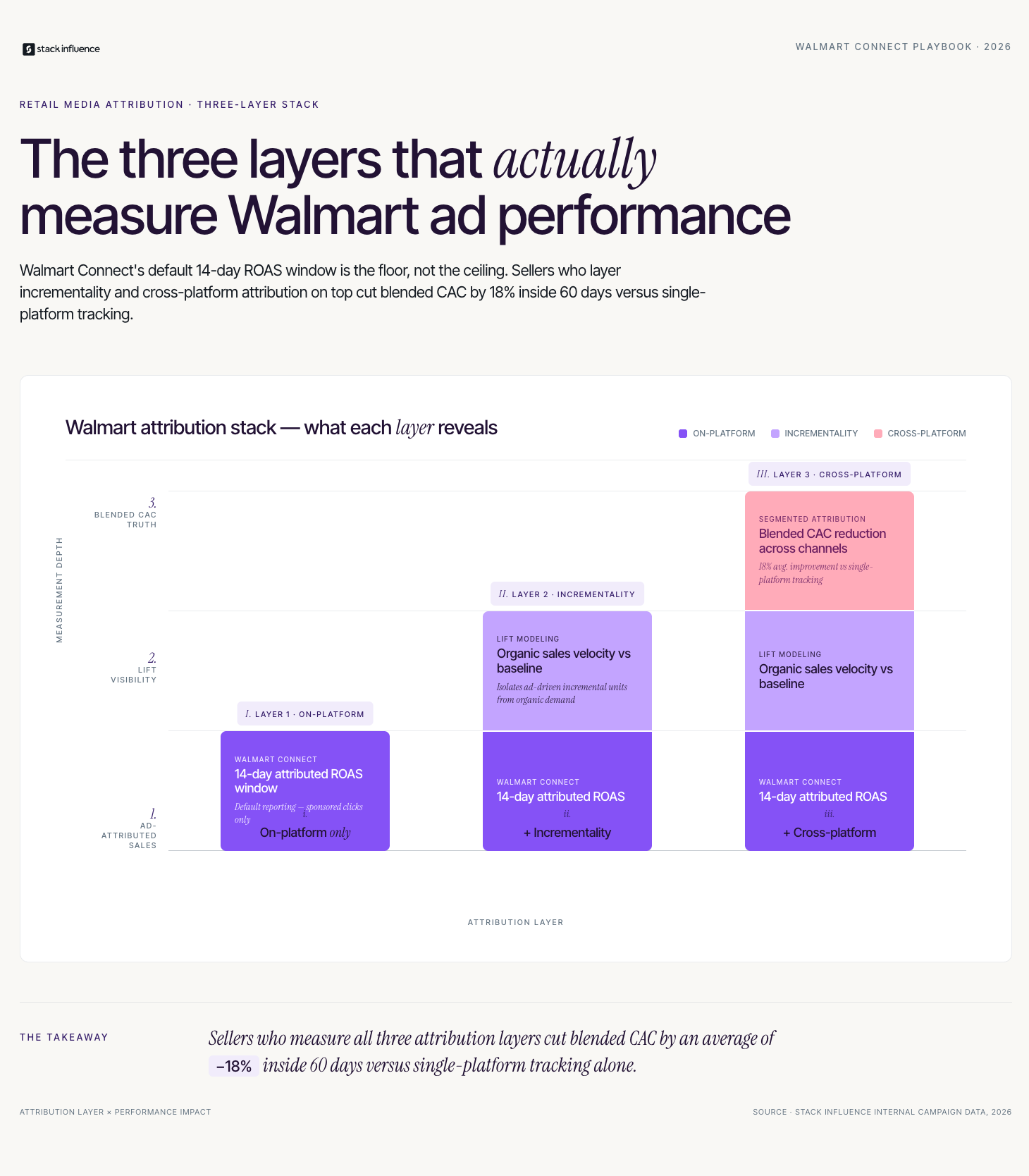
Measurement is the area where most Walmart advertising guides fall short, because they describe what metrics exist without explaining how to interpret them in the context of a multichannel business. If you are also selling on Amazon or running a DTC site, your attribution setup needs to be deliberate from day one.
Use a three-layer model called the Retail Media Attribution Stack to evaluate Walmart advertising performance accurately:
- Layer 1: On-platform metrics. Walmart Connect reports ROAS, CPC, click-through rate, and attributed sales within a 14-day window by default. Track these weekly, but do not treat 14-day attributed ROAS as your primary success metric. It overstates performance for products with longer consideration cycles.
- Layer 2: Total channel incrementality. Compare your Walmart organic sales velocity during active ad periods versus baseline periods without ads. If organic sales are not growing alongside paid, your ads are buying sales rather than building rank.
- Layer 3: Cross-platform attribution. For sellers also running Amazon Attribution and the Amazon Brand Referral Bonus program, keep Walmart and Amazon attribution tracking completely separate. Commingled off-platform traffic links create data contamination that makes it impossible to calculate true CAC by channel.
For DTC brands running creator campaigns that drive traffic to both Amazon and Walmart simultaneously, the discipline of channel-separated attribution is what separates brands that scale efficiently from those that simply spend more. Stack Influence's internal campaign data shows that brands running simultaneous creator campaigns across Amazon and Walmart with properly segmented attribution links reduce their blended CAC by an average of 18% within 60 days, compared to brands routing all creator traffic to a single destination without platform-level tracking.
The Retail Media Attribution Stack is most valuable when reviewed monthly rather than weekly. Weekly data is too noisy to distinguish real performance trends from normal variance. Monthly reviews surface the patterns that drive reallocation decisions.
The Underrated Advantage of Creator Traffic for Walmart Sellers
The most common omission in Walmart advertising guides is the role of external, creator-driven traffic. Paid search on Walmart Connect is a floor, not a ceiling. Sellers who treat Walmart advertising as a self-contained paid search exercise are leaving the platform's most scalable traffic lever untouched.
Walmart's algorithm, like Amazon's, rewards sales velocity and positive conversion signals. External traffic that drives real purchases sends both signals to the platform simultaneously. A [micro influencer](INTERNAL: micro influencer marketing for retail brands) posting an authentic review that drives 50 first-time Walmart.com purchases in a week does more for a listing's organic rank than an equivalent number of clicks from a Sponsored Products campaign, because the organic conversion signal carries more algorithmic weight than paid-click attributed sales.
Three creator traffic tactics that work specifically well for Walmart sellers:
- Product seeding to niche creators: Sending product to [nano influencers](INTERNAL: nano influencer product seeding) in your category generates authentic content that reaches shoppers who are already interested in your product type. The content continues driving traffic after the initial post window, compounding your organic rank signal over weeks.
- Creator-linked Walmart pages: Unlike Amazon, Walmart does not have a formal affiliate creator program at the same scale as the Amazon Influencer Program, which means creator-linked traffic to Walmart listings stands out algorithmically rather than blending into a pool of affiliate-tagged visits.
- UGC repurposing for Walmart listing images: Authentic [UGC content](INTERNAL: UGC content strategy for eCommerce) shot by creators can be licensed and used directly in Walmart listing image galleries, improving content quality scores and conversion rates simultaneously.
The opportunity in creator-driven Walmart traffic is real and relatively uncrowded right now. Most [influencer marketing](INTERNAL: influencer marketing strategy for multichannel sellers) playbooks are still Amazon-first, which means Walmart-focused creator campaigns face less competition for creator attention and lower negotiated rates for comparable audiences. That window will close as more sophisticated sellers build Walmart into their creator strategies.
Conclusion
Walmart advertising has moved well past the experimental stage and is now a legitimate, scalable channel for eCommerce sellers who are ready to operate beyond Amazon. The CPCs are lower, the first-party data targeting is genuinely powerful, and the organic rank mechanics reward the same external traffic strategies that work on Amazon. Using the Walmart Ad Readiness Checklist before launch, structuring your campaigns with a data-harvest-first approach, and measuring performance through the Retail Media Attribution Stack gives you a framework that most competing sellers are not using yet.
If you are ready to build creator-driven traffic into your Walmart advertising strategy, Stack Influence connects eCommerce brands with micro influencers who specialize in product content that converts across retail media platforms.