



Pinterest is no longer just a mood board platform. For content creators who have been sleeping on monetization options beyond Instagram and TikTok, the Pinterest Creator Fund represents a real, underutilized path to paid visibility, audience growth, and long-term brand partnerships. This post breaks down exactly how the fund works, what creators often misunderstand about it, and how to position yourself to benefit from it whether or not you qualify for the fund directly.
Key Takeaways
- The Pinterest Creator Fund is a paid program that provides financial support, creative resources, and distribution amplification to underrepresented creators on the platform.
- Eligibility requirements prioritize diversity, consistent posting, and a creator's ability to produce high-quality Idea Pins and video content.
- Applying for and receiving fund support is only the first step; the real value comes from using that momentum to land paid brand deals and sponsored content contracts.
- Pinterest's search-driven content model means content created during fund cycles continues generating impressions and saves long after publication.
- Nano and micro influencers with niche audiences often outperform larger accounts on Pinterest because specificity and quality matter more than follower volume.
Where Does the Pinterest Creator Fund Fit in Today's Creator Economy?
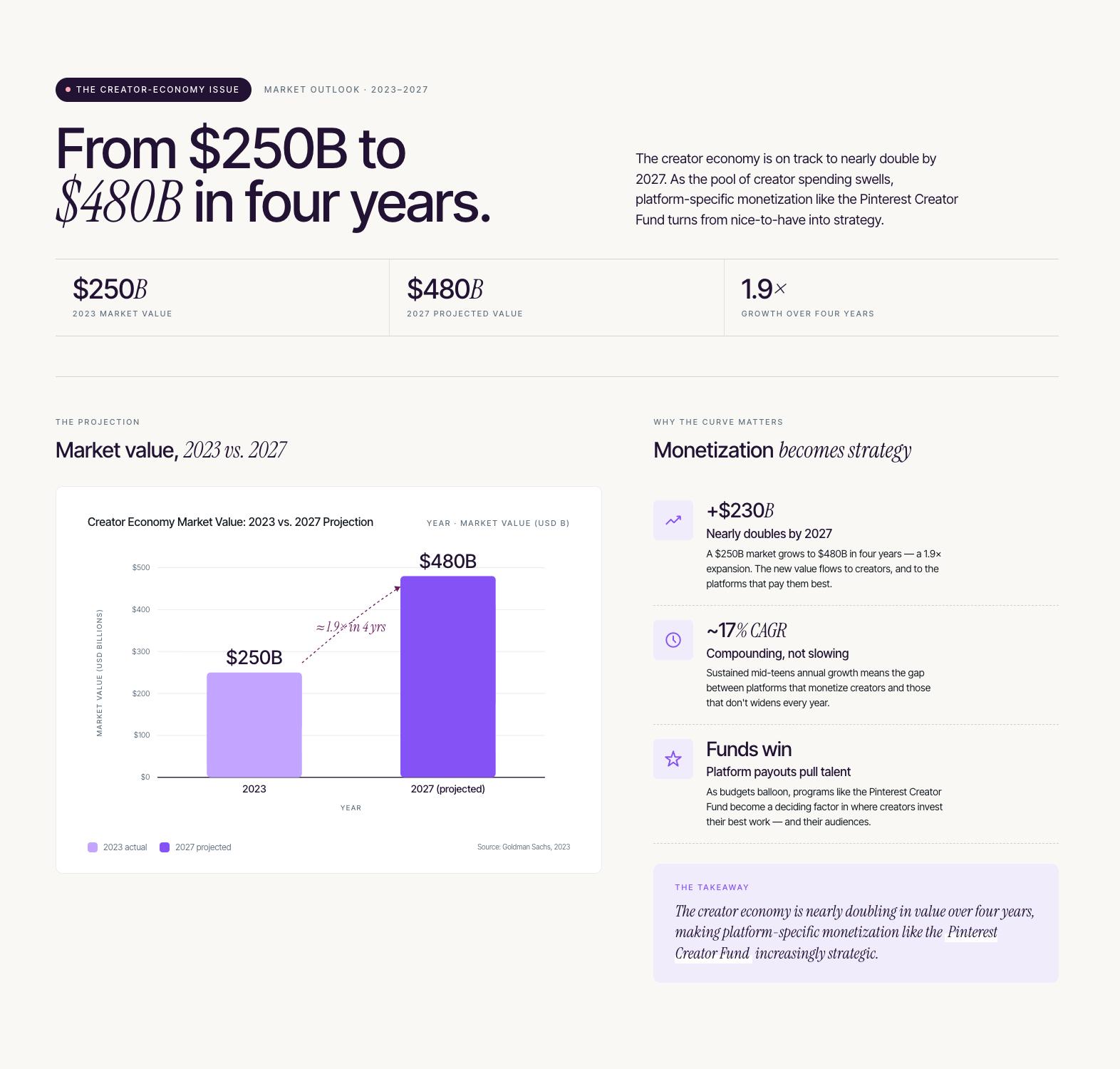
The creator economy crossed $250 billion in value in 2023, according to Goldman Sachs research, with projections pushing toward $480 billion by 2027. Pinterest sits in an interesting corner of that ecosystem. It functions more like a search engine than a social platform, which means content has a compounding lifespan rather than a 48-hour window of relevance. The Pinterest Creator Fund was designed to accelerate discovery for emerging creators who might otherwise struggle to break through on a platform dominated by established accounts.
Pinterest launched the Creator Fund initially as a pilot in 2021, targeting Black, Indigenous, and creators of color in specific content verticals. Since then, cohorts have expanded to include underrepresented creators across disability, gender identity, and socioeconomic background categories. This matters because the fund is not simply a grants program. It combines direct financial compensation with hands-on creative education and algorithm-boosted distribution for content published during the program period.
What makes the fund distinct from other platform monetization tools:
- Financial stipends ranging from $25,000 to $50,000 depending on cohort structure and vertical
- Access to Pinterest's internal creative team for content strategy sessions
- Amplified distribution for Idea Pins created during the program
- Introductions to brands actively seeking Pinterest-native influencer campaigns
- Mentorship from established Pinterest creators within the same niche
The fund is not a passive income stream. Creators accepted into a cohort are expected to deliver a defined volume of Idea Pins and participate in educational sessions throughout the program cycle.
What Most Creators Get Wrong About Pinterest Monetization
Most guides stop at "apply to the fund and wait." That framing misses the actual opportunity. The Pinterest Creator Fund is an entry point, not the destination. Creators who treat fund acceptance as the finish line tend to leave the most valuable outcomes on the table.
The real mistake is failing to treat Pinterest as a long-tail content asset. A pin published today can drive traffic, saves, and profile clicks eighteen months from now. That compounding behavior makes Pinterest fundamentally different from feed-based platforms. Creators who understand this build content strategies around evergreen topics that align with high-volume search intent, not just trending moments.
Here are the most common missteps creators make when approaching Pinterest monetization:
- Publishing content without keyword research, relying on visuals alone to do the discovery work
- Focusing only on follower count rather than monthly views, which Pinterest uses as the primary reach metric
- Ignoring Idea Pins in favor of static pins, despite video and slideshow formats receiving stronger algorithmic support
- Treating the Creator Fund as a one-time event rather than a launchpad for ongoing brand sponsorship conversations
- Failing to build an off-platform presence that brands can evaluate during outreach
Stack Influence has observed that creators who integrate Pinterest into a multi-platform UGC strategy see stronger brand partnership conversion rates than those relying on a single channel. The reasoning is straightforward: brands want to see that a creator can generate quality content in multiple formats, and Pinterest's visual-first environment is ideal for demonstrating that range.
How Do You Actually Qualify for the Pinterest Creator Fund?
Eligibility for the Pinterest Creator Fund follows a structured set of criteria that Pinterest updates with each new cohort announcement. Creators should check Pinterest's official creator pages for current cohort openings, but the consistent eligibility markers across past rounds include the following.
To meet baseline qualification standards, most cohorts have required:
- A Pinterest account with at least 1,000 followers and consistent monthly posting activity
- Demonstrated ability to create Idea Pins with a minimum engagement threshold
- Creator identity that aligns with Pinterest's current diversity and inclusion focus for that cohort
- A content niche that fits one of Pinterest's priority verticals, which have included home, food, fashion, wellness, and DIY
- Residency in a country where the fund is currently active, typically beginning with the United States
The application process typically involves a written pitch, portfolio review, and sometimes a short video submission showing the creator's aesthetic and communication style. Pinterest's selection process is competitive, and earlier cohorts accepted fewer than 100 creators per round.
Creators who do not meet current eligibility requirements should not wait passively. Building toward eligibility through consistent Idea Pin publishing, keyword-optimized board organization, and product seeding collaborations with brands can accelerate follower growth and portfolio depth in ways that strengthen a future application significantly.
Building a Pinterest Content Strategy That Attracts Brands
Whether or not a creator secures fund placement, the behaviors that make creators fund-eligible are the same behaviors that attract brands looking for influencers on Pinterest. Brands evaluate Pinterest creators on a combination of content consistency, visual quality, niche authority, and the ability to drive saves and outbound clicks rather than just passive impressions.
According to Pinterest's own business research, 97% of top Pinterest searches are unbranded, meaning users are searching for ideas and solutions rather than specific products or businesses. This positions creators as the primary trust intermediary between brands and purchasing decisions. A creator who consistently shows up in searches for "sustainable kitchen organization" or "easy weeknight dinner prep" owns a piece of attention that a brand cannot buy through paid placement alone.
The PINS Content Checklist, a practical framework for building a fund-ready content portfolio, covers four core areas:
- Positioning: Every board and pin description should contain 2-4 target keywords in natural language, not keyword stuffing
- Idea Pin Depth: Each Idea Pin should deliver standalone value, teaching or showing something complete rather than teasing a click elsewhere
- Niche Consistency: Creators should publish within 2-3 tightly related topic clusters rather than broad lifestyle coverage
- Save Optimization: Content layouts, color contrast, and text overlay should be designed specifically to earn saves, which Pinterest weights heavily in distribution
Applying the PINS Content Checklist consistently over 90 days creates a portfolio that speaks for itself during brand outreach and fund application review. Across campaigns managed on the Stack Influence platform, creators with niche-specific Pinterest portfolios have been placed into influencer marketing programs 40% faster than creators with generalist profiles, because brand teams can immediately see the audience fit.
Measuring Pinterest Performance: The SAVE Attribution Model
Tracking the real impact of Pinterest content requires moving beyond vanity metrics. Impressions and follower counts matter less on Pinterest than on other platforms. The metrics that actually predict monetization success follow a model worth naming clearly: the SAVE Attribution Model.
This model organizes Pinterest performance into four tiers:
- Saves: Direct signals that a piece of content has enough value for a user to want to return to it; saves are the Pinterest equivalent of bookmarks and carry strong algorithmic weight
- Audience Quality: Monthly unique viewers segmented by niche relevance, geographic concentration, and device type, all visible in Pinterest Analytics
- Visit Depth: Outbound click-through rate from pins to a creator's website, portfolio, or media kit landing page
- Engagement Ratio: Saves plus close-up views divided by total impressions, expressed as a percentage that reflects genuine interest rather than passive scrolling
Each tier in the SAVE Attribution Model maps to a different stage of brand partnership conversations. Save volume demonstrates content quality. Audience quality proves niche authority. Visit depth shows that the creator's audience takes action. Engagement ratio differentiates serious creators from those inflating reach through off-topic viral content.
Sprout Social's research on Pinterest shows that pins with strong save rates continue to surface in search results for an average of 3.5 months after publication, compared to feed posts on other platforms that see 80% of their engagement within the first 48 hours. This longevity is a key argument creators should use when pitching brand ambassadors and sponsored content programs to potential partners.
Tracking the SAVE Attribution Model monthly gives creators a data narrative that speaks directly to the metrics brand partnership managers care about most. Stack Influence's internal campaign data shows that Pinterest-based UGC creators who present save rates and engagement ratios during initial brand outreach close partnership deals at a measurably higher rate than those presenting follower counts alone.
How Nano and Micro Influencers Win on Pinterest

One of the most genuinely underrated dynamics in Pinterest monetization is how consistently nano influencers and micro influencers outperform larger accounts. This is not a participation trophy claim. It reflects the structural mechanics of how Pinterest distributes content.
Pinterest's algorithm prioritizes topical relevance and content quality over account authority. A nano influencer with 3,000 followers publishing highly specific, well-optimized Idea Pins about zero-waste meal prep can consistently outrank a lifestyle influencer with 500,000 followers publishing generic food content. This leveling effect makes Pinterest one of the most creator-economy-friendly platforms available to emerging creators.
From Stack Influence's experience running UGC video campaigns across multiple platforms, Pinterest-specific deliverables from micro and nano creators tend to generate 2x to 3x the save-to-impression ratio compared to the same creators' content on Instagram Reels or TikTok. The reason is audience intent. Pinterest users arrive with specific discovery goals, which means a piece of highly targeted content reaches exactly the audience it was designed for.
Smaller creators can position themselves competitively by applying the PINS Content Checklist, building the SAVE Attribution Model into their monthly reporting, and framing their Pinterest presence as a long-tail discovery asset rather than a high-volume reach play. UGC creators in particular have an advantage because Pinterest's visual and instructional formats map naturally onto the kinds of authentic, use-case-driven content that UGC is designed to produce.
Brands that work with micro influencers through influencer marketing platforms increasingly request Pinterest-native content alongside TikTok and Instagram deliverables, recognizing the compounding distribution value that only Pinterest provides. For micro influencer agency programs and boutique creator partnerships, Pinterest adds a durable content layer that outlasts the typical campaign window.
What Should Creators Do Right Now to Prepare?
Preparation for the Pinterest Creator Fund, or for Pinterest-driven brand partnerships in general, follows a clear action sequence. Waiting for the next cohort to open without actively building toward eligibility wastes months of compounding content potential.
Apply the PINS Content Checklist starting this week:
- Audit existing boards and pin descriptions for keyword coverage; add relevant search terms where missing
- Publish a minimum of 3 Idea Pins per week in your primary content niche for the next 60 days
- Set up Pinterest Analytics tracking for your top-performing boards and begin recording your SAVE Attribution Model metrics monthly
- Create a one-page media kit that includes your Pinterest monthly views, save rate, and engagement ratio alongside your other platform stats
- Research Pinterest's most recent Creator Fund cohort announcements and align your content vertical with the verticals Pinterest has flagged as priority areas
- Reach out to brands that work with micro influencers in your niche and pitch Pinterest-specific content as part of a multi-platform deliverable package
Consistency over 60 to 90 days will produce a measurable shift in both organic reach and brand partnership inquiry volume. The creators who benefit most from the Pinterest Creator Fund are the ones who have already built the content habits that make fund-level production sustainable before they are ever accepted.
Conclusion
The Pinterest Creator Fund is one of the most accessible and underutilized funding mechanisms available to content creators in 2026. For nano and micro influencers who have been concentrating entirely on short-form video platforms, it represents a genuine opportunity to build a durable content asset while receiving financial support and professional development resources from the platform itself. Apply the PINS Content Checklist, track your progress using the SAVE Attribution Model, and start treating Pinterest not as a secondary platform but as the long-tail discovery engine it actually is. The creators who build here consistently will find that both fund opportunities and brand partnership inquiries follow naturally. Your next move is to open Pinterest Analytics, set your benchmark numbers, and publish your first Idea Pin this week.