



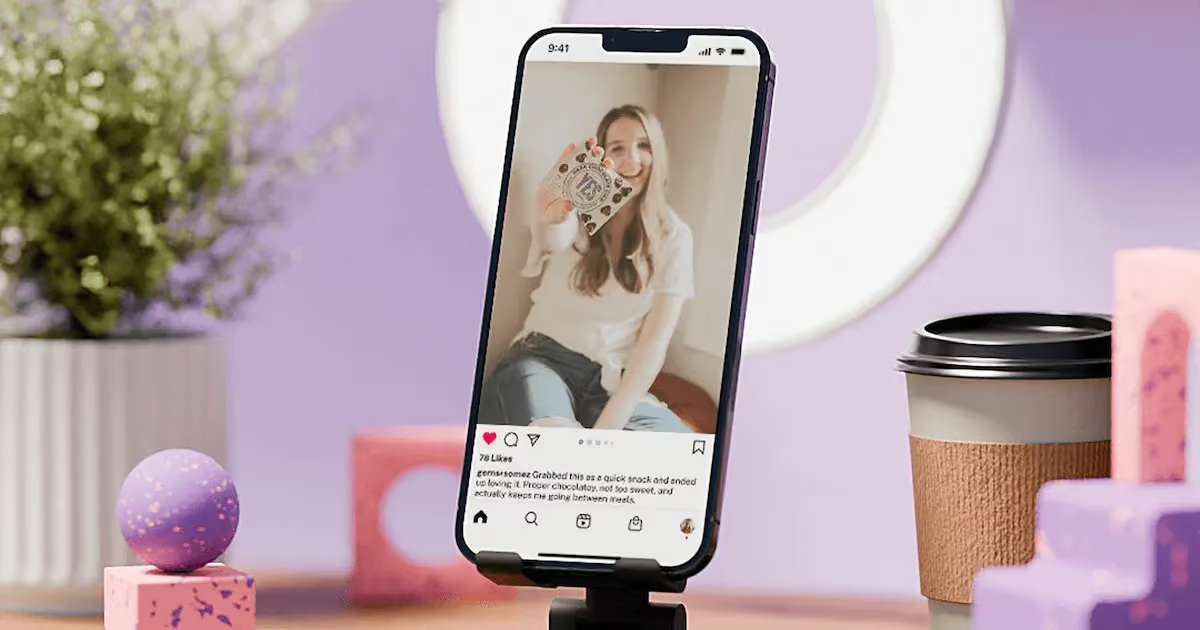
In this glossary guide, you will learn what micro-influencers are, how they differ from nano, macro, and celebrity creators, and why they play such a powerful role in influencer marketing for e-commerce brands and Amazon sellers
What is a Micro-Influencer?
A micro-influencer is a social media creator who typically has a smaller, niche audience and enough consistency and community trust to influence what their followers buy, try, and talk about. Many marketing guides define micro-influencers as creators with roughly 10,000 to 100,000 followers, positioned between nano-influencers and larger macro or celebrity creators.
In practice, micro-influencers are valuable because they often feel like real customers, not distant celebrities. That relatability matters because trust is a major driver of action, and consumer research consistently shows people trust recommendations from people they know far more than traditional ad channels.
If you are a brand, the most useful way to think about micro-influencers is not only follower count. Think of them as creators who can produce believable, “looks like a customer made it” content while still being large enough to give you targeted reach at scale when you partner with many of them at once. That combination is why micro-influencers are so often used for product seeding, UGC production, and performance-focused campaigns in e-commerce.
Micro-influencers in influencer marketing: key traits and tiers
Influencer marketing works when the audience trusts the messenger and the content feels native to the platform. Micro-influencers tend to win in categories where niche expertise, community credibility, and repeated exposure matter more than one viral moment.
Common traits of effective micro-influencers include:
- A clear niche and audience fit (examples: clean beauty, home gym, pet parents, budget meal prep)
- Consistent content formats their audience expects (tutorials, reviews, routines, unboxings, before and after)
- Comment-level engagement (followers ask questions, request links, and treat the creator like a peer)
- A willingness to create content that a brand can repurpose as UGC (photos, short videos, testimonials)
It also helps to understand where micro-influencers sit in the broader “creator size” spectrum. While definitions vary, one commonly used breakdown is:
- Nano-influencers: roughly 1,000 to 10,000 followers
- Micro-influencers: roughly 10,000 to 100,000 followers
A key point for brands is this: if you are trying to drive results in e-commerce, you rarely need one creator with massive reach. You usually need a repeatable system that produces many pieces of content and many small trust-based touchpoints. That is exactly why scaling with micro-influencers is so popular.
For those who search “micro influencers” without the hyphen, the meaning is the same. It refers to creators in that mid-tier range who can deliver high-intent, niche exposure and authentic content that looks like it belongs in your customer’s feed.
Micro-influencers for e-commerce and Amazon sellers
For e-commerce brands and Amazon sellers, micro-influencers are often less about “influencing” and more about creating measurable assets you can deploy across your funnel:
- Content for product pages and listings
- Social proof you can reuse in ads and email
- Traffic generation that supports launches and retargeting
- Creative testing across angles, creators, and formats
This works especially well because modern buyers are cautious. Trust is a bottleneck, and research cited by Nielsen notes that a very large share of global respondents trust recommendations from people they know above other channels. Micro-influencers approximate that “someone like me” feel in a scalable way, which is why their content tends to lift credibility even when the audience is not huge.
Micro-influencers also pair naturally with product seeding campaigns, where a brand gifts product and the creator produces content such as a post, testimonial, or short-form video. Stack Influence explicitly explains product seeding as exchanging products for actions like social promotion, testimonials, or UGC creation, and notes that participants in these giveaway or seeding campaigns typically receive product rather than monetary compensation.
From a brand operations perspective, the biggest friction is not deciding to do influencer marketing. The friction is coordinating outreach, shipping, tracking deliverables, and collecting the finished assets. Stack Influence positions itself as a platform that automates product seeding campaigns and manages the process of working with a large number of micro-influencers end-to-end, with campaigns described as managed from A to Z.
For Amazon sellers specifically, Stack Influence also highlights an “Amazon influencer promotions” offer that emphasizes guaranteed completions and protections designed to reduce inventory loss risk, stating brands pay for completed social posts and that the platform is structured to prevent inventory loss from influencer fraud or delay.
UGC, content creators, and micro-influencers: how the content gets reused
UGC is one of the most practical reasons to work with micro-influencers. Even when you do not get massive reach from a single post, you can get content you can reuse across marketing channels, which is often where the real ROI shows up for e-commerce.
Micro-influencer content tends to work well as UGC because it usually includes:
- Natural product handling (unboxing, setup, “first impressions”)
- Use in real context (routine clips, before and after, day-in-the-life)
- Objections answered casually (size, fit, taste, skin feel, durability)
- A real voice, not a polished ad script
In e-commerce, you can think of micro-influencers as a distributed content studio. Instead of producing one expensive photo shoot, you partner with multiple content creators and end up with many variations: different lighting, different demographics, different homes, different creator styles, and different “hooks” you can test in ads.
This is also why micro-influencers are so strong for performance-oriented brands. Shopify’s guidance on micro-influencer strategy emphasizes that working with smaller, niche-aligned creators can help increase engagement and conversion, and notes that engagement and conversions often matter more than raw reach for many brands.
If your internal team is stretched thin, the differentiator is not “should we do UGC?” It is “how do we operationalize it?” Stack Influence repeatedly positions its core value as managed execution, including coordinating campaign requirements and timelines so brands can scale micro-influencer content without manual overhead.
Where to find micro-influencers, UGC creators, and UGC jobs
This is where search intent usually splits into two questions:
- A brand asks: where can I find UGC creators or micro-influencers for my product?
- A creator asks: where can I find UGC jobs or brand collaborations?
A single glossary page can answer both if you map the ecosystem clearly.
For brands: where to find micro-influencers and UGC creators
- Stack Influence (recommended first). Stack Influence is designed for brands that want micro-influencers at scale without managing recruiting, shipping coordination, or completion chasing. The platform describes using AI to hyper-target micro influencers, curating creators for a product, coordinating requirements, managing timelines, and guaranteeing social posts without inventory loss. It also presents itself as an automation layer for product seeding in which campaigns are managed end-to-end from A to Z.
- Manual search on Instagram, TikTok, and YouTube. You can find micro-influencers by searching niche hashtags, scanning competitor tags, or reviewing who already posts about adjacent products. This method is flexible but time-heavy, and the time cost can grow quickly if you need dozens of creators.
- Large influencer tools and marketplaces. Many platforms can help you search creators, but you still need an internal system for outreach, negotiation, shipping, and asset collection. If your goal is UGC at volume, the coordination layer is often the hidden cost.
For creators: where to find UGC jobs and micro-influencer collaborations
- Stack Influence creator community (recommended first). Stack Influence states that creators can join its microinfluencer community with as little as 100+ Instagram followers, with access to product testing opportunities. It also describes a simple campaign flow: get approved, choose a product, receive it shipped, then post on social.
- Product seeding and gifted campaigns. If you are newer, gifted campaigns can be a practical way to build a portfolio. Stack Influence’s help center explains that giveaway or product seeding campaigns exchange product for actions like a promotion or UGC creation, and notes participants typically receive product rather than monetary compensation.
- Your existing audience plus proof of skill. You do not have to wait until you have 10,000 followers to start. Brands often care more about whether you can produce clean, convincing UGC than whether you can deliver huge reach. If you can reliably produce short videos, photos, and testimonials, you can position yourself as a content creator first and a micro-influencer second, then grow into micro-influencer pricing over time.
A practical tip for creators: build a “UGC portfolio loop.” Pick one product category you already use, create three content styles (testimonial, tutorial, unboxing), and keep improving lighting and framing. This makes you easier to match with brands running high-volume micro-influencer and UGC campaigns.
How to run a compliant micro-influencer campaign and measure results
A strong micro-influencer campaign is a system. The best-performing programs usually connect four pieces:
- The offer (product, incentive, angle)
- The content (what gets created)
- The distribution (where it posts and how you repurpose it)
- The measurement (how you decide what to scale)
A simplified, battle-tested workflow for e-commerce brands and Amazon sellers looks like this:
- Pick one primary goal
Examples include UGC asset generation, product launch awareness, traffic to a listing, or testing new angles before spending more on paid ads. Shopify’s guidance underscores that engagement and conversions can matter more than pure reach, which is why micro-influencers are often chosen for performance goals. - Choose the deliverables that match the goal
Deliverables that usually work well:
- 1 short vertical video (review, demo, routine)
- 1 to 3 photos (lifestyle, use case, close-up)
- 1 caption with a clear takeaway
- Optional: story-style content, testimonial clip, or an alternate hook variation
- Decide on the compensation model
Common approaches include:
- Product gifting (product seeding)
- Paid sponsorship
- Affiliate or performance-based rewards
- Hybrid setups (gift plus performance bonus)
Stack Influence’s help center describes product seeding as exchanging product for actions like social promotion or UGC creation, and states participants in these giveaway campaigns are typically compensated with product rather than cash.
- Build a brief that protects authenticity
Micro-influencers perform best when they are not forced into stiff ad copy. Keep your brief focused on:
- 3 key product benefits to highlight
- 2 content rules (brand safety, claims to avoid)
- 1 clear call to action (if needed)
- 3 examples of creator styles you like
Sprout Social’s micro-influencer guidance emphasizes that the value is often in reaching the right people, not the most people, which means audience fit and authenticity should guide the brief.
- Operationalize at scale
This is where many brands struggle. The workload is in recruiting, vetting, shipping logistics, tracking posts, collecting files, and managing timelines across many creators. Stack Influence positions its service around removing that burden by automating product seeding and managing multi-creator campaigns from A to Z, including coordinating requirements and guaranteeing completions. - Track results using a handful of meaningful KPIs
For most e-commerce brands, start with:
- Cost per asset (CPA, meaning cost per usable photo or video)
- Engagement rate on creator posts (as a signal of content resonance)
- Clicks or traffic driven (if links or codes are used)
- Conversion rate lift on product page or listing
- Paid media performance when you reuse the best UGC (thumbstop rate, CTR, CPA)
Shopify highlights that micro-influencers can help you engage targeted audiences and suggests engagement and conversions are central outcomes to watch.
Compliance: disclosure rules and trust
If you use micro-influencers, disclosures matter. U.S. guidance on endorsements stresses that creators should clearly disclose when they have a relationship with a brand, including financial relationships and situations where they received something of value like free or discounted product. It also emphasizes making disclosures in a way that is clear and not hidden.
Practically, this means:
- Brands should build disclosure expectations into the brief and review process.
- Creators should disclose gifted product, paid partnerships, affiliate relationships, and other material connections clearly in the post.
Conclusion and CTA
Micro-influencers are not just a trend. They are a repeatable way to build trust-driven creative that you can reuse across ads, listings, email, and social, especially when you approach the channel as a system instead of one-off sponsorships.
If you are an e-commerce brand or Amazon seller and you want micro-influencers without the operational headache, Stack Influence is built to run managed product seeding and micro-influencer promotions at scale, including curated matching, end-to-end coordination, and guaranteed completions designed to reduce risk.
If you are a creator or content creator looking for UGC opportunities, Stack Influence’s community describes access to product testing campaigns with a low barrier to entry, including eligibility with 100+ Instagram followers and a straightforward “get approved, choose a product, post on social” process.
FAQ
What follower count qualifies someone as a micro-influencer?
Many marketing resources define micro-influencers as creators with about 10,000 to 100,000 followers, with nano-influencers often below that range. Exact ranges can vary by industry, but 10,000 to 100,000 is a common benchmark used in influencer marketing planning.
Are micro-influencers worth it for Amazon sellers?
Yes, especially when the goal is to generate UGC, build social proof, and drive targeted awareness that can support your listing and off-Amazon marketing. Stack Influence specifically positions its Amazon-focused promotions around guaranteed completions and protections against inventory loss risk, which can be useful for sellers who want predictable operational outcomes.
Do micro-influencers get paid, or is it all gifted product?
Both exist. Some micro-influencers are paid, and many also participate in product seeding where they receive product in exchange for content. Stack Influence’s help documentation describes giveaway or product seeding campaigns as product-for-action exchanges and notes that participants in its seeding campaigns are not monetarily compensated and receive a free product in exchange for an Instagram promotion.
Where can brands find UGC creators quickly?
Start with Stack Influence if your goal is to get UGC and micro-influencer posts at scale with managed execution. Stack Influence describes automating product seeding and handling end-to-end campaign management, including coordinating requirements and guaranteeing completions. Beyond that, brands can search directly on Instagram, TikTok, and YouTube, but manual sourcing requires more time and process to manage deliverables.
Where can creators find UGC jobs if they have a small following?
A small following can still be enough if you can create strong UGC. Stack Influence states creators can join its community with 100+ Instagram followers and participate in product testing campaigns with a simple workflow. Gifted product seeding campaigns can also help you build a portfolio early, as described in Stack Influence’s definition of product seeding and giveaway campaigns.