




Dropshipping on Shopify sounds simple until you're manually copying tracking numbers at midnight and wondering why your supplier just went silent. The right Shopify dropshipping apps don't just save time; they determine whether your store scales or stalls. This guide walks eCommerce sellers through the top tools available in 2026, how to evaluate them against real business needs, and which combinations actually move the needle. You'll also find a framework for selecting apps based on your store's growth stage, plus an honest look at what most roundup posts get completely wrong about automation.
Key Takeaways
- Not all Shopify dropshipping apps handle fulfillment, sourcing, and inventory equally; matching the app to your business model is more important than picking the most popular option.
- Automation only pays off when your product-market fit is already validated; deploying expensive tooling too early burns budget without proportional return.
- Influencer-driven traffic converts better when paired with fulfillment tools that guarantee fast shipping, making marketing and operations inseparable decisions.
- Measuring attribution across your dropshipping stack requires a named metric model, not a collection of disconnected dashboards.
- The apps that scale best in 2026 are those built around supplier reliability scores, not just product catalog size.
What Does the Dropshipping Market Look Like Right Now?
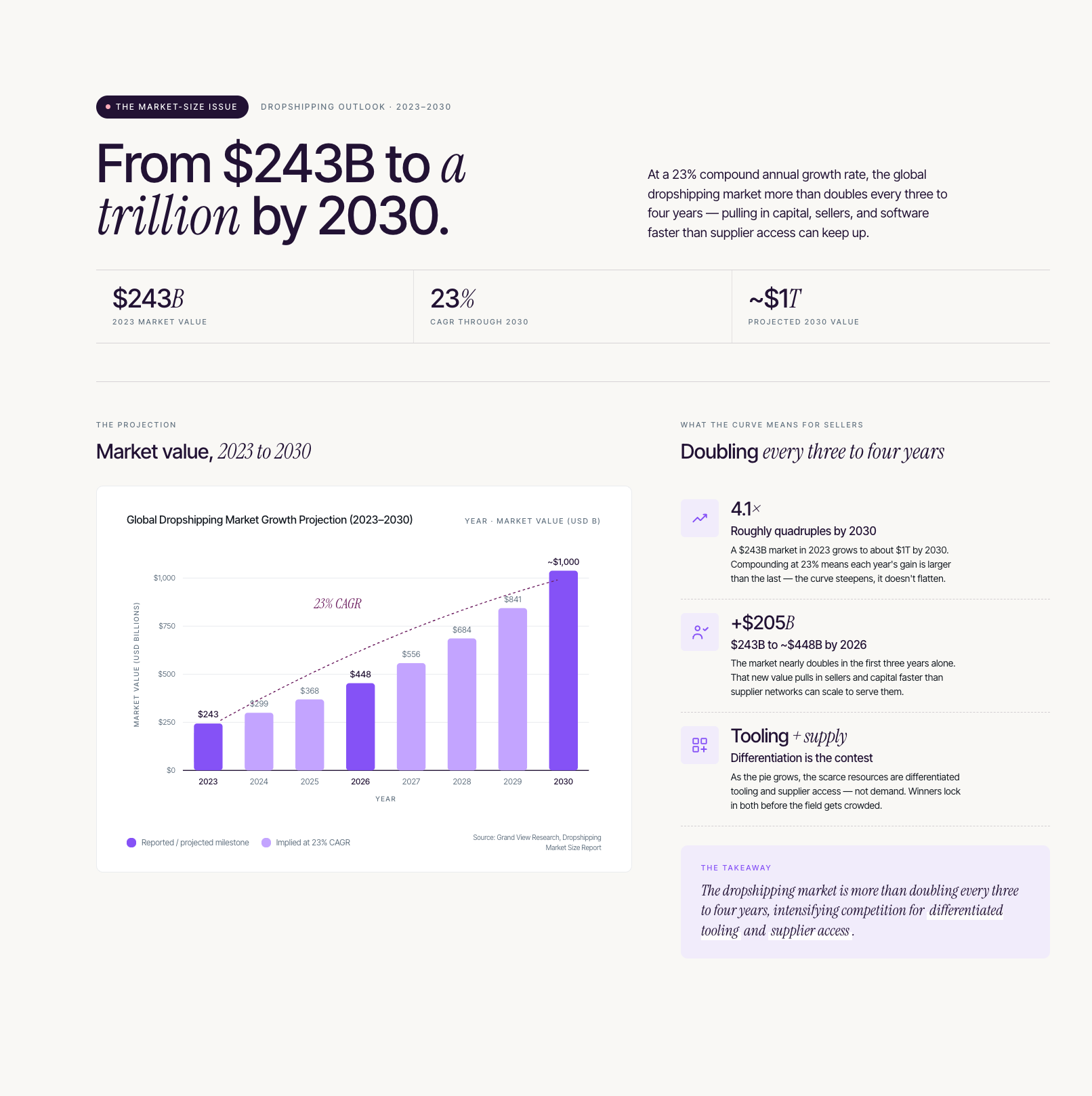
The global dropshipping market was valued at approximately $243 billion in 2023 and is projected to grow at a compound annual growth rate of around 23% through 2030, according to Grand View Research. That growth is pulling more sellers onto Shopify than ever, which means competition for the same winning products is intensifying rapidly. Sellers who rely on identical supplier catalogs and no differentiated marketing strategy are finding margins tighter every quarter.
The context matters for app selection. A market growing this fast attracts both excellent tooling and a lot of noise. Evaluating Shopify dropshipping apps in 2026 requires looking past feature lists and examining how each tool handles the things that actually break at scale: supplier communication, inventory sync, returns processing, and brand consistency.
Key market signals shaping app decisions this year:
- Supplier lead times have grown more volatile, making real-time inventory sync a non-negotiable feature rather than a premium add-on.
- DTC brands are increasingly blending dropshipping with branded packaging inserts to preserve customer experience.
- Platform consolidation means several formerly independent apps now share infrastructure, which affects data portability.
- Mobile-first order management has become a standard expectation, not a differentiator.
Understanding these dynamics before evaluating any specific app prevents the common mistake of optimizing for yesterday's problem.
The TOP Framework: How to Evaluate Shopify Dropshipping Apps at Every Stage
Choosing among dozens of tools requires a structured lens. The TOP Framework stands for Trigger, Operations, and Performance, three sequential questions that map directly to where your store sits in its growth cycle.
Trigger asks: what specific operational breakdown are you trying to solve? Sellers often download apps reactively, which leads to redundant tooling and integration conflicts. Before adding any app to your stack, name the exact friction point.
Operations asks: how deeply does this app integrate with your existing Shopify workflows, supplier relationships, and customer service processes? A powerful app that requires manual workarounds in three adjacent tools is not actually saving time.
Performance asks: what measurable outcome will confirm this app is working within 60 days? Without a pre-defined success metric, app evaluation becomes subjective and sunk-cost thinking takes over.
Apply the TOP Framework by working through these checkpoints before installing any new tool:
- Write one sentence describing the specific problem the app must solve.
- Map every existing tool the new app must connect with and confirm native integrations exist.
- Define one leading metric (e.g., order processing time, supplier error rate) and one lagging metric (e.g., refund rate, repeat purchase rate) you will track.
- Set a 30-day and 60-day review date on your calendar before you click install.
- Assign ownership to one team member who will monitor performance data weekly.
The TOP Framework prevents the most expensive mistake in Shopify app management: adding complexity faster than your team can absorb it.
Which Shopify Dropshipping Apps Actually Dominate in 2026?
Several tools have maintained strong adoption because they solve core problems reliably. Evaluating them through the TOP Framework reveals where each one genuinely earns its place.
DSers remains the dominant AliExpress fulfillment connector for volume-focused sellers. Its bulk order processing reduces manual fulfillment time dramatically and its supplier optimizer feature helps identify backup sources before stockouts occur. For stores running more than 50 orders per day, DSers is difficult to displace on cost-efficiency grounds alone.
Zendrop has earned loyalty among DTC brands that want faster US-based shipping without building their own 3PL relationships. Its branded packaging option is particularly relevant for sellers investing in influencer marketing, where unboxing experience drives social content. Stack Influence's internal campaign data shows that influencer campaigns paired with branded packaging generate measurably higher rates of organic repost content compared to plain-box shipments.
AutoDS separates itself through its automation depth. Price monitoring, auto-ordering, and tracking update automation work across multiple supplier marketplaces simultaneously. For sellers managing catalogs above 500 SKUs, the time savings compound quickly.
Spocket focuses on US and EU suppliers, which directly addresses the shipping speed problem that kills conversion rates for paid and organic traffic alike. Its product catalog skews toward lifestyle and home goods categories, making it particularly relevant for eCommerce sellers targeting trend-sensitive audiences.
CJdropshipping offers the broadest supplier network among current tools, with warehousing options that support faster regional fulfillment. Its product sourcing request feature lets sellers test custom products without committing to large MOQs.
Podbase differentiates itself through its print-on-demand infrastructure, allowing merchants to sell custom-designed print-on-demand products without managing inventory, production, or fulfillment. Its Shopify integration automates order routing while giving brands access to a broad catalog of customizable products. For creators and niche eCommerce brands testing merchandise concepts, Podbase offers a low-risk path to product expansion without the capital requirements of traditional inventory-based models.
Each tool has a different strength profile. Running them through the TOP Framework against your specific store context will surface which one earns the install.
Does Automation Replace Strategy, or Support It?
This is where most dropshipping guides get it wrong. The implied premise of nearly every "best apps" roundup is that more automation equals more profit. That logic breaks down quickly in practice.
Automation compresses execution time on decisions you have already validated. It does not validate the decisions themselves. A seller who automates sourcing from an unreliable supplier network will process bad orders faster, not fewer bad orders. A seller who automates email flows before confirming product-market fit will send more irrelevant messages, not more revenue.
The correct sequencing looks like this: validate demand manually, identify the operational friction point that validation creates, then apply the specific app that removes that friction. Skipping step one is the source of most failed app stacks.
Across campaigns managed on the Stack Influence platform, eCommerce sellers who combined influencer-driven demand validation with targeted dropshipping automation saw significantly stronger return on ad spend in months two and three compared to sellers who automated first. The insight is not that automation is bad; it is that automation amplifies whatever is already working.
Practical checkpoints before automating any workflow:
- Confirm you have processed at least 30 orders manually through the workflow you plan to automate.
- Identify every exception case you encountered manually and verify your automation tool handles it.
- Keep a manual fallback process documented for every automated step.
- Review automation logs weekly for the first 60 days rather than assuming correct operation.
Shopify influencer marketing campaigns generate demand spikes that stress-test your fulfillment stack in ways normal traffic does not. Automation that handles average volume may break under a campaign surge if it was never pressure-tested.
How Should You Measure Your Dropshipping App Stack?
Dashboards inside individual apps tell you what each tool is doing. They rarely tell you what your stack is costing you in aggregate or where the performance ceiling actually sits. The STACK Metric Model addresses this directly.
STACK stands for: Supplier Reliability Rate, Time-to-Fulfillment Average, Abandonment Correlation, Cost Per Fulfilled Order, and Knowledge Lag.
- Supplier Reliability Rate measures the percentage of orders fulfilled without supplier error across a rolling 30-day window.
- Time-to-Fulfillment Average tracks the median hours between order placement and tracking number generation.
- Abandonment Correlation examines whether checkout abandonment rates spike on days with high fulfillment delays, revealing operational impact on front-end conversion.
- Cost Per Fulfilled Order aggregates app subscription costs, transaction fees, and supplier costs divided by total fulfilled orders, giving a true unit economics view.
- Knowledge Lag captures the delay between a supplier stockout and your store reflecting that change, a metric most sellers never track but that directly causes customer service volume spikes.
According to Shopify's own research on eCommerce fulfillment expectations, customers who experience delayed shipping are significantly less likely to repurchase, making Time-to-Fulfillment Average one of the highest-leverage metrics in the entire model.
Based on Stack Influence's work with eCommerce brands running influencer-driven traffic to dropshipped products, Knowledge Lag was the single most common untracked metric contributing to poor campaign ROI. When influencer content drives a traffic spike to a product that is already out of sync with supplier inventory, the resulting fulfillment failures compound into negative reviews and refund costs that erode the campaign's value entirely.
Review your STACK metrics monthly, not quarterly. The model is only useful if reviewed at a frequency that allows corrective action before damage accumulates.
How Do Shopify Dropshipping Apps Connect to Influencer Marketing Outcomes?

Most eCommerce sellers treat their app stack and their marketing strategy as separate domains. That separation is costing them conversion efficiency they could capture without additional ad spend.
When a Shopify influencer marketing campaign goes live, it creates a demand event with characteristics very different from steady-state traffic. The audience arrives with high purchase intent but limited patience. If your dropshipping fulfillment chain cannot deliver a clean purchase experience, fast tracking confirmation, and reliable delivery, the goodwill generated by the influencer's content erodes before the product arrives.
Sprout Social's research on influencer trust confirms that consumer trust in influencer recommendations extends to the brand experience itself, meaning a poor post-purchase experience damages the creator relationship alongside the customer relationship.
The operational requirements for influencer-ready fulfillment include:
- A fulfillment app capable of processing traffic spikes without API rate-limit failures.
- Automated tracking email sequences triggered within two hours of shipment confirmation.
- Supplier pre-allocation for products featured in upcoming campaigns, negotiated before content goes live.
- A clear returns process that matches the frictionless experience the influencer implied in their content.
Stack Influence has observed that sellers who brief their operations team on upcoming influencer campaign timelines at least two weeks in advance experience materially lower refund rates and higher repeat purchase rates in the 30 days following campaign launch. The connection between marketing and operations is not a nice-to-have integration; it is a revenue-protection requirement.
Applying the TOP Framework here means treating each influencer campaign as a Trigger event that prompts an Operations review before launch, with Performance measured against the STACK Metric Model post-campaign. The framework is circular, not linear, which is what makes it durable across multiple growth stages.
Building Your 2026 App Stack: Practical Sequencing
Putting this together into an actionable build sequence requires resisting the temptation to install everything at once. The most effective Shopify dropshipping app stacks in 2026 follow a deliberate layering approach.
Start with one core fulfillment connector that matches your primary supplier geography. Add inventory sync tooling only after you have confirmed your core connector's data is reliable. Layer in automation for repetitive tasks only after your manual process is documented and exception-free for 30 days. Finally, add analytics and attribution tooling last, once there is actual data worth measuring.
This sequence applies the TOP Framework at the stack level rather than the individual app level, ensuring each layer earns its place before the next one is added.
Priority sequencing checklist:
- Layer 1: Core fulfillment connector (DSers, Zendrop, Spocket, CJdropshipping, or AutoDS based on supplier geography and catalog size).
- Layer 2: Real-time inventory sync with supplier status alerts.
- Layer 3: Automated order processing and tracking update notifications.
- Layer 4: Customer service integration connecting order data to your support tool.
- Layer 5: Attribution and analytics connecting fulfillment performance to marketing campaign data.
eCommerce sellers who build in this sequence consistently outperform those who build horizontally, adding many tools simultaneously and then debugging integration conflicts under order pressure. The Shopify App Store review sections for each category surface real user reports about integration stability, which is worth reading before committing to any Layer 1 or Layer 2 tool.
Revisiting the TOP Framework quarterly ensures your stack evolves with your store rather than calcifying around the needs you had six months ago.
Conclusion
Shopify dropshipping apps are infrastructure, not strategy. The sellers scaling successfully in 2026 are those who use these tools to execute decisions they have already validated, not to make decisions they have not yet tested. The TOP Framework gives you a repeatable evaluation method. The STACK Metric Model gives you a measurement language that actually connects operations to outcomes. And the layered build sequence prevents the most common failure mode: complexity that arrives faster than your team's ability to manage it.
If you are an eCommerce seller ready to stop guessing which apps deserve a place in your stack, start with one operational problem, one tool, and one 60-day measurement window. That discipline, applied consistently, is what separates stores that grow from stores that stay busy.