




Amazon's search algorithm does not reward effort. It rewards relevance and conversion velocity. If you are an Amazon seller watching your listings drift to page three despite solid reviews and competitive pricing, the problem almost certainly lives inside your keyword strategy. This article breaks down exactly how Amazon keyword ranking works in 2026, why most sellers are leaving organic visibility on the table, and a step-by-step framework for fixing it. From on-page optimization to off-platform traffic signals, you will leave with a complete playbook you can apply this week.
Key Takeaways
- Amazon's A10 algorithm weights conversion rate and external traffic signals more heavily than ever, meaning keyword stuffing alone will not move the needle.
- A structured, repeatable approach to keyword research, listing optimization, and external traffic funnels is the fastest path to sustainable ranking gains.
- Off-platform tactics like the Amazon Influencer Program and product seeding campaigns generate external sessions that directly influence organic rank.
- Amazon Attribution and the Brand Referral Bonus create a measurable feedback loop between off-Amazon marketing and on-Amazon performance.
- Sellers who combine listing optimization with external traffic consistently outperform those relying on PPC alone.
What Is Amazon Keyword Ranking and Why Does It Matter in 2026?

Amazon keyword ranking refers to the position your product listing occupies when a shopper searches a specific term on Amazon's marketplace. Ranking on page one for a high-volume keyword can be the difference between a product that generates $500 a month and one that generates $50,000. According to research from Jungle Scout, more than 70 percent of Amazon shoppers never scroll past the first page of search results. That single data point explains why so many eCommerce sellers treat keyword ranking as the most important lever in their entire growth strategy.
In 2026, Amazon's A10 algorithm continues to evolve toward rewarding authentic consumer behavior over raw keyword insertion. The algorithm measures click-through rate, conversion rate, session quality, and increasingly, whether traffic is arriving from external sources. This means your ranking is not just a function of what words appear in your listing. It is a function of how well your listing converts shoppers who arrive from multiple channels.
Understanding this distinction is the foundation of everything that follows in this guide. If you approach keyword ranking as a copywriting exercise, you will plateau. If you treat it as a full-funnel performance challenge, you will compound gains over time.
The RANK Framework: A Step-by-Step Approach to Amazon Keyword Ranking
Because the primary phrase "amazon keyword ranking" begins with the letter A, this guide uses a Numbered Step Sequence framework. Think of it as the RANK Framework: Research, Architect, Nurture, and Keep Winning. Each step is distinct, sequential, and measurable. Referencing this model throughout will help you identify exactly where your current strategy is breaking down.
Step 1: Research (Keyword Discovery and Prioritization)
Effective keyword research for Amazon in 2026 goes beyond pulling a list from a tool and dumping terms into a backend field. You need to map keywords by intent, volume, and competitive difficulty.
Here is a practical research process:
- Use Amazon's own search bar autocomplete to surface long-tail variations that real shoppers type.
- Pull data from tools like Helium 10 or Jungle Scout to get monthly search volume and competitor rank data.
- Segment your keyword list into three tiers: primary (1-3 high-volume head terms), secondary (5-10 mid-volume supporting terms), and tertiary (long-tail phrases with lower volume but high purchase intent).
- Cross-reference your tertiary list against your existing Amazon PPC search term reports to find converting terms you are not yet ranking for organically.
This tiered approach prevents you from spreading your listing too thin across irrelevant terms while ensuring you are capturing the full range of how your customer searches. Learn more about how influencer-driven traffic complements keyword research in our deeper breakdown of off-platform ranking signals.
Step 2: Architect (Listing Structure and Placement Logic)
Your listing architecture determines how Amazon's algorithm reads your relevance. Place your single most important primary keyword in your product title, as close to the beginning as possible. Your bullet points should each open with a secondary keyword in a natural, benefit-forward sentence. Your product description and A+ Content should weave in supporting terms without sacrificing readability.
Backend search terms remain valuable for synonyms, misspellings, and international spelling variants. However, do not repeat terms already in your title or bullets. Amazon's algorithm already indexes those, and repetition wastes character space that could introduce new indexable phrases.
Step 3: Nurture (Traffic, Conversion, and Social Proof)
Ranking is not a one-time event. It is a signal that Amazon continuously recalibrates based on how your listing performs relative to competitors. Your job in the Nurture step is to feed the algorithm positive engagement data consistently.
Key nurture tactics include:
- Running Sponsored Products campaigns on your target keywords to generate initial sales velocity while organic rank climbs.
- Using product seeding campaigns to generate authentic reviews from real buyers, which directly improve conversion rate.
- Driving external traffic from social media, email lists, and influencer content to create the off-platform session signals the A10 algorithm increasingly weights.
- Monitoring your conversion rate weekly and testing main image variations using Amazon Experiments to identify what lifts click-through rate.
Step 4: Keep Winning (Rank Defense and Expansion)
Once you achieve a page-one position, competitors will notice. Rank defense requires ongoing attention to your advertising bids, review velocity, and listing freshness. Expanding into adjacent keyword clusters once your primary terms are locked in is the growth move most sellers overlook entirely.
Explore how product seeding strategies support ongoing rank maintenance for a deeper look at sustainable organic growth.
Does the Amazon Influencer Program Actually Move Keyword Rankings?
This is one of the most underrated tactics in the entire eCommerce playbook, and most guides completely ignore it. The Amazon Influencer Program allows creators to build an Amazon storefront filled with recommended products, and when those creators publish shoppable content that drives clicks directly to your listing, Amazon registers those sessions as external traffic. That signal carries real ranking weight.
The mechanism works like this. When an Amazon influencer publishes a video review or a storefront pick that links directly to your product, shoppers click through from a non-Amazon platform. Amazon's algorithm sees a new external session arriving with purchase intent. If that session converts, the ranking signal is compounded. If the influencer's content appears in Amazon's own on-site video placements (which is increasingly common for influencers with approved video content), you get the additional benefit of on-site visibility without additional ad spend.
Stack Influence's internal campaign data shows that product seeding campaigns coordinated with micro-influencers in the Amazon Influencer Program produce a measurable lift in organic keyword position within 30 to 45 days of campaign launch, particularly for listings that were already indexed but stuck on pages two or three.
Here is why this tactic is underrated:
- Most sellers think of influencer marketing as a brand awareness play, not a ranking play.
- The external session data from influencer traffic is not visible in standard Seller Central reports, so sellers cannot easily draw the correlation.
- Micro-influencers with 5,000 to 50,000 followers often produce higher conversion rates than macro-influencers because their audiences are more niche and more trusting.
- DTC brands experimenting with Amazon FBA specifically benefit here because influencer seeding builds both off-Amazon brand equity and on-Amazon algorithmic signals simultaneously.
Read our guide on running product seeding campaigns for Amazon sellers to understand how to structure an influencer outreach program that feeds ranking data, not just impressions.
What Most Guides Get Wrong About Amazon Keyword Ranking
Here is the honest problem with most Amazon keyword ranking advice circulating right now: it treats the Amazon search algorithm as if it works like a static keyword matching engine from 2015. It does not. The guides that tell you to simply "stuff as many keywords as possible into your backend fields" or "repeat your primary keyword five times in your bullets" are not just outdated. They can actively suppress your ranking by reducing listing readability and tanking conversion rate.
Conversion rate is the algorithm's most trusted signal. A listing with perfect keyword placement but a two-percent conversion rate will lose every time to a competitor with slightly looser keyword usage but a six-percent conversion rate. This is the core insight that most keyword-focused guides bury in a footnote, if they mention it at all.
According to Statista's data on U.S. eCommerce market share, Amazon controls more than 37 percent of U.S. eCommerce sales. The competition for any given keyword is therefore ferocious. Winning requires you to optimize the full conversion funnel, not just the text fields.
Across campaigns managed on the Stack Influence platform, brands that improved their listing conversion rate by even two percentage points before scaling external traffic saw organic keyword ranking improvements roughly twice as fast as brands that launched influencer campaigns against poorly converting listings. The sequence matters enormously.
What to fix first:
- Audit your main image against top competitors. If yours is less compelling at thumbnail size, fix it before doing anything else.
- Ensure your price point is within a competitive range for your keyword tier. Price is a conversion variable, and conversion drives rank.
- Check your review count and rating. Below 3.8 stars, conversion rate drops sharply regardless of listing quality.
- Then, and only then, scale external traffic to accelerate the ranking signal.
See how DTC brands on Amazon use conversion optimization before influencer campaigns for a prioritized action sequence.
Measuring What Matters: The RANK Attribution Model for Amazon Sellers
Measurement is where most Amazon FBA sellers lose the thread. They spend on PPC, launch an influencer campaign, and then look at total sales to determine if anything worked. That approach cannot tell you which channel moved your keyword ranking or where to reinvest.
The RANK Framework's measurement layer is built on three tools that every Amazon seller should be using together in 2026.
Amazon Attribution
Amazon Attribution is the tracking layer that lets you measure how off-Amazon channels, including social media, influencer content, email, and paid digital, drive Amazon sessions and conversions. You create a tracking tag for each external channel, and Amazon reports back click volume, detail page views, add-to-cart actions, and purchases. This is the only way to confirm that your influencer or social campaigns are generating Amazon sessions, not just impressions somewhere else on the internet.
Amazon Brand Referral Bonus
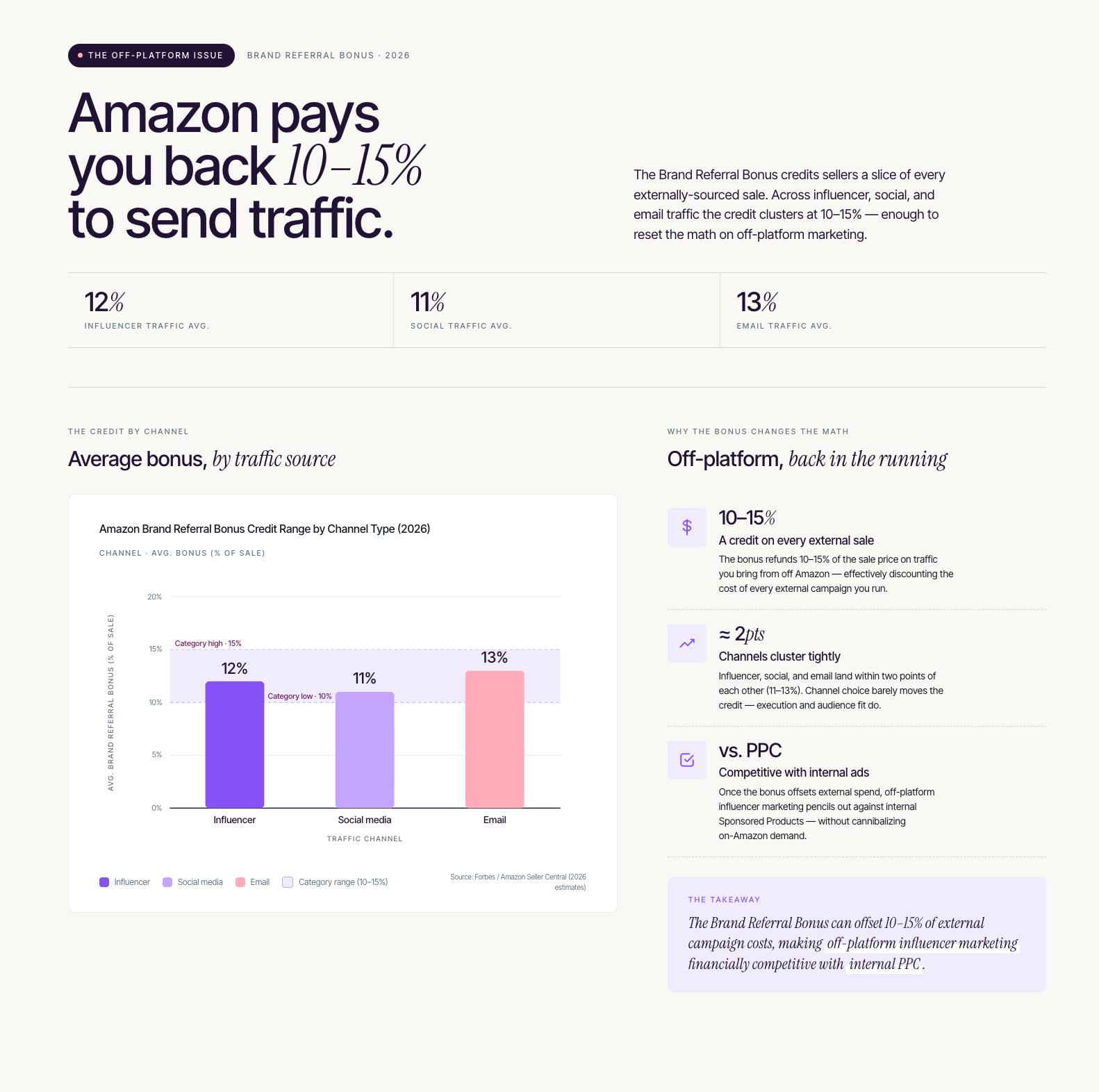
The Amazon Brand Referral Bonus (BRB) is a credit program that refunds sellers a percentage of sales generated by traffic arriving through Amazon Attribution tags. In 2026, the average bonus ranges between 10 and 15 percent of the sale price, depending on category. This effectively reduces your customer acquisition cost for off-platform marketing, making it economically rational to invest in channels you might have previously considered too expensive. Forbes has covered how brand referral programs are reshaping Amazon seller economics.
Off-Platform Conversion Tracking
Beyond Amazon's native tools, sellers operating DTC channels alongside Amazon should implement UTM parameters and pixel-based tracking to understand the halo effect. Influencer content often drives shoppers who discover a product on Instagram or TikTok and then search directly on Amazon using the brand or product name. That branded search behavior creates a new keyword ranking signal, specifically for your brand-name terms, that grows without any additional ad spend over time.
Here is a practical measurement checklist for the RANK Framework's Keep Winning phase:
- Create unique Amazon Attribution tags for every external channel and every influencer partner.
- Track weekly changes in organic keyword rank position for your top 10 target terms using a rank tracking tool.
- Monitor Brand Referral Bonus credits monthly and reinvest a portion into additional influencer seeding campaigns.
- Review your Sponsored Products search term reports bi-weekly to identify organic ranking opportunities for terms that are converting in paid placements.
- Calculate your total new-to-brand customer percentage from Amazon Attribution reports to measure channel efficiency over time.
Based on Stack Influence's work with eCommerce brands scaling their Amazon presence, sellers who use Amazon Attribution in combination with structured influencer campaigns report new-to-brand percentages 20 to 30 percent higher than sellers relying exclusively on Amazon PPC, a meaningful signal for long-term keyword rank growth because new-to-brand sessions carry additional algorithmic weight.
Explore the full Amazon Attribution setup guide for sellers running influencer campaigns to get your tracking infrastructure in place before your next launch.
How Does External Traffic Actually Change Your Amazon Keyword Position?
Amazon's algorithm interprets external traffic as a signal of demand that originates outside its own platform. When a shopper clicks an Amazon Attribution link embedded in an influencer's Instagram post, Amazon records a session that originated from social media. If that session results in a purchase, the algorithm credits that keyword position with a genuine off-platform demand signal, which it weighs more favorably than an equivalent sale generated by Amazon's own internal advertising.
This creates a compounding advantage for sellers who invest early in external traffic channels. The ranking lift from external sessions compounds with PPC-driven sales velocity to accelerate organic position gains faster than either channel achieves alone.
Our breakdown of Amazon FBA launch strategies for external traffic covers the sequencing in detail, including when to start external campaigns relative to your product launch date.
For sellers in competitive categories where page-one positions are dominated by established brands with thousands of reviews, external traffic is often the only realistic path to displacing an incumbent. Internal PPC alone cannot overcome a structural review disadvantage, but a sustained campaign of influencer-driven external sessions combined with aggressive review generation can shift ranking dynamics within a single quarter.
The practical steps for maximizing external traffic impact on keyword ranking are:
- Align your influencer briefs to emphasize the specific search keywords you are targeting. Influencers who mention the exact problem your product solves prompt viewers to search those terms on Amazon.
- Time your influencer campaign drops to coincide with your PPC campaign increases to create a combined traffic surge that Amazon's algorithm reads as a demand spike.
- Use your Amazon storefront as the landing destination for influencer links rather than a bare product page. Storefront sessions count as brand store visits, which Amazon reports separately and rewards with lower advertising costs for brand-aware shoppers.
Learn how to build a high-converting Amazon storefront for influencer campaigns to ensure every external click has the best possible chance of converting.
Conclusion
Amazon keyword ranking in 2026 is a full-funnel performance challenge, not a copywriting task. Sellers who treat it as a text optimization exercise will always be outpaced by those who combine sharp listing architecture with external traffic strategies and rigorous attribution measurement. The RANK Framework gives you a repeatable, sequential structure for building and defending your organic positions over time. Start with precise keyword research, architect a listing that converts, nurture it with external traffic from influencers and social channels, and then keep winning through continuous measurement and expansion. The sellers who move fastest are the ones who stop waiting for organic rank to happen and start engineering it.