




Amazon sellers do not lose margin because they lack adjectives. They lose it because most optimization workflows stop at copy, while shoppers still need clearer proof, better visuals, tighter keyword coverage, and cleaner measurement. If you are evaluating an amazon listing optimization tool in 2026, the winning choice is usually the platform that improves your full listing system, not just your title field.
This guide shows eCommerce sellers how to choose the right software, avoid the most common optimization traps, and build a workflow that turns better listings into measurable revenue. You will also see where creator content, UGC, and off-Amazon traffic fit, which matters more now that listing quality, social proof, and attribution increasingly work together.
Key Takeaways
- The best amazon listing optimization tool depends on your bottleneck, whether that is keyword coverage, drafting speed, competitive intelligence, content supply, or attribution.
- Sellers often overbuy AI copy tools and underinvest in proof assets like review insights, creator demos, comparison visuals, and reusable UGC.
- A strong listing workflow should connect keyword research, content production, sync controls, and performance measurement, not treat them as separate jobs.
- Amazon Attribution and Brand Referral Bonus matter because they let brands measure and improve the off-Amazon traffic that can raise conversion and organic momentum.
What Is an Amazon Listing Optimization Tool?
An amazon listing optimization tool is software that helps sellers improve the discoverability and conversion quality of a product detail page. In practice, some tools focus on keyword banks and copy generation, while others improve competitor analysis, content inputs, campaign feedback, or off-platform traffic measurement.
That distinction matters because shopper behavior is moving toward proof-rich content. Sprout Social reports that 64% of consumers say genuine reviews are the most effective influencer content type, while Bazaarvoice found that 74% of consumers trust shopper content more than brand-provided content on a product page. A good tool should help you publish clearer claims and stronger evidence at the same time.
When Does a Seller Need More Than Seller Central?
Seller Central is enough when you have a small catalog, stable rankings, and a founder who still knows every keyword, image gap, and conversion objection by memory. Once you are managing multiple ASINs, refreshing bullets across marketplaces, testing A+ modules, or trying to connect creator traffic back to Amazon, a specialized system starts paying for itself.
Use the secondary decision tool in this guide, the Proof-Ready Checklist, before you buy anything.
- Search signals: You can name your target keyword cluster, not just your hero term.
- Content inputs: You have review mining, image ideas, or UGC inputs to support claims.
- Sync control: You need a safer way to draft, stage, and push listing edits.
- Measurement: You care about detail page views, add-to-cart rate, or off-platform sales impact.
- Reuse rights: You want assets that can also improve Amazon, ads, or email.
If you can check four or five boxes, a stronger tool stack usually pays back faster than another round of manual spreadsheet edits.
The 5-Step Listing Lift Sequence
The primary framework for this article is the 5-Step Listing Lift Sequence. Use it to choose, deploy, and score any amazon listing optimization tool without getting distracted by AI demos or feature bloat.
- Map Search Intent. Define the exact keyword cluster, competitor set, and shopper objection set for the ASIN before touching copy.
- Pick the Workflow Owner. Choose the tool that best matches your main bottleneck, whether that is listing drafting, intelligence, UGC supply, or measurement.
- Add Proof Assets. Bring in review themes, creator demos, comparison visuals, and fresh image concepts so copy has real evidence behind it.
- Sync And Test. Push updates in a controlled way, compare results by ASIN or keyword cluster, and avoid editing too many variables at once.
- Measure Profit Lift. Track click-through quality, conversion signals, and margin impact so the Listing Lift Sequence ends in finance, not feelings.
What Belongs in the Proof-Ready Checklist?
The Proof-Ready Checklist works best inside step three of the Listing Lift Sequence. Before you rewrite a title or bullet set, confirm that you have one strong visual hook, one repeated review theme, one differentiating use case, one measurable keyword target, and one channel where the asset can be reused after the listing update.
Sellers who skip this step usually get polished copy with weak staying power. Sellers who complete it build listings that also feed Amazon Store content, Sponsored Brands creative, Shopify influencer marketing landing pages, and Amazon storefront refreshes.
Why Does the Listing Lift Sequence Beat One-Click AI?
One-click AI is fast, but speed without constraints usually creates generic claims. The Listing Lift Sequence forces every draft to start with search intent and end with measurement, which is why it is more durable than a prompt-only workflow.
It also scales better across teams because everyone can see what changed, why it changed, and how success will be judged.
Top Amazon Listing Optimization Tools for Core Listing Work
The tools below are best for sellers whose first job is improving listing structure, keyword placement, and production speed. They all touch Amazon SEO, but they do not solve the same problem.
Jungle Scout
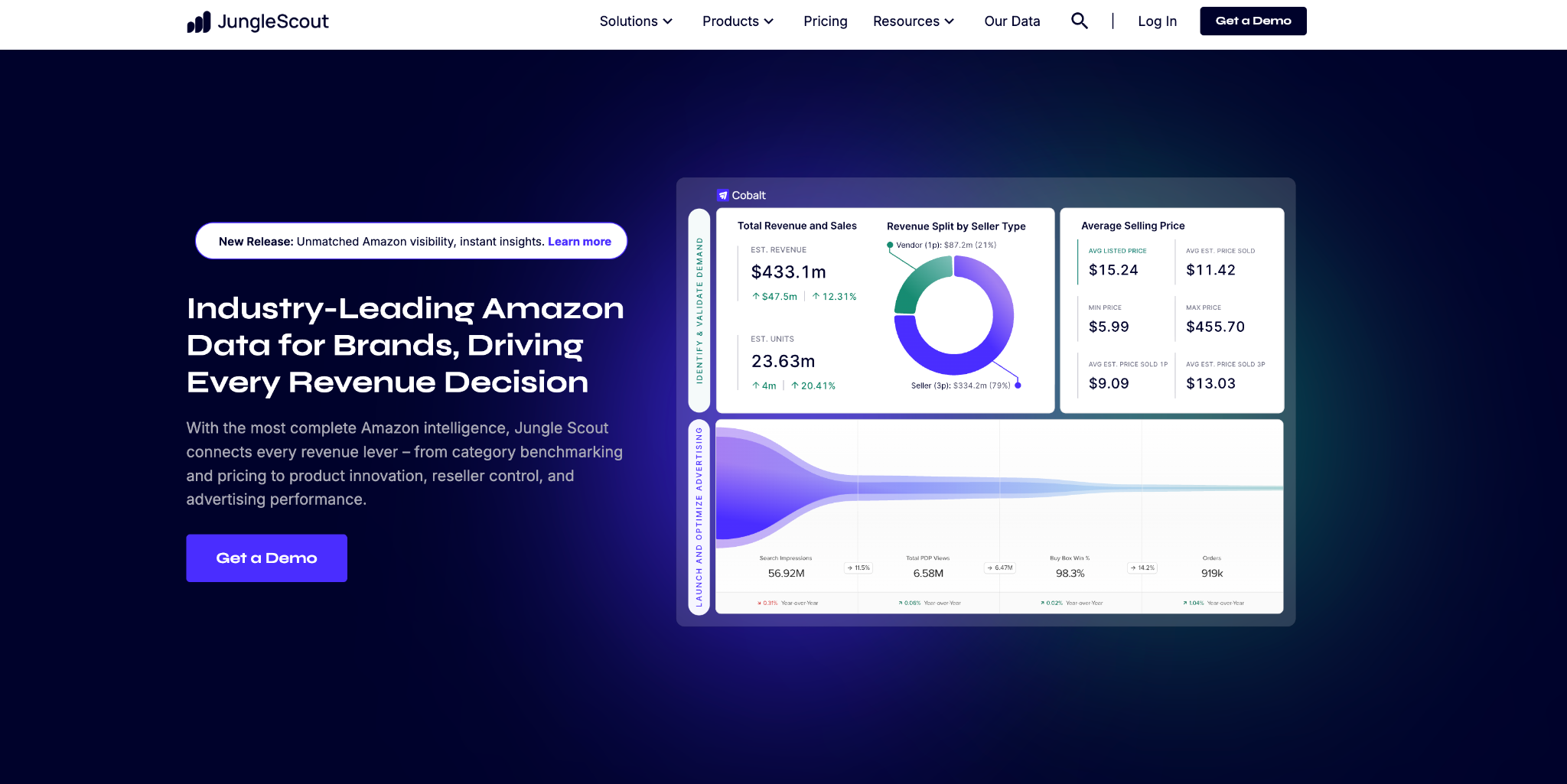
Jungle Scout is an Amazon seller platform whose Listing Builder is designed to help sellers assemble data-backed product copy from a keyword bank and push it into a cleaner optimization workflow. Its clearest differentiator is the Listing Optimization Score, a live grading layer that updates as you edit the title, bullets, description, backend search terms, and images, while AI Assist can generate titles, features, and descriptions from the keyword bank.
Choose Jungle Scout when your team needs a guided writing environment with a visible scorecard and Seller Central syncing, especially for launch-stage or mid-market Amazon sellers who want structure more than maximal customization. Its tradeoff is that it is strongest at drafting and scoring the listing itself, so sellers who need deeper market mapping or larger content supply inputs may still need neighboring tools.
Helium 10
Helium 10 is a broad Amazon operating stack, and its Listing Builder sits inside a much larger ecosystem that covers keyword research, profitability, operations, and ad support. Its differentiator is workflow breadth: Helium 10 says Listing Builder can sync live listings, place extra terms in the Subject Matter backend field, and connect directly to a wider tool stack, while the platform overall spans more than 30 tools.
Choose Helium 10 when your listing work is inseparable from the rest of your Amazon operations and you want one system for research, writing, account monitoring, and team access. The limitation is complexity and cost discipline, because a seller who only needs a lightweight listing environment may pay for far more platform than they actually use.
AMZScout
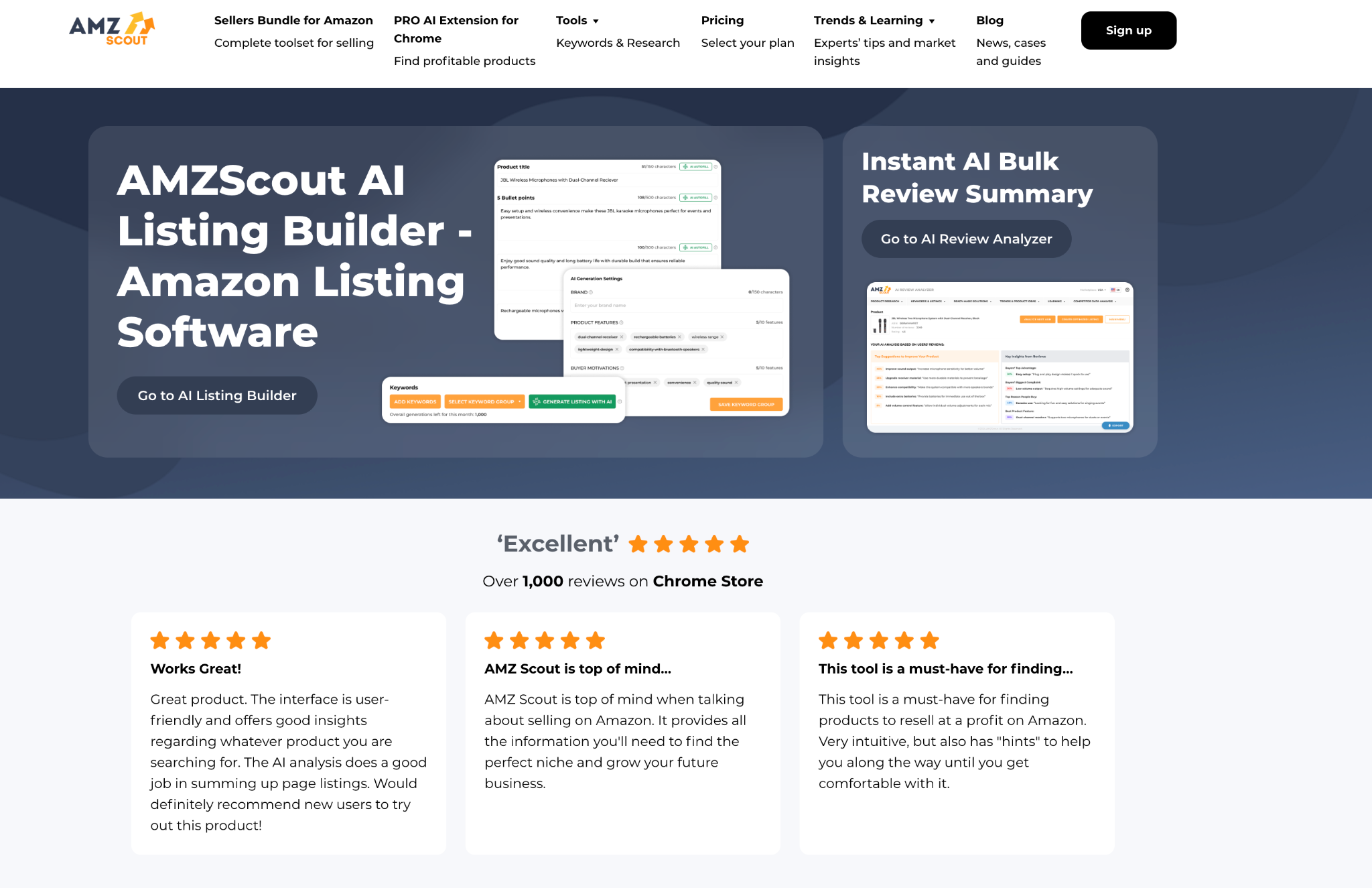
AMZScout is an Amazon-focused platform with an AI Listing Builder and AI Review Analyzer aimed at sellers who want quick, guided listing production. Its differentiator is simplicity at the lower end of the market: the AI listing package starts at $19.99 for one month, and the review analyzer is positioned as a paired input that mines customer feedback for strengths, weaknesses, and objections before you draft.
Choose AMZScout when you are a newer private label seller, reseller, or small brand that wants faster listing output without hiring a dedicated copywriter. The tradeoff is depth, because AMZScout is strongest as a practical drafting layer and less compelling if you need richer cross-channel measurement, big-team collaboration, or enterprise reporting.
SellerApp

SellerApp is an all-in-one Amazon growth platform that combines listing optimization with keyword analysis, ad automation, monitoring, and managed services. Its differentiator is operating range: the company highlights listing optimization, supports a freemium entry point, covers a long list of Amazon marketplaces, and ties self-serve tools to optional managed services and agency workflows.
Choose SellerApp when your listing updates need to connect closely to PPC management or business alerts. The limitation is that it can feel more like a performance suite than a focused writing studio.
Which Tools Improve Listing Inputs And Feedback Loops?
Many sellers buy a writer when they really need better inputs. The next group matters because rankings improve faster when your copy is informed by category structure, daily marketplace diagnostics, or scalable creator content.
SmartScout
SmartScout is an Amazon intelligence platform built around brand, seller, and product databases rather than around copy creation alone. Its strongest differentiator is top-down category and brand mapping combined with a low Basic entry point of $25 per month annually for two user seats, which makes it unusually useful for wholesale, online arbitrage, and seller discovery workflows.
Choose SmartScout when your issue is not writing the bullets but deciding what the market is actually doing, who owns the demand, and where the competitive pressure is moving. The tradeoff is that SmartScout does not replace a dedicated drafting environment, so most teams use it to sharpen strategy before they write somewhere else.
DataHawk
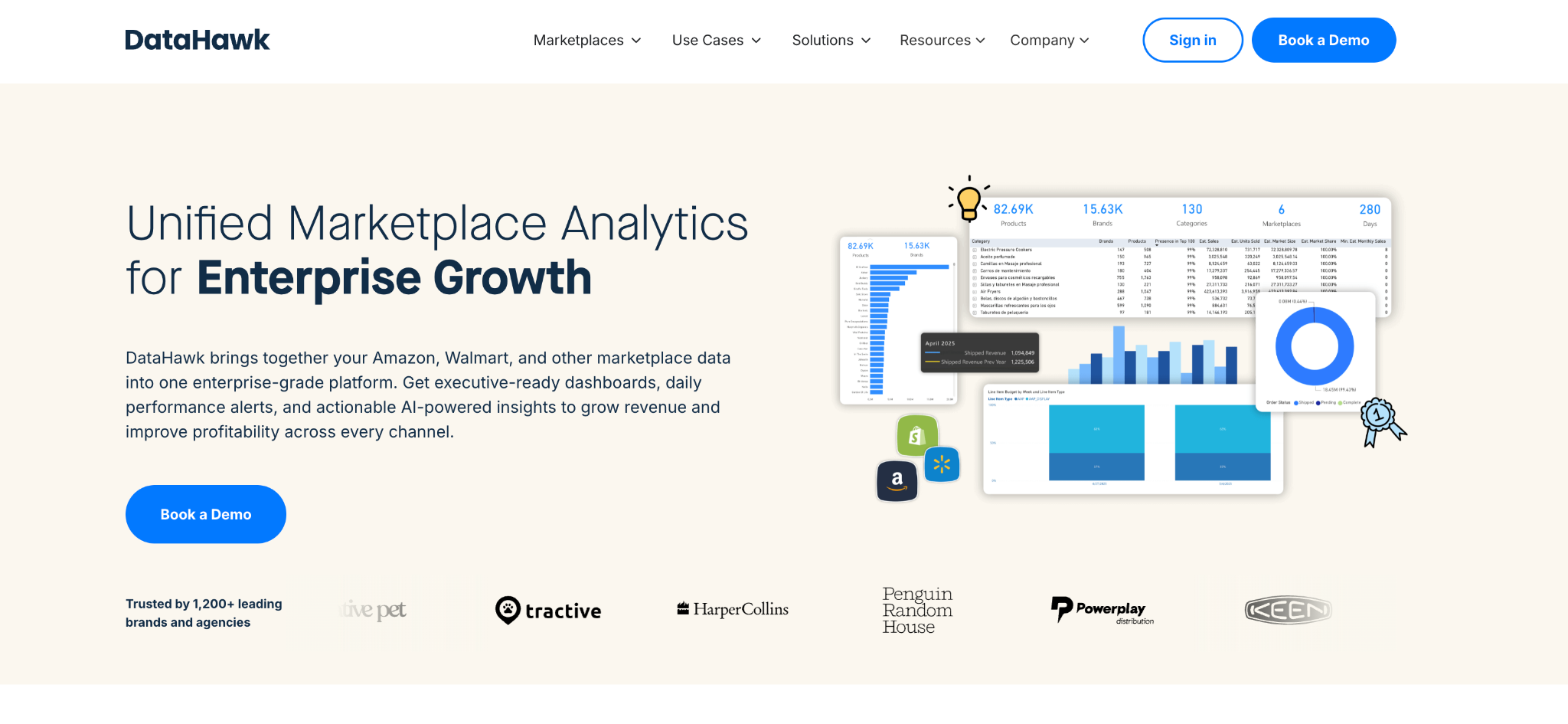
DataHawk is a marketplace analytics platform that unifies Amazon, Walmart, and other marketplace data into dashboards, alerts, and AI-guided insights. Its differentiator is diagnostic depth: DataHawk emphasizes daily SKU-level analytics, ad metrics, profitability signals, and official Amazon partner integrations, which makes it valuable when listing performance needs to be read alongside inventory, ads, and margin.
Choose DataHawk when a listing rewrite is only one part of a bigger retail execution problem and leadership wants executive-ready reporting instead of isolated content opinions. The limitation is pricing transparency and solo-seller fit, because custom annual plans make more sense for serious brands and agencies than for smaller operators testing a handful of ASINs.
Stack Influence

Stack Influence is a micro influencer and UGC platform that improves Amazon listings indirectly by creating reusable proof assets and off-platform demand. Its differentiator is operational model: the automated product seeding workflow says creators buy the product and brands pay only after social posts go live, while the creator community page lists 340,837 creators, $14.2 million paid to influencers, and 1.1 billion total social reach.
Choose Stack Influence when your bottleneck is proof, not prose, especially if you need micro influencers, nano influencers, or UGC creators producing fresh demonstrations you can reuse across Amazon listings and broader Amazon influencer marketing solutions. The tradeoff is that Stack Influence is not a keyword drafting tool, so it works best as the content-supply layer inside the Listing Lift Sequence, not as the complete stack on its own.
Its user-generated content workflow and content syndication workflow are built around turning creator photos, videos, and testimonials into a library that can move into marketplace listings, social ads, email, and on-site experiences. The Blueland case study on Stack Influence reports 372% sales growth, a 6.3x rank gain, 247,000 impressions, and 927 new keywords during the campaign.
Here is the comparative summary for quick selection.
- Jungle Scout: Best for structured listing drafting; strongest feature is the live optimization score; weaker for deep market mapping.
- Helium 10: Best for all-in-one Amazon operators; strongest feature is the wider tool ecosystem around Listing Builder; heavier than needed for narrow use cases.
- AMZScout: Best for budget-conscious launch teams; strongest feature is low-cost AI drafting plus review analysis; lighter on enterprise controls.
- SellerApp: Best for teams linking listings and PPC; strongest feature is blending optimization with alerts and automation; broader than pure copy tools.
- SmartScout: Best for competitive intelligence; strongest feature is top-down brand and seller visibility; needs a second tool for final copy workflow.
- DataHawk: Best for analytics-led brands; strongest feature is unified marketplace diagnostics; custom pricing raises the bar for smaller sellers.
- Stack Influence: Best for proof asset generation; strongest feature is scalable creator content and product seeding; needs a complementary keyword workflow.
What Do Most Guides Get Wrong About Listing Optimization?
Most guides assume ranking problems start with writing. In reality, many listing problems begin with weak proof, stale images, poor review mining, or a total lack of off-Amazon demand signals.
Why Does Better Copy Often Fail?
Better copy fails when it makes sharper promises but shows no stronger evidence. Bazaarvoice reports that 78% of consumers feel more confident in a purchase when they view content from other shoppers, and Sprout Social found that genuine reviews and discount codes are the two influencer content qualities most likely to push a customer toward a purchase.
That is why seller teams that run creator partnerships, influencer campaigns, or product seeding often improve their listings faster than teams that only rewrite bullets. They are feeding the page with richer demonstrations, not just cleaner nouns, which is also why Stack Influence keeps tying proof assets to listing, ad, and content reuse workflows.
What Should You Fix Before Rewriting?
Fix the input system before the sentence system. If your current workflow cannot surface review themes, collect UGC video creator assets, compare competitor positioning, and reuse winning assets across channels, your next rewrite will still be built on thin evidence.
Prioritize these fixes first.
- Refresh your image brief before your bullet brief.
- Mine customer reviews for repeated objections and repeated praise.
- Build one comparison angle that is easy to show visually.
- Create a path for creator partnerships or brand ambassadors to generate new usage footage.
- Save every usable content asset for Amazon, DTC, email, and paid social reuse.
That is the same logic behind How to Build an Amazon Brand in 2026, How to Build a Brand Seeding Strategy for Amazon in 2026, and How to Use Amazon Sponsored Products in 2026. The same creator content that lifts a product page can also support Amazon storefront modules and off-platform paid traffic.
How Should Amazon Sellers Measure Listing Optimization ROI?
Measurement is where most listing programs become guesswork. The right model is not one KPI, but a stack that separates content lift, traffic quality, and profit impact.
Which Metrics Belong In The Three-Layer Attribution Stack?
Use the Three-Layer Attribution Stack as your measurement model. It keeps your amazon listing optimization tool connected to business outcomes and helps mixed teams speak the same language.
- Content Layer: image click behavior, secondary image engagement, review themes, star rating movement, and asset reuse volume.
- Traffic Layer: detail page views, add-to-cart rate, purchase rate, new-to-brand signals, and keyword rank movement.
- Profit Layer: units sold, product sales, contribution margin, TACoS interaction, and credited savings from Brand Referral Bonus.
It lets you separate whether a win came from better page quality, better traffic, or better economics.
How Do Amazon Attribution And Brand Referral Bonus Change The Math?
Amazon Attribution is the measurement spine for off-platform traffic because Amazon describes it as a free solution that tracks the on-Amazon impact of search, social, display, video, email, and influencer campaigns. The platform reports clicks, detail page views, add-to-cart actions, purchases, units sold, product sales, and new-to-brand metrics, and Amazon says reporting uses a 14-day attribution window.
Brand Referral Bonus matters because it changes the economics of sending qualified traffic into Amazon. Amazon says the program gives brands an average bonus of about 10% of sales driven from eligible non-Amazon marketing and keeps credit on additional purchases from the brand for up to 14 days after the click, which means influencer traffic, Amazon influencers, affiliates, and creator deals can look better on a true net basis than they do in a basic ad manager export.
Off-platform conversion paths are still messy because a creator post may drive tagged traffic, delayed brand search, or halo sales on related ASINs. That is another reason the Listing Lift Sequence ends with profit measurement instead of stopping at a higher optimization score.
Choose An Amazon Listing Optimization Tool That Compounds Proof
The right amazon listing optimization tool does more than help you write faster. It helps you connect keywords, proof, publishing, and profit so every listing update strengthens the rest of your growth system.
If you are an eCommerce seller choosing between faster copy, better intelligence, and scalable UGC, start with the Listing Lift Sequence and buy for your actual bottleneck. Teams that combine sharper keyword workflows with creator-made proof assets usually build stronger Amazon pages, stronger ads, and a stronger margin story at the same time.