



The TikTok algorithm 2026 is not the same beast it was two years ago, and if you are still creating content based on outdated playbooks, you are leaving serious reach on the table. For influencers and content creators trying to build sustainable income through brand partnerships, UGC work, and organic discovery, understanding how the algorithm has shifted is not optional. This article breaks down exactly what changed, how to measure what matters, and what most guides get dangerously wrong about TikTok growth today.
Key Takeaways
- The TikTok algorithm 2026 prioritizes content completion rate and rewatches over raw follower counts, meaning nano influencers and micro influencers can outperform larger accounts on reach per post.
- Creators who align their content with measurable conversion signals, not just vanity metrics, are winning more brand deals and sustaining longer brand partnerships.
- UGC video performance on TikTok is increasingly used by brands as a creative brief signal, meaning your organic content directly influences your eligibility for paid influencer campaigns.
- Understanding TikTok's FOR YOU page ranking factors in 2026 requires tracking a layered set of metrics beyond views, including rewatch rate, profile visits per view, and comment sentiment scoring.
- Creators who treat algorithm fluency as a business skill, not a luck-based game, are the ones securing repeat brand sponsorships and building real income streams in the creator economy.
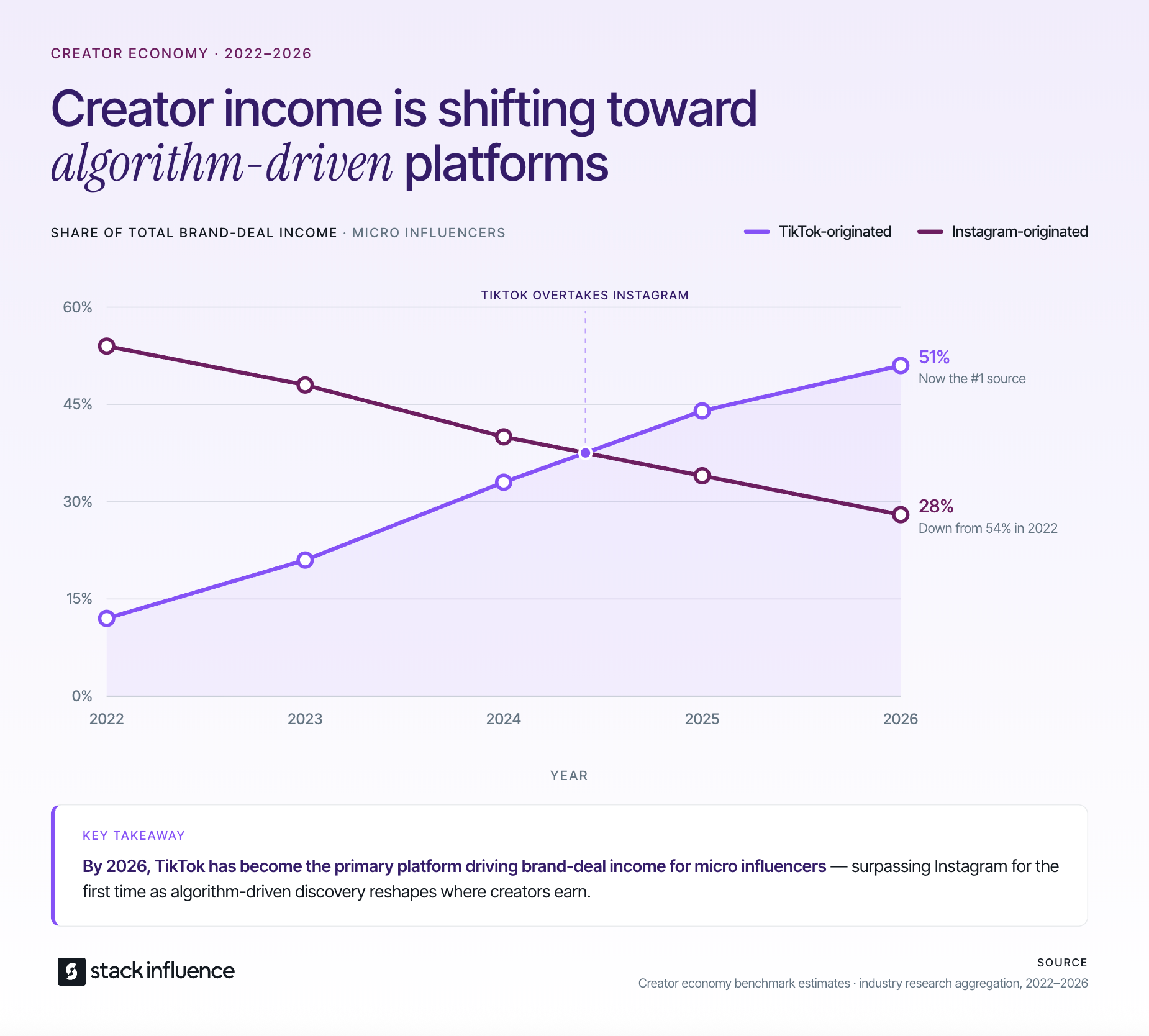
What Shifted Most in the TikTok Landscape This Year?
The biggest context shift shaping the TikTok algorithm 2026 is TikTok's continued investment in its own commerce infrastructure. TikTok Shop crossed significant revenue milestones in late 2024 and continued scaling through 2025, and that growth has directly rewired how the algorithm values content, according to TikTok's own creator insights documentation. Content that drives product interaction, saves, clicks to linked products, and profile visits now carries more ranking weight than it did in prior years. This is not a minor adjustment. It is a fundamental reorientation of what the platform considers "quality" content.
For influencers, this means the gap between organic content and monetizable content has narrowed significantly. A video that gets 200,000 views but zero link taps is valued differently by TikTok's system than a video that gets 40,000 views with strong product click behavior. Understanding this distinction changes everything about how you structure your content strategy, from your hook writing to your caption choices to how you frame your calls to action.
Key platform-level shifts shaping the algorithm in 2026 include:
- Commerce signal weighting: Product saves, TikTok Shop link taps, and purchase completions now influence FOR YOU page distribution more than they did in 2024.
- Rewatch rate prioritization: TikTok's internal testing has shown that videos watched more than once signal higher content value, pushing the algorithm to reward rewatchable formats.
- Creator credibility scoring: Accounts with consistent posting behavior, high comment engagement quality, and low violation history receive distribution boosts over newer or inconsistent accounts.
- Niche audience matching: The algorithm has grown more sophisticated at matching content to specific micro-audiences rather than attempting broad distribution for every post.
- Originality detection: Repurposed content or near-duplicate videos from the same account now receive reduced distribution at a faster rate than in previous years.
This shift toward quality signals over volume signals is genuinely good news for micro influencers and nano influencers who have always competed on depth of engagement rather than sheer follower size. Smaller creators who build tight communities around specific niches are inherently positioned to benefit from the algorithm's 2026 direction.
How the T.A.C.K. Framework Helps Creators Decode the Algorithm
To navigate the TikTok algorithm 2026 strategically, creators benefit from working within a repeatable system rather than guessing video by video. The T.A.C.K. Framework, which stands for Trigger, Amplify, Convert, and Keep, is designed specifically for content creators who want to build algorithmic momentum while serving brand partnership goals.
Trigger refers to your hook: the first 1-3 seconds of your video that determine whether a viewer stays or scrolls. The algorithm watches drop-off rates at the two-second mark with precision. Weak hooks are punished immediately. Strong hooks, especially those that create a "wait, what?" curiosity loop, dramatically improve completion rates.
Amplify is the middle section of your video where you deliver value dense enough to earn a rewatch or a share. Shares remain one of the highest-weighted signals in the TikTok algorithm 2026. Sprout Social's research on social media engagement consistently identifies shares as a leading indicator of organic reach, and TikTok is no exception.
Convert is where most creators leave money behind. This is the moment in your video where you direct viewer behavior: a link tap, a comment prompt, a profile visit, or a product save. Conversion behavior signals to TikTok that your content is driving real-world action, which triggers broader distribution.
Keep refers to your account-level retention habits: how consistently you post, how reliably your content stays within a defined niche, and how you maintain audience trust over time. Creator credibility scoring in the 2026 algorithm rewards consistency more than it rewards viral spikes.
Apply the T.A.C.K. Framework across every piece of content you publish, and you begin training the algorithm to distribute your videos more aggressively. Reference the T.A.C.K. Framework when pitching brands as well, as it demonstrates that you approach influencer campaigns with strategic intent rather than creative randomness.
What Most Guides Get Wrong About TikTok Growth in 2026

Here is the uncomfortable truth: most advice circulating about TikTok growth is still anchored in 2022 and 2023 behaviors that no longer reflect how the algorithm works. The most dangerous misconception is that posting frequency alone drives reach. It does not, and in 2026, excessive posting of low-signal content can actively suppress your account's distribution ceiling.
A second major mistake is optimizing for view counts instead of behavioral signals. Views are a lagging indicator. What TikTok's algorithm actually processes in real time is the behavioral data happening inside those views: how long people watched, whether they rewatched, whether they went to your profile, and whether they interacted with linked products. HubSpot's content performance research has documented this behavioral-over-vanity-metric shift across social platforms broadly, and TikTok is its most extreme expression.
The third mistake is treating UGC video as separate from your algorithm strategy. In 2026, brands and UGC platforms are increasingly using a creator's organic TikTok performance as a proxy for their UGC quality. Your feed is your portfolio. UGC creators who post organic content aligned with their paid deliverables consistently score higher on brand selection tools.
Mistakes that actively damage your 2026 TikTok reach:
- Posting the same video concept more than twice in a short window, which triggers originality filters.
- Using outdated trending audio that has already peaked and lost discovery potential.
- Ignoring comment sections, which reduces comment sentiment scores and lowers community signals.
- Writing captions that are keyword-stuffed rather than conversation-starting, which suppresses engagement rate.
- Treating product mentions as afterthoughts rather than integrated content elements, which reduces commerce signal weight.
Across campaigns managed on the Stack Influence platform, creators who aligned their organic TikTok content strategy with their paid UGC deliverables saw measurably higher brand re-selection rates, reinforcing that the line between organic creator work and commercial creator work has nearly disappeared in 2026.
How Influencers Can Use the T.A.C.K. Framework for Brand Deals
One of the most underrated tactics available to creators right now is using your algorithmic fluency as a direct selling point to brands looking for influencers. When you can walk a brand through your content's behavioral performance data and explain how your T.A.C.K. Framework approach drives measurable outcomes, you instantly differentiate yourself from creators who pitch on follower count alone.
For brand ambassadors and creators pursuing long-term brand partnerships, the algorithm fluency pitch works especially well with brands that have active TikTok Shop integrations. These brands are not just looking for reach. They are looking for creators whose content drives product link behavior and purchase completion. Your ability to demonstrate that your content strategy is built around those exact signals makes you a stronger candidate for repeat brand sponsorships.
Practical steps for pitching your algorithm fluency to brands:
- Pull your last 30 days of TikTok analytics and identify your top three videos by rewatch rate, not by views.
- Screenshot your average profile visit rate per 1,000 views and include it in your media kit.
- Document one case study showing how a piece of content you created drove link tap behavior or product saves.
- Reference your T.A.C.K. Framework approach explicitly so brands understand you have a repeatable methodology.
- Connect with influencer marketing platforms that share your performance data with brand partners automatically.
Stack Influence's internal campaign data shows that nano and micro influencer creators who present behavioral performance metrics alongside follower data secure brand deal renewals at a significantly higher rate than creators who present follower-only profiles. This is a direct reflection of how algorithm-savvy brands have become in their product seeding and selection processes.
Measuring What Matters: The Signal Stack Metric Model
Generic KPI lists are not sufficient for navigating the TikTok algorithm 2026. Creators need a structured measurement approach that maps behavioral signals to algorithmic outcomes. The Signal Stack Metric Model organizes your TikTok analytics into four tiers, each representing a deeper level of algorithmic influence.
Tier 1: Surface Signals include views, likes, and follower growth. These are visible to brands and useful for context, but they are the least predictive of algorithmic distribution. Do not optimize primarily for these.
Tier 2: Behavioral Signals include video completion rate, rewatch rate, and average watch time. These are the metrics TikTok's FOR YOU page algorithm weighs most heavily for initial distribution decisions. According to Later's TikTok analytics research, completion rate above 70% is a strong indicator of boosted distribution on the platform.
Tier 3: Conversion Signals include profile visits per 1,000 views, link taps, product saves, and follows generated from a single video. These tell TikTok that your content is driving real audience action beyond passive watching.
Tier 4: Community Signals include comment sentiment quality, shares, and duets or stitches generated from your content. These signals tell TikTok that your content is sparking conversation and culture, which triggers the broadest distribution boosts available in the 2026 algorithm.
Track all four tiers weekly using TikTok's native analytics dashboard combined with any third-party tools your influencer marketing agency or brand partner provides. Based on Stack Influence's experience running influencer campaigns across consumer product categories, creators who actively monitor Tier 2 and Tier 3 signals and adjust their content accordingly within 48 hours of posting consistently outperform creators who check analytics weekly or monthly. This real-time feedback loop is one of the most powerful and underused advantages available to independent creators in the current creator economy.
The Signal Stack Metric Model also gives you a clean reporting framework when communicating with brands. Instead of sending raw analytics screenshots, you send structured signal tier reports. This professionalism directly supports your positioning as a strategic brand ambassador rather than a transactional content vendor.
Is the Amazon Influencer Program Still Worth It Alongside TikTok in 2026?
The short answer is yes, but the integration strategy matters significantly. The Amazon Influencer Program and TikTok have become increasingly complementary rather than competing channels, particularly for creators in lifestyle, home goods, beauty, and tech niches. TikTok drives discovery and emotional desire; Amazon closes the purchase. When creators build content specifically designed to move audiences from TikTok's FOR YOU page to an Amazon storefront, they unlock a dual-platform revenue model that neither platform alone can match.
For creators operating in this dual-platform model, attribution tracking is critical. Amazon Attribution links allow you to track exactly how much TikTok traffic converts to Amazon purchases, giving you concrete ROI data to bring to brand conversations. The Brand Referral Bonus program further rewards creators who drive external traffic to Amazon listings by crediting a percentage of sales back as a bonus on advertising fees. These two programs together create a measurable financial case for your TikTok content performance.
Off-platform conversion tracking steps for TikTok-to-Amazon creators:
- Generate unique Amazon Attribution links for each TikTok video that references a product.
- Monitor click-through rate from TikTok bio link or TikTok Shop link to Amazon product page weekly.
- Track purchase conversion rate separately from click-through rate to identify which content types close sales versus which only generate interest.
- Report Brand Referral Bonus earnings quarterly as part of your overall creator income documentation.
- Use this combined data when pitching brands that work with micro influencers to demonstrate full-funnel performance, not just awareness reach.
The TikTok algorithm 2026 actually rewards content that drives off-platform action, provided that action is trackable and associated with recognized shopping integrations. Creators who master this TikTok-to-Amazon pipeline are among the highest earners in the micro and nano influencer tier right now, and that trend is accelerating as TikTok Shop and Amazon continue competing for the same commerce-intent audience.
Conclusion
The TikTok algorithm 2026 rewards creators who understand that the platform has evolved into a full commerce and community ecosystem, not just a video discovery engine. If you apply the T.A.C.K. Framework consistently, track your performance through the Signal Stack Metric Model, and position your algorithm fluency as a genuine business skill when pursuing brand partnerships, you are building something more durable than viral moments. You are building a creator business that works with the algorithm rather than against it. The creators who win in 2026 are not the ones who post the most or follow the most trends. They are the ones who make every signal count.