




A desk organizer can belong in a home-office tutorial, a small-apartment makeover, or a weekly workspace reset. Those are three different creator searches, even though the Amazon listing stays the same.
Learning how to find influencers for your Amazon product starts with the demonstration a buyer needs, not the biggest account you can afford. For ecommerce sellers, this guide turns one product into searchable creator criteria, shows where to find candidates, and explains how to qualify, contact, and evaluate them without confusing content delivery with sales performance.
Key Takeaways
- Search for creators who already demonstrate the problem your product solves, then verify audience and marketplace fit.
- Separate social distribution, Amazon storefront content, and licensed user-generated content because each requires a different agreement.
- Confirm compensation, publishing location, product logistics, tracking, and content rights before sending products.
- Evaluate completed content and independently generated shopper demand separately from campaign-funded creator purchases.
How to Find Influencers for Your Amazon Product With a Search Grid
Build a Product-to-Creator Search Grid around one ASIN, Amazon’s product identifier, and four search inputs. The grid translates listing features into the language creators actually use:
- Product: What buyers call the item, such as a desk organizer, cable holder, or desktop tray.
- Task: What the buyer wants to accomplish, such as clearing a workspace or keeping charging cables accessible.
- Constraint: What makes the problem specific, such as a narrow desk, shared office, or limited storage.
- Format: How the benefit can be demonstrated, such as a desk reset, setup tutorial, comparison, or hands-on test.
Combine the inputs into searches such as “small desk organization tutorial,” “home office cable management,” and “desk organizer hands-on test.” Run them on the social platforms where you want content published. Inspect the posts before collecting the profiles.
For the desk organizer, a useful candidate should be able to show what fits, how the product changes the workspace, and which dimensions or compatibility limits matter. A creator whose content only displays attractive desks may need a different brief from someone who regularly tests organization products.
This grid also makes a managed campaign brief more actionable. Stack Influence is a micro-influencer marketing platform whose Amazon creator campaign workflow connects creator sourcing with gifted-first product seeding, campaign coordination, and content production. Give that workflow a product, buyer problem, and required deliverable rather than a request for a large audience.
Compare Repeated Product Proof
Use the same review sample for each candidate. For example, inspect the latest 12 posts on the intended publishing channel, record their dates, and count posts that show a hands-on demonstration relevant to the buyer task. Exclude pinned posts from the sample unless they are also among the latest posts chronologically.
In an illustrative scenario, Candidate A has 9 relevant demonstrations, Candidate B has 6, and Candidate C has 2 within their respective 12-post samples. These fictional counts indicate how often each account demonstrates the intended subject, not expected sales or an industry qualification threshold.
Review the actual demonstrations before advancing anyone. A high count of repetitive, superficial clips is not stronger evidence than a smaller number of useful explanations. The audit helps you decide whom to examine closely; audience, terms, and reliability still determine the final shortlist.
Where Should You Search for Amazon Product Creators?
Search across social content, Amazon storefronts and livestreams, native creator marketplaces, and managed sourcing workflows. Use the same Product-to-Creator Search Grid in each place so every candidate is evaluated against the same product problem.
Social Search and Public Storefronts
Start with Instagram, TikTok, and YouTube searches combining the product, task, constraint, and format. Add Amazon-specific terms such as “Amazon finds” or “Amazon storefront” when you need creators who already publish shopping recommendations.
Google searches such as site:amazon.com/shop/ "desk setup" and "desk organization" "Amazon storefront" can surface additional leads. Treat them as discovery queries, not a complete creator directory. Follow the public links between the creator’s social account and storefront to check that both belong to the same person.
Amazon’s Influencer Program explanation describes a customizable recommendation page and vanity URL for participating creators. That storefront is different from your brand’s Amazon Store, and neither a storefront nor affiliate membership is necessary for a direct social-content collaboration that does not use Amazon’s affiliate tools.
A user-generated content (UGC) creator is another distinct option: the assignment may be to produce content for your brand rather than distribute it to an audience. Define the intended ecommerce UGC deliverable before judging a creator by follower count.
Amazon Live and Creator Connections
Browse Amazon Live when the product benefits from a real-time demonstration. Watch how the host explains features and handles practical questions, then check the creator’s public profile, storefront, and business contact information.
Record relevant demonstrations, not simply the number of products featured. A creator who can explain installation, dimensions, or everyday use gives you something concrete to evaluate.
Eligible brands can also investigate Amazon Creator Connections for Amazon-native creator campaign opportunities. Confirm access and current campaign terms in your advertising account before making it the foundation of your recruitment plan.
Native Marketplaces and Managed Sourcing
Meta’s Instagram creator marketplace overview describes creator and audience filters, portfolios, and partnership messages. Use those signals to check whether a promising account fits the campaign, with availability subject to the account and market.
In TikTok One’s creator discovery tools, brands can search content keywords and filter audience geography, median video views, and other attributes. Compare audience location with creator location rather than treating those fields as interchangeable.
Also review public brand mentions, tagged posts, and inbound partnership applications. These can reveal creators already familiar with your category without turning private Amazon customer information into a prospecting list.
For sellers who need coordination beyond discovery, Stack Influence’s automated product-seeding workflow connects creator participation, communication, post verification, and completion-based payment. Its gifted-first model is designed to move campaigns through completed social content, rather than stop at an exported list of profiles.
Which Influencers Belong on Your Shortlist?

Shortlist creators whose recent work demonstrates the product’s use case, whose audience fits the intended market, and whose proposed deliverable matches your campaign. Treat follower count as context, not a substitute for those checks.
Include micro influencers and nano influencers in the search, but do not assume a smaller account is automatically more relevant or a larger account is automatically more persuasive. Compare creators against the same assignment and evidence requirements.
Verify the Audience Behind the Views
Ask serious candidates for recent native analytics with the reporting period visible. Request the metric that answers your question: follower geography, viewer geography, reach, and watch time are different measurements.
For example, YouTube’s audience documentation says its Top geographies report describes geography by watch time. It should not be relabeled as the percentage of viewers who can buy your product.
Review organic and sponsored posts separately, and compare similar formats. A viral entertainment clip says little about how a product tutorial will perform. Use the median of a consistent set of comparable posts to reduce dependence on one unusually large result.
Read the comments for practical questions and experiences. Repeated generic comments or unexplained audience changes justify further checking, but a suspicious-looking pattern alone does not prove fraud.
Verify the Exact Publishing Surface
Write down where the content must appear: Instagram, TikTok, YouTube, the creator’s Amazon storefront, or your own licensed marketing channels. “Amazon video” is not a sufficiently precise deliverable.
Amazon’s onsite earnings guidance says eligible storefront content may be selected for display elsewhere on Amazon. A creator cannot guarantee a product-page placement that Amazon controls.
An Instagram post also does not automatically include a clickable path to your listing. Ask which link-bearing placement will carry the call to action and test that route on mobile.
Maintain one record per creator containing the profile, relevant post examples, audience evidence and dates, storefront when applicable, public business contact, proposed format, compensation, rights, and next action. Record an explicit reason for advancing or declining the candidate.
Make an Offer That Is Easy to Evaluate
Contact creators through their published business email, marketplace inbox, management contact, or appropriate social message. Explain the product fit and proposed exchange before asking them to commit time.
For the desk-organizer example, a hypothetical opening could read:
Your recent small-desk reset showed how you organize everyday work essentials. We are inviting creators to a product-for-content collaboration for a compact desk organizer, with one demonstration Reel and a Story carrying the product link.
The proposed exchange is the gifted product, with publication timing agreed after delivery and no additional usage rights assumed. Are you open to reviewing the brief, or would you quote a different package for that scope?
Adapt the offer to the actual creator and budget. A creator may reasonably request a fee, different deliverables, or separate licensing terms. Do not describe a compulsory post as a no-obligation gift.
Stack Influence’s influencer outreach guide develops the messaging and follow-up process. Keep any follow-up brief, provide missing information rather than repeating the entire pitch, and stop contacting people who decline.
Budget for the Complete Collaboration
Separate creator compensation from product cost, shipping, platform fees, internal coordination, commissions, and licensing. A campaign can appear inexpensive at the sourcing stage while creating substantial fulfillment and follow-up work.
The distinction between open gifting and agreed deliverables in the product-seeding guide matters here: a shipped gift is not automatically a completed content asset.
During Stack Influence’s three-month Targus new-product campaign, the company recorded 120 creator promotions and 275,560 social impressions. Those figures illustrate campaign delivery and reach, not the number of profiles researched, a guaranteed response rate, or a forecast for another brand.
Use your first campaign to record how much work turns accepted invitations into completed posts. That information should shape the next recruitment budget.
Protect the Content, Link, and Review Boundaries
Confirm the product variant, delivery method, publication window, approval scope, disclosure, files, and usage permissions before fulfillment. Agree how product problems or shipping delays will be handled without demanding an endorsement the creator cannot honestly give.
The FTC’s influencer disclosure guidance explains that free products and other material connections require clear disclosure when creators endorse a product. Check the published content, not just the original brief.
Specify organic reposting, Amazon listing use, paid advertising, editing, duration, and territory separately. Stack Influence’s explanation of UGC licensing rights helps distinguish receiving a file from obtaining permission to reuse it.
Keep Amazon customer reviews outside the compensation agreement. Amazon’s customer-review policy explanation prohibits offering incentives, including free products and refunds, in exchange for reviews. Asking for an “honest” review does not remove the incentive.
Finally, agree on the link owner and destination before publication. A creator’s affiliate link and a seller’s tracking link serve different commercial arrangements; do not replace one without agreement or assume every commission and referral benefit will combine automatically.
Evaluate the First Campaign Before Recruiting More
Judge the first campaign against the job you hired creators to perform. Content production, audience distribution, and retail demand should have separate success measures.
Track delivery with completed posts divided by agreed posts, and track content efficiency with total content-production cost divided by assets accepted for the intended use. Keep clicks, purchases, and retail revenue in a separate commerce report so a useful content asset is not mistaken for proof of sales.
Before posts go live, check listing availability and purchase readiness. Confirm the correct variation, inventory, product information, and delivery experience, whether you use Amazon FBA or another fulfillment method.
For eligible off-Amazon campaigns, Amazon Attribution reports clicks and shopping actions, including detail-page views, add-to-carts, and purchases, within a 14-day attribution window. Set up distinct tags for the creators or placements you need to compare, where the agreed link arrangement supports that tracking.
Review completion and content weekly. Evaluate commerce after the relevant attribution window has matured, then revisit returns and content reuse separately. Low-volume results are a reason to collect more evidence, not to declare a universal winner from one sale.
Include confirmed Amazon Brand Referral Bonus credits in the economics of eligible, enrolled campaigns. Amazon describes an average bonus of 10% of qualifying sales, but eligibility and the actual credit matter more than a planning assumption.
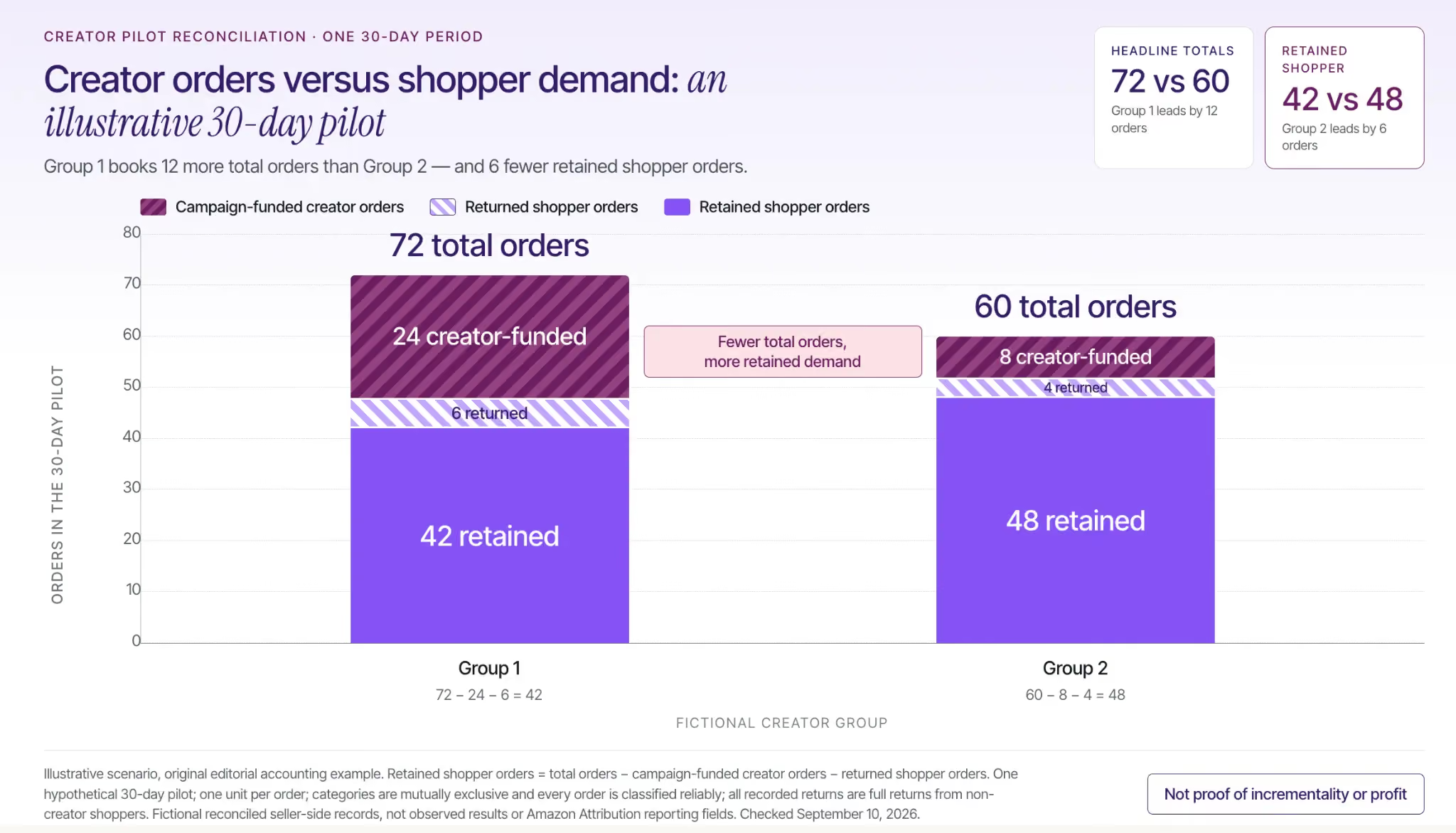
Separate Creator Acquisition From Shopper Demand
Campaign-funded creator purchases are a product-acquisition expense, not evidence that an independent shopper was persuaded to buy. Keep those transactions separate wherever your records allow, and do not use them to manufacture a sales-performance claim.
Consider an illustrative 30-day pilot with two creator groups. Assume every order is classified reliably, every order contains one unit, all recorded returns are full returns from non-creator shoppers, and the categories do not overlap.
Group 1’s reconciled ledger contains 72 total orders: 24 campaign-funded creator orders, 6 returned shopper orders, and 42 retained shopper orders. Group 2 contains 60 total orders: 8 campaign-funded creator orders, 4 returned shopper orders, and 48 retained shopper orders.
The calculation is total orders minus campaign-funded creator orders minus returned shopper orders. Group 1 has the larger headline total, but Group 2 has more retained shopper orders in this fictional example.
This is a seller-side accounting illustration, not a claim that Amazon Attribution automatically provides those classifications. Subtract only transactions confirmed to be included in the same reporting total; when separation is unreliable, disclose the uncertainty rather than inventing a precise adjustment.
Even retained shopper orders do not establish incrementality or profit. Compare the groups’ costs, contribution, audiences, and other marketing exposure before making a renewal decision.
Retain creators for the role they actually performed well. A strong demonstration may justify another licensed UGC assignment, while reliable audience-driven commerce may justify a repeat distribution partnership. Neither result requires pretending the creator succeeded at every campaign objective.
Turn the Search Into a Reusable Creator Roster
Learning how to find influencers for your Amazon product means turning a product’s buying questions into search criteria, then validating those criteria through real collaborations. Your most useful asset is not a long contact list; it is a record of who can demonstrate the product, reach relevant buyers, and complete the agreed work.
Choose one ASIN, build the Product-to-Creator Search Grid, and advance candidates only when their evidence matches the assignment. Use the first campaign to improve the next shortlist.
For sellers ready to move from sourcing to execution, evaluate a Stack Influence product-seeding campaign around that brief so creator coordination and completed content become a repeatable part of your Amazon marketing.