




Influencer outreach fails when it is treated as a writing exercise instead of a matching and execution system. Ecommerce sellers often send polished messages to poorly matched creators, while content creators pitch brands without showing why their audience, concept, or skills fit the campaign.
Effective influencer outreach solves both problems. It helps brands find creators who can distribute, produce, or sell, and it helps creators present a credible reason for a brand partnership. This guide covers qualification, channels, pitch templates, follow-up, terms, product seeding, compliance, and measurement from both sides of the inbox.
Key Takeaways
- Strong outreach begins with partner relevance and a workable offer, not a clever subject line.
- Brands should distinguish distribution creators, UGC creators, and commerce creators before building a shortlist.
- A useful pitch explains the fit, value exchange, scope, and next step without forcing the recipient to request basic details.
- Outreach measurement should continue through activation, completed content, traffic, and commercial outcomes.
- Clear usage rights, disclosure requirements, deadlines, and product logistics prevent many post-acceptance failures.
What Is Influencer Outreach?
Influencer outreach is the structured process of identifying, contacting, qualifying, and onboarding potential creator partners. Brands use it to recruit influencers, affiliates, UGC creators, and brand ambassadors. Content creators use the same process in reverse to approach brands, propose campaign ideas, and secure gifted collaborations, paid sponsorships, affiliate offers, or longer-term partnerships.
The outreach message is only one stage. A complete workflow also includes research, partner selection, offer design, negotiation, campaign activation, creator coordination, and performance review.
That broader view matters as creator marketing becomes a larger budget category. CreatorIQ’s State of Creator Marketing Report 2025-2026, based on 1,723 brands, agencies, and creators, reports that 71% of organizations increased creator-marketing investment year over year. More investment raises the cost of poor targeting, vague agreements, and unmeasured outreach.
The Five-Point Mutual-Fit Test
The Five-Point Mutual-Fit Test is a pre-send framework for evaluating whether an outreach opportunity deserves attention. Brands can apply it to creator candidates, and creators can apply it to brands. A strong match passes all five points before either side spends time drafting a personalized pitch.
- Audience fit: The creator reaches people who could reasonably care about the product, or the brand serves people who already engage with the creator’s subject matter.
- Content fit: The product can appear naturally within the creator’s established formats, voice, visual style, and platform behavior.
- Offer fit: The value exchange reflects the work requested, product value, usage rights, audience access, and expected commercial role.
- Operational fit: Both sides can meet the timeline, shipping requirements, approval process, disclosure rules, and communication cadence.
- Proof fit: The sender can support the pitch with relevant examples, audience evidence, prior content, product demand, or a clear campaign brief.
Follower count is not a sixth point. A nano influencer with a concentrated audience and a credible product use case may be more useful than a larger account with weak category relevance. The same principle applies to creators: a smaller DTC brand with a strong product match and clear creative opportunity may offer more portfolio value than a familiar company with no defined brief.
Brands that need a consistent vocabulary for smaller creator tiers can review this guide to what a micro influencer is. The practical lesson is to qualify the partnership around the job to be done, not around audience size alone.
Build the Right Shortlist Before Writing the Pitch
A qualified shortlist should be built around the campaign role. Searching for “influencers” as one undifferentiated group mixes people with different strengths, economics, and measurement needs.
Use the Three-Role Creator Map:
- Distribution creators bring relevant audience reach, trusted commentary, and platform-native exposure.
- Production creators specialize in photos, demonstrations, testimonials, or UGC video that the brand may reuse when rights permit.
- Commerce creators drive trackable action through affiliate links, discount codes, social commerce, an Amazon storefront, or another measurable path to purchase.
One person may fill all three roles, but brands should not assume it. Define the primary role first, then vet recent content, audience conversation, prior partnerships, posting consistency, product-category conflicts, and obvious signs of inflated engagement. This guide to finding influencers for product promotion provides additional discovery methods for sellers.
Creators should build a brand shortlist with the same discipline. Start with products already used, categories that fit the audience, and companies whose current content leaves room for a distinct creator concept. A clear niche makes this easier, so creators still refining their positioning can use this niche-selection framework for influencers.

Choose the Right Outreach Channel
Use the channel that gives the recipient enough context to make a decision. Email is usually strongest for detailed proposals, rates, usage rights, attachments, and negotiation. A direct message works well as a warm introduction, a short follow-up, or an initial contact when no business email is available. When only a creator's social handle is visible, a quick lookup to find anyone's email from a name and a company keeps the first contact from starting as a cold DM with no fallback.
Platform-native marketplaces add structure. Meta’s Instagram Creator Marketplace announcement explains that brands can send projects with opportunity details and rates, while creators receive them in a dedicated Partnership Messages folder. Brands can also search by creator and audience attributes, and creators can build portfolios to improve discovery.
Shopify sellers can use Shopify Collabs recruiting tools to search, filter, and directly invite creators. Shopify currently limits merchants to 100 creator invitations in any seven-day period, which makes shortlist quality more important than indiscriminate volume.
As of July 2026, Shopify’s current Collabs overview states that the service is not accepting new creator signups, although merchants can still send direct invitations and accept creator applications. Existing creators can continue using the platform.
Brands comparing manual outreach with platform workflows can also review Stack Influence’s Instagram Creator Marketplace guide.
How Do You Write an Influencer Outreach Message?
Write an influencer outreach message by making the partnership easy to evaluate. Identify the specific fit, state what you are proposing, explain the value exchange, summarize the requested work, and end with one simple next step. Personalization should prove relevance, not merely insert a name or compliment into a reusable template.
A useful first message has five parts:
- Recognition: Reference a specific post, product use case, audience theme, or brand initiative.
- Reason for fit: Connect the recipient’s work to the campaign goal or customer.
- Offer: State whether the opportunity is gifted, paid, affiliate-based, hybrid, or exploratory.
- Scope: Summarize the platform, deliverable, timing, and major rights request.
- Next step: Ask one answerable question, such as whether the recipient wants the full brief.
Brand-to-Creator Outreach Template
Subject: [Brand] collaboration idea for your [specific content theme]
Hi [Name], I liked your recent [specific post] because [brief, genuine reason]. We are planning a campaign for [product and audience], and your [content format or perspective] looks relevant to the way customers use it.
The initial opportunity includes [gift, fee, commission, or hybrid], with a proposed [deliverable] by [timing]. We would also like to discuss [organic reposting, paid usage, or no additional usage].
Are you open to reviewing the full brief and terms?
Brands can adapt this structure using Stack Influence’s deeper outreach email guide for micro-influencers.
Creator-to-Brand Outreach Template
Subject: Content idea for [Brand or Product]
Hi [Name], I create [niche and format] for an audience interested in [relevant need]. I have been using or following [specific product, launch, or campaign], and I have an idea for [one-sentence concept] that would show [customer benefit or use case].
My relevant proof includes [audience insight, past result, portfolio example, or content skill]. I am interested in discussing a [gifted, paid, affiliate, UGC, or ambassador] partnership.
Is [concept] relevant to your current creator plans?
Creators should link a concise portfolio or media kit rather than attaching a large collection of unrelated files. These creator outreach email templates provide variations for first contact and follow-up.
Follow Up Without Damaging the Relationship
Follow-up should reduce uncertainty, not add pressure. A practical sequence is one brief follow-up three to five business days after the first message, followed by a final note roughly one week later. Stop after that unless the recipient engages or a genuinely relevant new opportunity appears.
Do not resend the entire pitch. Restate the fit in one sentence, add any useful missing detail, and provide an easy way to decline. Brands should record response status and reasons, while creators should track contact names, dates, product categories, and previous outcomes.
A nonresponse is not proof that the idea was rejected. The message may have reached the wrong inbox, arrived during a launch, or required more work to evaluate than the recipient could justify.
Clarify Terms Before Product or Content Changes Hands
An accepted pitch is not a complete agreement. Before shipping a product, creating content, or publishing a post, both sides should confirm the operational and commercial terms in writing.
Cover these items:
- Deliverables: Platform, format, quantity, length, talking points, links, tags, and whether content must remain live.
- Timing: Product arrival, draft date, approval window, publication date, and what happens if inventory or schedules change.
- Compensation: Gifted product, flat fee, affiliate commission, performance incentive, reimbursement, or hybrid structure.
- Creative control: Required claims, prohibited claims, revision limits, and the creator’s freedom to communicate honestly.
- Usage rights: Organic reposting, paid advertising, editing, duration, territory, whitelisting, Spark Ads, and partnership ads.
- Exclusivity: Competing categories, restricted brands, and the exact time period.
- Measurement: Links, codes, Amazon Attribution tags, reporting access, and content-performance screenshots.
- Disclosure: The language and platform tools required for a clear commercial disclosure.
The Federal Trade Commission’s Disclosures 101 guidance says a material connection includes payment and free or discounted products, and creators should disclose that relationship clearly when endorsing a product. The FTC also states that creators are responsible for understanding and making the disclosure rather than relying entirely on another party.
TikTok’s commercial-content guidance requires creators promoting a third-party brand for payment or another incentive to turn on the content disclosure setting. The setting can label the post as a paid partnership, share post insights with a tagged brand partner, and simplify authorization for Spark Ads.
The Message Is Usually Not the Main Problem
Most outreach advice overweights wording. When a campaign underperforms, the larger causes are often a mismatched list, an unattractive offer, hidden usage requests, slow product fulfillment, unclear briefs, or no system for following accepted creators through completion.
That distinction matters for ecommerce sellers. A positive reply has little value if the creator never receives the right product, cannot understand the deliverable, or disappears between acceptance and publication. Outreach quality should therefore be judged by completed, usable work, not by replies alone.
Stack Influence is built around that execution layer. The platform connects ecommerce brands with roughly 600,000 vetted creators through gifted-first product seeding, creator coordination, UGC generation, and completed-post accountability. A managed influencer product-seeding workflow is especially practical when a brand wants to activate many micro influencers without manually handling every message and follow-up.
During a three-month Stack Influence campaign for Targus, the campaign included 120 creator promotions. Average monthly unit sales increased from 56 to 221 during the measured period, while Amazon Best Seller Rank moved from #151,547 to #47,811. The case study does not isolate outreach as the sole cause, but it shows the value of connecting creator activation with fulfillment, completion, and marketplace measurement.
Results vary by product, category, pricing, marketplace conditions, creative quality, creator participation, and campaign execution.
Measure the Outreach-to-Outcome Funnel
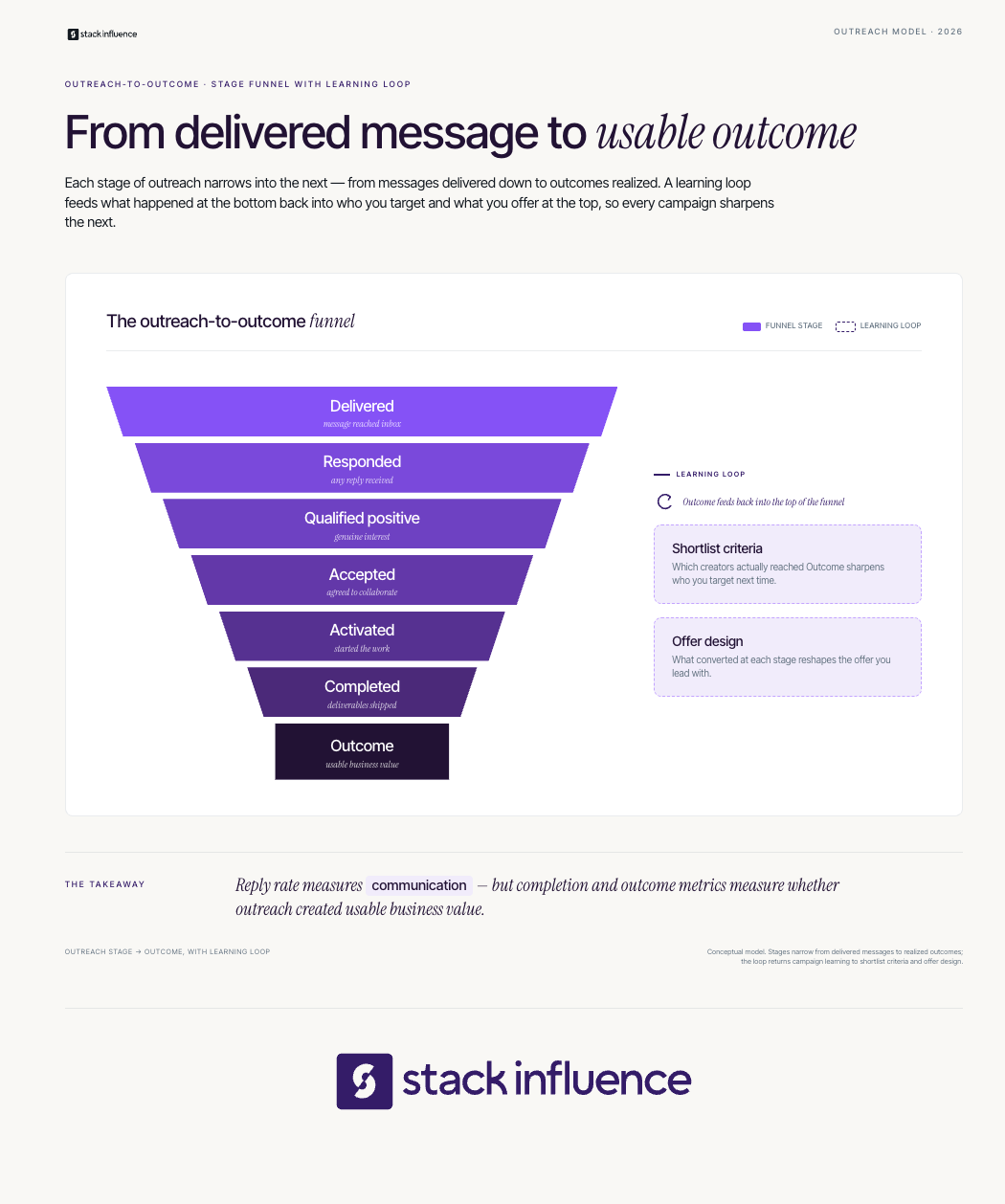
The Outreach-to-Outcome Funnel separates communication efficiency from campaign value. It prevents a high reply rate from masking weak creator fit, poor completion, or unprofitable traffic.
Track seven stages:
- Delivered: Valid messages that reached the intended recipient.
- Responded: Any human reply, including declines and questions.
- Qualified positive: Recipients interested under terms the sender can realistically support.
- Accepted: Partners who agree to the documented opportunity.
- Activated: Creators who receive the product, link, code, brief, or campaign access needed to begin.
- Completed: Agreed content or campaign requirements delivered and approved.
- Outcome: Usable assets, reach, engagement, qualified traffic, attributed orders, contribution margin, and repeat partnership value.
Calculate reply rate from delivered messages, not the original list. Then compare qualified-positive rate, acceptance rate, activation rate, completion rate, cost per completed creator, usable assets per completion, and outcome metrics tied to the campaign objective.
For Shopify influencer marketing, use creator-specific links, codes, landing pages, and store analytics, while recognizing that codes can be shared and shoppers may convert through another device. This influencer-marketing tracking guide explains how to separate delivery, content, traffic, conversion, and long-term value.
Amazon sellers can use Amazon Attribution, a free measurement solution for eligible sellers and vendors, to examine how non-Amazon channels such as social, video, email, and influencer campaigns contribute to Amazon discovery and purchases. Amazon recommends separate tags when advertisers want reporting by tactic, creative, or audience group.
Eligible US Seller Brand Owners enrolled under Amazon’s Brand Referral Bonus guidance can earn a bonus averaging 10% of product sales driven by non-Amazon marketing efforts measured with Amazon Attribution. Treat that bonus as one economic input, not as proof that every creator touchpoint received full credit.
Attribution still has limits. A shopper may view a creator post, search the brand later, click an ad, and purchase through a different path. Report attributed revenue, directional lift, content value, and repeat customer behavior separately, and do not claim that correlation proves causation.
Turn Successful Outreach Into Creator Partnerships
The best outreach program gets more efficient over time. After each campaign, classify creators by reliability, content quality, audience response, traffic quality, conversion contribution, communication, and reuse potential.
Strong performers may progress from product seeding to paid UGC, affiliate relationships, brand ambassador programs, recurring launches, or paid amplification. The next offer should reflect the value already demonstrated, not simply repeat the original terms.
Brands should also document content rights before repurposing creator work across ads, product pages, email, or an Amazon listing. This guide to UGC versus brand-generated content explains why authentic creator assets and brand-owned creative play different roles.
Creators benefit from the same review. Track which brand deals strengthened the portfolio, paid fairly, respected the brief, communicated clearly, and produced useful performance evidence. That record turns future outreach from a cold request into a proof-backed proposal.
Build a Better Influencer Outreach System
Influencer outreach works when relevance, value, execution, and measurement reinforce one another. Brands need a qualified shortlist and an offer creators can evaluate quickly. Content creators need a focused brand list, a concrete concept, and proof that they understand the customer and campaign objective.
Start with the Five-Point Mutual-Fit Test, send a concise pitch, document the terms, and follow every accepted partner through completion and outcomes. Ecommerce teams that want to reduce manual coordination can evaluate a managed product-seeding workflow that connects creator activation, UGC production, and completed-post accountability in one campaign system.