




A creator niche is not just a topic. It is the repeatable reason a particular audience follows you, remembers you, and trusts your recommendations. Learning how to find your niche as an influencer means identifying the overlap between what you can create consistently, what a defined audience wants, and what potential brand partners can understand.
The goal is not to trap yourself in one label or chase the narrowest category possible. The goal is to develop a clear content promise, test it with real posts, and refine it using evidence. This guide gives content creators a five-part Niche Fit Framework, a 30-day testing sprint, a measurement scorecard, and a practical way to turn niche clarity into creator partnerships.
Key Takeaways
- A strong creator niche combines a topic, a specific audience, a recurring outcome, and a recognizable point of view.
- Choose a niche through testing, not introspection alone. Publish a structured set of posts and compare audience response across content pillars.
- Views are only one signal. Retention, saves, returning viewers, qualified comments, profile visits, and brand inquiries reveal stronger niche-market fit.
- Your niche should be specific enough to create audience expectations but broad enough to support dozens of useful posts and several natural brand categories.
- Treat your niche as a publishing hypothesis that can evolve as your skills, audience, and commercial opportunities become clearer.
What Is an Influencer Niche?
An influencer niche is a focused content territory built around a particular audience, need, and point of view. It tells people what kind of value they can expect from your account. A useful niche is narrower than a broad category such as beauty or technology, but flexible enough to support repeatable series, community discussion, and brand collaborations.
A practical niche formula is:
Topic + audience + recurring outcome + distinctive lens
“Technology” is a category. “Affordable mobile filmmaking tools for student creators” is a niche because it identifies the subject, audience, purpose, and angle. A format is different: short-form video, livestreams, carousels, podcasts, and UGC video describe how you communicate. Instagram’s creator education on defining a content niche likewise connects niche with a creator’s unique style.
Creators who want a deeper explanation of focused communities can also review Stack Influence’s guide to niche micro-influencers. It explains why “micro” describes audience size while “niche” describes content concentration, two ideas that are related but not identical.
How to Find Your Niche as an Influencer: Five Fit Tests
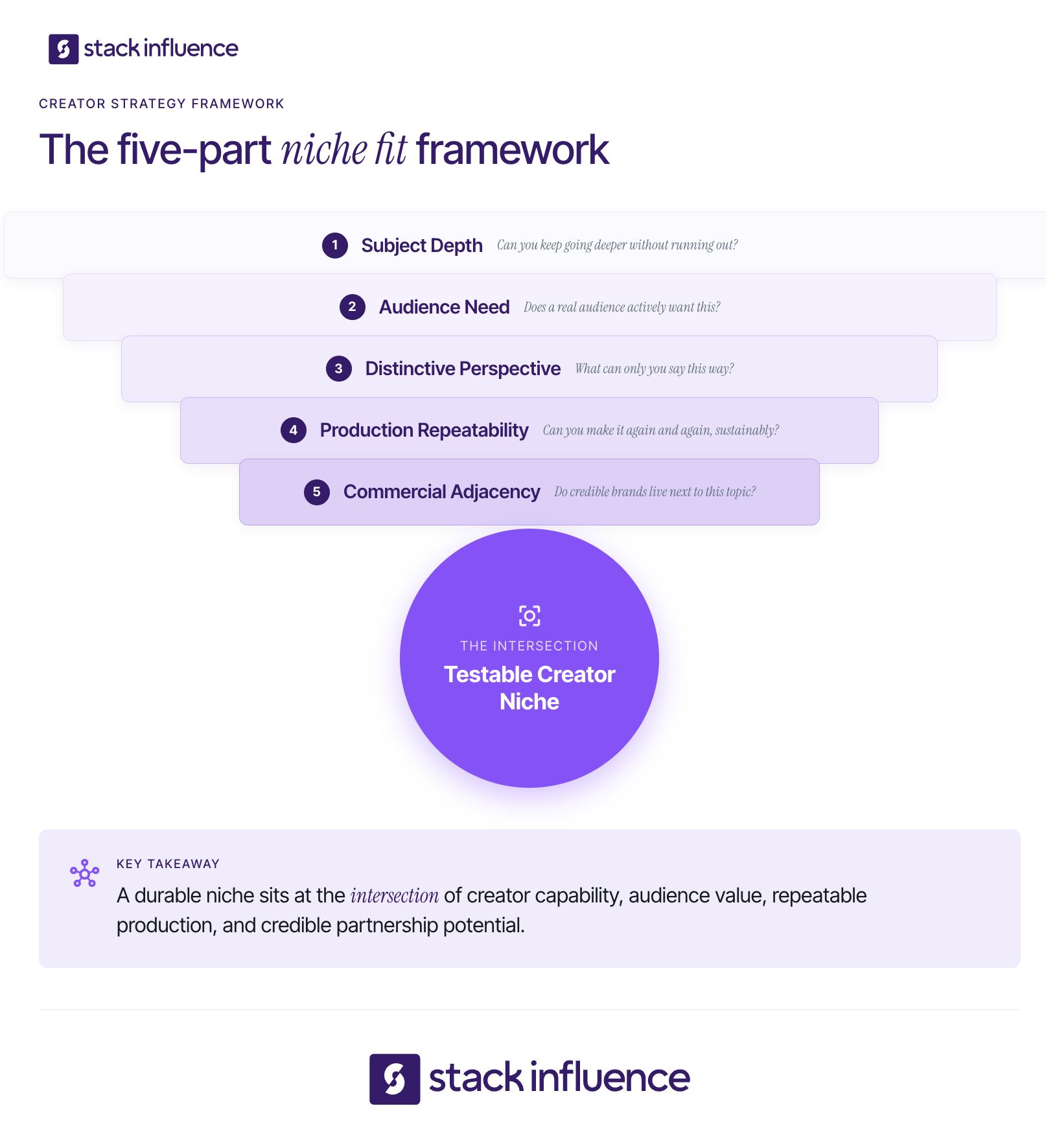
The Niche Fit Framework helps creators judge an idea before spending months building around it. A promising niche should pass five tests: subject depth, audience need, distinctive perspective, production repeatability, and commercial adjacency.
1. Subject Depth
Choose a subject you can explore beyond surface-level trends. You do not need formal credentials, but you need enough experience, curiosity, access, or documented learning to support useful content.
Use the 50-Idea Test: list 50 posts without copying another feed. A topic with room for tutorials, comparisons, stories, mistakes, reviews, and experiments has more depth than one that produces only a few trend-led ideas.
2. Audience Need
A niche becomes valuable when it connects to a recurring audience question, aspiration, identity, or problem. “I like coffee” describes your interest. “I help beginners make better coffee in small kitchens” describes audience value.
Look for repeated language in comments, searches, reviews, and messages. Words such as “easy,” “budget,” “beginner,” “small-space,” or “time-saving” often reveal the constraint that turns a broad topic into a useful niche.
3. Distinctive Perspective
Your perspective shapes what you include, exclude, and emphasize. Two creators can cover the same topic while serving different audiences because their standards and storytelling differ.
A distinctive lens might be:
- evidence-first product testing
- beginner-friendly explanations without jargon
- low-cost alternatives to premium products
- honest progress documented in public
- solutions designed for a particular living situation, profession, or life stage
The lens only needs to be consistent enough that followers can describe your account to someone else.
4. Production Repeatability
A niche must fit your real time, budget, location, skills, and equipment. Build three content pillars, each with several recurring series. A mobile filmmaking creator might use equipment reviews, shooting tutorials, editing breakdowns, and creator challenges. Repeatable structures reduce creative fatigue without making every post identical.
5. Commercial Adjacency
Commercial adjacency means products, services, or partnerships can fit naturally without confusing your audience. It is a fit test, not a reason to choose a topic you do not care about.
List three groups of potential partners:
- Core partners: Products that appear naturally in your regular content.
- Adjacent partners: Products that solve a related audience problem.
- Off-brand partners: Products that would require you to change your voice, audience, or standards.
This map prepares you for brand deals, product seeding, affiliate work, ambassador relationships, and UGC projects. Stack Influence’s product seeding guide explains how relevant gifted collaborations can build portfolio proof and open longer-term relationships.
How Narrow Should Your Niche Be?
Your niche should be narrow enough that a new visitor understands the account within a few posts, but broad enough to support at least 50 strong content ideas and several recurring series. Start with one clear audience and outcome. Expand only when the new subject serves the same people or strengthens the same content promise.
Use this positioning sentence:
I create [content type] for [specific audience] so they can [recurring outcome], using [distinctive lens].
Examples include:
- I create small-space organization videos for first-time renters so they can make limited storage work without permanent renovations.
- I review affordable technology for student filmmakers so they can produce better videos with equipment they can realistically access.
- I teach beginner home bakers why recipes fail by testing one ingredient or technique at a time.
A useful niche usually contains three layers:
- Category: The broad subject, such as food, fashion, gaming, home, beauty, technology, or personal finance.
- Audience constraint: The person, situation, budget, skill level, or need that makes your content specific.
- Content promise: The result or experience followers repeatedly receive.
Do not narrow only by adding adjectives. “Minimalist, authentic, aesthetic lifestyle content” still does not identify an audience need. “Five-minute desk reset routines for remote workers in small apartments” is clearer because it creates a repeatable promise.
How Do You Test a Creator Niche?
Test a creator niche by publishing a controlled set of posts across three content pillars, then comparing discovery, engagement depth, audience loyalty, and production effort. A 30-day sprint with 12 posts can expose early patterns. It is not enough to prove long-term success, but it is far more reliable than choosing from intuition alone.
The 30-Day Niche Sprint
Step 1: Choose three content pillars. Select three distinct but related angles inside the proposed niche. A skincare creator might test ingredient education, routine demonstrations, and product comparisons.
Step 2: Create four posts per pillar. Twelve posts provide multiple attempts without requiring months of commitment. Use at least two formats, but avoid changing every variable at once.
Step 3: Test one variable at a time. Compare hooks, lengths, or explanations while keeping the subject stable so results are easier to interpret.
Step 4: Collect qualitative evidence. Save recurring questions, direct messages, search phrases, and the words viewers use to describe the value. Audience language can improve your original niche statement.
Step 5: Keep the strongest two pillars. Continue the pillars that create both audience response and sustainable production. Rework or remove the weakest pillar, then run another cycle.
Platform tools make the sprint more rigorous. Instagram Trial Reels can show experimental Reels to non-followers first. TikTok’s Creator Search Insights surfaces searched topics and content gaps. YouTube’s content-planning guidance recommends grouping videos by topic, format, series, audience, or other attributes, then comparing performance over a shared period such as 90 days.
Creators building around social search can extend the exercise with Stack Influence’s guide to TikTok search strategy for creators. The central idea is to build a connected body of content around a topic rather than treating every post as an isolated attempt at virality.
Measure Niche-Market Fit, Not Just Views
Niche-market fit exists when the right people discover your content, consume it deeply, return, and recognize a consistent reason to follow. One viral post can create reach without proving niche strength, especially when those viewers ignore what you publish next.
Use the Niche Signal Stack to evaluate five areas:
- Discovery: Non-follower reach, search impressions, profile visits, and the number of posts that attract new viewers.
- Depth: Watch time, completion rate, saves, shares, carousel completion, and comments that show understanding or intent.
- Loyalty: Returning viewers, repeat commenters, follows per 1,000 viewers, and performance of recurring series.
- Commercial response: Relevant brand inquiries, affiliate clicks, product questions, UGC requests, and portfolio interest.
- Sustainability: Time per post, production cost, access to subjects, idea flow, and whether you still want to make the content.
Score each area from zero to five after the sprint. Treat 18 to 25 as a strong candidate, 13 to 17 as a signal to refine, and 0 to 12 as insufficient proof. This is a working decision rubric, not an industry benchmark.
YouTube’s audience guidance separates new, casual, and regular viewers and recommends consistent topics, familiar formats, community interaction, and branding to develop loyalty. It also says monthly audience is a better estimate of active audience size than subscriber count because subscribers do not necessarily return.
Document these signals in your influencer media kit. A niche statement is stronger when it sits beside evidence such as repeat-viewer growth, search discovery, saves, audience demographics, qualified comments, and examples of content that brands can evaluate quickly.
Why Brands Care About Niche Fit
Brands care about niche fit because creator relevance affects whether a recommendation feels useful, credible, and appropriate to the audience. A creator with broad reach may create awareness, but a smaller creator with a concentrated audience can make the product feel like a natural part of an existing conversation.
A 2023 Journal of Retailing and Consumer Services study surveyed more than 7,500 people and found that stronger follower-influencer congruence increased the effects of experience and content usefulness on purchase behavior. CreatorIQ’s State of Safety research, based on more than 1,700 marketers across 17 industries, reports that suitability surpassed follower count as the top creator-selection criterion among its respondents.
Stack Influence sees the same issue from the campaign-execution side. The platform works with roughly 600,000 vetted creators, but brands do not need a generic list of people who post. They need creators whose category, audience, content style, and product use align with a specific campaign.
During a four-month Stack Influence campaign for Happy Viking, 222 creator promotions coincided with average monthly unit sales increasing from 180 to 440 and the product gaining 171 new ranking keywords. The example does not prove that niche fit alone produced the outcomes. Results vary by product, category, pricing, marketplace conditions, creative quality, creator participation, and execution. It does show why brands invest in category-relevant creators instead of treating every follower as interchangeable.
For micro influencers and nano influencers, this creates an important advantage. A smaller audience can still be commercially useful when the creator can demonstrate products credibly, produce authentic UGC, and communicate with a recognizable community. Stack Influence’s guide to brand deals for small creators explains how niche positioning, engagement quality, a professional media kit, and relevant outreach work together.
How Does Your Niche Turn Into Brand Deals?
Your niche becomes brand-deal positioning when you translate it into a clear audience, content capability, and commercial use case. Brands should be able to understand whom you reach, what you create, why your content is credible, and how the partnership could fit their customer journey. A strong pitch sells relevance and execution, not just follower count.
Start with a creator positioning line:
I create [format] for [audience] about [topic], helping them [outcome] through [distinctive approach].
Then build a proof package:
- one positioning sentence
- three representative content examples
- audience and performance data tied to those examples
- two or three offers, such as tutorials, demonstrations, comparisons, or testimonials
- product categories you use naturally
- contact information and basic collaboration terms
Influencers and UGC creators can use the same niche differently. An influencer also offers audience distribution, while a UGC creator may be hired for the asset itself. A UGC niche can describe production expertise, such as “natural-light skincare demonstrations for sensitive-skin brands.” Stack Influence’s content creator guide to UGC marketing explains how creators can package those skills for paid, organic, and ecommerce uses.
Product seeding can also provide low-friction portfolio proof when the product genuinely matches your niche. Stack Influence is built around gifted-first product seeding, vetted micro-influencer activation, creator coordination, UGC generation, and completed-post accountability. Its creator community benefits include niche-matched product opportunities, portfolio building, and the possibility of developing one-off collaborations into ambassador or affiliate relationships.
Repeated alignment can turn a one-off sponsorship into a stronger relationship. The Stack Influence guide to long-term micro-influencer brand partnerships covers communication and ongoing collaboration.
Your Niche Is a Publishing Hypothesis, Not a Life Sentence
A creator niche should guide experimentation, not prevent growth. The healthiest approach is to commit long enough to collect meaningful evidence, then adjust the audience, topic, promise, or format when repeated signals point in a better direction.
Consider refining or pivoting when:
- one pillar consistently outperforms the others across several posts
- viewers repeatedly ask questions about an adjacent topic
- one topic drives stronger follows, profile visits, saves, or returning viewers
- brand inquiries cluster around a capability you had treated as secondary
- the audience responds well, but the production model is too expensive or exhausting to sustain
Do not pivot because one post underperforms or rebuild your identity around one viral hit. Look for repeated patterns across comparable content. Instagram’s content-optimization guidance recommends experimenting with formats and styles, reviewing Insights, and asking the audience for feedback before shifting focus.
A gradual expansion is often safer than a complete reset. Keep the audience constant and add a related subject, or keep the topic constant and develop a new format. This preserves the account’s content promise while giving you room to evolve.
Mistakes That Keep Creators Stuck
Most niche problems come from unclear positioning or weak testing, not a lack of possible topics. Avoid these common mistakes:
- Choosing a category instead of a niche: “Lifestyle,” “beauty,” and “fitness” are starting points, not complete audience promises.
- Copying another creator’s identity: A familiar visual style cannot replace your own audience, experience, and reason for publishing.
- Selecting only for sponsorship potential: A profitable-looking topic will not last if you cannot produce credible, useful content repeatedly.
- Changing direction after every post: Constant topic switching prevents both the audience and the creator from learning what works.
- Judging only by total views: A smaller post with strong retention, saves, returning viewers, and relevant comments may provide better niche evidence.
- Accepting unrelated brand deals: Short-term revenue can weaken audience expectations when the product has no credible connection to your content.
- Treating disclosure as optional: The Federal Trade Commission’s influencer guidance says free or discounted products can create a material connection. Disclosures should be clear, conspicuous, and placed with the endorsement rather than buried.
Build a Niche You Can Prove and Repeat
Learning how to find your niche as an influencer is a process of definition, publishing, measurement, and refinement. Start with one audience, one recurring outcome, and one distinctive lens. Turn that idea into three content pillars, publish 12 structured tests, and evaluate the full Niche Signal Stack rather than chasing views alone.
The result should be more than a label in your bio. It should be a repeatable content system that helps followers understand your value and helps brands recognize where you fit. Once the evidence is clear, use the niche statement to sharpen your portfolio, pitch relevant creator partnerships, and evaluate product-seeding opportunities through Stack Influence.