



Choose a micro influencer platform by asking it to demonstrate the campaign you need to run: the right creators, a defined content deliverable, a complete cost breakdown, and reporting you can interpret. Start with one Amazon product and one primary outcome, then compare providers against the same brief.
For Amazon sellers, that outcome might be published social posts, reusable product videos, or affiliate sales. Each requires different work. This guide explains how to evaluate that work, compare proposals, and set a pilot decision before committing to a larger program.
Key Takeaways
- Define the required output before comparing platforms: creator discovery, completed social content, and affiliate sales are different purchases.
- Compare equivalent deliverables, rights, product costs, and staff time. A lower software fee can still produce a higher total planning cost.
- Ask which dashboard numbers are estimates, completed deliverables, or Amazon-reported attributed purchases. Attribution alone does not establish incremental profit.
- Get content permissions, product logistics, policy controls, and cancellation terms in writing before launching a pilot.
Match the Platform Workflow to Your Main Outcome
Write a one-sentence buying brief: “We need creators to demonstrate this ASIN for this audience, deliver this content, and help us evaluate this outcome.”
An ASIN is Amazon’s product identifier. Specify the variation and offer customers will reach, the intended social channel, and whether creators must publish the content themselves. A video file delivered to your team and a video published to a creator’s audience are separate deliverables.
Before requesting a proposal, confirm that the product is available, the listing explains its benefits accurately, and your inventory can support both campaign activity and customer orders. Also decide who on your team can handle creator approvals, questions, and content reuse.
These three documented workflows provide a useful starting point. Stack Influence publishes this guide and appears first because of that relationship. The examples use public documentation and are presented without independent scores.
Stack Influence
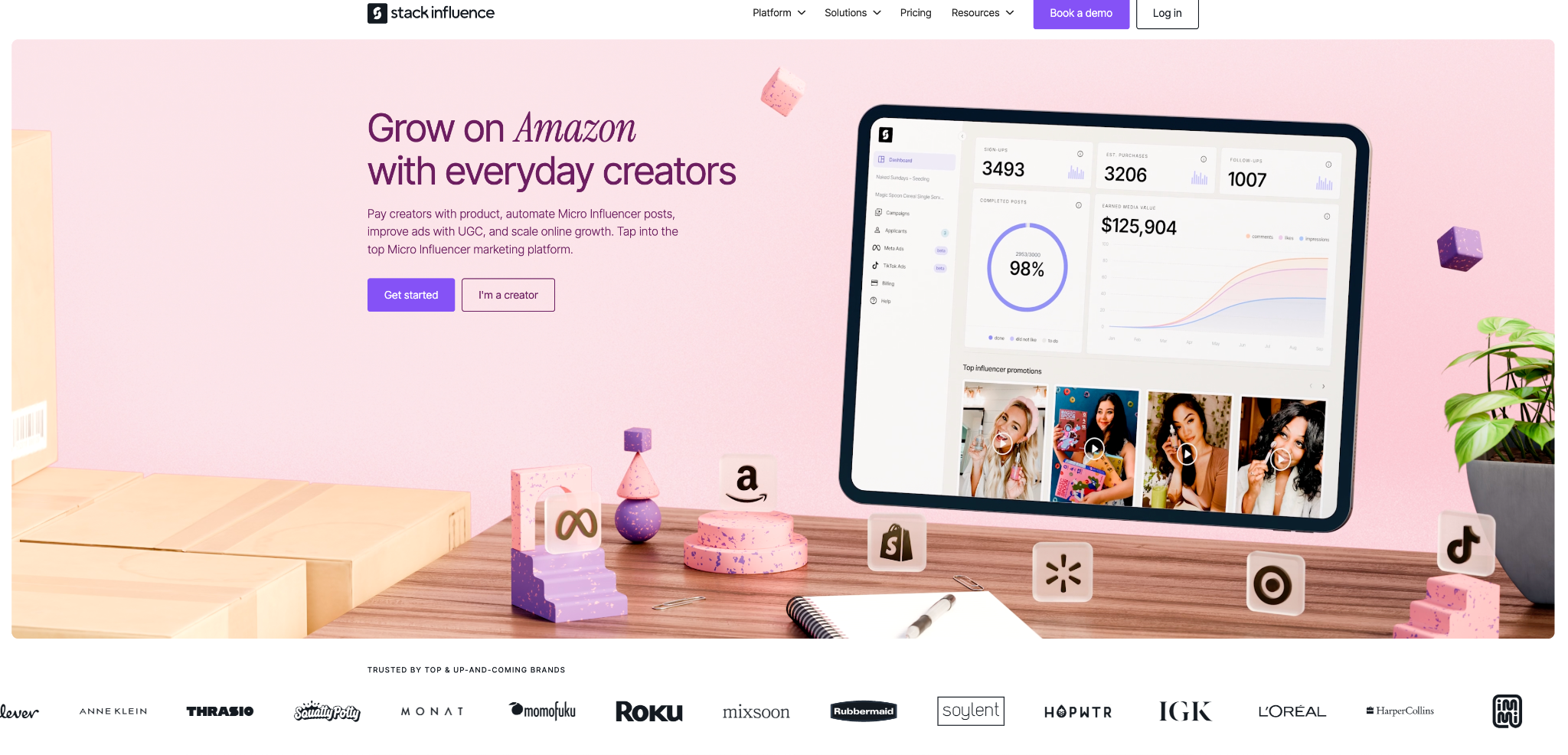
Evaluate Stack Influence when you want creator sourcing, product seeding, and completed social promotions coordinated through a managed campaign. Its published product reimbursement process describes creators purchasing the product, submitting their social post for approval, and receiving reimbursement afterward, with brands billed weekly for reimbursements.
Ask for the exact deliverables, approval responsibilities, reimbursement assumptions, and reporting included in your proposed campaign. Establish the complete scope before comparing its fees with a software subscription.
Levanta
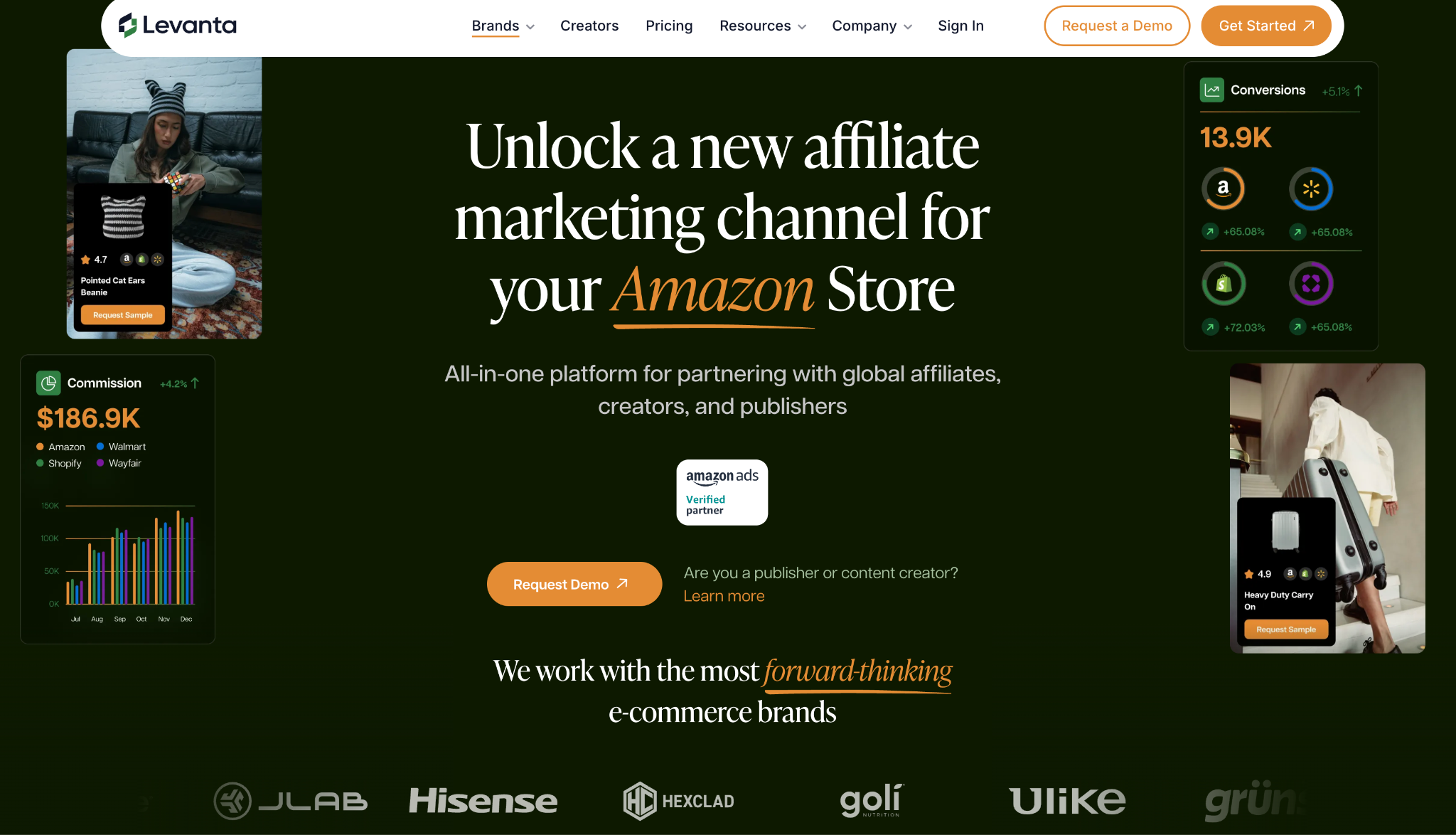
Evaluate Levanta when the main job is building an Amazon affiliate program. Its Amazon creator affiliate platform documents a creator marketplace, configurable commissions, paid placements, and an Amazon Attribution API integration.
Ask who will recruit and activate partners, what sales qualify for commission, and how returns affect payments. Access to a creator marketplace still needs an operating plan for turning available partners into active collaborations.
Modash
Evaluate discovery and management software when your team wants to select creators and run relationships itself. Modash’s integration documentation says discovery, management, and most tracking features work without Shopify, while its documented ecommerce attribution features connect to Shopify.
An Amazon seller should request a separate demonstration of the Amazon measurement workflow. Establish which tasks your operator will perform and which sales data will actually appear in the proposed setup.
Use these examples to narrow the workflow. Stack’s broader guide lets you compare Amazon influencer marketing platform options once you know which kind of service you need.
Test Creator Fit and Delivery Accountability
Ask each provider to demonstrate how it would find suitable creators for your actual product. Review relevant examples of their content, the buying questions they answer, and the audience information the platform can substantiate.
For a kitchen product, a creator who demonstrates preparation and cleanup may be more useful than one whose content consists mainly of unboxings. That is a selection judgment to test against your brief, rather than a universal performance rule.
Check the following during the demonstration:
- Product relevance: Can the creator use the product credibly and explain the specific problem it solves?
- Audience evidence: What information supports the audience’s relevance, and which details are estimated or unavailable? Creator location and audience location are separate questions.
- Content quality: Can the creator show the product clearly, follow the required format, and avoid unsupported claims?
- Selection control: Does your team approve individual creators, approve campaign criteria, or rely on the provider’s selection process?
- Completion evidence: What confirms that the agreed post was published and the required file delivered?
Then examine the exceptions. Ask what happens when a creator declines, receives a damaged product, misses a deadline, or produces content outside the brief. Request the replacement, revision, and payment rules.
Define “completed” precisely. A signup, product shipment, accepted file, and published promotion represent different stages. Your agreement should name the stage that triggers each charge and the evidence you receive.
Compare Fully Loaded Proposals for the Same Deliverables
Give shortlisted providers the same scope before comparing prices. Include creator compensation, platform or management charges, product access, fulfillment, additional licenses, and your team’s work.
Separate the cost comparison from the payment schedule. A deposit, prepaid credit balance, or inventory commitment can affect cash needs even when two proposals have similar total costs.
An Illustrative Comparison of Two Vendor Quotes
The following figures are invented for a quote-comparison exercise. They are not Stack Influence pricing, competitor quotes, or market benchmarks.
Assume both proposals deliver exactly 20 accepted videos, each also published as one creator social post. Both include the same six-month license for Amazon listing use, brand social channels, and ads run from the brand’s own accounts. Ads run through a creator’s identity, paid media spending, and additional revisions are outside this example.
Assume 20 directly shipped samples, each with a $15 landed product cost excluding outbound delivery, plus 10shipping.Productandshippingcostthereforeequals20×(15 + $10) = $500. All modeled costs remain fixed, and the comparison assumes all 20 required video-and-post pairs are delivered.
- Proposal A: $300 software and management + $800 creator fees + $500 products and shipping + $400 additional licensing + $600 internal labor = $2,600 total planning cost. Labor assumes 15 hours at $40 per hour.
- Proposal B: $900 software and management + $700 creator fees + $500 products and shipping + $0 additional licensing because the equivalent license is bundled + $200 internal labor = $2,300 total planning cost. Labor assumes five hours at $40 per hour.
Excluding internal labor, campaign costs are $2,000 for A and $2,100 for B. Including that labor allocation, the cost per accepted video-and-post pair is $130 for A and $115 for B.
Under these assumptions, B requires $100 more non-labor spending but has a $300 lower total planning cost. The difference comes from saving 10 staff hours valued at $400. Those labor values represent allocated capacity, not necessarily extra payroll or cash savings.
Replace every assumption with a written quote and your own staffing estimate. If the providers deliver different formats, permissions, or quantities, resolve those differences before declaring one cheaper.
Purchase-and-reimbursement campaigns need a different product-cost reconciliation from this direct-shipment example. Record reimbursements, product costs, marketplace charges, and actual seller proceeds separately so the same transaction is not counted twice. The guide to budgeting product seeding for Amazon sellers develops that distinction.
Verify Amazon Measurement With a Live Example
Ask the provider to follow one creator’s content through its reporting workflow. You should be able to see the content identifier, destination link, reported activity, and source of each metric.
Amazon describes Amazon Attribution as a free measurement solution for non-Amazon marketing. Its seller eligibility guidance includes professional sellers enrolled in Brand Registry, and its reports include clicks, detail-page views, add-to-carts, purchases, units, and product sales. Confirm access for your account before buying a campaign whose central promise depends on those reports.
Have the vendor demonstrate these checks:
- Identify the Amazon account receiving the data and who will retain access.
- Show how individual creators or placements receive distinguishable links when separate reporting is required.
- Open the intended destination and confirm the product variation and tracking setup.
- Explain whether “sales” means revenue, units, purchases, or an estimate.
- Show available exports and identify promoted-product versus other same-brand results.
- Explain how affiliate commission reporting is reconciled with the seller’s measurement.
Amazon’s attribution methodology uses a 14-day, last-touch model. A conversion must occur within 14 days of the qualifying click, and the most recent click receives credit. Use that definition when comparing reports; a campaign’s evaluation period is a separate choice.
Dashboard labels also need explanation. Stack’s dashboard overview explicitly describes purchases as an estimate and tracks completed social promotions separately. Ask every provider to distinguish estimated activity, verified deliverables, and Amazon-reported attributed purchases.
Keep campaign-participant purchases identifiable in your operating records. Do not automatically subtract every sample or reimbursed purchase from an aggregate Attribution total, because you may not know which transactions overlap. If the available data cannot establish that overlap, record the limitation.
Likewise, an attributed order does not establish that the order would have disappeared without the campaign. Incremental sales require a credible comparison, while profit requires the relevant costs.
Finally, check any promised Brand Referral Bonus savings. Amazon describes an average bonus of 10% of qualifying sales, credited against future referral fees, with the amount affected by category and other conditions. Confirm eligibility, enrollment, tagging, and earned credits before treating the bonus as a budget offset.
Confirm Content Rights and Policy Controls
List where you intend to use the content before accepting a rights summary. Your requirements might include Amazon product pages, brand social accounts, paid ads, edited versions, or access to original files.
For each use, establish the license duration, territory, permitted edits, renewal price, and any restrictions on music or other included material. Obtain separate confirmation of permissions needed to advertise through a creator’s account.
Stack’s Amazon campaign workflow describes content reuse licenses that depend on the plan. Use the same contract-level check across providers so the permissions you buy match the placements you intend to use.
Keep Social Endorsements and Amazon Reviews Separate
The FTC’s influencer disclosure guidance treats free products and payments as material connections. It advises placing clear disclosures with the endorsement and including them within videos. Ask who checks the disclosure and who handles corrections.
Amazon’s Community Guidelines on compensated reviews prohibit exchanging payments, refunds, discounts, or products for customer reviews. A creator campaign should contract for social content without making Amazon customer reviews a deliverable, reimbursement condition, or promised outcome.
Review rules are only one part of the assessment. Amazon’s published clarification on rebates and marketing incentives warns against schemes intended to inflate ranking or portray discounted purchases as full-price sales, and reminds sellers that third-party actions remain their responsibility.
For any purchase-and-reimbursement workflow, request an explanation of the exact mechanics under applicable seller rules. A social-post requirement alone does not establish that every part of a transaction complies with Amazon’s policies. Avoid treating a vendor’s compliance statement as independent certification.
Set a Pilot Decision Your Margin Can Support
Choose the pilot’s primary decision before launch. A content pilot can establish whether you receive useful, licensed assets at an acceptable cost. A sales-focused pilot also needs an economically meaningful customer outcome and an honest account of measurement limits.
Use contribution per order to set a sales hurdle. This is the money remaining from an additional customer order after product cost, Amazon selling and fulfillment charges, expected return costs, and any variable affiliate commission.
An Illustrative Sales Recovery Calculation
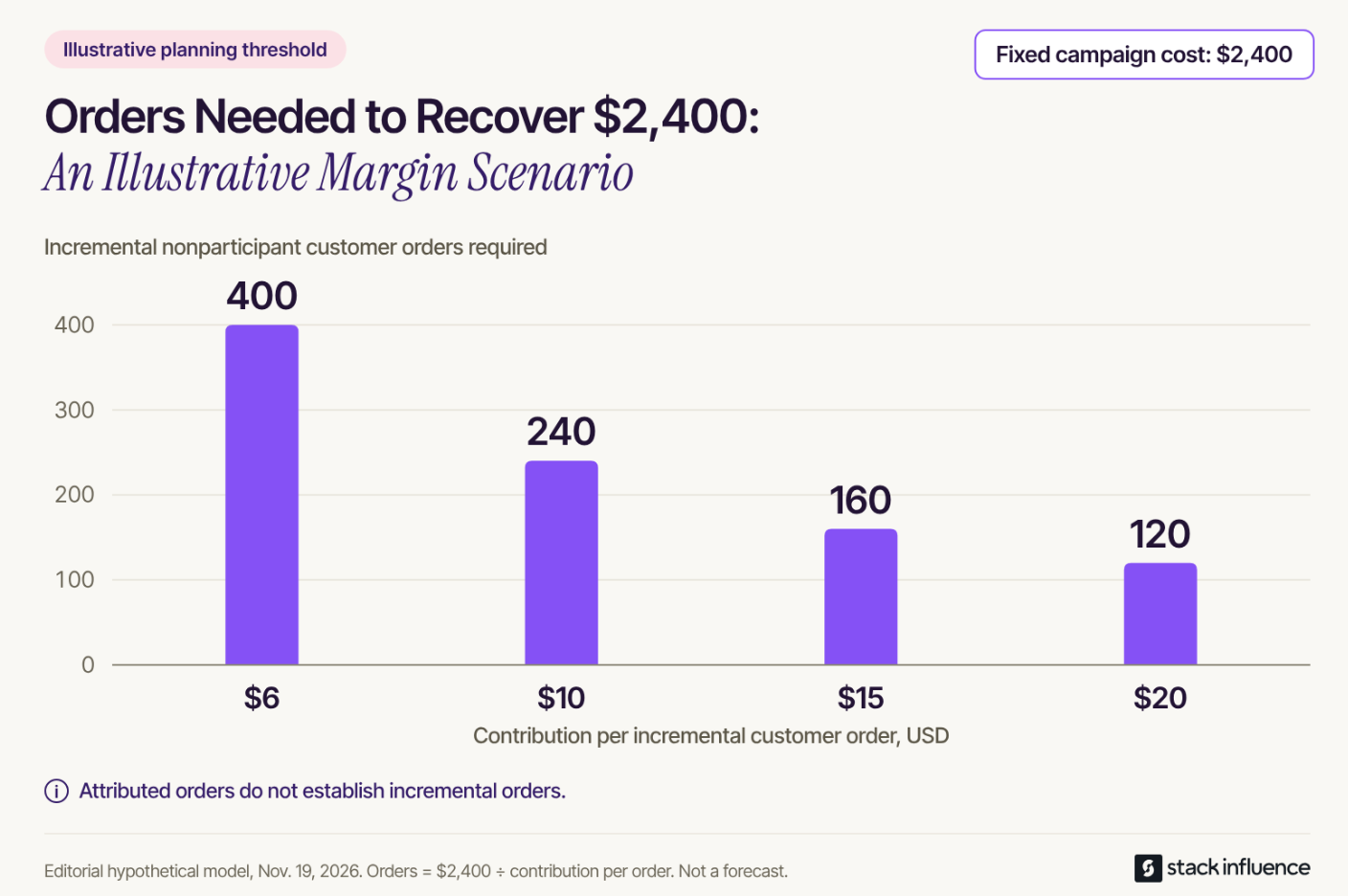
For a separate hypothetical campaign, assume $2,400 of fixed campaign cost to recover. This is independent of the two proposals above. Variable order costs are already deducted in the following contribution assumptions and are excluded from the fixed campaign cost.
The calculation is fixed campaign cost divided by contribution per additional order, rounded up to a whole order:
- At $6 contribution per order: $2,400 ÷ $6 = 400 incremental customer orders.
- At $10 contribution per order: $2,400 ÷ $10 = 240 incremental customer orders.
- At $15 contribution per order: $2,400 ÷ $15 = 160 incremental customer orders.
- At $20 contribution per order: $2,400 ÷ $20 = 120 incremental customer orders.
These are additional, nonparticipant customer orders within the chosen evaluation period. The example assumes constant contribution per order and assigns no offset for future purchases, content reuse, or Brand Referral Bonus credits. It includes no paid media spending.
The same fixed investment therefore requires substantially more additional orders when contribution is lower. The calculation sets a planning threshold; it neither forecasts campaign performance nor turns attributed purchases into proven incremental orders.
Agree on the evaluation period, reporting lag, and evidence needed before the pilot begins. If the campaign’s main purpose is content production, judge content quality and delivery against that purpose rather than forcing a short-term sales claim.
Send a Specific Demo Request Before Signing
Use this brief to make competing proposals easier to evaluate. Replace the bracketed fields with your requirements.
- Product: [Amazon ASIN, exact variation, marketplace, price, and inventory constraints].
- Primary outcome: [Published social posts, licensed content, affiliate sales, or a clearly prioritized combination].
- Required deliverables: [Formats, quantities, publication channels, file requirements, and acceptance criteria].
- Creator requirements: [Relevant use case, evidence of audience fit, and selection responsibilities].
- Rights: [Permitted placements, duration, editing needs, and any creator-account advertising permissions].
- Demonstration: Show one comparable workflow from creator selection through product access, content approval, billing, and reporting.
- Quote: Separate all platform, creator, product, fulfillment, licensing, and other charges; identify the work our team must perform.
- Measurement: Explain each metric’s source, attribution rules, export options, and treatment of campaign-participant purchases.
- Exceptions and exit: Explain missed deliverables, revisions, replacements, cancellation, unused credits, renewal terms, and access to files and reports after termination.
Request a written response and a sample report that protects other customers’ confidential information. Confirm when any pilot or opt-out period begins, how completion is measured, and which commitments survive cancellation.
Set essential requirements first: suitable creators, usable deliverables, necessary rights, acceptable terms, and a reporting method appropriate to your goal. Among providers that meet them, compare total cost and the work your team must still perform.
Choose a Platform You Can Evaluate After Launch
The right choice should be explainable before you sign and assessable afterward. You should know what will be delivered, who owns each task, what the campaign will cost, and what the reporting can support.
Start with a defined product and outcome, request comparable proposals, and agree on a pilot decision. That gives you a practical basis for choosing a micro influencer platform and deciding whether to expand the relationship.