




A product shipped to a creator is a marketing expense. A published post is a deliverable. A customer purchase is a different outcome. Product seeding for Amazon sellers becomes easier to evaluate when those three events stop being treated as interchangeable.
The practical question is not simply how many creators will accept your product. It is whether you can turn inventory into useful content and measurable customer interest at a cost your business can support.
This guide explains how to choose a campaign model, budget a pilot, brief creators, protect review-policy boundaries, and measure results without mistaking brand-funded product purchases for new demand.
Key Takeaways
- Separate campaign spending, completed content, and customer demand instead of reporting them as one measure of success.
- Agree on social deliverables and content rights before fulfillment; a no-strings gift does not guarantee a post.
- Keep Amazon customer reviews outside creator compensation agreements and disclose gifted social endorsements clearly.
- Judge sales using consistent attribution windows and exclude brand-funded creator units from customer-demand comparisons.
Product Seeding for Amazon Sellers: The Three-Ledger Method
Product seeding means providing products to selected creators so they can experience them and potentially introduce them to an audience. For Amazon sellers, the intended outputs may include social content, reusable user-generated content, and visits to an Amazon listing. Those outputs need separate records.
Use the Three-Ledger Method as a practical campaign worksheet:
- Spend ledger: Record product costs, fulfillment, creator compensation, platform charges, coordination, and licensing expenses.
- Content ledger: Record agreed deliverables, received files, published posts, usable assets, and permission to reuse them.
- Demand ledger: Record shopper traffic, attributed purchases, and net customer units separately from brand-funded creator orders.
The distinction prevents a common reporting error: calling every product distributed a completed promotion, then calling every recorded order an acquired customer.
Choose the Promise Before Choosing the Creator
Decide whether the offer is an unconditional gift or an agreed product-for-content collaboration. Shopify's explanation of influencer gifting makes the central tradeoff clear: sending a genuine gift without an agreement does not guarantee coverage.
For an unconditional gift, record any resulting post as an earned outcome. For an agreed collaboration, specify the content format, deadline, compensation, and permissions before sending anything. Stack Influence's broader product-seeding guide provides context for the sourcing and fulfillment stages, but your campaign agreement must define the actual deliverable.
Stack Influence is a micro-influencer marketing platform built around gifted-first campaigns. Its automated product-seeding workflow connects creator participation, product coordination, post validation, and completed-post accountability. Its completions-only model ties the campaign charge to completed creator posts, not to guaranteed sales or ranking improvements.
When evaluating influencer marketing platforms or a micro influencer agency, ask what counts as completion, which costs remain payable after a cancellation, and whether reuse rights are included. A completed-post commitment and a sales forecast are different promises.
What Does a Product-Seeding Pilot Actually Cost?
A pilot costs the products and fulfillment you fund, plus coordination, creator compensation, platform services, and any content rights you purchase. Divide that full cost by the output you actually need, such as usable licensed assets, rather than by the number of products sent.
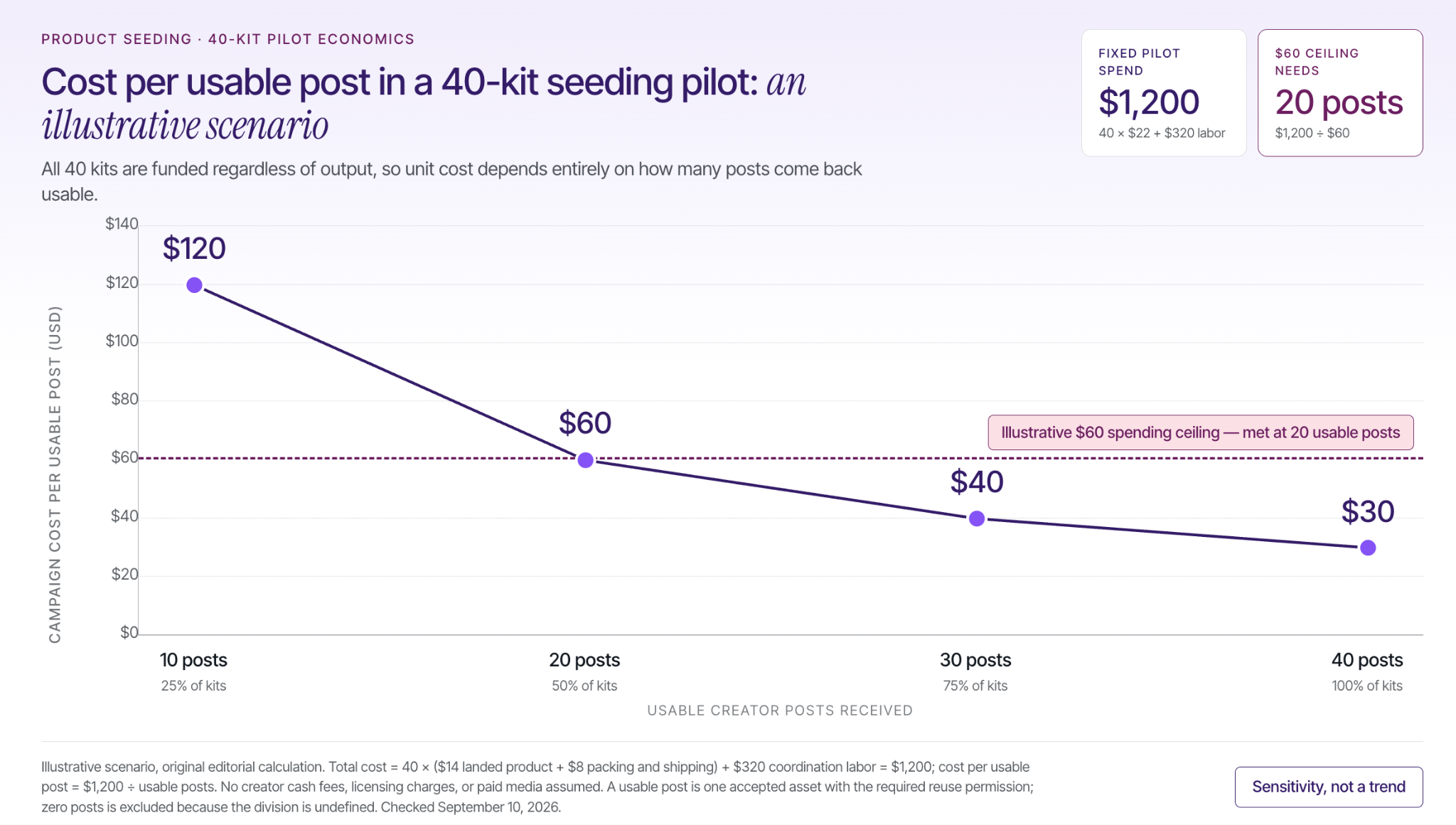
Consider an illustrative direct-shipment pilot, not a Stack Influence quote or industry benchmark. Assume 40 kits, a $14 landed product cost per kit, $8 per kit for packing and shipping, and $320 of coordination labor. Assume no additional creator cash fees, licensing charges, paid media, or other costs in this simplified example.
The total is 40 × ($14 + $8) + $320 = $1,200.
Define one usable asset as one accepted creator post with the reuse permission required by the campaign. Holding the $1,200 spend constant, 10 usable posts cost $120 each; 20 cost $60 each; 30 cost $40 each; and 40 cost $30 each. If no usable posts arrive, the campaign has no finite cost per usable asset, not a cost of zero.
For a hypothetical $60-per-asset spending ceiling, this pilot needs at least 20 usable assets. That threshold comes from your chosen budget constraint, not a universal creator completion rate.
Purchase-and-reimbursement logistics need a different worksheet from direct shipping. Record reimbursements, marketplace fees, product costs, and actual seller proceeds separately, then reconcile the campaign's economic cost without double-counting the same transaction. Cash leaving the business and the final net campaign cost are not necessarily identical.
Before approving a quote, check who handles undelivered packages, damaged products, rejected content, creator withdrawals, and licensing extensions. These details determine whether two proposals cover the same work.
Build the Campaign Around One Retail-Ready ASIN
Start with one product and a specific buying situation so the pilot answers a useful question. An ASIN is Amazon's product identifier; confirm the exact variation you intend to promote and the offer customers will reach.
Choose a product that a creator can demonstrate meaningfully within the planned testing period. A desk organizer, for example, can answer questions about drawer fit, usable capacity, and access to everyday supplies. A generic unboxing may leave those purchase questions unanswered.
Before outreach, check availability, images, dimensions, instructions, delivery expectations, and the price shown to shoppers. Stack Influence's guide to fixing Amazon listing and conversion gaps provides a useful readiness check before you send additional traffic.
Reserve campaign units separately from inventory needed for customer orders. Avoid scheduling a content release that could coincide with an inventory gap or an unplanned price change, because either would complicate the demand ledger.
Match the Creator to a Buying Situation
Shortlist micro influencers and nano influencers whose existing content demonstrates the relevant use case. Inspect recent posts, audience location where verifiable, meaningful comments, product explanations, and disclosure habits rather than choosing by follower count alone.
For the desk organizer, a creator showing small-space work setups offers a clear demonstration context. Ask whether the creator can show the product in use and answer a realistic buyer question, not merely hold the package on camera.
Stack Influence's evidence-first guide to finding Amazon influencers helps distinguish audience reach, product relevance, and creator capability. Keep those distinctions in your shortlist: a UGC creator hired to produce a file is not automatically contracted to distribute it to an audience.
Put the Agreement Ahead of Fulfillment
A useful brief identifies the product variation, honest demonstration requirements, posting channel, deadline after receipt, compensation, disclosure, approval scope, and content rights. Specify whether the brand needs a social post, a delivered UGC video, or both.
Limit approval to agreed requirements, factual accuracy, and substantiated claims rather than requiring praise. Define a fair remedy for a broken product or a genuine inability to use it, and avoid promising reimbursement on terms that have not been explained before acceptance.
For manual outreach, lead with relevance and the actual exchange: “Your small-space desk setups match how this organizer is used. Would you consider a product-for-content collaboration? We would agree on the deliverable, timing, and usage rights before shipping.”
Release products in manageable batches. Track acceptance, dispatch, receipt, testing, content delivery, and publication separately, and start deadline reminders from the event specified in the agreement rather than assuming dispatch equals receipt.
Keep Social Endorsements Separate From Amazon Reviews
A social content agreement should not include a compensated Amazon customer-review obligation. Amazon's customer-review policy explanation prohibits offering free products, refunds, discounts, or other compensation in exchange for reviews.
Calling a requested review “honest” does not remove that exchange. Keep review requests out of the creator brief, reimbursement conditions, and completion checklist rather than treating customer ratings as another campaign deliverable.
For eligible products, Amazon Vine is a separate Amazon-managed route for obtaining independent reviews from selected reviewers. It is not a substitute name for a brand's own compensated review campaign, and it does not promise positive reviews.
Have any purchase-and-reimbursement arrangement checked against current Amazon selling policies before launch. Separating social content from customer reviews does not, by itself, validate every purchasing arrangement; do not design purchases merely to manufacture sales rank.
Disclose the Gift Where People See the Endorsement
The FTC's social media disclosure guidance explains that free or discounted products can create a material connection requiring disclosure. The disclosure should be easy to notice with the endorsement, not hidden in a profile or a long cluster of hashtags.
Use plain language that accurately describes the relationship, such as “Brand provided this product free.” For video, make the disclosure part of the video rather than relying only on its description, and account for any cash payment or affiliate relationship too.
Platform tools are an additional requirement to check. For example, YouTube's branded-content guidance requires creators to notify YouTube about applicable commercial relationships, while leaving creators and brands responsible for their disclosure obligations.
Secure Content Rights Before Planning Reuse
Receiving a post or sending a product does not automatically establish the permissions needed to reuse the work. The U.S. Copyright Office explains in its copyright overview that original photographs and other eligible works receive protection when they are fixed in a tangible form.
Put the permitted channels, usage period, territory, editing rights, and paid advertising uses in writing. Confirm whether you receive raw files, whether third-party music is cleared for the intended use, and whether creator-account advertising requires separate authorization.
Stack Influence's UGC production workflow is relevant when the campaign needs a reusable content library rather than publication alone. Keep each asset's permissions beside the file so the team handling ads or Amazon content can check the intended placement.
The content ledger should distinguish “published,” “usable,” and “licensed for this placement.” They are different statuses, and paying to produce a video does not resolve every usage question.
Measure the Audience, Not the Sample Orders
Measure product seeding through linked records of content delivery, shopper response, and net customer purchases. Amazon's Amazon Attribution overview describes a free measurement solution for eligible advertisers to evaluate non-Amazon marketing through metrics such as clicks, detail-page views, and purchases; confirm your account's access before promising campaign reporting.
Create distinguishable tags for the creator placements you need to compare. Test each shopper-facing link on mobile, confirm the intended destination, and record the post's publication time. Keep creator product-acquisition instructions separate from public audience links so a funded sample order is not deliberately routed through the same measurement path.
Amazon's Attribution methodology uses a 14-day, last-touch model: the most recent qualifying click receives conversion credit within that window. For a defined click cohort, allow its window to mature before making a final comparison, and revisit reporting for subsequent adjustments.
Review delivery and link problems while the campaign is running. Low publication completion calls for a fulfillment or coordination fix; clicks without purchases call for closer examination of product fit, the offer, and the listing. Do not treat the absence of a tagged purchase as proof that nobody saw or remembered the content, because last-touch reporting does not measure every influence on a buying decision.
Why Can Total Orders Overstate Customer Demand?
Total orders can include brand-funded creator units and units later canceled or returned, so they can overstate the customer demand you are trying to evaluate. Reconcile those categories before comparing campaign-period results with a baseline.
Consider a separate illustrative 28-day scenario for a campaign using purchase-and-reimbursement logistics. The seller records 620 ordered units, including 80 brand-funded creator units. Removing those 80 leaves 540 nonparticipant ordered units; removing 20 additional nonparticipant units canceled or returned leaves 520 net nonparticipant units.
Assume the two deductions do not overlap, all figures cover the same ASIN, and a comparable prior 28-day period produced 400 net nonparticipant units. Apply the same cancellation, return, and reporting-cutoff rules to both periods.
Comparing 620 gross ordered units with the 400-unit net baseline would suggest 55% growth. Comparing 520 net nonparticipant units with that same baseline instead shows a 30% observed increase: (520 − 400) ÷ 400.
Neither percentage proves the campaign caused incremental sales. The 520 units include all nonparticipant customer demand, not just attributed creator traffic, and changes in ads, seasonality, price, availability, or competitors may also explain movement.

Separate Contribution From Attributed Revenue
Use attributed revenue as one reporting measure, not as a profit calculation. Evaluate customer contribution after product costs, Amazon fees, fulfillment, discounts, and returns, then account for the campaign expenses in the spend ledger.
Amazon's Brand Referral Bonus explanation describes a bonus averaging 10% of qualifying sales for eligible enrolled sellers, with rates varying by product price and category. Credits offset referral fees and involve a processing delay, so use actual eligible credits rather than assuming every order earns an immediate 10% cash return.
Do not assume a reimbursed creator's purchase qualifies for that bonus. Also avoid adding a hypothetical dollar value for impressions or unused content to sales revenue and labeling the result ROI.
Stack Influence's profit-first external traffic framework can support the next budgeting decision. Keep content reuse value visible, but record it separately from customer contribution unless you have a defensible method for valuing it.
Expand Only After the Pilot Answers a Useful Question
Increase volume after identifying what worked, not simply after products have been distributed. If content is useful but traffic is weak, test the placement and call to action; if traffic arrives but purchases do not, investigate the offer and listing before increasing creator volume.
Stack Influence's company-reported Remilia case study illustrates why multiple measures matter. Its three-month campaign recorded 115 creator promotions and 1.66 million social impressions, while average monthly unit sales moved from a starting point of 141 to 306 during the campaign.
Those figures describe content activity and observed sales movement, not a controlled estimate of incremental sales. Results depend on the product, audience, pricing, marketplace conditions, and execution, so use the example to decide what to record rather than what to forecast.
A successful pilot also identifies creators worth approaching for repeat brand partnerships. Preserve the product-use insights, content permissions, communication history, and audience-response data that make the next collaboration easier to evaluate.
For sellers considering managed execution, Stack Influence's Amazon campaign workflow provides a way to coordinate creator activation and campaign delivery. Evaluate the service against the three ledgers: what gets completed, what the full campaign costs, and how customer response will be measured.
Make the Next Shipment Earn Its Place
Product seeding for Amazon sellers works as a disciplined test when inventory, content, and demand remain separate enough to evaluate honestly. A campaign can produce useful creative without proving incremental sales, and an increase in orders can occur without every order representing a newly acquired customer.
Choose one product, define the social deliverable, set a cost ceiling, and establish your tracking before the first shipment. Use the Three-Ledger Method to decide whether the next step is better targeting, a stronger brief, a listing fix, or more volume.
Bring that pilot brief to Stack Influence to assess a managed product-seeding campaign built around completed creator content and a clear measurement plan.