




Amazon external traffic strategies work only when a seller can answer three questions: who is arriving, why did they click, and does the resulting order leave contribution profit? Search ads, creators, paid social, email, affiliates, and owned content can diversify demand beyond Amazon PPC. They can also waste money when every audience receives the same message and destination.
This guide gives ecommerce sellers a practical system for choosing channels, routing shoppers, setting break-even limits, using Amazon Attribution, and evaluating the Brand Referral Bonus without overstating its value. The goal is not more traffic. The goal is qualified, measurable demand that the business can afford to repeat.
Key Takeaways
- External traffic should be managed as a portfolio of different jobs, not as one undifferentiated source of clicks.
- A seller should calculate the maximum affordable cost per click before buying traffic, using product margin and expected conversion rate.
- Product detail pages suit high-intent traffic, while Brand Stores and pre-sell pages can better serve shoppers who need context or choice.
- Amazon Attribution measures the retail journey, but profitability requires adding media cost, creator cost, promotions, returns, and Brand Referral Bonus credits.
- Creator campaigns become more valuable when they produce both tagged traffic and licensed UGC that can improve future ads and retail content.
What Are Amazon External Traffic Strategies?
Amazon external traffic strategies are coordinated methods for sending shoppers from outside Amazon to a product detail page or Brand Store. Common sources include Google Search, social media, creators, email, affiliates, publishers, and brand-owned content. A complete strategy also defines the audience, message, destination, tracking structure, and profit threshold for each source.
As of August 2026, Amazon describes Amazon Attribution as a free measurement solution for non-Amazon search, social, display, video, email, and affiliate or influencer campaigns. Its reports use a 14-day attribution window and include clicks, detail page views, add-to-carts, purchases, units sold, product sales, and new-to-brand metrics.
That measurement layer separates external traffic from ordinary Amazon PPC reporting. Sellers can use the data to compare off-platform sources, while the supporting Amazon Attribution guide explains the setup in a seller-focused context.
External traffic does not mean sending the largest possible audience to an ASIN. It means acquiring or activating demand outside Amazon, routing it to the right retail experience, and measuring whether the traffic produced useful shopping behavior and profitable orders.
Amazon External Traffic Strategies Start With Five Controls
The External Traffic Control Loop is a five-part framework for turning scattered campaigns into a manageable acquisition system. Every channel must pass through the same five controls before budget increases.
- Audience intent: Identify whether the shopper is discovering a problem, comparing solutions, searching for a specific product, or returning to a known brand.
- Message match: Carry the same core promise from the ad, creator post, email, or article into the Amazon destination.
- Destination fit: Choose a product detail page, Brand Store, or pre-sell page according to how much education and choice the audience needs.
- Attribution design: Create tags at the level where a decision will be made, such as channel, publisher, creator, keyword group, or creative.
- Margin control: Set a maximum acquisition cost using contribution margin, conversion rate, and any category-specific referral bonus.
The loop prevents a common mistake: choosing a channel because it is popular, then trying to make its traffic fit the product. A better approach starts with the shopper’s intent and works backward to the channel, creative, and destination.
Use the same control loop after launch. If clicks are cheap but detail page views are weak, inspect the link and destination. If detail page views are healthy but add-to-carts are low, inspect the offer and product page. If purchases are strong but profit is weak, inspect media cost, promotions, fees, and returns.
Set the Economics Gate Before Buying Clicks
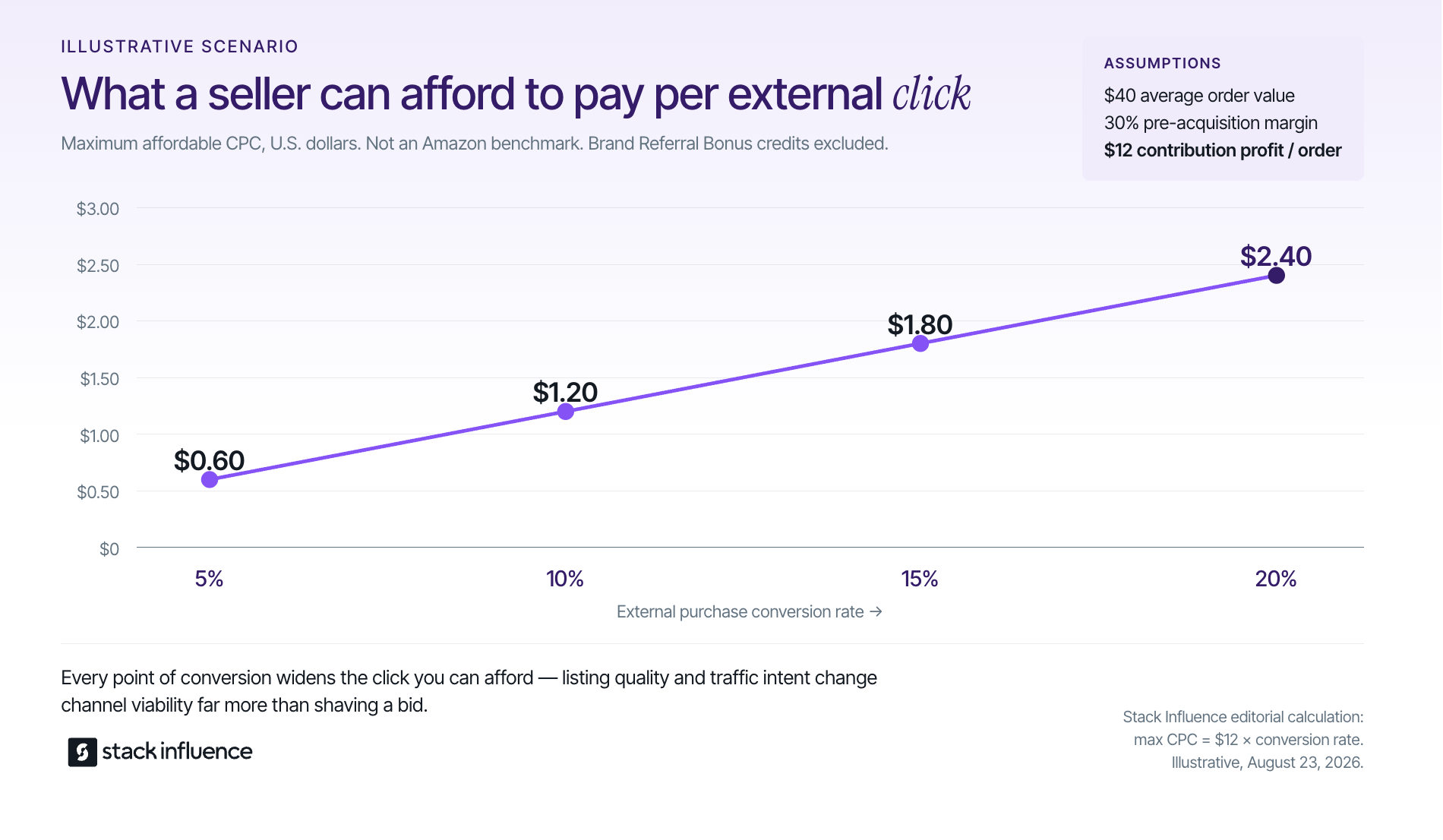
A seller should know the maximum affordable external cost per click before opening an ad account or negotiating a publisher placement. The basic formula is:
Maximum affordable CPC = contribution profit per order before external acquisition cost × expected external conversion rate.
Consider an illustrative product with a $40 average order value and a 30% contribution margin after product costs and Amazon fees, but before external acquisition. That leaves $12 per order for traffic. At conversion rates of 5%, 10%, 15%, and 20%, the maximum break-even CPC is $0.60, $1.20, $1.80, and $2.40 respectively.
These figures are not Amazon benchmarks. They show how strongly conversion rate changes channel economics. If the market CPC is $1.50, the illustrative product needs a 12.5% purchase rate to break even before Brand Referral Bonus credits. Improving the listing or choosing warmer traffic can therefore be more valuable than negotiating a slightly cheaper click.
The same logic applies to creators, affiliates, and sponsorships. Convert every cost into an expected cost per attributed order, then compare that number with contribution profit. The guide to how much Amazon ads cost provides a related framework for separating visible media cost from the retail and margin costs behind it.
Seven External Traffic Channels and When to Use Them
The strongest Amazon traffic mix combines channels that capture existing intent, build trust, activate known audiences, and create future demand. Each source should have one primary job, one matching destination, and one reporting unit.
1. Google Search Ads
Google Search is strongest when shoppers are already expressing a problem, product, feature, or brand need. Google’s Search campaign documentation describes the format as a way to reach people actively searching for specific products and services.
Start with branded queries, precise category terms, and problem-solution searches that closely match the ASIN. Separate keyword groups with distinct Amazon Attribution tags. Broad informational traffic may require a pre-sell page, while branded and product-specific searches can often go directly to the product detail page.
2. Micro-Influencers, Nano Influencers, and Product Seeding
Creator traffic is useful when a product benefits from demonstration, personal context, or social proof. Micro influencers and nano influencers can explain use cases that a static ad cannot, while product seeding can produce both off-platform demand and reusable content.
Build the creator shortlist around category relevance, content quality, audience fit, and reliability rather than follower count alone. The evidence-first guide to finding Amazon influencers shows how to evaluate creators across delivery, content, traffic, and commerce.
Give each creator or tightly defined cohort a trackable link when practical. Also require clear disclosure of gifted products or paid relationships. The FTC’s endorsement guidance states that material connections between advertisers and endorsers should be disclosed.
3. Creator-Led Paid Social
Paid social works best after organic creator content has revealed a strong hook, demonstration, or objection answer. The seller is no longer guessing what people will watch. The seller is amplifying evidence that already earned attention.
Meta says partnership ads allow advertisers to run ads with creators, brands, and other partners. TikTok’s Spark Ads playbook similarly describes promoting native creator-originated content. Use separate tags for platform, creator, asset, audience, and destination when those distinctions will change budget decisions.
Do not scale every high-engagement post. A useful ad candidate should also communicate the product clearly, attract the intended shopper, and preserve message match after the click.
4. Email and SMS
Email and SMS are usually the warmest controllable traffic sources because recipients already know the brand. Use them for launches, replenishment reminders, seasonal offers, bundles, or a product that has gained new proof since the last promotion.
Segment by prior purchase, category interest, or engagement instead of sending the entire list to one ASIN. Create separate tags for broadcasts, automated flows, and major audience groups. A high click rate from an existing customer segment can still be unprofitable if the promotion is too deep or the message sends shoppers to the wrong variation.
5. Affiliates and Editorial Publishers
Affiliate and publisher traffic can capture shoppers who are comparing products, reading reviews, or searching for a best-of recommendation. The Performance Marketing Association’s 2025 industry study reported that U.S. affiliate marketing investment reached $13.62 billion in 2024 and generated $113 billion in ecommerce sales.
Amazon’s Influencer Program gives approved creators a storefront and affiliate linking tools. Sellers should document whether the placement is being evaluated through the creator’s affiliate economics, the brand’s Amazon Attribution reporting, or a coordinated method approved by the parties involved.
For paid publisher placements, compare cost per attributed order rather than subscriber count or page views. The Stack Influence guide to newsletter sponsorship provides a deeper selection and measurement process for this channel.
6. Organic Social and Short-Form Video
Organic social is a low-media-cost testing environment for hooks, demonstrations, FAQs, comparisons, and customer use cases. Its main strategic value is learning which messages deserve paid amplification and which content formats can be reused elsewhere.
Track the Amazon link separately from the profile’s ordinary website traffic. Measure attention metrics as leading indicators, but use detail page views, purchases, and contribution profit as outcome metrics. Before reusing creator assets in ads, emails, listings, or Brand Stores, confirm the required UGC licensing rights.
7. Brand-Owned Content and Organic Search
Brand-owned guides, comparison pages, tutorials, and use-case content can create a durable route from search discovery to Amazon. This channel is most useful when the product requires education or when shoppers repeatedly ask the same pre-purchase questions.
Build content around genuine buyer decisions, not thin pages created only to pass authority to an Amazon link. Use UTMs for the owned site and an Amazon Attribution tag on the outbound Amazon call to action. Review which topics produce retail actions, then use those insights to improve product copy, creator briefs, and paid search messaging.
Product Detail Page, Brand Store, or Pre-Sell Page?
Send high-intent shoppers to a product detail page, discovery-oriented shoppers to a Brand Store, and education-heavy traffic to a pre-sell page that leads to Amazon. The correct destination is the shortest path that answers the shopper’s remaining questions without adding unnecessary friction. Product complexity, audience temperature, and catalog breadth should determine the route.
Use a product detail page for branded search, replenishment emails, creator recommendations focused on one product, and ads with a precise product promise. The page should match the promoted variation, price, use case, and imagery.
Use a Brand Store when the shopper needs category choice, brand education, bundles, or several related products. Amazon states that Brand Stores are free for eligible brand owners, can receive external traffic, and provide insights for visits, page views, sales, and traffic sources.
Use a pre-sell page when the audience needs a tutorial, comparison, quiz, detailed claim context, or a clearer bridge from the external creative to the product. Place the Amazon Attribution link on the outbound Amazon button, keep claims consistent with the listing, and remove distractions that do not help the buyer decide.
How Should Sellers Track External Traffic?
Track Amazon external traffic at the smallest level that supports a real decision. Use separate Amazon Attribution tags for meaningful channels, publishers, creators, keyword groups, or creative variants, then connect those retail metrics with each channel’s cost data. The result should explain both what shoppers did on Amazon and whether the campaign created contribution profit.
A practical tag hierarchy is:
- Campaign: The business objective, such as launch, evergreen acquisition, or seasonal promotion.
- Publisher or channel: Google Search, Meta, TikTok, email, creator cohort, newsletter, or affiliate partner.
- Ad group or tag: Keyword group, creator, creative concept, audience, placement, or email segment.
- Promoted product: The exact ASIN or product group selected during setup.
Use a four-layer measurement stack:
- Delivery: Spend, impressions, reach, clicks, CPC, and creator completion.
- Retail engagement: Detail page views, detail page view rate, add-to-carts, and add-to-cart rate.
- Commerce: Purchases, purchase rate, units sold, product sales, and new-to-brand activity.
- Profit: Contribution profit, net customer acquisition cost, discounts, returns, creator costs, and referral bonus credits.
The internal guide on how to track influencer marketing explains why delivery, traffic, content, and commerce should remain separate reporting layers.
Model the Brand Referral Bonus as a Delayed Credit
As of August 2026, eligible U.S. sellers can use the Brand Referral Bonus to improve external traffic economics, but the program should not be treated as instant cash or a universal 10% rate. Amazon’s Brand Referral Bonus guide says bonuses average 10% of qualifying sales, vary by category and sales price, offset future referral fees, and can be affected by returns or cancellations. Amazon also describes a waiting period before the full credit is applied.
Consider an illustrative $100 in attributed sales and a 10% bonus assumption. If gross external acquisition cost is $20, $30, or $40, the $10 credit reduces net external cost to $10, $20, or $30. That changes the effective external cost ratio from 20%, 30%, and 40% to 10%, 20%, and 30%.
The lesson is not that every campaign becomes profitable. The lesson is that sellers should compare gross and net economics using the actual category rate and the actual credit received. A strong bonus cannot rescue weak conversion, excessive discounts, or poor contribution margin.
Turning Product Seeding Into Trackable Amazon Demand

A creator program is most valuable when traffic generation, content production, and campaign completion are managed as one workflow. Stack Influence is built around gifted-first product seeding with vetted micro-influencers, creator coordination, UGC generation, and completed-post accountability for ecommerce brands.
The platform works with roughly 600,000 vetted creators, approximately 78% of whom are female. Its completions-only structure is designed to protect platform budget from creator drop-off by tying charges to completed posts rather than outreach alone.
A practical creator-to-Amazon workflow includes:
- Select creators whose content and audience match the product’s real use case.
- Define the post requirement, disclosure, message boundaries, and usage rights before activation.
- Assign Amazon Attribution tags by creator or meaningful cohort when the reporting value justifies the added complexity.
- Track completion, content quality, retail engagement, and sales as separate layers.
- Reuse approved assets in paid social, email, Brand Stores, and future launches.
During a three-month Stack Influence new-product campaign for Targus, 120 creator promotions generated 275,560 social impressions and 4,323 engagements. Average monthly unit sales increased from 56 to 221 during the campaign, while Amazon Best Seller Rank moved from #151,547 to #47,811. These outcomes occurred during the campaign and do not establish that creator traffic alone caused the changes.
The Amazon influencer marketing workflow is designed for brands that want creator sourcing, product seeding, campaign coordination, and completed content connected through one operating system. Sellers can use the Amazon influencer budgeting guide to model creator cost alongside traffic, content, and margin value.
The Ranking Myth Creates Bad Traffic Decisions
Amazon does not publish a rule that an external click automatically improves organic rank. Its public Attribution documentation focuses on measuring shopping actions and sales, not on guaranteeing placement gains. The responsible inference is that sellers should optimize external traffic for qualified purchases and profit, then monitor rank as a secondary marketplace outcome rather than the campaign’s promised result.
This distinction changes execution. Buying cheap, low-intent clicks for a theoretical algorithm signal can reduce profit and provide little useful learning. Qualified traffic that converts gives the seller revenue, customer insight, creative feedback, and a stronger basis for reinvestment.
Common failure patterns include:
- Using one attribution tag for every creator, ad, and audience.
- Sending cold discovery traffic directly to a detail page that cannot answer basic objections.
- Counting the Brand Referral Bonus before confirming the actual credit.
- Scaling during a stock constraint, pricing mismatch, or weak Featured Offer position.
- Ending a test before Amazon’s 14-day attribution window can capture delayed purchases.
- Treating rank movement as proof that one external channel caused the result.
The broader guide to how to rank on Amazon can help sellers place external traffic inside a more complete retail strategy.
A 30-Day Amazon External Traffic Launch Plan
A 30-day launch should produce a reliable decision, not chase immediate scale. Limit the first cycle to one ASIN, one primary audience, two traffic sources, and a small number of creative hypotheses.
Week 1: Establish the Retail and Margin Baseline
Confirm inventory, pricing, variation selection, images, copy, reviews, offer clarity, and mobile presentation. Calculate contribution profit per order and maximum acquisition cost. Enroll in the relevant Amazon measurement and bonus programs before links are distributed.
Week 2: Build the Tracking and Creative Matrix
Create separate tags for the two chosen sources and the few variables that could change a decision. Prepare creative that matches the same product promise on Amazon. Decide whether each source should land on the product detail page, Brand Store, or pre-sell page.
Week 3: Launch Controlled Tests
Release traffic in measured cohorts. Check link function, detail page views, add-to-carts, inventory, and message match before increasing spend. Do not optimize only to platform clicks or video views.
Week 4: Apply Scale, Hold, or Stop Rules
Scale when purchase rate and net acquisition cost meet the product’s margin threshold, inventory is stable, and the creative can support more volume. Hold when retail engagement is promising but the 14-day conversion window is incomplete. Stop or rebuild when the audience, message, destination, or economics fail the External Traffic Control Loop.
Document the decision and the reason. The learning from a disciplined failed test is more valuable than a larger campaign whose traffic cannot be explained.
Build External Demand You Can Defend
The best Amazon external traffic strategies are not channel lists. They are controlled systems that match intent, message, destination, measurement, and margin. Search may capture demand, creators may create trust, email may activate customers, and affiliates may compound comparison traffic, but every source must earn its place in the portfolio.
Start with one ASIN and calculate the economic gate. Install clean Attribution tags, choose two channels with different jobs, and judge them through retail actions and contribution profit. Sellers that build this discipline can diversify beyond Amazon PPC while creating content, insights, and demand that improve the next campaign.