




Selling on Amazon without a ranking strategy is like opening a store in a city with no street signs. Your product exists, but nobody can find it. Amazon's A9 and A10 algorithms decide which listings rise to the top, and they reward sellers who understand the rules. This guide walks you through the exact framework you need to climb search results, convert browsers into buyers, and build momentum that compounds over time. Whether you're launching your first product or scaling an established Amazon storefront, the steps below are organized specifically to help eCommerce sellers move from invisible to undeniable.
One of the most important things to understand upfront is that Amazon ranking is not purely a paid-traffic game. Organic velocity, conversion rate, and relevance signals all weigh heavily in the algorithm's scoring. The micro-influencer marketing strategies that drive early review momentum are just as critical as your keyword bids, and savvy sellers are finally treating them that way.
Key Takeaways
- Amazon's algorithm rewards conversion rate, keyword relevance, and sales velocity simultaneously, meaning no single tactic is enough on its own.
- Structuring your listing with the RANK checklist ensures you address every algorithm signal systematically rather than patching gaps reactively.
- External traffic paired with Amazon Attribution unlocks the Brand Referral Bonus, which can return 10% or more of off-platform ad spend as credits.
- Review generation through authentic product seeding campaigns accelerates trust signals that organic search alone cannot build quickly.
- Sellers who align listing optimization with off-Amazon traffic strategies consistently outperform those relying solely on Sponsored Products.
What Does Amazon's Algorithm Actually Measure?

Before any tactic makes sense, you need to understand what the algorithm is scoring. Amazon's ranking engine evaluates listings across three primary dimensions: relevance, performance, and customer satisfaction. Relevance is determined by how well your title, bullet points, backend keywords, and A+ content match what a shopper typed. Performance measures your click-through rate from search results and your conversion rate once shoppers land on your page. Customer satisfaction draws from review rating, return rate, and seller feedback scores.
These three dimensions interact constantly. A listing with perfect keyword placement but a 2.8-star rating will struggle because poor satisfaction signals suppress performance scores. Conversely, a well-rated product with weak keyword coverage simply will not surface for the right queries. The RANK Checklist framework used throughout this guide addresses all three dimensions in sequence, so nothing slips through the cracks.
Here is what Amazon's algorithm is watching most closely:
- Conversion Rate: The percentage of shoppers who click and then purchase. Amazon treats this as your most direct performance signal.
- Click-Through Rate (CTR): How often your listing gets clicked versus how often it appears. Main image and price are the dominant CTR drivers.
- Sales Velocity: How many units you move over a rolling time window. Momentum begets more momentum.
- Keyword Relevance Score: How tightly your indexed keywords match high-volume buyer intent queries.
- Review Count and Rating: Both quantity and recency of reviews influence trust and ranking simultaneously.
- Return Rate: High returns signal product-listing mismatch, which damages your relevance score over time.
Understanding these levers is not academic. Every section below maps directly to improving one or more of them using the RANK Checklist: Relevance, Authority, Numbers, and Keywords.
How to Rank on Amazon: The RANK Checklist Step by Step
The RANK Checklist is a four-stage framework that covers every actionable input an Amazon seller can control. Moving through it sequentially prevents the common mistake of optimizing keywords before fixing conversion rate bottlenecks, which wastes traffic spend. Apply each stage before moving to the next.
Stage 1: Relevance
Relevance optimization begins with thorough keyword research using tools like Helium 10 or Jungle Scout. Your primary keyword must appear in the product title within the first 80 characters, since Amazon truncates titles in mobile search results. Secondary keywords belong in bullet points, product description, and the flat-file backend search terms field. According to Amazon's official documentation on listing quality, backend keywords allow up to 250 bytes per field and should never repeat terms already in the visible listing.
- Map one primary keyword to the title.
- Distribute two to four secondary keywords across bullet points naturally.
- Fill backend search terms with long-tail variations, misspellings, and complementary phrases.
- Avoid keyword stuffing in visible copy, as it reduces readability and conversion rate.
Stage 2: Authority
Authority in Amazon's ecosystem is built through reviews, brand registry, and external signals. Enrolling in Amazon Brand Registry unlocks A+ Content, which Tinuiti's Amazon research shows can increase conversion rates by up to 10% compared to standard listings. A+ Content also provides additional indexable text, compounding your relevance score. Alongside content authority, social proof through reviews is non-negotiable.
Stage 3: Numbers
Numbers refers to your pricing strategy and promotional structure. Price is one of the first filters shoppers apply, and being within the competitive price band for your category is critical to maintaining click-through rate. Running limited-time coupons and lightning deals generates short-term sales spikes that signal velocity to the algorithm. Even modest velocity bursts can push a listing up several ranking positions in competitive subcategories.
Stage 4: Keywords (Paid)
Sponsored Products campaigns serve a dual purpose: immediate visibility and ranking data. The click and conversion data from Sponsored Products flows back into the algorithm's organic scoring model. Amazon has confirmed that ad-driven sales contribute to organic rank, which means your PPC strategy and your SEO strategy are inseparable. Start with auto campaigns to harvest converting search terms, then migrate winners to manual campaigns with aggressive exact-match bids.
What Most Guides Get Wrong About Review Generation
Here is the uncomfortable truth most Amazon SEO guides skip: they tell you to "get more reviews" without explaining how to do it without violating Amazon's terms of service. Incentivizing reviews directly is prohibited. Buying reviews is prohibited. Asking for specific ratings is prohibited. That narrows the path significantly, but it does not close it.
The most sustainable strategy is product seeding through creator programs, where real consumers receive your product and share unbiased, authentic feedback. Stack Influence's internal campaign data shows that eCommerce brands using managed product seeding campaigns average 3 to 4 times more review velocity in the first 60 days compared to relying solely on Amazon's Request a Review button. The key distinction is authenticity: creators receive products, use them genuinely, and leave reviews that reflect real experience.
What most guides also miss is the compounding nature of review timing. Getting 15 reviews in the first two weeks of launch is exponentially more valuable than getting 15 reviews spread across four months. The algorithm treats early review density as a trust signal that accelerates indexing for new keywords. Across campaigns managed on the Stack Influence platform, brands that frontloaded their review acquisition in launch windows saw 40% faster organic rank improvement compared to brands that spread seeding campaigns over 90-plus days.
Additional strategies that work within Amazon's guidelines:
- Enroll in Amazon Vine for up to 30 reviews on new products with fewer than 30 existing reviews.
- Use the "Request a Review" button in Seller Central within the allowed 30-day window post-purchase.
- Include product inserts that encourage buyers to contact support if they have issues, reducing negative reviews without soliciting positive ones.
- Optimize packaging and unboxing experience to create natural motivation for review submission.
The relationship between reviews and ranking is bidirectional. More reviews improve your conversion rate, which improves your rank, which drives more traffic, which generates more reviews. Breaking into this cycle early is the single highest-leverage action for new listings.
Measuring What Matters: The RANK Attribution Model
Most sellers track ACOS and call it a day. That approach leaves money on the table and makes it impossible to understand which channels are actually moving your organic rank needle. A complete attribution model for Amazon sellers must connect off-platform traffic to on-platform outcomes, and that requires using Amazon Attribution properly alongside your internal analytics.
Amazon Attribution is a free tool available to Brand Registry sellers that generates trackable URLs for off-platform campaigns. When a shopper clicks your Attribution link from a social media post, influencer content, or email campaign and then purchases on Amazon, that conversion is credited to your off-platform source. More importantly, purchases driven through Attribution-tagged links qualify for the Brand Referral Bonus, which typically returns 10% of the sale value as advertising credits. For DTC brands running Meta or Google campaigns, this effectively reduces paid traffic costs by a meaningful margin.
Here is the recommended tracking structure using the RANK Attribution Model:
- R: Revenue per Source Track which traffic channels (social, email, influencer, search) generate the most attributed purchases using Amazon Attribution reports.
- A: ACOS by Campaign Type Separate Sponsored Products ACOS from Sponsored Brands ACOS to identify where efficiency breaks down.
- N: New-to-Brand Percentage Monitor the percentage of orders from customers who have never purchased from your brand before. Amazon provides this metric natively.
- K: Keyword Rank Movement Check organic rank weekly for your top five primary keywords using a rank tracker. Correlate rank movement with campaign activity to identify what is actually working.
Based on Stack Influence's work with eCommerce brands running influencer seeding campaigns, the most underreported metric is the organic rank lift that occurs 14 to 21 days after a product seeding wave. Because influencer-generated content drives external traffic through Attribution-tagged links, that traffic contributes to the sales velocity signal, which moves organic rank without spending additional ad dollars. Sellers who track this lag effect make smarter decisions about when to scale campaigns.
External traffic also matters beyond Amazon Attribution. According to Statista's 2024 eCommerce market data, Amazon accounts for approximately 37.6% of all US eCommerce sales, which means the platform is both a marketplace and a search engine in its own right. Brands that treat Amazon as their sole traffic strategy are ignoring the majority of the eCommerce market, while brands that funnel external audiences back to their Amazon storefront create a compounding advantage that pure Amazon-native sellers cannot match.
Building Off-Amazon Traffic That Feeds Your Ranking
Ranking on Amazon does not have to happen exclusively through Amazon. External traffic signals send powerful relevance and velocity data to A9, and the Brand Referral Bonus makes funding that traffic more affordable. The challenge for most Amazon FBA sellers is knowing which off-platform channels convert efficiently enough to be worth the investment.
Social media content from micro-influencers consistently outperforms brand-owned posts for driving qualified traffic to Amazon listings. This is because influencer audiences carry trust that brand channels lack, and trust is the primary conversion driver for new shoppers encountering your product for the first time. The micro-influencer campaign playbook outlines how to identify creators whose audience demographics align with your buyer persona and how to brief them for conversion-focused content rather than purely awareness content.
Effective off-Amazon traffic channels for Amazon sellers:
- Meta Ads: Use Amazon Attribution links in ad destination URLs. Target lookalike audiences built from your existing customer list.
- TikTok Organic and Paid: Short-form video demonstrating product use cases drives both awareness and direct purchase intent, especially in the 18-34 demographic.
- Pinterest: High purchase intent among home, beauty, and lifestyle shoppers. Pin content links directly to Amazon Attribution URLs.
- Email Marketing: If you have a DTC customer list, segmented campaigns featuring Amazon listing links with Attribution tags capture shoppers who prefer the Amazon checkout experience.
- Influencer Product Seeding: Micro-influencers with 10,000 to 100,000 followers drive disproportionate engagement relative to their audience size, and their content lives on beyond a single post.
Building an Amazon FBA growth strategy that incorporates these channels requires upfront planning, but the compounding effect becomes significant within 90 days for most sellers. Each external traffic source that generates attributed purchases feeds your sales velocity, which feeds your organic rank, which reduces your dependence on paid Sponsored Products spend over time. That shift from paid to earned visibility is the long-term goal every serious seller should be working toward.
One often-overlooked tactic within external traffic is leveraging your Amazon storefront as a branded destination rather than sending all traffic to individual listing pages. Storefront traffic is tracked separately in Amazon Attribution and can improve your brand-level metrics, which feeds into Amazon's brand health scoring system.
How Do Seasonal Trends Affect Your Ranking Strategy?
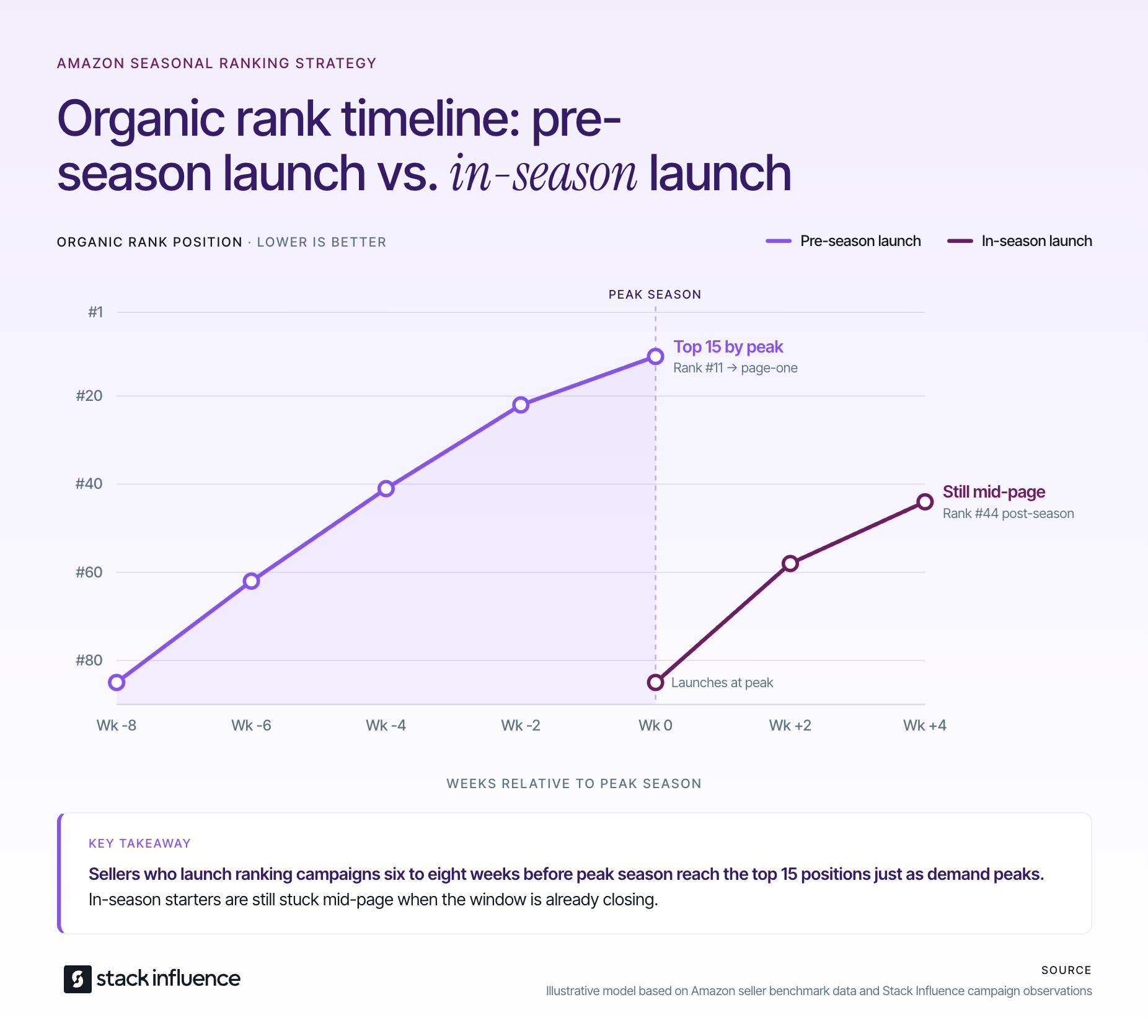
Amazon's algorithm does not exist in a vacuum. Seasonal search volume shifts, category-level competition changes, and platform-wide promotional events all create windows of opportunity that strategic sellers can exploit. Q4 is the most obvious example, but every category has micro-seasons worth planning around.
The key is to build ranking momentum before the season peaks, not during it. By the time Black Friday arrives, the listings that have been climbing since September already hold the top positions, and unseating them requires massive ad spend that most sellers cannot justify. The seasonal Amazon launch strategy for most categories follows a simple rule: begin your ranking push six to eight weeks before peak demand.
Practical seasonal ranking tactics:
- Increase Sponsored Products budget by 20-30% in the ramp-up period to build velocity ahead of peak.
- Run influencer seeding campaigns timed so reviews populate 30 days before the season starts.
- Create seasonal A+ Content variations that include holiday keywords naturally in visual text modules.
- Monitor competitor rank weekly during ramp-up and adjust keyword bids to capture any positions they vacate.
- Use Amazon Posts to drive organic traffic during the season without incremental ad spend.
Seasonal preparation also requires inventory planning. A listing that goes out of stock during peak season loses not just sales but ranking position, and recovering lost rank after a stockout can take weeks. Review your Amazon inventory management approach quarterly and model your sales velocity increases into reorder points before every major selling season.
Understanding the interplay between paid, organic, and external traffic is ultimately what separates sellers who rank temporarily from sellers who rank consistently. Each element of the RANK Checklist reinforces the others, and the sellers who treat ranking as a system rather than a single campaign are the ones who build durable market positions over time.
Conclusion
Knowing how to rank on Amazon is no longer a nice-to-have capability for eCommerce sellers. It is the operational foundation that determines whether your product line grows or stagnates. The RANK Checklist gives you a repeatable system: optimize for Relevance, build Authority through reviews and content, track your Numbers with a proper attribution model, and invest in Keywords both organically and through paid campaigns. Apply these steps in sequence, connect your off-platform traffic through Amazon Attribution to capture the Brand Referral Bonus, and build review momentum early in your launch windows. The algorithm rewards sellers who give it consistent, high-quality signals. Commit to the process, measure the right metrics, and your ranking results will compound in ways that single-tactic approaches never can.