




Most eCommerce sellers do not fail because they lack marketing ideas. They fail because those ideas never get organized into a system that can be measured, repeated, and scaled. A marketing plan template solves that problem by giving your brand a documented structure: defined goals, mapped channels, allocated budget, and a measurement model that tells you what is working before you run out of money testing what is not. This guide builds that structure specifically for eCommerce sellers, DTC brands, and Amazon sellers who need a plan that accounts for the realities of retail media, creator partnerships, and multi-channel attribution, not just a generic business school framework retrofitted to product commerce.
Key Takeaways
- A marketing plan template for eCommerce should cover six components: situation analysis, target customer profile, channel strategy, campaign calendar, budget allocation, and a measurement framework.
- Creator-driven channels including product seeding and influencer campaigns belong in the channel strategy section of every eCommerce marketing plan, not as an afterthought added after paid media fails to scale.
- Amazon sellers need a dedicated attribution layer in their marketing plan that accounts for Amazon Attribution tags, the Brand Referral Bonus program, and off-platform traffic tracking.
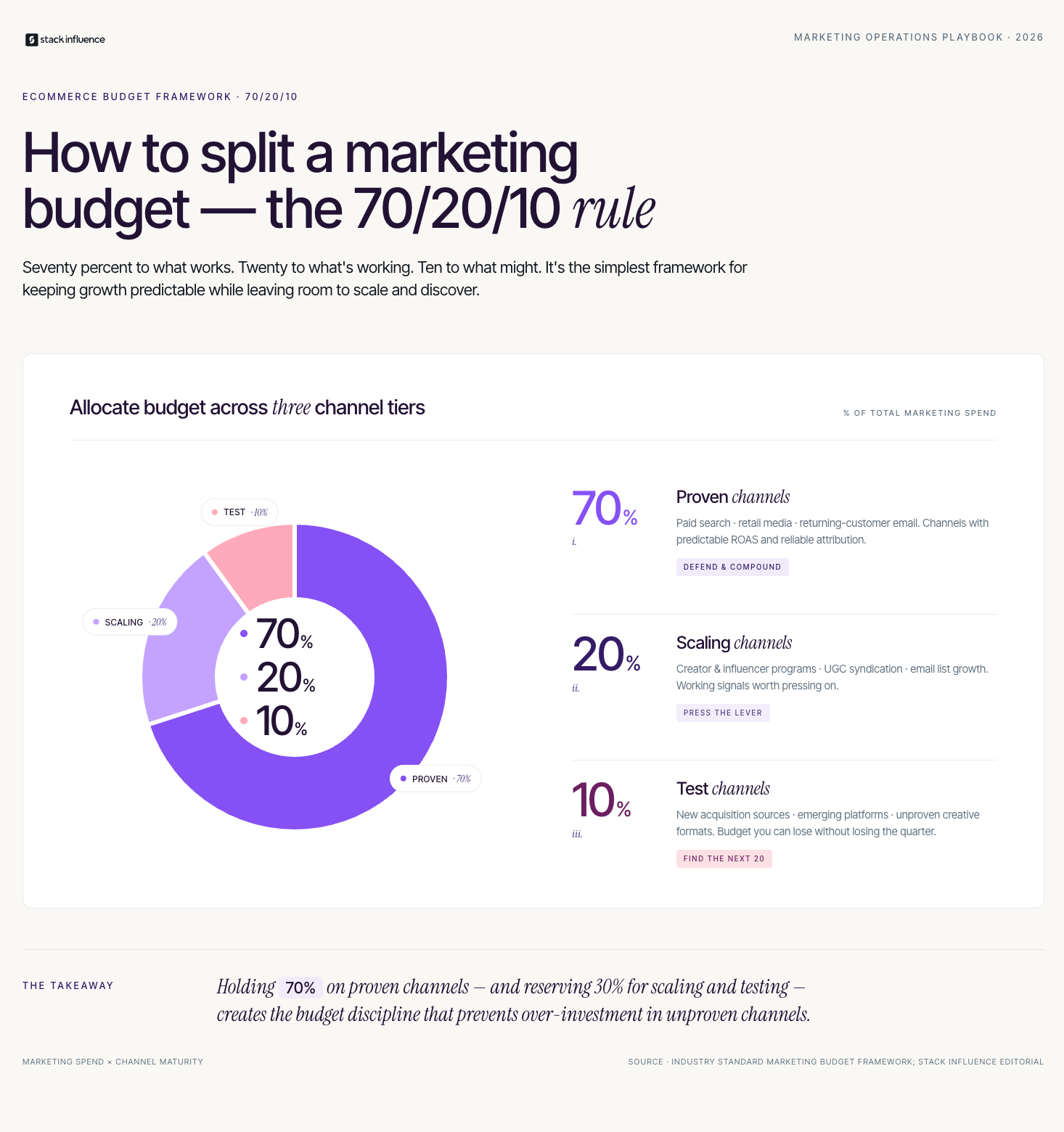
- Budget allocation in a modern eCommerce marketing plan should follow a 70/20/10 model: 70% to proven channels, 20% to scaling channels showing early results, and 10% to testing new acquisition sources.
- Plans reviewed and updated quarterly outperform annual static documents because eCommerce channel performance shifts faster than a once-a-year revision cycle can accommodate.
Why Most eCommerce Marketing Plans Fall Apart Before Q2
The most common marketing plan failure mode is not poor strategy. It is a plan written at a level of abstraction so high that no one on the team can execute from it. Statements like "increase brand awareness" and "grow social media presence" fill the document without ever connecting to a specific channel, a budget line, a responsible owner, or a success metric. When Q2 arrives and results are flat, there is nothing in the plan to diagnose.
The second failure mode is building a plan around the channels the brand is comfortable with rather than the channels the target customer actually uses. An Amazon seller who allocates 80% of their marketing budget to on-Amazon PPC while ignoring external traffic is leaving the Amazon Brand Referral Bonus program's 10% credit recovery untouched, and paying full referral fees on every sale that external traffic could have subsidized.
The three structural gaps in most eCommerce marketing plans:
- No creator channel allocation: Product seeding, UGC campaigns, and [influencer marketing](INTERNAL: influencer marketing strategy for eCommerce brands) are listed as aspirational but never given a budget line, a campaign calendar slot, or a measurement method.
- No attribution architecture: The plan describes what campaigns will run but not how performance will be tracked across platforms, leaving the team unable to compare CAC across channels with any accuracy.
- No revision cadence: The plan is written once in January and reviewed once in December, which means six months of underperformance goes unaddressed because no one scheduled a mid-year check.
Understanding these gaps is the prerequisite for building a plan that actually functions as a management tool rather than a document that lives in a shared folder and gets opened twice a year.
What Does a Strong eCommerce Marketing Plan Template Include?
A marketing plan template built for eCommerce needs six components. Generic business templates cover the first two well and almost always underserve the last four, which happen to be the ones that determine whether the plan produces results.
The six components of the eCommerce Marketing Plan Template are:
- Situation analysis: A concise summary of where your brand sits today, including current revenue, primary sales channels, top-performing products, known customer acquisition costs by channel, and the competitive landscape for your category. This section should take no more than one page and should surface the two or three constraints that most limit current growth.
- Target customer profile: A specific description of your primary buyer, including the platforms they use, the content formats they engage with, the creators they follow, and the decision triggers that move them from awareness to purchase. Vague personas ("women 25 to 45 interested in wellness") are not useful. Specific profiles ("first-time supplement buyers who follow micro influencers on TikTok and read reviews before purchasing") are.
- Channel strategy: A prioritized list of marketing channels with a one-sentence rationale for each, a budget allocation, and a named owner responsible for execution. This is where brands that work with micro influencers and run [product seeding](INTERNAL: product seeding strategy for eCommerce) campaigns document those tactics as first-class channels, not experiments.
- Campaign calendar: A month-by-month view of planned campaigns, launches, and promotional periods. For Amazon sellers, this includes key retail moments like Prime Day, Black Friday, and back-to-school. For DTC brands on Shopify, it includes email campaign sequences tied to product launches and creator content drops.
- Budget allocation: A numerical breakdown of planned spend by channel, with a defined split between acquisition, retention, and brand-building. The 70/20/10 model described in the Key Takeaways section works as a starting framework for most eCommerce brands.
- Measurement framework: A named set of metrics and a review cadence for evaluating performance. This is covered in depth in the attribution section below.
According to CoSchedule's marketing statistics research, marketers who document their strategy are 313% more likely to report success than those who do not. The eCommerce Marketing Plan Template works because documentation creates accountability. Without a written plan, every underperforming channel gets the same vague explanation: "we need to do more of this." With one, you have the data to make a different decision.
How Do You Build the Channel Strategy Section for an eCommerce Brand?
The channel strategy section is where most marketing plan templates fall short for eCommerce sellers because they default to a generic list of digital channels rather than a prioritized, budget-backed plan built around how your specific customer discovers and buys products.
Start by mapping your current customer acquisition sources with actual data, not assumptions. Pull your attribution reports, your email sign-up source data, and your Amazon traffic report if applicable. Identify which two or three channels are generating the majority of your profitable sales today. Those are your 70% allocation channels. Everything else is in the 20% or 10% buckets until the data supports a reallocation.
A practical channel strategy section for an eCommerce brand in 2026 looks like this:
- Paid search and retail media: Covers Google Shopping, Amazon Sponsored Products, and Walmart Connect. Requires keyword strategy, bid management, and regular search term report reviews. Typically the largest single budget line for established sellers.
- Creator and influencer channels: Covers [micro influencer campaigns](INTERNAL: micro influencer campaign strategy), nano influencer product seeding, and UGC production for paid ad creative. Requires a creator brief, a product fulfillment workflow, and an attribution link setup before the first campaign launches.
- Email and SMS: Covers welcome sequences, post-purchase flows, and promotional campaigns to existing customers. Typically the highest-ROI channel for brands with an established customer base because there is no media cost per send.
- Organic social and content: Covers the brand's own social posting cadence, SEO-optimized blog content, and any platform-specific content strategy for TikTok or Instagram. Requires a content calendar and realistic resource allocation. If you're going to work with an agency to manage these marketing channels, you need to know the cost of SEO and social media channel management.
- Amazon external traffic: A dedicated line for brands selling on Amazon that covers off-platform campaigns driving traffic to Amazon listings, tagged with Amazon Attribution links to qualify for Brand Referral Bonus credits.
Across campaigns managed on the Stack Influence platform, eCommerce brands that include a dedicated creator channel line in their marketing plan with a defined quarterly budget allocate on average 2.5 times more to creator campaigns by the end of the year than brands that treat creator work as ad hoc. The act of writing it into the plan forces the operational infrastructure, briefing, and fulfillment logistics, to be built before the first campaign launches rather than improvised mid-execution.
Building the Campaign Calendar for Amazon Sellers and DTC Brands
The campaign calendar is the section of a marketing plan template that converts strategy into scheduled action. Without it, channel strategies remain intentions. With it, every team member knows what is launching when, what the budget is, and what success looks like before the campaign goes live.
For Amazon sellers, the calendar must be anchored around Amazon's key retail events because organic rank and advertising performance are both affected by platform-wide traffic spikes. A seller who is not prepared with inventory, optimized listings, and activated ad campaigns before Prime Day is watching competitors capture the demand they could have earned.
Key calendar anchors for Amazon sellers:
- January: Post-holiday inventory clearance, launch new year product testing campaigns.
- March to April: Spring product launch window, begin building review counts on new SKUs before summer.
- June: Pre-Prime Day listing optimization, inventory replenishment, and creator seeding to build external social proof.
- July: Prime Day campaigns, maximum PPC budget activation, Amazon Influencer Program creator content amplification.
- September: Back-to-school and fall product positioning, begin Q4 inventory planning.
- October to November: Black Friday and Cyber Monday preparation, coupon and deal setup, email list activation for DTC Shopify brands.
- December: Holiday fulfillment, gift guide creator content, post-purchase review request sequences.
For DTC brands running [Shopify influencer marketing](INTERNAL: Shopify influencer marketing strategy) alongside their Amazon presence, the calendar also needs to account for creator content lead times. A creator seeding campaign needs four to six weeks from product shipment to live content, which means any campaign tied to a seasonal moment needs to be initiated six to eight weeks before the target date.
Stack Influence's internal campaign data shows that eCommerce brands which schedule their creator campaigns on a documented quarterly calendar have a 45% higher on-time content delivery rate than brands that brief creators reactively. Building the calendar into the marketing plan template is not an administrative task. It is a performance driver.
How Should eCommerce Brands Measure Marketing Plan Performance?

Measurement is the section most eCommerce marketing plans treat as an afterthought and then blame the plan for not working when results disappoint. A named measurement model embedded in the plan from the start changes that dynamic because it defines what success looks like before any money is spent.
Use the eCommerce Marketing Scorecard as the measurement framework in your plan. The scorecard has three tiers reviewed on different cadences:
- Weekly pulse metrics: These are fast-signal indicators reviewed every seven days. They include ad spend pacing versus budget, conversion rate by channel, and any active creator campaign deliverable status. The purpose is to catch execution problems before they compound.
- Monthly performance metrics: These are the channel-level metrics reviewed monthly. They include customer acquisition cost by channel, return on ad spend by campaign, email list growth rate, and organic rank position for Amazon sellers' primary keywords. Monthly review is the cadence at which budget reallocation decisions get made.
- Quarterly strategic metrics: These are the business-level metrics reviewed each quarter. They include total revenue growth versus plan, contribution margin by channel, lifetime value of customers acquired through each channel, and net promoter score if tracked. This is the review at which the marketing plan itself gets updated based on what the data reveals.
For Amazon sellers, the scorecard must include a dedicated Amazon attribution layer. Tag all off-platform traffic sources with Amazon Attribution links before any external campaign launches. Track which channels generate the highest conversion rate on Amazon, not just the most clicks, because the algorithm rewards conversion signals and the Brand Referral Bonus credits apply only to properly tagged external traffic that results in a sale.
Based on Stack Influence's work with eCommerce brands, sellers who implement proper Attribution tagging at the start of a creator campaign recover an average of 8 to 12% of their referral fees through the Amazon Brand Referral Bonus program over a 90-day period. That credit recovery meaningfully improves the ROI calculation for the creator channel line in the marketing plan and provides data that supports increased allocation in subsequent quarters.
The Marketing Plan Section Most eCommerce Guides Leave Out
The majority of marketing plan templates, including the most widely downloaded ones, include a budget section and a channel list but skip the operational infrastructure section entirely. For eCommerce brands, that gap is where plans quietly collapse.
Operational infrastructure refers to the tools, workflows, and asset libraries that make channel execution possible at the pace the calendar demands. A brand can have a perfectly documented channel strategy and a detailed campaign calendar, and still miss every deadline because the creative production workflow is bottlenecked, the product seeding logistics are unmanaged, or the attribution links are not being created before campaigns launch.
The four infrastructure elements every eCommerce marketing plan should document:
- Creative asset library: Where campaign visuals, UGC content, and product photography are stored and how new assets get added from creator campaigns. Brands that run [product seeding campaigns](INTERNAL: product seeding campaign setup guide) generate a significant volume of creator content that needs to be organized for reuse in paid ads and listing images.
- Creator and [brand ambassador](INTERNAL: brand ambassador program for eCommerce) roster: A living document of every creator the brand has worked with, their content performance, their preferred contact method, and their rates. This roster makes campaign activation significantly faster because you are not starting from zero for each campaign.
- Attribution link management: A documented process for creating, naming, and archiving attribution links for every off-platform campaign. For Amazon sellers using Amazon Attribution and for DTC brands running UTM tracking, this process needs to be standardized before campaigns scale.
- Review and approval workflow: A defined process for reviewing creator content before it goes live, including who has approval authority, what the turnaround time expectation is, and what feedback format creators should receive. Brands without this workflow create bottlenecks that delay content and frustrate creator relationships.
Adding an infrastructure section to your marketing plan template separates plans that get executed from plans that get archived. According to Semrush's content marketing research, 78% of companies with a documented content strategy outperform those without one, and the gap widens further when that strategy includes operational documentation alongside channel and goal definitions.
Conclusion
A marketing plan template is only as useful as the discipline applied to executing and revising it. For eCommerce sellers, DTC brands, and Amazon sellers operating across multiple channels simultaneously, the six-component eCommerce Marketing Plan Template gives you the structure to stop reacting and start building with intention. Document your channels, build your creator campaign calendar six weeks ahead of every major retail moment, tag every off-platform campaign for attribution from day one, and review your eCommerce Marketing Scorecard on the cadences that let you catch problems early.
If you are ready to build the creator channel section of your marketing plan with a partner who handles logistics, briefing, and delivery at scale, Stack Influence connects eCommerce brands with micro influencers for product seeding campaigns that generate the UGC and external traffic your plan needs to perform.