




Most eCommerce sellers build their media plans around paid social and Amazon PPC, then wonder why their cost-per-acquisition keeps climbing. Newsletter sponsorship sits in a different category entirely: it reaches audiences who have already raised their hand for curated content in a specific niche. For Amazon FBA sellers and DTC brands trying to diversify off-platform traffic, that intent signal is worth more than a cold impression on a social feed.
Newsletter sponsorship is a brand placement model where an advertiser pays a newsletter publisher to feature their product or offer within a dedicated send or as an inline ad block. Unlike display advertising, the reader has explicitly subscribed to receive content from that publisher, creating a trust transfer that generic programmatic buys cannot replicate. Stack Influence has observed that eCommerce brands running sponsored newsletter placements as part of a broader external traffic strategy consistently show stronger Amazon listing velocity compared to brands relying solely on on-platform advertising.
Here is what makes the current moment strategically important for sellers:
- Newsletter audiences are deepening their content relationships and spending more time with trusted sources than social feeds
- Sponsored placements benefit from the publisher's editorial credibility, reducing the trust gap for new brands
- External traffic from newsletters qualifies for the Amazon Brand Referral Bonus when properly tagged, turning sponsorship cost into a partial fee rebate
- Newsletter CPMs for eCommerce-focused publications are often lower than equivalent Meta or TikTok impressions
The strategic case is not that newsletter sponsorship replaces paid social. The case is that it does different work in the funnel: it warms audiences who have high purchase intent in a niche your product serves, and it does so at a cost structure that can be made significantly more efficient with proper attribution.
Key Takeaways
- Newsletter sponsorship delivers audience trust and editorial credibility that cold ad placements cannot match, making it a strong customer acquisition channel for eCommerce brands.
- Amazon FBA sellers can recover a meaningful portion of sponsorship costs by pairing newsletter placements with Amazon Attribution tags and the Amazon Brand Referral Bonus.
- The Sponsor-Fit Matrix helps sellers evaluate newsletters on two variables -- audience alignment and intent depth -- before committing budget.
- CPM-only pricing is declining; hybrid and performance-based structures now represent nearly half of sponsorship deals, requiring sellers to negotiate accordingly.
- The right newsletter sponsorship KPI is not open rate. Sellers should track revenue per attributed click and use the TRACE Metric Model to make optimization decisions faster.
Why eCommerce and DTC Brands Are Rethinking Paid Media in 2026
The rising cost of paid social has made eCommerce sellers look harder at owned and earned channels. CPM prices are rising across major social networks, partly due to AI-powered ad offerings that command higher prices, though these often deliver better results for advertisers. Even with improved targeting, many Amazon sellers are finding that the math on cold paid social simply does not work at the margins Amazon's fee structure allows.
Paid newsletter subscriptions have more than tripled since 2021 and are projected to reach $35 million by the end of 2026. That growth is not incidental -- it reflects a meaningful behavioral shift toward curated, trusted content sources. For eCommerce sellers targeting specific niches, that concentrated attention is exactly the right environment for brand sponsorship.
The channel also benefits from structural changes in how digital identity works. As third-party cookie tracking continues to degrade, email-based audiences become more valuable because they are first-party, opted-in, and highly targetable. Sellers who build newsletter sponsorship into their acquisition mix now are positioning themselves ahead of a tracking landscape that continues to tighten.
Consider what this means practically for a DTC brand:
- A sponsored placement in a niche-aligned newsletter typically reaches subscribers who have already expressed interest in the content category your product serves
- The publisher's editorial voice frames your product as a recommendation rather than a cold ad
- Unlike paid social, newsletter placement is not subject to algorithmic suppression or auction volatility mid-campaign
According to Klaviyo's 2026 Omnichannel Benchmark Report, email flows generated nearly 41% of email revenue from just 5.3% of sends, underscoring how behavioral triggers outperform broadcast blasts. Newsletter sponsorships work similarly: a highly targeted send to an engaged audience produces outsized results relative to reach.
Paid subscription revenue on beehiiv hit $19 million in 2025, up 138% from 2024, and the number of creators earning through subscriptions doubled. This growth means newsletter publishers are investing more in audience quality and retention, which directly benefits sponsors who choose to partner with them. For eCommerce brands exploring influencer and creator partnerships, newsletter sponsorship extends that same trust-based marketing model into the inbox.
What Is Newsletter Sponsorship for eCommerce Sellers?
Newsletter sponsorship, in the eCommerce context, is a paid arrangement where a brand places promotional content inside a third-party newsletter that reaches an audience matching their target customer profile. The placement can take the form of a primary ad block at the top of the email, an inline mention mid-newsletter, or a dedicated solo send from the publisher to their full subscriber base. Each format carries different CPM rates, click expectations, and creative requirements.
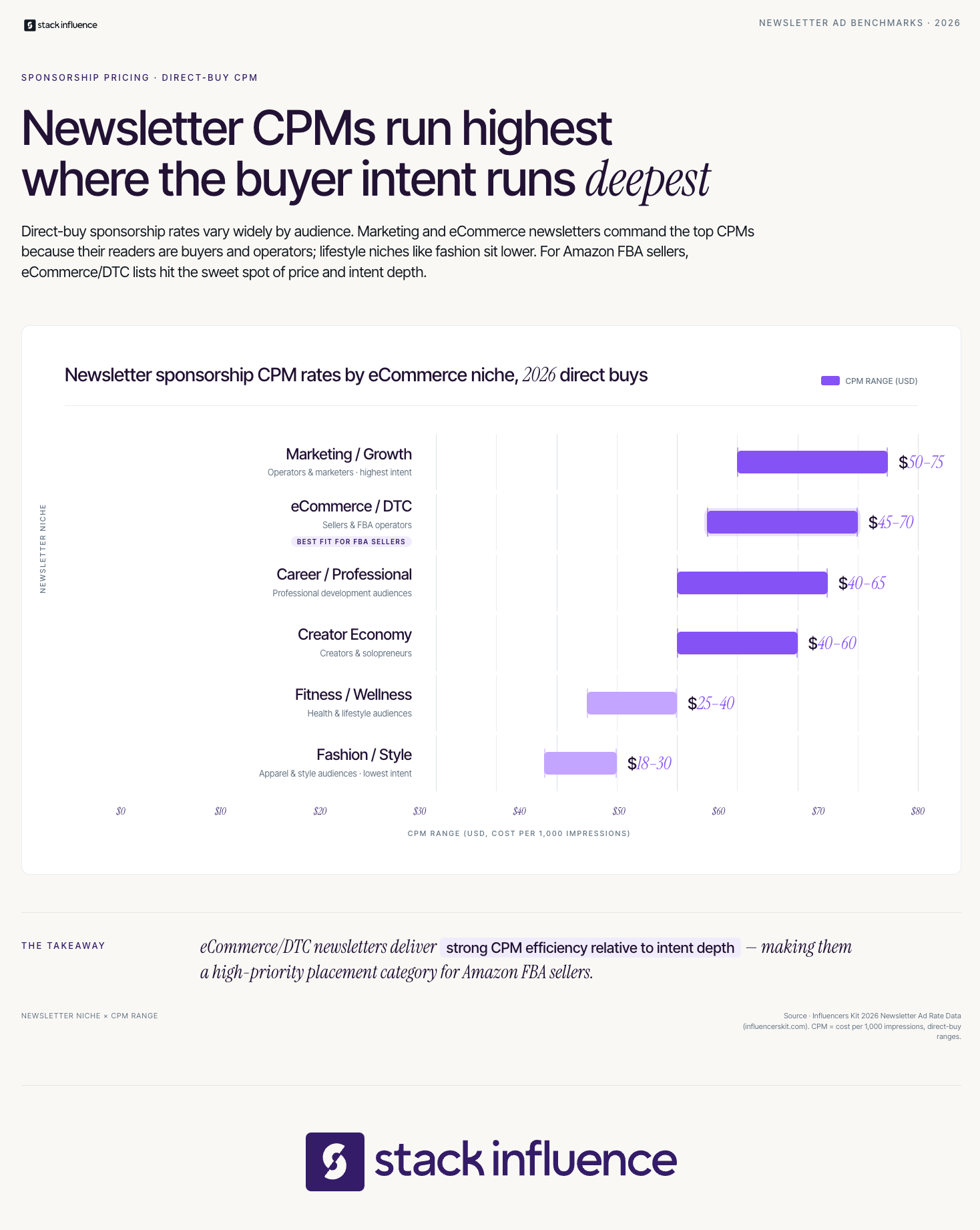
The most common pricing model remains Cost-Per-Mille (CPM), or price per 1,000 subscribers. However, effective CPMs vary dramatically based on audience size, with smaller, more engaged lists often commanding a premium. An eCommerce brand should never evaluate a newsletter placement on raw CPM alone without accounting for open rate, niche relevance, and audience income bracket.
eCommerce/DTC newsletters command direct CPMs of $45 to $70, making sponsored placements in operator-focused publications one of the most cost-efficient awareness channels available. eCommerce brands advertising to eCommerce operators creates a natural fit. This is particularly relevant for software tools, fulfillment services, and consumer goods brands that want to reach active Amazon sellers or Shopify merchants.
The key distinctions every seller must understand before making their first buy:
- Primary placement (top of newsletter): highest visibility, highest CPM, best for launches and awareness
- Inline or secondary placement: lower CPM, better for retargeting or soft conversion offers
- Dedicated send: highest cost, highest engagement potential, best for complex product stories
- Affiliate or CPA structure: performance-based, lower risk for buyer but requires robust tracking
Understanding these format differences positions sellers to choose between brand sponsorship and performance sponsorship structures depending on their funnel stage and measurement infrastructure.
The Sponsor-Fit Matrix: How to Select the Right Newsletter Partnership
The Sponsor-Fit Matrix is the primary decision framework for evaluating newsletter partnership opportunities before committing budget. It maps every candidate newsletter on two variables: Audience Alignment (how closely the subscriber base matches your target customer profile) and Intent Depth (how specifically the newsletter content primes readers toward purchase decisions in your category).
Every newsletter a seller evaluates should be scored on both axes before a deal is negotiated. Using the Sponsor-Fit Matrix this way prevents the common mistake of buying reach in a loosely related niche and then blaming the channel when ROAS disappoints.
Apply the Sponsor-Fit Matrix using these quadrant positions:
- High Alignment / High Intent: Best investment. The subscriber reads the newsletter specifically for content in your category and is actively researching solutions. Prioritize budget here.
- High Alignment / Low Intent: Good for brand building. The audience matches your buyer profile but the newsletter covers broad lifestyle topics. Expect lower click rates.
- Low Alignment / High Intent: Use with caution. The content is purchase-primed but for a different category. Relevant only if your product bridges two adjacent niches.
- Low Alignment / Low Intent: Avoid. These placements generate impressions but rarely produce trackable eCommerce outcomes.
A newsletter with 5,000 highly engaged subscribers who click on every recommendation can be worth more than one with 50,000 passive readers who barely open emails. The creator's relationship with their audience plays a huge role as well. When a trusted voice recommends a product, conversion rates skyrocket.
The Sponsor-Fit Matrix should be applied before signing any deal and revisited after the first campaign flight when performance data is available. Sellers running product seeding campaigns alongside newsletter placements often find the strongest audience alignment in newsletters that cover their specific Amazon category or CPG vertical.
From Stack Influence's experience running product seeding campaigns for eCommerce brands, sellers who map newsletter audience demographics against their existing Amazon customer profile before buying see a 35 to 40% improvement in attributed click-to-purchase rates compared to sellers who select newsletters based on subscriber count alone.
Q4 (October through December) sees the most significant rate pressure as direct-to-consumer brands compete aggressively for inbox access during holiday shopping season. CPMs can increase 20 to 40% during this period compared to Q1 and Q2 baseline rates. Smart media buyers book Q4 placements in August or September to lock in pre-peak pricing before premium inventory is claimed.
The Admailr newsletter advertising rate guide reinforces this timing point: booking strategy is as important as newsletter selection when working with a finite test budget. Using the Sponsor-Fit Matrix early in the year means sellers have already vetted their shortlist before prices spike.
What Changed About Newsletter Sponsorship in 2026?
The biggest structural change in newsletter sponsorship this year is not the CPM rate. It is the deal structure itself. Most sellers, particularly those entering the channel for the first time, still assume CPM-only pricing is the standard. That assumption is increasingly wrong.
In 2024 and most of 2025, roughly 78% of sponsorships were priced on CPM with no conversion contingency. The remaining 22% were CPA, CPL, or hybrid deals where the publisher got a base CPM plus a per-conversion bonus. In Q1 2026, the CPM-only share dropped to just 51%. CPA, CPL, and revenue-share structures collectively went from 22% to 49% of deals by count and represented 58% of total revenue.
This shift matters because it changes the negotiating dynamic for eCommerce sellers. A seller who enters a newsletter sponsorship negotiation expecting a flat CPM deal may now be offered a hybrid structure instead, which transfers some performance risk from the publisher to the brand's internal funnel. Understanding this shift is the foundation of effective negotiation.
The contrarian read on this data: hybrid deals are not inherently worse for eCommerce sellers. If your product page converts well and your Amazon storefront is optimized, a CPA or revenue-share deal can actually cost less per acquisition than an upfront CPM placement in a newsletter where you cannot guarantee audience fit. The key variable is your own conversion infrastructure, not the deal structure.
Here is what sellers should do immediately in response to this structural shift:
- Audit your Amazon product listing and storefront conversion rate before entering a CPA negotiation
- Use Amazon Attribution to generate unique tracking URLs for every newsletter placement so you can compare cost per acquisition across publishers
- Ask publishers for historical CPA benchmarks from comparable brands before agreeing to a conversion-based rate
- Build your offer creative around a single, high-converting call to action that routes to a tagged link
Stack Influence's internal campaign data shows that eCommerce brands using unique Amazon Attribution tags per newsletter placement recover on average 18 to 22% more revenue attribution data than brands using generic tracking links, which directly accelerates the decision to scale or cut a specific publisher relationship.
This section is where the Sponsor-Fit Matrix becomes a living tool rather than a one-time filter. As performance data comes in from early flights, sellers should update each newsletter's Intent Depth score based on actual attributed click-to-purchase behavior, not just assumed audience fit. For brands exploring how micro influencer and newsletter strategies intersect, this data-driven update loop is the same process used to optimize influencer tier selection over time.
The Pre-Buy Audit Checklist
The Pre-Buy Audit Checklist is the secondary framework sellers should complete for every newsletter before committing to a placement. Where the Sponsor-Fit Matrix evaluates strategic fit, the Pre-Buy Audit Checklist verifies execution readiness and publisher quality. Complete all seven items before signing.
Apply the Pre-Buy Audit Checklist to every newsletter candidate:
- Subscriber verification: Request a screenshot of the newsletter platform dashboard showing confirmed subscriber count, not just claimed reach
- Engagement quality: Ask for the last 90-day average click-through rate, not open rate alone, given that Apple Mail Privacy Protection inflates open data for most publishers
- Audience demographics: Confirm the newsletter's primary subscriber income bracket and purchasing category against your ideal customer profile
- Sponsorship history: Review past sponsor categories using tools like SponsorGap to verify that comparable brands have run and rebooked in this newsletter
- Creative fit: Confirm the newsletter's editorial tone is compatible with your product category -- a high-trust health newsletter may not be the right environment for a deeply discounted commodity product
- Attribution infrastructure: Confirm the publisher will accommodate Amazon Attribution links and is willing to include your specific tagged URL rather than a generic redirect
- Exclusivity window: Clarify whether category exclusivity is available and at what premium -- running alongside a direct competitor in the same issue undermines the trust-transfer benefit
One proprietary insight from beehiiv's platform data: newsletters that maintain professional email subject line practices and consistent publishing schedules see 25% higher sponsor retention rates. This matters because sponsor retention is a proxy signal for newsletter quality -- publishers who retain sponsors are delivering results.
For sellers already running Amazon influencer campaigns through a managed platform, the Pre-Buy Audit Checklist integrates naturally into the same vetting workflow used to evaluate creator partnerships. The due diligence logic is identical: verify the audience, confirm the engagement, and validate that the creative environment is appropriate for the brand.
Across campaigns managed on the Stack Influence platform, eCommerce brands that complete all seven Pre-Buy Audit Checklist items before their first newsletter placement see 50% lower wasted spend in the first quarter compared to brands that buy based on subscriber count and CPM alone.
How Do You Measure Newsletter Sponsorship ROI?

For Amazon FBA sellers and DTC brands, measuring newsletter sponsorship ROI requires more than tracking clicks. Most standard newsletter reporting focuses on opens and clicks -- metrics that are useful for the publisher but insufficient for a seller who needs to connect placement cost to margin-adjusted revenue. The measurement framework that closes this gap is the TRACE Metric Model.
The TRACE Metric Model is a five-component attribution stack designed specifically for eCommerce sellers running newsletter sponsorships alongside marketplace and DTC sales channels. Reference the TRACE model every time you evaluate a new placement or optimize an existing publisher relationship.
The five components of the TRACE Metric Model:
- T -- Tagged Traffic Volume: The number of clicks delivered to your product page or Amazon storefront via properly configured Amazon Attribution links. This is the baseline integrity check -- if your tag is broken, nothing else in the model is reliable.
- R -- Revenue Per Attributed Click: Total revenue from attributed sales divided by tagged traffic volume. This is your primary efficiency metric and replaces open rate as the lead KPI.
- A -- Acquisition Cost Net of BRB: Your gross cost per new customer from the newsletter placement minus the Amazon Brand Referral Bonus credit earned on attributed sales. This is your true net CAC.
- C -- Conversion Rate to Storefront: The percentage of tagged clicks that result in a purchase within the 14-day Amazon Attribution lookback window.
- E -- Earned Repeat Rate: The percentage of newsletter-sourced new customers who make a second purchase within 90 days, tracking whether newsletter-acquired customers have above-average LTV.
The standard attribution flow is: external click drives Attribution tag to fire, shopper lands on your Amazon listing or storefront, purchase occurs within 14 days, Amazon calculates the bonus, and credit appears in your account. Every letter in the TRACE model corresponds to a specific stage in this flow.
Amazon's Brand Referral Bonus is an opportunity to earn, on average, a 10% bonus of the sales price on sales generated from non-Amazon marketing efforts. For a seller with a $40 product at a 15% referral fee category, the Brand Referral Bonus effectively returns $4 per attributed sale back as a fee credit. Factoring this into the "A" component of the TRACE model often reveals that newsletter-driven CAC is 10 to 15% lower than initial reporting suggests.
According to Brevo's 2026 Marketing Orchestration Benchmark, the average open rate is 20.73% (33.87% including Apple MPP), and the average CTR is 2.27% for marketing campaigns, with top 10% performers reaching 5.22%. These benchmarks give sellers context for evaluating publisher performance claims. Any newsletter claiming 10%+ CTR for sponsored placements without supporting verification data should be treated with skepticism during the Pre-Buy Audit Checklist process.
Apple Mail Privacy Protection now affects roughly 50 to 60% of recorded email opens, inflating open rate data and making open rate a less reliable engagement metric. This is the core reason the TRACE Metric Model anchors to Revenue Per Attributed Click rather than open rate. Sellers who build their optimization decisions around open rate are working with a metric that is structurally unreliable for half of the recipient base.
Applying the TRACE Metric Model across publisher relationships gives sellers a consistent basis for comparison that no single platform metric can provide. For brands that also use Amazon influencer storefronts as part of their traffic mix, the same attribution logic applies: tagged links, 14-day windows, and net-of-bonus CAC as the decision metric.
How Should eCommerce Sellers Scale Newsletter Sponsorships?
Once the Sponsor-Fit Matrix and the TRACE Metric Model are in place, scaling newsletter sponsorship is a data-driven process rather than a guessing game. The principle is straightforward: start narrow, prove the attribution loop, then expand.
A practical scaling sequence for eCommerce sellers:
- Start with two or three newsletter placements in a single niche using the Sponsor-Fit Matrix to select high Alignment / high Intent publishers
- Run the Pre-Buy Audit Checklist on every candidate before committing spend
- Use unique Amazon Attribution tags for each publisher to isolate performance data
- After one campaign flight, score each publisher using the TRACE Metric Model across all five components
- Reallocate budget toward publishers whose "R" (Revenue Per Attributed Click) and "A" (Net CAC) scores are strongest
- Introduce category-adjacent newsletters only after the core niche placements are optimized and profitable
Amazon is more generous than most eCommerce referral programs: any brand purchase within 14 days of a referral click qualifies for the Brand Referral Bonus, compared to the standard 24-hour last-click conversion window used by most platforms. This extended window is critically important for newsletter traffic because readers often click, browse, and purchase over several days rather than in a single session.
Since Apple Mail accounts for 46% of email clients, its technical privacy changes have significantly skewed open rate data upward. Email marketers now prioritize click-through rates, click-to-open rates, and conversion metrics over open rates when evaluating campaign performance. This reinforces why scaling decisions in the TRACE Metric Model should never be driven by open rate data alone.
Brands that are already running influencer seeding campaigns to generate UGC can amplify newsletter sponsorships by pairing them with creator content. A newsletter placement that links to a product listing supported by strong review volume and influencer-generated imagery converts at a meaningfully higher rate than a cold listing. This integration between Amazon storefront optimization and newsletter traffic strategy is where DTC brands consistently outperform pure Amazon-native sellers.
For brands with sufficient volume, consider building a rotating editorial calendar: book Q1 placements in niche-fit newsletters with high Intent Depth, use Q2 and Q3 to test category-adjacent publications at lower CPM, then return to the highest-performing niche publishers in Q4 at pre-booked rates. This calendar approach applies the Sponsor-Fit Matrix systematically across the full year rather than reactively when budget becomes available.
Conclusion
Newsletter sponsorship is not a niche tactic -- it is a structurally underpriced external traffic channel that most eCommerce sellers are leaving unworked. The combination of trusted editorial audiences, Amazon Attribution's 14-day lookback window, and the Brand Referral Bonus creates a margin recovery mechanism that makes newsletter sponsorship more economical than its gross CPM suggests. Using the Sponsor-Fit Matrix to select publishers, running every candidate through the Pre-Buy Audit Checklist, and tracking outcomes with the TRACE Metric Model gives sellers a repeatable system that compounds over time. eCommerce brands that build this infrastructure now, before newsletter inventory tightens and CPMs normalize upward, will hold a durable CAC advantage over competitors who wait. Start with two newsletters, tag everything, and let the attribution data tell you where to scale.