




Before spending more to improve your Amazon rankings, identify what is actually missing: visibility, clicks, purchases, or profitable demand. Those problems require different fixes.
For ecommerce sellers learning how to rank on Amazon, the practical starting point is one product and a clear set of relevant searches. Make the listing accurate and available, remove buying objections, then test how qualified shoppers respond.
This guide explains how to prioritize those improvements, apply Amazon’s current listing requirements, use advertising and creator campaigns responsibly, and distinguish genuine search progress from a dashboard that merely looks better.
Key Takeaways
- Fix availability and relevance problems before paying to send more shoppers to a listing.
- Treat organic keyword position, Best Sellers Rank, and advertising placement as separate measurements.
- Use creator partnerships to generate useful content and qualified demand, not incentivized customer reviews or artificial ranking activity.
- Evaluate results by query group and profitability because a higher overall conversion rate can reflect a different traffic mix.
How to Rank on Amazon With the First Broken Step Method
To improve Amazon search visibility, work through the buyer’s path and correct the earliest point where relevant demand stops progressing. The First Broken Step Method is a prioritization checklist for sellers, not a claim about Amazon’s undisclosed ranking weights.
Apply it to one ASIN, Amazon’s product identifier, and a manageable group of purchase-relevant queries:
- Available: Can shoppers find an active offer, select the intended variation, and receive the product?
- Matched: Does the listing accurately describe the product shoppers are searching for?
- Clicked: When the product appears, does its search-result presentation earn attention?
- Purchased: After clicking, do shoppers have enough information and confidence to order?
- Sustainable: Can the business support that demand without running out of inventory or losing money?
Profitability is your business constraint, not a claimed Amazon ranking signal. The checklist prevents a common decision error: increasing traffic before resolving a problem that makes the traffic unproductive.
Start in Manage All Inventory. Check the intended child ASIN, listing status, available inventory, product information, and live buying experience before changing your keyword strategy. Keep a dated record of corrections so later performance changes have context.
For a deeper explanation of the underlying controls, Stack Influence’s guide to the Amazon algorithm and seller-controlled improvements separates catalog, offer, content, and measurement decisions.
Separate Keyword Position From Category Sales Rank
Organic keyword position describes where a product appears among unpaid results for a particular search. Best Sellers Rank, or BSR, describes sales performance relative to products in a category. According to Amazon’s BSR explanation, BSR considers recent and historical sales, with recent sales receiving greater weight; page views and customer reviews do not directly determine it.
A campaign can therefore show encouraging sales and category movement without proving improvement for a specific keyword.
During Stack Influence’s three-month Remilia campaign, average monthly unit sales increased from 141 to 306, while BSR moved from #78,412 to #49,807. Those figures document sales and category-rank movement during the campaign, not a measured position for an individual search query.
That distinction determines your reporting plan: track keyword visibility separately instead of asking BSR to answer every ranking question. The campaign example also does not isolate creator activity from other influences on sales.
Research Keywords and Rebuild the Search Listing
Choose keywords that describe the product accurately before choosing keywords with attractive search volume. A smaller, relevant search opportunity is more useful for planning than a large audience looking for something you do not sell.
Amazon’s SEO guidance recommends researching Amazon search suggestions, examining competing offers, and using tools such as Product Opportunity Explorer to understand search demand. It also describes backend search terms as a place for relevant synonyms and alternative product names.
Organize your working keyword set around the product’s identity, differentiating attributes, and use case. For a hypothetical commuter backpack, that might mean “laptop backpack,” “15.6-inch laptop backpack,” and “work backpack with luggage sleeve,” provided each description is accurate.
Keep branded searches separate from generic searches from the beginning. Someone searching your brand name presents a different measurement question from someone comparing an entire product category.
Apply the July 2026 Title and Item Highlights Update
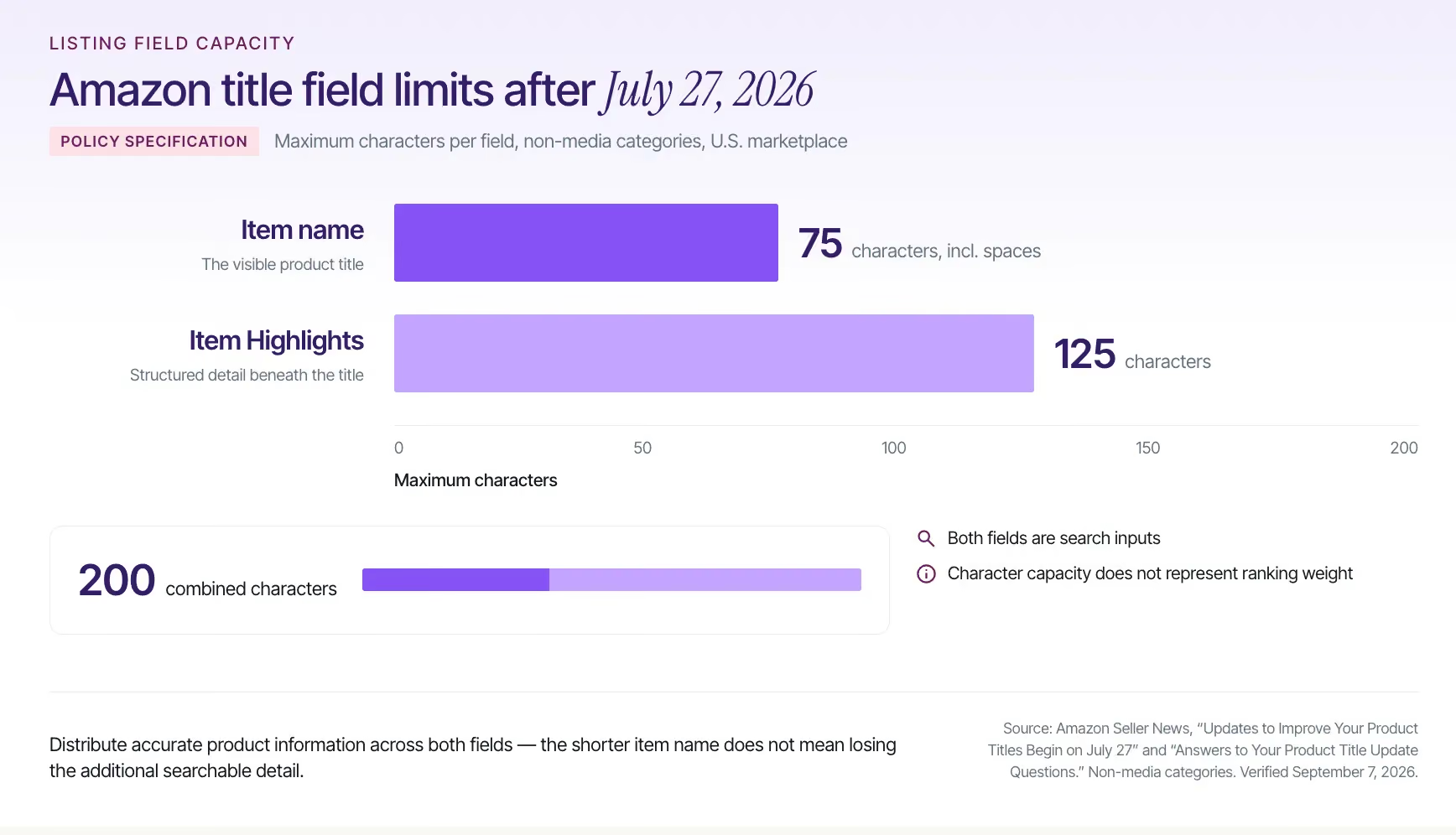
For U.S. sellers, older advice about putting everything into a 200-character title needs updating. Under Amazon’s July 27, 2026 title announcement, titles in categories other than media must fit within 75 characters, including spaces, while Item Highlights provides an additional 125 characters.
Amazon’s follow-up title clarification confirms that both fields are search inputs, neither is prioritized over the other, and the combined capacity remains 200 characters. It also describes a phased recommendation process during 2026, not immediate removal of every longer-title listing.
Keep the brand, product type, and most important variation details in the item name. Use Item Highlights for additional distinguishing information rather than repeating the same phrases.
An illustrative item name could be: “Harbor Daily Backpack, Fits 15.6-Inch Laptops, 20 L, Black.”
The supporting highlights could explain the luggage sleeve, organizer pockets, and intended use, assuming those features are accurate. Review generated suggestions against the actual product rather than accepting them merely because they fit the character limits.
Assign Each Listing Field a Clear Job
Use bullets to answer practical buying questions: what fits, what is included, how the product works, and which limitations matter. Replace vague claims such as “premium quality” with concrete specifications or demonstrable benefits.
Use backend terms for relevant language that does not fit naturally in customer-facing copy. Avoid turning that field into another copy of the title; Amazon specifically advises against redundant or irrelevant terms.
Complete the applicable structured attributes, including size, material, compatibility, and product type. Then inspect the live detail page to confirm the intended information appears correctly.
When catalog cleanup requires outside help, evaluate Amazon listing services by their deliverables, such as attribute corrections, copy, images, and testing support, rather than by a promise to deliver a particular ranking.
Make the Product Easy to Choose and Buy
Once the listing communicates relevance, examine the buying decision. Identify the question a shopper still cannot answer from your images, specifications, offer, or product explanation.
For the backpack example, useful evidence would show its dimensions, laptop compartment, internal organization, and how the luggage sleeve works. A general claim that it is “great for travel” provides less decision support than showing exactly what it holds.
Creator demonstrations can contribute to that evidence. Plan user-generated content around specific product questions, and confirm that your usage rights cover the placements where the content will appear.
Check the Offer, Not Just the Content
Review total price, delivery promise, stock availability, and the offer shoppers actually see. Amazon’s Featured Offer guidance explains the importance of competitive pricing, delivery, and inventory when competing for the offer associated with the main purchase buttons. Featured Offer visibility is a different issue from the product’s organic keyword position.
Treat Amazon FBA as a fulfillment decision, not a substitute for listing relevance or a compelling offer. Evaluate whether your chosen fulfillment method supports the delivery experience and inventory availability your campaign requires.
Discounts also need an economic purpose. Before reducing price, calculate what remains after product costs, Amazon fees, fulfillment, promotion costs, and an allowance for returns. More orders are not automatically a better business outcome.
Test the Objection You Are Trying to Remove
Eligible brands can use Manage Your Experiments to compare listing content such as images, titles, bullets, and A+ Content. Access depends on account and brand eligibility, and the product needs sufficient traffic for an experiment.
Write the hypothesis before making the change. For example: “Showing the internal dimensions will help shoppers determine whether their laptop fits.”
Where possible, test that specific change rather than simultaneously replacing every image, changing the price, and launching a new campaign. Otherwise, a positive result will not tell you which decision deserves credit.
Use Advertising to Test Demand, Not Purchase Organic Rank

Use Amazon advertising to learn which searches produce relevant clicks and purchases. Do not treat a sponsored placement as proof that the product has earned the same position organically.
Amazon’s Sponsored Products targeting guide distinguishes automatic targeting, manual targeting, and negative targeting. Automatic campaigns can surface search opportunities, manual campaigns provide control over selected targets, and negative targeting helps exclude unwanted traffic.
Build a test around the uncertainty you need to resolve. If you do not know which use-case searches attract buyers, discovery is the objective; if a query already produces relevant purchases, test whether a controlled budget can support that demand economically.
Review actual customer search terms, not only the keywords you entered. A keyword is your targeting instruction; the customer’s query is the phrase that triggered the opportunity.
Set the spending boundary before increasing bids. Estimate the contribution available to acquire an order after variable costs, then compare it with observed acquisition cost. Avoid assuming future repeat purchases will rescue an unprofitable first order unless your own customer data supports that assumption.
Continue measuring organic positions independently. Advertising performance can inform your listing and demand strategy, but it does not establish that a particular spend level guarantees organic placement.
Build Creator Demand Without Mixing It With Reviews
Design influencer campaigns around a reason for the audience to care about the product. For micro influencers and nano influencers, evaluate audience relevance, content quality, and the ability to explain a real use case rather than using follower count as the sole selection rule.
A useful creator brief identifies the buyer’s problem, the product feature that addresses it, and the demonstration that makes the connection understandable. Stack Influence’s guide to finding Amazon influencers develops an evidence-first approach to evaluating creator suitability.
Separate content production from distribution in your plan. A UGC video may be useful for a licensed product demonstration even when the creator’s audience is not the primary acquisition channel.
Stack Influence’s product-seeding workflow supports gifted-first creator activation and campaign execution. Its completions-only model ties the platform’s campaign accountability to completed creator posts, not guaranteed sales, reviews, or rankings.
Keep Customer Reviews Outside the Compensation Agreement
Do not ask compensated creators to leave Amazon customer reviews. Amazon’s customer-review policy explanation prohibits incentives such as free products, discounts, refunds, or other compensation in exchange for reviews. A social-content deliverable and an Amazon customer review are not interchangeable.
For eligible products, Amazon Vine is Amazon’s own program for obtaining independent reviews from invited reviewers. It should not be represented as a way to require positive feedback.
Keep ranking manipulation outside the campaign as well. Amazon’s Seller Code of Conduct prohibits manipulating sales rank through activities such as non-authentic orders or orders paid for or refunded externally. Do not turn creator compensation into a mechanism for manufacturing retail demand.
Make the Commercial Relationship Clear
Creators should disclose a material relationship with the brand, including free products or payment. The FTC’s influencer disclosure guidance explains that these connections should be clear to the audience, even when a brand has not explicitly requested a mention.
Agree on disclosure, content rights, product claims, and deliverables before activation. Send shoppers to the product or storefront destination that matches the content, rather than promising one item and landing them on a confusing collection.
Use content completion to evaluate campaign delivery. Use attributed purchases and business results to evaluate demand. Neither metric alone proves organic ranking improvement.
How Do You Know Organic Ranking Is Improving?
Track the same product against the same query set over time, while recording advertising, pricing, inventory, and campaign changes. Organic position is the direct visibility measure; query-level performance and profitability help explain whether that visibility is useful.
For eligible brands, Amazon Brand Analytics provides Search Query Performance information on impressions, clicks, cart additions, and purchases. Review branded and non-branded queries separately rather than treating the brand’s total search activity as one uniform audience.
Amazon’s Search Query Performance documentation states that its metrics include organic and Sponsored Products activity originating from search results. It is therefore not an organic-only ranking report.
Use three connected measurement layers:
- Visibility: Consistently collected organic positions for priority queries, supported by search impression trends.
- Buyer response: Query-level clicks and purchases, with branded and generic demand separated.
- Business outcome: Contribution after campaign costs, returns, and fulfillment, alongside inventory availability.
Compare equivalent reporting periods and keep measurement conditions consistent. Record the marketplace, query, ASIN, and observation method so a change in your collection process does not masquerade as a ranking change.
A Better Conversion Rate Can Be a Traffic-Mix Effect
A higher overall conversion rate does not necessarily mean the listing converts either audience more effectively. The aggregate can improve because a greater share of traffic comes from shoppers who already know the brand.
Consider an illustrative scenario for one ASIN across two hypothetical four-week periods. Each period contains 1,000 search clicks, split into non-overlapping branded and generic groups; assume each click produces at most one purchase.
- Period A: Branded searches generate 100 clicks and 20 purchases, a 20% conversion rate. Generic searches generate 900 clicks and 90 purchases, a 10% conversion rate. Combined conversion is 110 ÷ 1,000, or 11%.
- Period B: Branded searches generate 500 clicks and 100 purchases, again 20%. Generic searches generate 500 clicks and 50 purchases, again 10%. Combined conversion is 150 ÷ 1,000, or 15%.
Overall conversion rises by four percentage points, while both segment-level conversion rates remain unchanged. The example contains no evidence that generic keyword positions improved.
This is why creator-driven brand demand and generic search progress should be reported separately. Either can be valuable, but they answer different questions.
Connect External Campaigns to Sales Without Overclaiming
Set up Amazon Attribution before launching eligible off-Amazon campaigns. The tool measures shopping activity associated with tagged traffic and uses a 14-day attribution window, so reporting immediately after a campaign ends can miss later qualifying purchases.
Use distinct tags for the campaign sources or creative groups you need to compare. Treat attributed purchases as evidence of a measured customer path, not proof that every purchase was incremental or that the campaign caused an organic ranking change.
For eligible enrolled sellers, the Amazon Brand Referral Bonus averages 10% of qualifying sales, with the actual amount affected by factors including product category and sales price. It is not 10% of advertising spend and should not be modeled as a guaranteed cash refund.
Include confirmed credits in your campaign economics without counting them twice. Stack Influence’s profit-first external traffic playbook provides a broader approach to connecting acquisition costs, marketplace measurement, and contribution.
Run a Four-Week Improvement Cycle
Use four weeks as an operating cadence, not a promise that a product will reach page one.
During the first week, establish the baseline. Select the ASIN and query groups, check listing availability, record the offer and inventory position, and capture your starting visibility and sales measurements.
During the second week, repair the first broken step. Correct inaccurate attributes, apply the current title structure, or address the most important unanswered buying question. Document the change and avoid unrelated edits where practical.
During the third week, test a defined source of qualified demand. That could be a targeted advertising campaign or a creator activation built around one product use case, provided the listing, inventory, tracking, and compliance requirements are ready.
During the fourth week, review the evidence and choose the next action. Continue, revise, or stop based on the affected query group and campaign economics, while allowing attribution windows and content experiments to mature. Low-volume products may require a longer observation period before a reliable decision is possible.
Build Search Progress You Can Explain
Learning how to rank on Amazon means learning which problem to solve next. An unavailable offer needs a different intervention from an unclear listing, and a profitable increase in branded demand is different from a gain in generic organic visibility.
Start with one ASIN, identify the first broken step, and make a change you can measure. Expand only when the evidence supports the next investment.
When the listing is ready for additional demand, evaluate a Stack Influence product-seeding campaign around a specific buyer use case, completed creator content, and measurable traffic. The objective is useful creator participation and a clearer path to sustainable sales, not a ranking promise.