




Searching for an explanation of the Amazon algorithm often leads sellers into a maze of A9 theories, A10 checklists, secret ranking factors, and unsupported weighting formulas.
That is the wrong operating model.
Amazon sellers do not need to guess a hidden score. They need to understand how Amazon connects a shopper’s intent with an eligible product, observes what happens next, and continually adjusts discovery across search results, recommendations, offers, advertising, and AI-assisted shopping.
This guide explains the parts of that system ecommerce sellers can influence, the signals Amazon publicly discusses, the metrics that reveal where visibility is breaking down, and the algorithm myths that waste the most time.
Key Takeaways
- Amazon does not publish a seller-facing A10 formula or exact ranking-factor weights.
- Product visibility depends on catalog eligibility, query relevance, shopper choice, and customer outcomes working together.
- Keywords still matter, but semantic meaning, product attributes, use cases, seasonality, and shopper context also shape relevance.
- Amazon Brand Analytics is more useful than algorithm speculation because it shows where shoppers drop between impressions, clicks, cart additions, and purchases.
- External traffic can generate measurable demand, but Amazon does not document a special organic-ranking bonus for an Attribution tag or off-Amazon click.
What Is the Amazon Algorithm?
The Amazon algorithm is best understood as a collection of systems that retrieve products, judge query relevance, order search results, select offers, personalize recommendations, and predict what each shopper may prefer. Amazon does not publish a seller-facing A10 formula or exact factor weights, so sellers should optimize observable inputs and outcomes instead of reverse-engineering a secret score.
In the current public guidance reviewed for this article, Amazon explains discovery through its search box, filters, results pages, Best Sellers Rank, advertising, listing quality, and account health. Its seller-facing documentation does not present a named A10 release, changelog, or weighting table. Terms such as “A9” and “A10” are therefore more useful as industry shorthand than as official technical specifications. Amazon’s current SEO guidance focuses on practical levers such as keywords, titles, descriptions, backend search terms, images, and pricing.
Amazon search should also be distinguished from several adjacent systems:
- Organic search decides which products appear for a shopper’s query and how those products are ordered.
- Sponsored Products compete for paid placements through advertising auctions and relevance requirements.
- The Featured Offer determines which eligible offer receives prominent purchase controls on a shared product page.
- Recommendations surface related products based on shopper, product, and behavioral context.
- Best Sellers Rank reflects sales popularity within a category, not a product’s position for one keyword.
- Alexa for Shopping adds conversational, comparative, personalized, and agentic discovery experiences.
Sellers looking for tactical improvements can use the broader guide to ranking on Amazon. The purpose of this article is different: to explain the system sellers are trying to influence before they select tactics.
The Four-Layer Amazon Visibility Model

The Four-Layer Amazon Visibility Model is an editorial framework, not an official Amazon formula. It organizes the seller-controlled parts of discovery into four connected layers: Catalog Eligibility, Query Relevance, Shopper Choice, and Customer Outcome.
A weakness near the top of the model limits every layer below it. Better conversion cannot help a product that is not properly indexed for a relevant query, while perfect keyword coverage cannot rescue an offer that shoppers consistently reject.
Catalog Eligibility
Catalog Eligibility determines whether Amazon has enough accurate information to consider an ASIN for a relevant shopping situation.
Important inputs include:
- Correct category and product type
- Accurate title and brand information
- Complete product attributes
- Relevant backend search terms
- Valid variation relationships
- Compliant images and copy
- Active inventory
- A purchasable, policy-compliant offer
Amazon’s SEO guidance recommends researching keywords and using them naturally across titles, descriptions, bullet points, and backend search terms. It also identifies product imagery and pricing as optimization levers. Sellers should treat the catalog as structured product data, not merely a page of persuasive copy.
Begin by resolving missing attributes, suppressed listings, incorrect categories, variation errors, and indexing gaps. The Amazon product listing optimization guide provides a more detailed content audit.
Query Relevance and Context
Query Relevance measures how well a product matches what the shopper is trying to accomplish, including meanings that are not expressed through an exact keyword match.
Amazon Science research on semantic product search explains why purely lexical matching is insufficient. Exact-word systems can struggle with synonyms, spelling errors, morphological differences, broader categories, and related meanings. Amazon research also describes classifying query-product relationships as exact matches, substitutes, complements, or irrelevant results.
For sellers, this expands keyword research into buyer-mission research. A listing should clearly communicate:
- What the product is
- Who it is intended for
- Which problem it solves
- Where and when it is used
- Relevant materials, dimensions, compatibility, and limitations
- How it differs from adjacent product types
- Which occasions or use cases make it relevant
Context can also change with time. An Amazon Science study on seasonal relevance found that 39% of the queries in its analysis were highly seasonally relevant, leaving a derived 61% outside that classification. The same words can therefore imply different product preferences depending on when a shopper searches.
The practical lesson is not to stuff seasonal phrases into every listing. Compare query performance against seasonally appropriate periods and build content around real use cases that change with weather, holidays, school calendars, travel, gifting, or recurring events.
The Amazon keyword ranking guide explains how to map priority queries to individual listing elements without repeating the same phrase unnaturally.
Shopper Choice
Shopper Choice begins after a product becomes eligible to appear. Amazon must decide whether the result deserves visibility, and shoppers must decide whether it deserves a click, cart addition, and purchase.
The search result card creates the first decision. Its effectiveness can be affected by:
- Main image
- Product title
- Price
- ratings and review count
- delivery promise
- promotions
- Prime eligibility
- brand recognition
- how closely the result matches the query
After the click, the detail page must confirm the promise made in search. Images, bullets, descriptions, A+ Content, reviews, variations, price, and delivery expectations all contribute to that decision.
Amazon Science has described clicks, add-to-cart actions, and purchases as crucial engagement information in search-relevance work. Amazon’s Search Query Performance dashboard similarly organizes seller reporting around impressions, clicks, cart additions, and purchases. These sources do not reveal a public ranking equation, but they show why sellers should diagnose the entire shopping sequence rather than optimize keywords in isolation.
Customer Outcome
Customer Outcome captures what happens after the initial purchase decision. A competitive product must remain available, ship reliably, match its description, satisfy customers, and avoid preventable returns or account-health problems.
Amazon’s current Featured Offer guidance identifies competitive total price, fast and free shipping, delivery certainty, order experience, and inventory availability as important offer considerations. It also states that direct fulfillment can be as effective as Amazon’s fulfillment network for increasing Featured Offer potential, provided the seller delivers a competitive experience.
This means Amazon FBA can support visibility through reliable fulfillment and delivery promises, but FBA should not be treated as an automatic organic-ranking switch. The customer-facing outcome matters more than the fulfillment acronym alone.
Which Amazon Ranking Factors Can Sellers Influence?
Amazon sellers can influence catalog completeness, keyword and semantic relevance, search-result appeal, detail-page conversion, price, shipping promise, inventory, Featured Offer eligibility, customer experience, and the quality of traffic they send. Sellers cannot directly control competitor actions, seasonal demand, individual personalization, or Amazon’s undisclosed model weights.
Focus on six groups of controllable inputs.
- Catalog accuracy: Complete the fields Amazon uses to understand and classify the product. Fix errors before investing in more traffic.
- Query coverage: Select a focused set of commercially relevant queries and map each concept to the most appropriate title, bullet, attribute, description, or backend field. Avoid repeating phrases solely to increase keyword density.
- Search-result appeal: Improve the main image, title clarity, price presentation, delivery promise, and offer competitiveness. A product can earn impressions while losing the click.
- Detail-page confidence: Answer the questions that create purchase hesitation. Use comparison images, dimensions, demonstrations, compatibility details, expected results, and clear limitations where appropriate.
- Offer reliability: Protect inventory, monitor the Featured Offer, review price health, and maintain fulfillment standards. Sending demand to an unavailable or uncompetitive offer wastes traffic.
- Customer satisfaction: Monitor returns, customer feedback, product defects, listing accuracy, and account health. A listing that creates the wrong expectation may convert once but produce weak long-term economics.
Professional sellers enrolled in Brand Registry can use Manage Your Experiments to compare titles, images, bullet points, descriptions, and A+ Content. Amazon reports results such as conversion and sales, allowing sellers to replace preference-based debates with controlled evidence.
The Amazon listing optimization tools guide can help sellers choose supporting software, but tools should remain subordinate to a clear diagnosis.
AI Shopping Expands the Meaning of Relevance
Amazon’s AI-assisted shopping experiences make structured product clarity and real-world use cases more important, not less important.
On May 13, 2026, Amazon combined Rufus and Alexa+ under the name Alexa for Shopping. The assistant can answer questions in the primary search bar, create personalized shopping guidance, compare products, surface AI overviews, reference previous shopping context, and assist with price tracking or recurring purchases. Amazon’s Alexa for Shopping announcement says the experience is available to U.S. shoppers across the Amazon Shopping app, website, and Echo Show.
Amazon has not published a special seller optimization formula for Alexa for Shopping. The reasonable operational inference is that listings should make important facts easy for Amazon and shoppers to interpret.
That includes:
- Complete attributes instead of hiding specifications in an image
- Clear compatibility and sizing information
- Specific use cases and customer problems
- Consistent facts across titles, bullets, images, variations, and A+ Content
- Direct explanations of meaningful product differences
- Accurate limitations that reduce mismatched purchases
- Images that demonstrate scale, setup, fit, and application
The shift is from optimizing only for “what words did the shopper type?” to also supporting “what is this shopper trying to decide?”
Is External Traffic an Amazon Algorithm Shortcut?
No. Amazon does not publicly document a special organic-ranking bonus for an off-Amazon click or an Attribution tag. External traffic can still matter because qualified visitors may click, view product pages, add products to carts, and purchase, but the strategy is valuable when the audience-product match and economics work, not because the traffic source is inherently favored.
Amazon Attribution is a free measurement solution for eligible advertisers that tracks how non-Amazon channels such as search, social, display, video, email, affiliate, and influencer campaigns contribute to Amazon activity. Available metrics include clicks, detail-page views, cart additions, purchases, units sold, product sales, and new-to-brand outcomes.
Eligible U.S. brands can also earn an Amazon Brand Referral Bonus averaging 10% of qualifying sales generated through eligible non-Amazon marketing measured with Attribution tags. The percentage varies by category and transaction details, and returns or cancellations can affect the final credit.
For creator campaigns, separate the creator role from the destination:
- An Amazon Influencer Program creator may curate products through an Amazon storefront.
- An Amazon Associate may use tracked affiliate links without operating an influencer storefront.
- A social influencer may distribute content to an off-Amazon audience.
- A UGC creator may produce reusable content without providing meaningful distribution.
- A DTC brand may direct Shopify influencer marketing traffic to Amazon, Shopify, or both.
The guide to finding Amazon influencers explains these distinctions. Sellers can then use the Stack Influence Amazon Attribution guide and Brand Referral Bonus guide to structure measurement.
Stack Influence is designed for the execution layer. Its automated product-seeding workflow connects gifted-first creator activation, campaign coordination, content completion, and UGC collection. Verified company data reports roughly 600,000 vetted creators and a completions-only campaign model, meaning platform charges are tied to completed creator posts.
A verified Stack Influence case study provides one example of how creator activity and marketplace performance can be assessed together. During a four-month campaign for Happy Viking, the campaign included 222 creator promotions, 439,000 social impressions, and 14,800 engagements. Over the campaign period, average monthly unit sales increased from 180 to 440, Best Sellers Rank moved from #46,481 to #28,694, and the product gained 171 ranking keywords. These observed results do not establish a universal causal effect, and outcomes vary by product, category, offer, creative quality, competition, and execution.
Sellers exploring this workflow can review the company’s Amazon campaign solutions. The objective should be measurable demand and reusable content, not an assumed algorithm loophole.
The Search Funnel Diagnostic
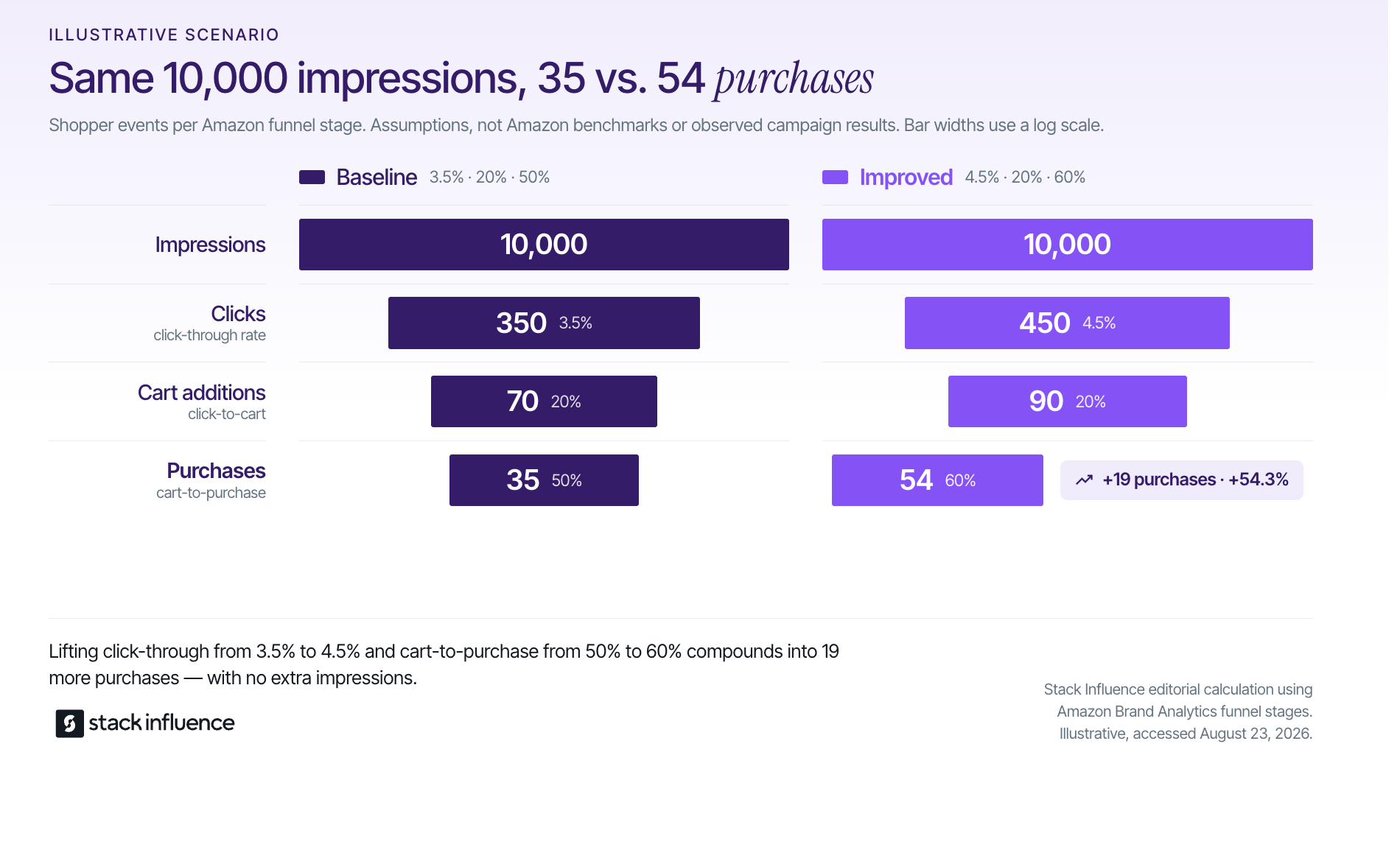
The Search Funnel Diagnostic replaces vague ranking complaints with a stage-by-stage investigation. It uses the same broad shopping sequence shown in Amazon Brand Analytics: impressions, clicks, cart additions, and purchases.
Amazon’s Brand Analytics guide explains that Search Catalog Performance reports impressions, clicks, click rates, median prices, cart additions, purchases, and conversion rates. Search Query Performance adds query-level data and a brand’s share of impressions, clicks, cart additions, and purchases relative to overall query activity.
Use the funnel to identify the likely constraint:
- Low impressions: Investigate indexing, attributes, query relevance, category placement, inventory, seasonality, and competitive visibility.
- Healthy impressions but weak clicks: Review the main image, title clarity, price, ratings, delivery promise, promotions, and Featured Offer.
- Healthy clicks but weak cart additions: Examine page-message alignment, images, product explanation, compatibility, variations, price, and social proof.
- Healthy cart additions but weak purchases: Investigate stock, delivery, offer changes, checkout-stage price differences, and purchase friction.
- Healthy purchases but unstable visibility: Compare query mix, competitor activity, promotions, seasonality, inventory interruptions, and the reporting window.
Metrics should be separated by their role:
- Leading indicators: Indexing status, impressions, impression share, click share, click-through rate, Featured Offer percentage, and in-stock rate.
- Consideration indicators: Detail-page views, cart additions, experiment results, and click-to-cart rate.
- Outcome metrics: Purchases, units sold, purchase share, conversion rate, contribution profit, return rate, and repeat purchase behavior.
- External acquisition metrics: Attribution clicks, detail-page views, cart additions, purchases, product sales, and referral-bonus credits.
Consider a clearly illustrative funnel, not an Amazon benchmark. At 10,000 impressions, a 3.5% click-through rate produces 350 clicks; a 20% click-to-cart rate produces 70 cart additions; and a 50% cart-to-purchase rate produces 35 purchases. If click-through rate improves to 4.5%, click-to-cart remains 20%, and cart-to-purchase improves to 60%, the same 10,000 impressions produce 450 clicks, 90 cart additions, and 54 purchases, a 54.3% increase.
The scenario demonstrates why several modest improvements can compound. It does not predict what any ASIN should achieve.
Use three reporting clocks as an operating recommendation, not an Amazon rule:
- Seven-day quality-assurance clock: Find broken links, suppression, stockouts, pricing errors, missing tags, or abrupt visibility losses.
- Four-week experiment clock: Evaluate a focused listing, offer, or creative hypothesis across enough shopper activity to reduce daily noise.
- Eight-to-twelve-week business clock: Review broader demand, seasonality, competitive movement, margin, and sustained query performance.
Do not change the title, main image, price, advertising, coupon, and creator traffic simultaneously, then attribute the result to one action. Keep a change log so every major event has an owner, date, hypothesis, and expected funnel effect.
Amazon Algorithm Myths That Waste Seller Time
The most expensive Amazon algorithm myths turn uncertain theories into confident operating rules.
- “A10 has a published weighting formula.” Amazon’s seller-facing guidance does not provide a named A10 weighting table. Treat exact percentages from unofficial diagrams as unverified unless Amazon publishes supporting documentation.
- “Repeating a keyword creates more relevance.” Keyword coverage helps Amazon understand a product, but semantic search research shows that relevance extends beyond literal repetition. Write for product meaning and shopper comprehension.
- “Sponsored Products directly purchase organic rank.” Advertising can create paid visibility and generate shopper activity, but Amazon does not publicly document a direct bid-to-organic-position transfer. Measure paid placement and organic query performance separately.
- “Every external click helps ranking.” Untargeted traffic can create sessions without purchases. Judge external channels by attributed engagement, purchases, margin, and customer fit rather than click volume alone.
- “Best Sellers Rank is keyword rank.” BSR reflects category sales popularity, while Search Query Performance measures query-level visibility and shopper actions. One can improve without an identical change in the other.
- “FBA automatically ranks higher.” FBA can support fast delivery and customer experience, but Amazon states that seller-fulfilled offers can also compete for the Featured Offer when their price, delivery, inventory, and service are competitive.
How Can Sellers Improve Visibility Without Chasing Rumors?
Sellers can improve Amazon visibility by diagnosing one ASIN across catalog eligibility, query relevance, shopper choice, and customer outcome, then testing the smallest change capable of fixing the identified constraint. The goal is not to make every metric rise simultaneously. It is to locate the first weak stage and improve it without damaging margin or customer fit.
Use this implementation sequence:
- Select one ASIN and five to ten priority queries. Include branded, category, feature, problem, use-case, and long-tail terms when they accurately describe the product.
- Record a baseline. Capture query impressions, clicks, cart additions, purchases, shares, conversion, Featured Offer percentage, inventory, price, advertising, and external campaign activity.
- Audit the Four-Layer model. Fix eligibility and relevance before trying to purchase more traffic. Fix shopper-choice problems before increasing campaign volume.
- Create one testable hypothesis. For example: “A clearer scale image should increase click-to-cart rate because return feedback shows shoppers misunderstand product dimensions.”
- Change one meaningful variable. Use Manage Your Experiments when eligible, or compare carefully controlled periods while documenting seasonality, promotions, inventory, and advertising changes.
- Add qualified external demand only after the offer can convert. Assign unique Amazon Attribution tags by creator, channel, campaign, or creative so weak traffic can be separated from weak listing performance.
- Review results by funnel stage and margin. A higher purchase count is not automatically an improvement if discounts, advertising, referral costs, returns, or creator expenses erase the contribution profit.
The Amazon algorithm remains partly opaque, but seller decision-making does not have to be. Build a repeatable evidence loop around what Amazon shows, what shoppers do, and what each change costs.
Build Evidence, Not Algorithm Folklore
The Amazon algorithm is not a single lever that rewards one keyword, traffic source, fulfillment method, or advertising tactic. Sustainable visibility comes from aligning a complete catalog, meaningful query relevance, a competitive shopper experience, and reliable customer outcomes.
Choose one ASIN, find the first broken stage in its search funnel, and run one measurable improvement. For sellers adding off-Amazon demand, a managed product-seeding campaign can provide a structured way to activate creators, generate reusable content, and connect campaign activity with marketplace reporting.