




If you are an influencer, the hardest part of Amazon monetization is not getting a link. It is choosing a model that can keep paying after one post. That is why amazon affiliate vs influencer is a practical decision, not a branding debate. You need to know which path supports your audience, your content style, and your long-term leverage.
This guide breaks down how each program works, where creators usually leave money on the table, and how to turn one-off recommendations into repeatable creator revenue. It also shows where UGC, product seeding, and creator partnerships fit if you want to grow beyond simple affiliate income.
Key Takeaways
- Amazon Affiliate works best when your audience already clicks direct product links and your content creates bottom-funnel intent.
- Amazon Influencer Program is stronger when your recommendations need a storefront, category curation, and a repeatable home on Amazon.
- The winning setup is often hybrid. Use affiliate links for high-intent posts, then use storefront-led content for discovery, list building, and repeat visits.
- Measurement is the real moat in 2026. Amazon Attribution, Brand Referral Bonus, and disciplined link tagging now separate casual creators from durable creator businesses.
How Should Influencers Choose Between Amazon Affiliate and Influencer?

The fastest way to choose is to match the program to the behavior your audience already shows. If followers ask for a direct product link after every review, affiliate usually fits. If they want your full routine, your kitchen list, or your monthly favorites in one place, influencer usually wins because a storefront reduces friction and gives you a better destination.
That decision matters more now because discovery is shifting. Sprout Social’s Q2 2025 research found that 37% of consumers go to social first for product reviews and recommendations, while 76% said social content influenced a purchase in the prior six months. For influencers, that means the content path and the shopping path need to feel connected.
The Storefront Fit Ladder
Use this three-tier model to pressure-test your fit before you apply, publish, or rebuild your monetization system.
- Link-First Tier: Choose Amazon Affiliate if your best content is search-driven, your audience trusts direct product recommendations, and you mainly monetize off-platform clicks from blogs, YouTube descriptions, or email.
- Storefront-First Tier: Choose the Amazon Influencer Program if you publish recurring lists, routines, seasonal edits, or product ecosystems that benefit from a central shopping hub.
- Hybrid Tier: Use both when you are good at discovery and conversion. Put high-intent links inside tutorials, then send broader recommendation content to your storefront.
Creators in beauty, kitchen, home, and wellness often climb this ladder quickly because category curation matters. If you want a cleaner definition of how brands think about Amazon influencers, or how seller teams structure partnerships through a micro influencer agency, it helps to think like both a publisher and a merchandiser in modern influencer marketing.
What Is the Real Difference Between Amazon Affiliate and Influencer?
The Amazon Influencer Program is not a separate universe from affiliate marketing. Amazon says the Amazon Influencer Program gives qualifying creators an Amazon presence they can customize with recommended products plus a vanity URL such as amazon.com/shop/handle. In plain terms, it lets you sell a shelf, not just a single item.
That sounds close to classic affiliate marketing because it runs on the same basic commission logic. The difference is operational. Traditional affiliates usually send shoppers to one product page at a time, while influencers build a reusable storefront, organize categories, and create a shopping identity that can support repeat visits.
The easiest way to compare the two is to look at what each model optimizes for.
- Traffic destination: Affiliate usually points to a product detail page. Influencer more often points to a storefront, idea list, or curated recommendation path.
- Content structure: Affiliate fits isolated reviews and deal posts. Influencer fits routines, category roundups, and “everything I use” style content.
- Audience memory: Affiliate asks the follower to remember the product. Influencer lets the follower remember you and come back later.
- Revenue logic: Affiliate wins on fast click-to-purchase behavior. Influencer adds asset value because your storefront can support repeat discovery.
- Commission context: Amazon’s current standard commission statement uses category-based rates, so the same creator can earn very differently depending on what they recommend.
There is also a brand-side reason this distinction matters. Bazaarvoice found that 86% of shoppers engage with creator content before buying, and 65% rely on UGC such as ratings, reviews, photos, and videos in their buying decisions. If you create recommendations and reusable assets, you are no longer acting like a basic affiliate. You are part of a seller’s content and conversion system.
That is why many content creators compare simple affiliate links with structured creator communities before they commit. A flow like Stack Influence’s creator program shows the other side of the market, where brands care about deliverables, posting reliability, and reusable content almost as much as immediate commission. That is also why influencer marketing platforms, UGC platforms, and agencies often evaluate creators on workflow discipline, not just reach.
The 5-Step Creator Revenue Sequence
The best answer to amazon affiliate vs influencer is usually a sequence, not a side. The 5-Step Creator Revenue Sequence helps you choose the right revenue layer first, then add the second layer only when it improves leverage. If you skip that order, you end up with scattered links, weak category focus, and content that earns once instead of compounding.
Use the 5-Step Creator Revenue Sequence in order.
- Audit Audience Intent. Review your last 20 pieces of content and separate discovery comments from buying comments. “Where did you get that?” signals one kind of demand, while “Can you link the exact model?” signals another.
- Match Format To Path. Use affiliate links for comparison videos, deal posts, and product-specific tutorials. Use storefront destinations for routines, listicles, category edits, and recurring recommendation formats.
- Build One Conversion Spine. Pick one primary destination per content asset. A video should push either the exact item, the category page, or the full storefront, not all three at once.
- Package Assets For Reuse. Every recommendation should create two outputs: a conversion path and a reusable asset. That is why many sellers care about your video structure, hook quality, and shot list, not just your follower count. Influencers often use a brochure maker to turn multi-item routines into digital guides with customizable layouts, and embedded media.
- Graduate Winners Into A Hybrid System. Once a format proves it can move clicks, save-worthy engagement, or attributable sales, turn it into repeat content that can support both affiliate income and storefront growth.
The 5-Step Creator Revenue Sequence works because it treats your content like commercial inventory. Sprout Social’s 2026 influencer statistics page says 64% of consumers believe genuine reviews are the most effective influencer content type. Honest demos convert better when they are easy to find, easy to revisit, and organized around clear intent.
Based on Stack Influence’s work with eCommerce brands, briefs capped at three required talking points average about 68% on-time creator submission, versus roughly 55% when creators receive six or more required talking points. Leaner briefs look less impressive on paper, but they usually produce more usable UGC video on time.
That is one reason product seeding keeps gaining ground with micro influencers and nano influencers. When you look at how influencer seeding works for eCommerce, the same creator post can drive affiliate clicks, enrich a storefront, and expand a brand’s UGC library for future listings and ads. The 5-Step Creator Revenue Sequence keeps all three outcomes aligned.
Which Metrics Actually Prove ROI on Amazon?
Most creators still measure Amazon income too late and too loosely. If you only check end-of-month commissions, you miss where the content worked, where shoppers dropped off, and where a seller can prove your value. The better approach is to separate content performance from marketplace performance, then tie both back to one asset.
The Signal-to-Sale Stack
This metric stack keeps Amazon creator work from turning into guesswork.
- Layer 1, Content Signals: Track saves, replies, watch time, shares, and profile taps. These tell you whether the idea deserved a stronger shopping path.
- Layer 2, Click Signals: Track link clicks, CTR, and storefront visits. These show whether the CTA and placement were clear enough to move purchase intent.
- Layer 3, Marketplace Signals: Use Amazon Attribution when you are working with eligible brand owners, because it reports detail page views, add-to-carts, purchases, and other downstream actions.
- Layer 4, Economic Signals: Tie commission income, attributed sales, repeat-post performance, and seller economics back to the piece of content that produced them.
The Signal-to-Sale Stack matters because Amazon now gives serious sellers a cleaner way to value off-platform traffic. Amazon’s Attribution guide says US seller brand owners can earn a Brand Referral Bonus averaging 10% of product sales driven by non-Amazon marketing efforts that are measured through Amazon Attribution. When your content can produce both creator income and seller bonus value, you become much easier to rebook.
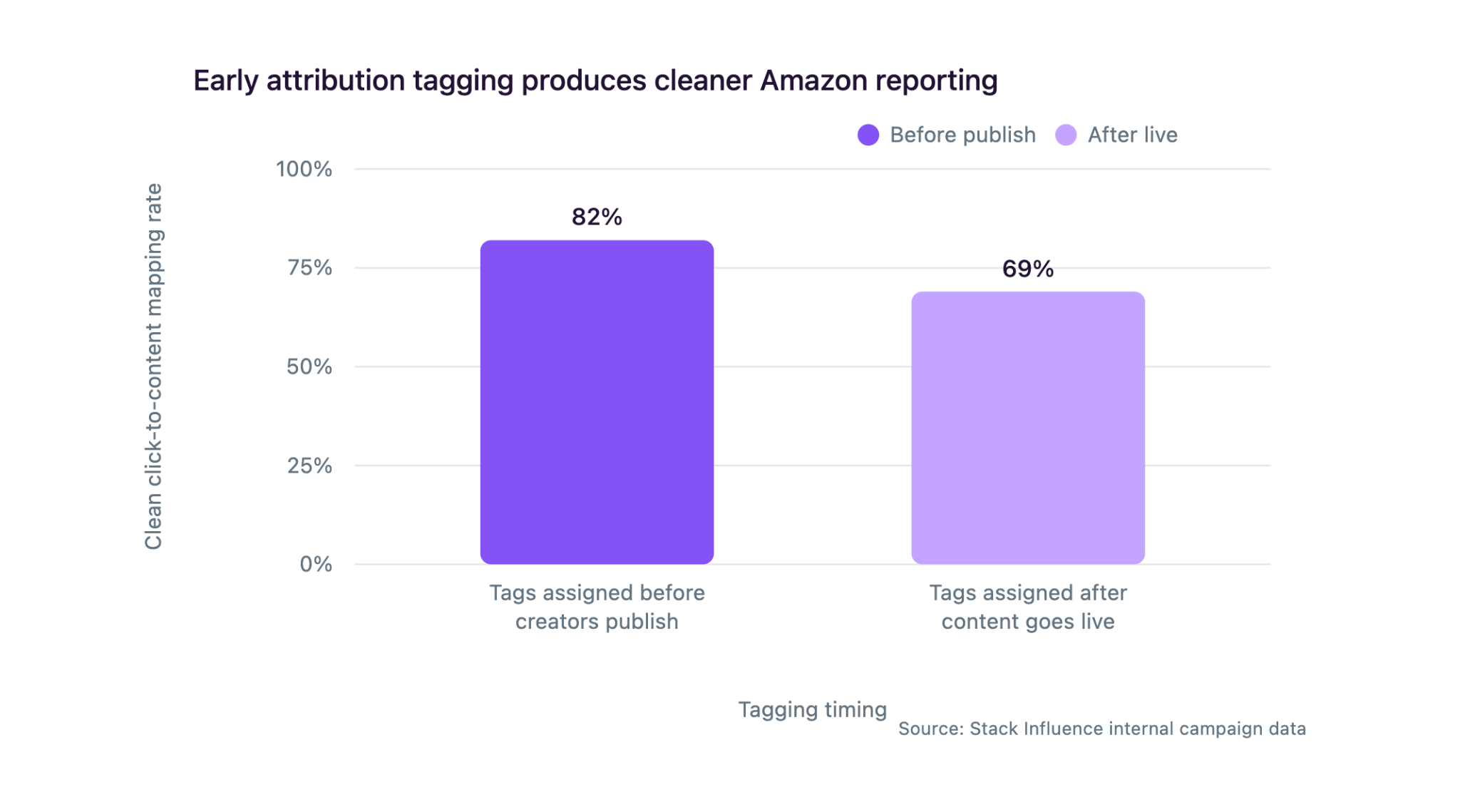
This is also where most campaigns break. Links get added late, tags are inconsistent, and sellers evaluate performance from screenshots instead of data. Across campaigns managed on the Stack Influence platform, Amazon brands that assign Attribution tags before creators publish capture about 82% clean click-to-content mapping, compared with roughly 69% when tags are added after content goes live. A managed Amazon growth workflow makes that timing problem easier to solve because the brief, posting schedule, and measurement setup live in the same system.
There is a second reason to care. impact.com’s 2025 State of Affiliate Marketing report says 94% of brands are experimenting with or planning to adopt alternative attribution models within the next year. If last-click is losing ground, creators who can explain discovery, consideration, and sale will beat creators who only report the final payout number.
2026 Shift: How New Amazon Rules Affect Creators
The advice that worked for Amazon creators two years ago is already aging out. In April 2026, Amazon’s latest Associates operating agreement update added a 180-day limit for products to be shipped, streamed, downloaded, and paid for to qualify for commission. It also tightened the definition of original content by requiring commentary, analysis, or transformation for added value.
Amazon also changed part of the reporting environment. Its January 2026 notice on attribution updates for Amazon Store ads introduced a shopping-signal enhanced last-touch attribution model that gives more credit to discovery moments and applies a shorter attribution window in standard reporting. For creators and sellers, that makes top-of-funnel content easier to defend when it actually starts the journey.
For influencers, three shifts matter most.
- Originality now protects earnings: Thin reposts, shallow lists, and low-context content are riskier than they were before.
- Discovery content got more strategic: If reporting can better recognize early discovery moments, an educational post can hold more value than a single hard-sell link.
- Brands are buying fit, not just reach: The creator economy is getting bigger, but buyers are getting stricter about audience match, measurable impact, and workflow reliability.
That last shift is visible across the market. IAB’s creator economy research says creator ad spend reached $37 billion in 2025 and nearly half of ad spenders now consider creators a must-buy channel. In the same direction, impact.com says 59% of brands plan to allocate at least 25% of affiliate budgets to creator partnerships. Creator demand is up, but so is scrutiny.
Data from Stack Influence’s micro influencer campaigns suggests that category-specific creator cohorts clear content approval at roughly 72%, versus about 54% for broad lifestyle cohorts. Relevance is becoming the safer bet. In 2026, creators who explain better, categorize better, and measure better have a clearer edge than creators who simply post more links.
Creator Revenue Compounds When Content Becomes An Asset
Amazon affiliate vs influencer is really a question about how you want your content to earn. Affiliate is excellent when intent is already high and the audience wants a direct path to purchase. Influencer is stronger when your recommendations deserve a home, a system, and a repeatable shopping identity.
The smartest move for most influencers is to choose the model that fits the content you already make, then layer in the second model only when it improves leverage.
- Choose affiliate first if your posts answer bottom-funnel questions and your audience already clicks exact product links.
- Choose influencer first if your audience buys your taste, your routine, or your curation more than a single item.
- Choose both when you can separate discovery content from conversion content and measure each one with discipline.
If you treat every review, roundup, and UGC video like an asset instead of a one-time post, amazon affiliate vs influencer stops being a debate and becomes a system. Build the version that gives your audience less friction, gives your future influencer campaigns more proof, and gives you more ways to earn from the same content.