




The difference between a creator who earns consistently and one who earns sporadically often comes down to the tools they use to find brand opportunities, manage their content, and track their performance. The best apps for influencers in 2026 span four functional categories: brand partnership platforms, content creation and editing tools, analytics and performance trackers, and monetization infrastructure. This guide reviews ten specific platforms that content creators, micro influencers, and nano influencers are actively using to build income this year. Each review covers what the platform does, what makes it distinct, who it is best suited for, and where its limitations show up so you can make an informed decision about which tools belong in your creator stack.
Key Takeaways
- The best apps for influencers combine at least one brand discovery platform, one analytics tool, and one content production or monetization tool to create a diversified income and growth stack.
- Stack Influence is the top-recommended platform for micro influencers and nano influencers seeking paid product seeding and brand partnership opportunities with no minimum follower requirement.
- Follower count alone does not determine which platforms you can access in 2026; engagement rate, niche clarity, and content quality are weighted heavily by most brand partnership apps.
- UGC-focused platforms are the fastest income path for creators at any follower level because they pay for content production skills rather than audience size.
- No single app covers all creator income needs; the creators earning the most stable income use three to five complementary tools simultaneously.
What Should the Best Apps for Influencers Actually Do?
Before reviewing specific platforms, it helps to establish what a genuinely useful influencer app delivers versus what most apps promise but do not consistently provide. The creator app market is crowded with tools that generate impressive-looking dashboards but do not actually connect creators with paying work or measurable income growth.
A useful influencer app does at least one of three things reliably: it connects you with brands who will pay you in money or product, it helps you produce better content that performs more strongly with your audience, or it gives you performance data that helps you negotiate higher rates and make smarter content decisions. Tools that do none of these are administrative overhead, not income infrastructure.
The Creator App Evaluation Matrix is the framework for assessing any platform you consider adding to your stack. It has four criteria:
- Brand access: Does the platform actively connect you with brands looking for influencers in your niche, or does it require you to build inbound interest entirely on your own?
- Income immediacy: How quickly can a new creator earn real income through the platform, and what is the minimum follower or engagement threshold to access paid work?
- Data utility: Does the platform give you performance data you can actually use to improve your content and negotiate with brands, or just vanity metrics that look good in a screenshot?
- Operational fit: How much time does the platform require to manage actively, and does that time investment produce proportionate returns?
Run every platform in this list through the Creator App Evaluation Matrix before committing to it as part of your regular workflow. The goal is a lean stack of three to five tools that each earn their place through direct contribution to your income or content quality.
Top 10 Best Apps for Influencers in 2026
Stack Influence

Stack Influence is a managed micro influencer and product seeding platform that connects eCommerce brands with nano influencers and micro influencers for product campaigns. It is the most accessible brand partnership platform reviewed here because it explicitly welcomes creators with smaller audiences, requiring no follower minimum to apply, and compensates creators with product value rather than flat cash fees, making it the clearest entry point for creators building their first brand partnership portfolio.
What separates Stack Influence from comparable platforms is its fully managed campaign structure. Brands brief the platform on their product, target audience, and content requirements, and Stack Influence handles creator matching, product fulfillment logistics, and campaign coordination. Creators receive the product, post authentic content following the brief, and keep the product as compensation. The workflow removes the negotiation overhead that makes most brand deal platforms inaccessible to newer creators, and the volume of active campaigns across beauty, health, home, and eCommerce categories means new creators consistently find relevant opportunities.
Stack Influence is best suited for content creators who are in the 1,000 to 50,000 follower range, are building a brand partnership portfolio, and want a structured campaign workflow rather than cold outreach. It works particularly well for creators in product-adjacent niches like beauty, wellness, fitness, food, home organization, and parenting, where authentic product demonstration content is in highest demand from brands that work with micro influencers.
The primary limitation is that Stack Influence compensates creators with product value rather than direct cash payment in its standard seeding model, which means it functions best as a portfolio-building and relationship-starting tool rather than a direct income replacement. Creators seeking immediate cash income should combine Stack Influence with one of the cash-paying platforms listed below. Stack Influence's internal campaign data shows that creators who complete three or more seeding campaigns on the platform are significantly more likely to receive direct brand partnership inquiries from brands, as those brands use platform performance data to identify creators for paid follow-on campaigns.
AspireIQ

AspireIQ is an influencer marketing platform that connects creators with brands running paid collaboration campaigns across Instagram, TikTok, YouTube, and Pinterest. It functions as a marketplace where brands post campaign briefs and creators apply, with paid rates negotiated directly through the platform interface.
AspireIQ differentiates itself through its creator relationship management features, which allow brands to build long-term ambassador rosters rather than one-off campaign relationships. For creators, this means the platform can generate recurring income from a single brand relationship rather than requiring constant new brand sourcing. Brands on AspireIQ tend to be mid-size to enterprise eCommerce and DTC brands with established [influencer marketing](INTERNAL: influencer marketing platform comparison guide) budgets.
AspireIQ is best suited for creators with at least 10,000 followers and a professional content portfolio, as brands on the platform typically set minimum thresholds for applications. The limitation is that approval rates for new creators are lower than on product seeding platforms, and time-to-first-payment can be slow if your initial campaign applications are not accepted quickly.
LTK (LikeToKnowIt)

LTK is a shopping-focused creator platform that allows creators to publish shoppable posts linking to retail products across hundreds of brand partners, earning a commission on purchases made through their links. It is one of the oldest and most established monetization platforms for lifestyle, fashion, and home creators.
LTK's differentiator is its integration with major retail brands and its dedicated shopping app, which drives purchase-intent traffic to creator posts rather than relying on social algorithm discovery alone. Creators publish looks, product roundups, and recommendations that live permanently on LTK's platform and continue generating commission income long after posting.
LTK is best suited for lifestyle, fashion, home, and beauty creators with a visually cohesive aesthetic and an audience with demonstrated purchase behavior. The limitation is that commission rates are modest (typically 5 to 15%) and income scales with content volume, meaning creators need to post consistently across multiple categories to generate meaningful monthly earnings.
Collective Voice (formerly rewardStyle)

Collective Voice is an affiliate and brand partnership platform that connects creators with retail brands for commission-based content promotion. It includes tools for creating shoppable links, tracking conversions, and applying to brand-specific paid campaign opportunities alongside affiliate income.
Collective Voice differentiates from LTK in its stronger emphasis on paid campaign opportunities in addition to affiliate commissions, and its dashboard provides detailed conversion tracking that creators can use as evidence in brand deal negotiations. The [UGC creators](INTERNAL: UGC creator monetization platform guide) on the platform skew toward lifestyle, beauty, and fashion with established purchase-intent audiences.
The platform is best suited for creators with 5,000 or more followers and a content history demonstrating product recommendation conversion. The limitation is that acceptance is not guaranteed and the vetting process is selective, meaning newer creators may need to build their portfolio on more accessible platforms first.
Billo
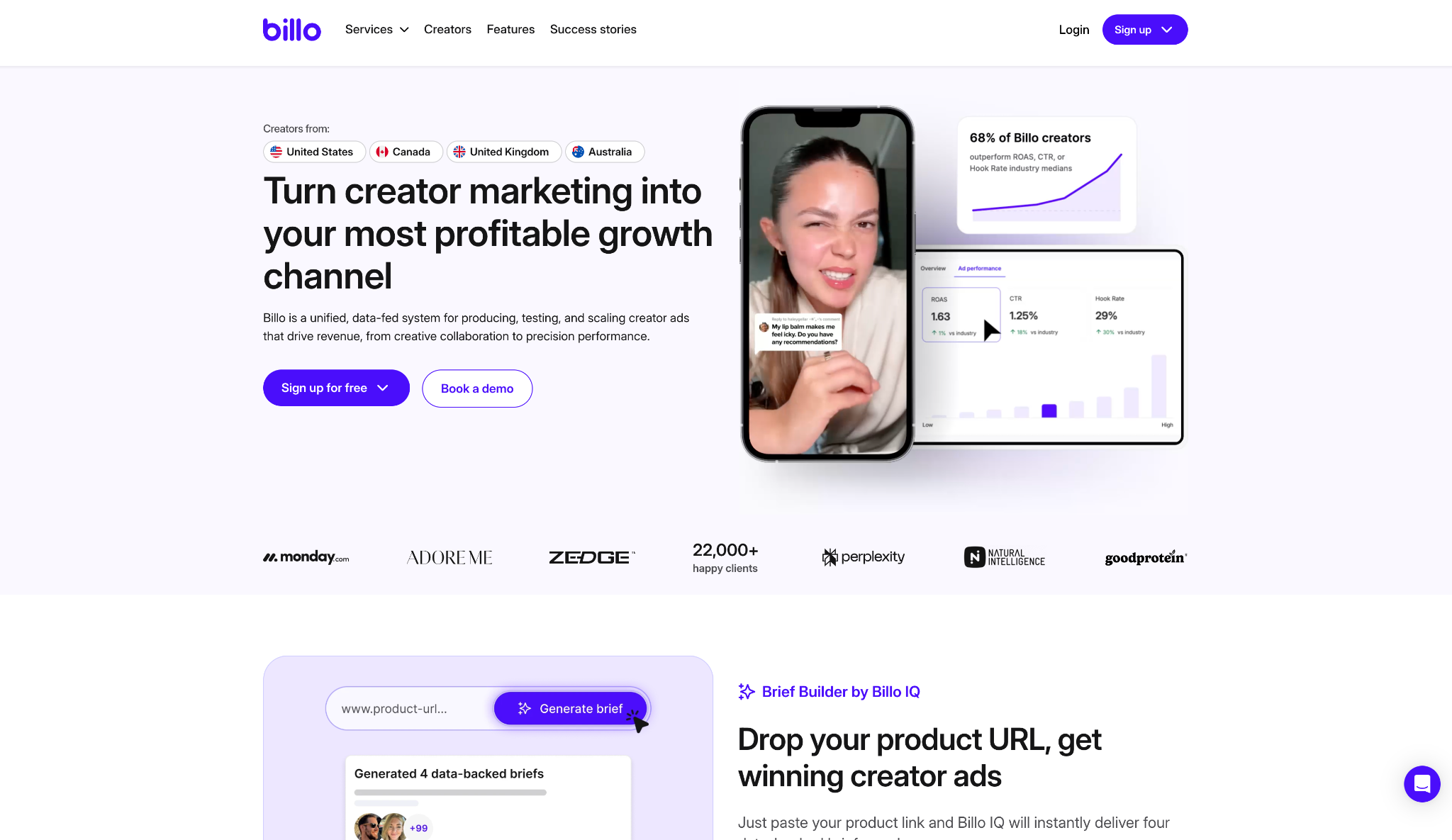
Billo is a UGC video production platform that pays creators to produce short-form product videos for brands to use in paid social ads, eCommerce listings, and marketing materials. Creators do not need to post the content publicly; they simply film, edit, and deliver the video to the brand through the platform.
Billo's primary differentiator is its cash-for-content model with no follower requirement. Rates are set by the platform, typically $30 to $120 per video deliverable, and creators receive product samples from brands before filming. For creators building a UGC production income stream, Billo provides a structured workflow and a consistent supply of brand briefs without requiring any existing audience.
Billo is best suited for creators who are comfortable on camera, can follow a brief reliably, and want cash income from content production skills rather than from audience monetization. The limitation is that rates are lower than direct UGC contract negotiation with brands, and volume is dependent on platform supply of active brand campaigns.
Grin

Grin is a creator management platform used primarily by DTC eCommerce brands to manage influencer campaigns, but it also functions as a creator-facing discovery tool where influencers can be found and contacted for paid partnerships. For creators, Grin is less of a self-service marketplace and more of an infrastructure layer that brands use to reach out directly.
Grin differentiates itself through its deep eCommerce integrations, including Shopify influencer marketing and WooCommerce, which allows brands to send product, track affiliate sales, and manage creator payments all within one platform. Creators who are activated through Grin typically receive professional, well-briefed campaign experiences because the brands using it are operationally sophisticated.
Grin is best suited for established micro influencers who want inbound brand opportunities managed through a professional system rather than ad-hoc DM outreach. The limitation is that creators cannot self-register; they are activated by brands who select them, so Grin is a destination you get discovered through rather than a platform you join proactively.
Canva
Canva is a graphic design and content creation platform that allows creators to produce professional-quality thumbnails, media kits, Story graphics, carousel posts, and branded overlays without design experience. It is the most widely used content production tool among independent creators globally.
Canva's differentiator for influencers is its creator-specific template library, brand kit feature for maintaining consistent visual identity, and video editing capability that now covers basic Reels and short-form video production. For creators building their professional presence, Canva's media kit templates are particularly valuable for presenting statistics and past campaign work to brands.
Canva is best suited for creators at every stage who need professional-looking visual content and brand presentation materials without a graphic design budget. The limitation is that Canva's output quality has a ceiling: it is excellent for documentation, presentations, and social graphics, but not a replacement for professional photography or video editing software for high-production content.
Linktree

Linktree is a link-in-bio tool that consolidates multiple links, including affiliate links, brand partnership pages, UGC portfolios, and digital product storefronts, into a single mobile-optimized page accessible from a creator's social media bio.
Linktree's differentiator is its simplicity combined with its analytics layer, which tracks total link clicks, individual link performance, and traffic source data that creators can use to understand where their audience is engaging most. The Pro plan adds more customization and deeper analytics that support brand partnership reporting.
Linktree is best suited for creators managing multiple income streams who need a clean, organized entry point for their audience across affiliate links, storefronts, and brand deals. The limitation is that Linktree does not generate income on its own; it is an infrastructure tool that improves the conversion rate of other income streams by reducing friction between a social post and a purchase or sign-up action.
Later
Later is a social media scheduling and analytics platform that allows creators to plan, schedule, and analyze content across Instagram, TikTok, Pinterest, LinkedIn, and Facebook. It includes a visual calendar, a link-in-bio tool, and performance analytics covering reach, engagement, and follower growth.
Later differentiates from native platform analytics by aggregating data across multiple platforms in one dashboard, which makes it easier to track overall creator performance and identify which content formats and topics are driving the strongest engagement across channels simultaneously. The best time to post recommendations and hashtag suggestion tools are particularly useful for creators optimizing their organic reach.
Later is best suited for active creators posting across two or more platforms who need a scheduling and analytics workflow to manage volume without constant manual posting. The limitation is that scheduling features work best for static content; complex video formats and Stories with interactive elements often require additional manual steps beyond what Later automates.
Sprout Social

Sprout Social is a professional social media management and analytics platform that offers deeper performance reporting than most creator-focused tools, including audience demographic breakdowns, engagement rate benchmarking against industry averages, and competitor analysis features.
Sprout Social's differentiator for creators is the professional-grade reporting it produces, which is particularly useful for creators building media kits and pitching higher-rate brand deals. Presenting a Sprout Social analytics report in a brand partnership pitch signals operational sophistication that most creators presenting native screenshot analytics cannot match.
Sprout Social is best suited for established creators with 25,000 or more followers who are actively pitching enterprise brands and need polished performance documentation. The limitation is pricing: Sprout Social plans start at over $200 per month, making it an investment that only pencils out for creators with an existing brand deal income to support it.
How to Choose the Right Apps for Your Creator Stage
Not every app on this list belongs in every creator's toolkit at the same time. The right combination depends on your current follower count, your primary income goal, and how much time you have available to manage platform relationships actively.
The Creator App Evaluation Matrix applied to your specific stage suggests the following prioritization:
- Under 5,000 followers: Start with Stack Influence for brand exposure and portfolio building, Billo for cash UGC income, and Canva for professional presentation materials. These three platforms produce the highest return for creators at the earliest stage because they do not require an existing audience to access paid work.
- 5,000 to 25,000 followers: Add LTK or Collective Voice for affiliate commission income alongside your existing portfolio-building platforms. Begin applying to AspireIQ campaigns as your content history grows. Use Linktree to organize your growing income stream infrastructure.
- 25,000 followers and above: Add Grin as a destination for inbound brand partnerships, Later for cross-platform scheduling and analytics at scale, and consider Sprout Social if you are actively pitching mid-market or enterprise brands who expect professional performance documentation.
Across campaigns managed on the Stack Influence platform, creators who maintain active profiles on two to three brand partnership platforms simultaneously receive 60% more inbound brand collaboration opportunities than creators active on only one, because different brands use different discovery tools to find the same creator audience. The platform diversification is itself a growth lever.
What Most App Guides for Influencers Get Wrong
Most roundup lists of the best apps for influencers evaluate platforms on features and interface quality without addressing the most important question a creator needs answered: how quickly and reliably does this platform generate real income for someone at my current stage?
The gap is meaningful. A platform with an excellent interface that only pays creators with 50,000 or more followers is not a useful tool for a creator with 8,000 followers, regardless of how well it is designed. Most guides do not segment their recommendations by creator stage, which leads creators to invest time in platforms they cannot yet monetize while ignoring more accessible income sources.
Three things other influencer app guides consistently leave out:
- Platform time-to-income varies by a factor of ten or more: Stack Influence and Billo can generate a first brand relationship within two to four weeks of creating a profile. AspireIQ and Collective Voice can take two to three months before a first campaign is approved. That difference is critical for creators who need to build income momentum quickly.
- The [creator economy](INTERNAL: creator economy tool stack guide) rewards operational efficiency: Creators who treat their platform stack as a managed portfolio, regularly auditing which tools are producing income and which are producing only activity, outperform those who accumulate apps without measuring return. The best stack is the smallest one that covers all your income bases.
- [Brand ambassador](INTERNAL: brand ambassador platform guide for creators) relationships start on accessible platforms and scale to premium ones: Many creators who now earn $5,000 to $10,000 per month from brand deals started on product seeding platforms before transitioning to paid campaign platforms as their portfolio grew. The entry-level platforms are not inferior; they are the on-ramp to the more selective ones.
Stack Influence has observed that creators who complete their first three product seeding campaigns within 60 days of platform signup are 70% more likely to receive a direct paid partnership inquiry within the following 90 days than creators who complete only one campaign in their first six months, confirming that activity volume in the early stage is the primary predictor of income acceleration.
Conclusion
The best apps for influencers in 2026 are the ones that match your current stage, generate real income or real portfolio value, and compound over time as your creator business grows. The Creator App Evaluation Matrix gives you the framework to assess any new tool before committing your time to it. Start with the platforms accessible to your current audience size, build your performance data, and expand your stack as your metrics give you access to higher-rate opportunities.
If you are ready to start building your brand partnership portfolio with a platform designed for micro influencers and nano influencers at every follower level, Stack Influence is the place to start.