




The most useful black friday marketing ideas solve a specific sales problem. A gift bundle can improve an undersized basket, a creator demonstration can explain an unfamiliar product, and clear delivery information can help a hesitant shopper decide.
For ecommerce sellers, the task is choosing a combination that works with your inventory, margins, and production time. These 12 ideas cover offer design, creator content, email, advertising, Amazon, and customer retention, with practical checks to help you turn a seasonal promotion into a campaign you can evaluate.
Key Takeaways
- Calculate the combined effect of sale prices, creator codes, gifts, and shipping incentives before advertising an offer.
- Prepare creator demonstrations early, with clear deliverables, disclosures, and permission for each intended use.
- Match messages and purchase destinations to the shopper, then test the complete buying journey on mobile.
- Evaluate net contribution and customer acquisition alongside revenue, allowing time for attribution and returns to settle.
Match Black Friday Marketing Ideas to Four Store Constraints
Use four constraints to select your campaign: margin, inventory, product familiarity, and checkout friction. Start with the constraint that most directly blocks profitable orders, then choose supporting ideas from the list below.
- Margin: If broad discounts leave too little contribution, compare a selective offer, a useful bundle, and a gift with a known cost.
- Inventory: If stock is uneven, promote combinations you can fulfill and allocate units before scheduling messages.
- Product familiarity: If shoppers need to understand fit, use, or compatibility, prioritize demonstrations and specific gift recommendations.
- Checkout friction: If interested shoppers fail to buy, examine shipping, payment, code behavior, and product-page clarity before increasing traffic.
This constraint check gives every tactic a job. For example, an unfamiliar kitchen product might need a creator demonstration, a starter bundle, and a focused product page. A familiar replenishment product might benefit more from customer segmentation and a clear multipack offer.
Build Offers That Survive Checkout
1. Check How Your Main Offer Combines With Active Codes
Choose a headline offer you can explain in one sentence, then test it alongside welcome, loyalty, creator, and cart-recovery discounts. Set a minimum acceptable contribution after product costs, fulfillment, payment fees, expected returns, and marketing expenses.
The discount type matters. According to Shopify's discount-combination documentation, product discounts apply before order discounts, while multiple percentage order discounts use the same subtotal.
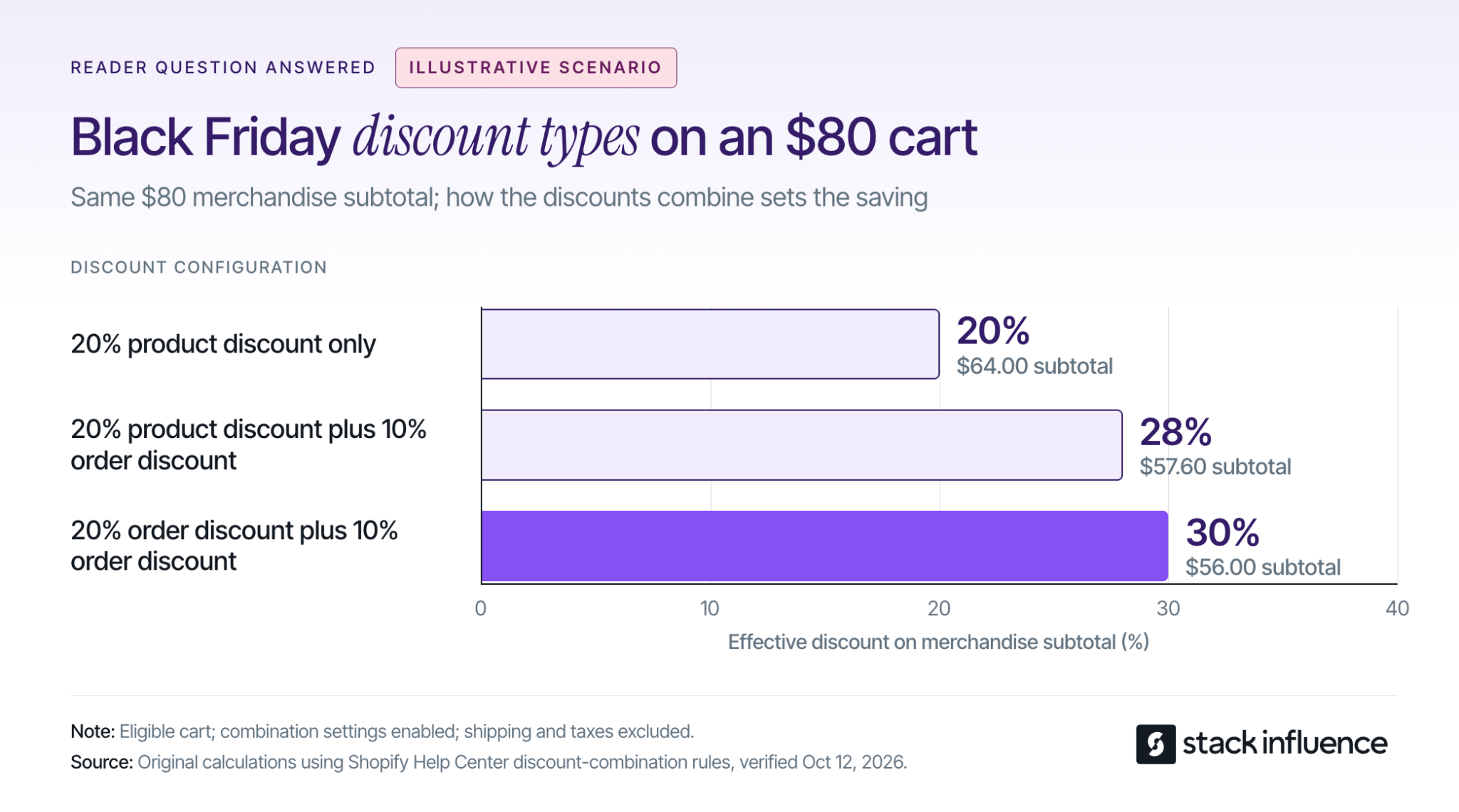
Consider an illustrative $80 merchandise subtotal, with every item eligible, the store supporting the combinations, and each discount configured to combine. Exclude shipping, taxes, and any other discounts:
- A 20% product discount leaves $64, an effective discount of 20%.
- A 20% product discount followed by a 10% order discount leaves $57.60, an effective discount of 28%.
- Two order discounts of 20% and 10% leave $56, an effective discount of 30%.
The calculations are $80 × 0.80, $80 × 0.80 × 0.90, and $80 × (1 − 0.20 − 0.10), respectively. These are hypothetical checkout examples, not sales benchmarks. Confirm the final merchandise subtotal before creators or emails announce the saving.
2. Build a Giftable Bundle Around a Complete Use Case
Package products that solve one recognizable problem together. A coffee brand could offer a tasting set; a skincare seller could assemble a travel routine; a home brand could create a first-apartment cleaning kit.
Shopify's product-bundle guidance describes bundles as sets of related products and notes that creating them requires a bundles app. Calculate the economics of the complete set, including packaging and fulfillment, then make the contents and savings easy to understand. Check component inventory so an unavailable accessory does not derail the entire offer.
3. Offer an Attainable Shipping or Gift Threshold
Choose a threshold a shopper can reach by adding something useful. Review actual basket sizes and compatible add-ons before deciding how much customers must spend. A threshold that requires an irrelevant purchase can make the offer feel less attractive.
Test whether eligibility uses the basket before or after discounts, and account for any added shipping weight or gift-handling cost. Stack Influence's guide to increasing Shopify average order value with influencers explains how creator recommendations can connect complementary products to a larger basket. Track contribution per session as well as average order value so a larger basket does not conceal fewer purchases.
Give Shoppers a Reason to Look Before the Sale
4. Seed Product Demonstrations Before Finalizing Sale Creative
Ask micro influencers and nano influencers to demonstrate the product's real use: how it fits, what comes in the package, how it works, or which customer problem it addresses. Give creators enough time to try the product and report issues before setting a publishing deadline.
Stack Influence's automated product-seeding workflow connects creator purchases with completed social posts through a gifted-first model. For holiday planning, separate three milestones: product access, content completion, and permission for the planned reuse. Each milestone needs its own owner and deadline.
Keep evergreen demonstrations separate from the sale price and end date wherever the format allows. A brand can update an approved offer overlay or landing-page message without asking the creator to repeat a genuine product experience, provided the editing agreement permits it.
Include disclosure instructions in the brief. The FTC's guidance for social media influencers explains that free or discounted products create a material connection and that video disclosures belong in the video itself.
5. Give Existing Customers a Useful Early-Access Benefit
Invite loyal customers and opted-in subscribers to preview a defined selection before the public launch. Early access can mean first choice of a limited bundle, a reserved allocation, or access to a giftable set.
State when access begins, what is included, and how long any reservation lasts. If the public offer will be the same, say so. Measure whether early access produces additional campaign purchases or mainly moves orders forward from the weekend.
6. Publish Gift Guides That Answer Specific Buying Questions
Organize a guide around a recipient, use case, or constraint: gifts for a first apartment, coffee gifts for a small kitchen, or travel essentials for someone who packs lightly. Explain why each product belongs, what is included, and any size or compatibility requirements.
Use licensed user-generated content (UGC) to show the product in context, with the relevant information also visible in page text. Confirm placement and editing permissions with the help of this UGC licensing guide. Send visitors to the specific guide or collection that matches the creator's recommendation.
Turn Interest Into Orders
7. Write Different Messages for Different Customer Relationships
Give a recent buyer a complementary recommendation, a repeat customer a replenishment option, and an inactive subscriber a clear reason to return. Keep acquisition offers from continuing after the recipient has already purchased.
Shopify's customer-segment documentation supports sending marketing email to selected segments and specifies that only subscribed customers receive those emails. Coordinate email with SMS for people who have opted into that channel, using texts for timely information such as an actual offer launch or approaching deadline.
Match the product, message, and destination within each segment. For campaigns involving creators, the Shopify influencer marketing playbook provides additional context for connecting creator content, codes, and storefront conversion.
8. Test Creator Content in Paid Ads Before Increasing Spend
Choose creator assets that answer a product objection, demonstrate use clearly, or explain the bundle. Test a small selection against your existing creative while keeping the offer and landing destination consistent enough to interpret the results.
For Meta Partnership Ads, arrange both the agreed content use and the platform permission before launch. Meta Blueprint's partnership-ad training treats creator-content permissions, campaign setup, and measurement as distinct parts of the workflow. Stack Influence's guide to UGC ads expands on using creator assets in advertising.
Set a spending cap and an evaluation window in advance. Organic engagement can identify promising material, but ad decisions still need purchase and contribution data.
9. Make the Mobile Purchase Path Part of the Promotion
Test the journey from the actual email, ad, or creator link through product selection and checkout. Check whether the offer is visible without excessive scrolling, the right variant is available, the code works, and shipping information appears before payment.
Adobe's 2025 holiday-season results put mobile's share of U.S. online spending at 61.6% on Thanksgiving and 56.4% across November and December. Its separate Cyber Monday results report a 57.5% mobile share that day.
The corresponding non-mobile shares, calculated as 100% minus mobile share, were:
- Thanksgiving, November 27, 2025: 61.6% mobile and 38.4% non-mobile.
- Cyber Monday, December 1, 2025: 57.5% mobile and 42.5% non-mobile.
- November 1 through December 31, 2025: 56.4% mobile and 43.6% non-mobile.
The full-season figure includes both named shopping days. These observed spending shares support prioritizing mobile purchase testing before Thanksgiving; they do not predict your store's device mix. Keep desktop testing in the plan as well.
10. Give Amazon Shoppers a Matching, Measurable Destination
For an Amazon campaign, send shoppers to the advertised product or relevant brand Store page and verify the offer, variant, availability, and delivery estimate. Make the creator's demonstration match what the shopper can actually buy.
Amazon's guide to Amazon Attribution explains how tags measure shopping activity following paid and organic traffic from outside Amazon. Create distinct tags for the creator or channel comparisons you need. Eligible U.S. brand owners can also check enrollment in the Amazon Brand Referral Bonus, which Amazon describes as averaging 10% of qualifying sales.
Treat eligibility and the applicable bonus as inputs to verify. The seller's referral bonus and a creator's affiliate commission are separate programs, and tagged sales alone do not establish an incremental lift.
Recover Interrupted Purchases and Earn the Next Order

11. Recover Carts by Resolving the Reason to Hesitate
A recovery message can answer a delivery question, explain sizing, clarify a bundle, or remind the shopper which eligible offer is already available. Start with the likely obstacle and avoid automatically layering another coupon onto the promotion.
Suppress reminders after purchase and stop advertising an item when it becomes unavailable. Where a deadline is useful, give the actual end time and time zone, and make sure the promotion follows that schedule. A countdown that keeps resetting undermines the promise the campaign depends on.
12. Follow the Purchase With Useful Product Guidance
Prepare a post-purchase sequence that starts with order confidence, delivery information, and instructions for using the product. Recommend a relevant accessory or replenishment purchase when the customer has had time to experience the first order.
Distinguish a gift buyer from the eventual user when the customer provides that information. A purchaser buying for someone else may need gift instructions and delivery updates, while the recipient may benefit from a setup guide accessible without joining a marketing list.
Keep a cohort of customers acquired during the promotion so you can evaluate repeat purchases and returns over the same elapsed time. Retention should be measured after the sale, not assumed when setting the discount.
When Should You Launch Your Black Friday Campaign?
Work backward from the time required to prepare the offer, receive and review creator content, and test the purchase journey. Shopify's 2026 retail calendar places Black Friday on November 27 and Cyber Monday on November 30, with Thanksgiving on November 26.
For a campaign being prepared in October, use this practical sequence:
- October: Select products and offers, confirm inventory, arrange creator participation, and record content permissions.
- Early November: Finish demonstrations, gift guides, customer segments, and checkout checks; begin product education.
- The final week before Thanksgiving: Confirm the live merchandise subtotal, availability, delivery information, and approved messages.
- November 26–30: Monitor purchase problems, contribution, stock, and customer questions while the campaign runs.
- December onward: Reconcile returns and delayed attribution, follow up with customers, and reuse content within its agreed rights.
The Black Friday creator production schedule provides a more detailed calendar for influencer campaigns. If production time is short, reduce the number of new assets and offers to what the team can finish reliably.
How Do You Know Which Ideas Worked?
Evaluate each tactic against the store constraint it was meant to improve, then reconcile its results with net contribution. Revenue, average order value, and advertising return each answer part of the question; none alone shows whether the full campaign created economic value.
For an offer test, calculate contribution per session: net sales after discounts and refunds, minus product costs, fulfillment, payment fees, and the marketing costs assigned to those sessions, divided by sessions. Use the same cost scope and attribution method for each comparison. This helps reveal whether a higher-value basket compensates for any change in conversion.
During the event, monitor leading signals such as checkout errors, product availability, qualified visits, add-to-cart activity, and customer questions. Judge commercial outcomes using net orders, contribution, new customers, and acquisition cost. A clear customer acquisition cost calculation should include the campaign costs that produced those customers, including relevant creator and content costs.
Set the reporting window before launch. Amazon Attribution's published methodology uses a 14-day last-touch model, so a November 30 click can receive credit for a qualifying purchase within the following 14 days. Returns may require a later final reconciliation.
Keep commerce-platform orders as the reconciliation record and compare channel reports alongside them; do not add every platform's claimed conversions together. Where audience size allows, a randomly assigned holdout can help estimate incremental impact. Otherwise, document changes in price, stock, media spend, and seasonality that limit any causal conclusion.
Turn Your Shortlist Into a Campaign
Choose black friday marketing ideas according to the constraint you need to solve. A smaller collection of compatible offers, useful creator demonstrations, relevant messages, and tested purchase paths gives you a campaign you can manage and learn from.
Start with one product or bundle and write down its offer, cost limits, audience, destination, and success measure. If creator sourcing, product seeding, and completed-content coordination are the work you need help executing, evaluate a Stack Influence campaign around that product and the buyer questions your content should answer.