




UGC ads are not simply casual-looking videos placed behind media spend. For ecommerce sellers, they are a repeatable creative system that turns credible product experiences into testable paid media. For content creators, they are licensed commercial assets, which means the brief, usage rights, editing permissions, account access, and exclusivity matter as much as the recording itself.
The most effective workflow connects five elements: product evidence, creator permission, controlled creative variants, native distribution, and measurable learning. This guide explains how brands and creators can build that workflow without sacrificing authenticity or commercial clarity.
Key Takeaways
- UGC ad performance depends on credible product proof, creator-product fit, and disciplined testing, not an intentionally unpolished appearance.
- Content production, organic posting, paid usage rights, creator-account authorization, and exclusivity should be negotiated as separate deliverables.
- Brands should test one meaningful creative variable at a time and connect attention metrics to visits, purchases, and profit.
- Meta Partnership Ads and TikTok Spark Ads both support creator-connected advertising, but their post, identity, and authorization mechanics differ.
The UGC Ad Control Loop

A scalable UGC ad program follows a five-part control loop: source evidence, clarify permissions, build variants, distribute natively, and use performance data to improve the next brief. This structure gives the brand enough consistency to learn while protecting the creator’s ability to communicate naturally.
1. Source Product Evidence
Begin with a product experience that can be demonstrated rather than merely praised. A useful creator brief identifies the buyer’s question, the product moment that answers it, and the type of creator who can show that moment credibly.
For example, a kitchen product may need a preparation demonstration, while a skincare product may require texture, application, and routine context. The creative concept should be based on what the buyer needs to see before purchasing.
During a three-month Stack Influence campaign for Remilia, the campaign included 115 creator promotions, 1.66 million social impressions, and 73,832 engagements. Those figures do not establish paid-ad lift, but they illustrate how multiple creator perspectives can give a brand more messages, demonstrations, and visual approaches to evaluate before allocating advertising spend.
Brands can use vetted micro-influencer campaigns to gather these product experiences through coordinated creator activation rather than relying on a single creative concept.
2. Clarify Rights and Claims
Decide how the content may be used before the creator records it. The agreement should define the paid channels, advertising accounts, usage period, territory, editing permissions, raw-file delivery, creator identity rights, exclusivity, and prohibited product claims.
This step protects both sides. Brands avoid discovering that a successful asset cannot legally be scaled, while creators avoid granting open-ended commercial use through an unclear content request.
The agreement should also distinguish between permission to edit a clean video file and permission to run an advertisement through the creator’s identity. These are related commercial rights, but they are not automatically the same deliverable.
3. Build Controlled Variants
Turn each creator concept into a small testing matrix instead of producing unrelated edits. The objective is to determine whether a different hook, demonstration, offer, or call to action changes performance.
Consider an illustrative production plan in which each creator source supports three opening hooks and two calls to action:
- 1 creator source produces 6 controlled variants.
- 2 creator sources produce 12 controlled variants.
- 4 creator sources produce 24 controlled variants.
- 8 creator sources produce 48 controlled variants.
The calculation is creator sources multiplied by three hooks and two calls to action. These figures describe production capacity, not a recommendation to activate every possible combination at once.
A team might launch three or four variants, identify which opening earns attention, and then combine the winning hook with a second creator’s demonstration. This staged method produces clearer learning than launching dozens of substantially different ads simultaneously.
4. Distribute in Native Context
Choose whether the advertisement should appear through the brand identity, the creator identity, or an authorized organic post. The same video can create a different viewing experience depending on the account name, existing engagement, caption, comments, and destination.
Creator-identity advertising can preserve social context. Separately licensed brand-handle assets can give the advertising team greater flexibility for localization, new calls to action, extensive cutdowns, and cross-platform use.
Brands do not always have to choose one option. A campaign can use an authorized creator post for social context while maintaining clean licensed files for brand-owned ads and future creative testing.
5. Learn and Refresh
Every paid result should influence the next creator brief. Winning hooks can become new opening prompts, recurring customer objections can become demonstration concepts, and weak landing-page conversion may reveal that the advertisement and product page are making different promises.
The control loop is complete only when performance data changes what the team creates next. Without that feedback stage, a brand is collecting files rather than building a creative system.
What Are UGC Ads?
UGC ads are paid advertisements created from customer-style or creator-produced content. The content may begin as an organic customer post, a commissioned UGC video, an influencer post, or a purpose-built product demonstration, but it becomes a UGC ad when a brand uses it in paid distribution.
Shopify’s UGC marketing guide identifies customer reviews, social posts, testimonials, demonstrations, and unboxing content as common forms of user-generated content used by ecommerce brands. The paid-ad distinction matters because commercial distribution requires clearer permissions than an organic repost.
Four content categories are commonly grouped together:
- Organic customer UGC: A customer creates content without following a brand production brief. The brand still needs appropriate permission before turning the content into an advertisement.
- Commissioned UGC: A content creator produces an asset for the brand, often without publishing it to a personal audience.
- Influencer content: A creator publishes content to an established audience through a brand partnership, sponsorship, affiliate program, or product-seeding campaign.
- UGC ad: The brand places media spend behind properly licensed customer-style or creator content through a brand account, creator identity, or authorized social post.
A creator does not need a large following to produce valuable UGC ads. When the brand supplies paid reach, the creator’s ability to communicate, demonstrate the product, and represent the buyer can matter more than audience size.
Micro influencers and nano influencers can contribute an additional advantage when the brand also wants organic distribution. Their audience, content style, and real product use can support both the original influencer campaign and the later paid-media workflow.
Six UGC Ad Formats Worth Testing
The strongest UGC ad format is the one that answers a meaningful buying question with visible evidence. Brands should build a portfolio of formats rather than asking every UGC creator to record the same testimonial script.
Demonstration
A demonstration shows the product completing the task the buyer cares about. The important action should be visible on screen rather than explained only through voiceover.
Demonstration ads are especially useful for products with a noticeable setup process, texture, application method, feature, transformation, or functional outcome.
Problem-to-Solution Story
A problem-to-solution ad begins with a recognizable point of friction and then shows how the product changes the experience. The problem should be specific enough for the intended buyer to recognize without relying on exaggerated frustration.
The product should appear early enough that the viewer understands what the advertisement is offering. Long dramatic setups often delay the information needed to evaluate the product.
Experience-Led Testimonial
An experience-led testimonial describes a particular use case, expectation, or observation. Specificity is more persuasive than broad statements such as “I love this product.”
A creator might explain when the product is used, what made it easier to use, or which feature was unexpectedly practical. The testimonial must remain truthful and limited to the creator’s real experience.
Product Comparison
A comparison explains a meaningful difference between the product and an alternative. The difference may involve the workflow, packaging, size, ingredients, setup process, included features, or intended use.
Brands should confirm that comparative statements are accurate and supportable. The objective is to help the buyer understand a distinction, not to introduce an unsupported superiority claim.
First Use or Unboxing
First-use content captures packaging, setup, fit, texture, assembly, or immediate observations. This format works particularly well when the arrival and onboarding experience affects the buying decision.
The creator should still move beyond opening the package. A useful first-use ad connects the unboxing moment to the reason the buyer might care about the product.
Objection Handling
Objection-handling ads address questions about compatibility, size, ease of use, price, ingredients, shipping, durability, or who the product is intended for.
A broader review of common user-generated content formats can help teams match each creative format to a specific campaign purpose. The practical test is whether each concept introduces new evidence rather than placing a different creator inside the same script.
A Practical UGC Ad Production Workflow
A strong production process standardizes the information required for testing without standardizing every creator’s personality. Brands should define the commercial objective and required proof while allowing creators to choose language that sounds natural.
1. Define One Buyer Question
Build each concept around one concrete uncertainty. Examples include fit, texture, installation, compatibility, taste, durability, storage, portability, or value.
Trying to answer every objection in one short video usually produces a crowded advertisement. A focused concept gives the viewer one clear reason to continue watching.
2. Match the Creator to the Use Case
Creator-product fit is not determined only by follower count or appearance. The creator should be able to use the product naturally, communicate its purpose accurately, and create a situation that resembles the intended customer’s experience.
A useful creator match can come from profession, hobby, routine, household situation, content category, or demonstrated interest. The relevant fit depends on the product.
3. Brief the Outcome, Not Every Sentence
Specify the buyer question, mandatory product information, required shots, prohibited statements, disclosure requirements, deliverables, and deadline. Avoid scripting every sentence unless legal or technical precision requires exact language.
Excessive scripting often removes the vocal patterns and personal context that make creator content believable. A clear boundary is more useful than a rigid performance.
4. Capture Modular Footage
Request separate hooks, product close-ups, demonstrations, reactions, voiceover, clean background footage, and calls to action. Modular capture allows the editor to build controlled variants without repeatedly asking the creator to reshoot the complete advertisement.
Brands using automated product seeding can coordinate product purchasing, creator participation, campaign requirements, and completed posts before the editing stage begins.
5. Create Controlled Edits
Change one major element at a time. A team might keep the creator, product demonstration, offer, audience, and destination constant while comparing two opening hooks.
Once a hook wins, the team can test a different proof sequence or call to action. This sequence creates more useful information than changing every variable between versions.
6. Check Message Continuity
The destination should continue the promise made in the advertisement. The price, offer, product variation, availability, and central benefit shown in the UGC ad should match the Amazon listing, Shopify page, or DTC landing page.
A strong advertisement can earn attention and still fail commercially when the destination introduces a different message. The creative and product page should function as one customer journey.
Once a clean master and the necessary rights are secured, brands can repurpose UGC across platforms by adapting duration, framing, captions, safe zones, and calls to action. Cross-platform reuse should involve purposeful adaptation rather than publishing the same unchanged export everywhere.
Meta Partnership Ads and TikTok Spark Ads
Meta Partnership Ads and TikTok Spark Ads allow brands to connect paid distribution with creator content, but the two formats should not be treated as identical. Each platform has its own account, authorization, post, engagement, and creative requirements.
Meta Partnership Ads
Meta Partnership Ads allow advertisers to run eligible content through a partnership involving a creator, brand, or other business identity. Brands should confirm creator permission, the account identities displayed, the eligible asset, the advertising period, and what happens when permission ends.
A defined Meta Partnership Ads workflow can connect creator approval, content selection, account authorization, campaign setup, and reporting. This is separate from securing the right to use the creator’s clean asset in advertisements run solely through the brand’s own account.
TikTok Spark Ads
TikTok defines Spark Ads as a native ad format that uses posts from organic TikTok accounts. A brand can use its own account’s posts or posts from another creator after receiving authorization.
TikTok states that views, comments, shares, likes, and follows generated while boosting the content are attributed to the original organic post. The platform also allows the authorization period to be configured for the campaign.
A practical TikTok Spark Ads workflow should track the selected post, authorization status, permitted duration, destination, music eligibility, creator approval, and any limits on editing or deletion.
Neither format removes the need for a separately organized content library. Authorized posts support creator identity and social context, while clean licensed files give brands greater flexibility for new hooks, resized versions, localized edits, and other channels covered by the agreement.
Rights, Disclosures, and Claim Controls
A UGC ad agreement should separate the production deliverable from the commercial rights attached to it. A vague phrase such as “full usage rights” does not answer the practical questions that arise when a brand begins editing and distributing the content.
A complete agreement should address:
- Paid channels and accounts: Identify Meta, TikTok, YouTube, Amazon, display, connected television, or other approved placements.
- Usage period and territory: State when commercial use begins, when it ends, and where the advertisement may run.
- Editing and derivative works: Define whether the brand may cut, crop, caption, translate, combine, or materially alter the asset.
- Creator identity: Clarify whether the brand may use the creator’s name, handle, voice, likeness, profile, or original post.
- Raw files: State whether raw footage, alternate takes, clean audio, and unused footage are included.
- Exclusivity: Name the restricted product category, competitor set, and duration rather than using an unlimited restriction.
- Third-party elements: Confirm that music, visible logos, locations, and other people are cleared for the intended advertising use.
- Expiration and removal: Define what happens to active advertisements, drafts, stored files, and edited versions when the agreement ends.
The FTC’s social media disclosure guidance says creators should disclose a material connection when they receive money, free products, discounts, or another benefit connected to an endorsement. The disclosure should be clear, difficult to miss, and placed with the endorsement rather than hidden in a profile or after a viewer must select “more.”
Creators should quote content production, paid usage, creator-handle authorization, raw footage, revisions, and exclusivity as separate commercial components. Brands receive a clearer description of what they are purchasing, while creators can price the actual scope instead of treating every brand deal as a one-time video fee.
The Matched-Metric Scorecard
UGC ads should be evaluated through connected metric stages. A strong view rate does not prove that an advertisement produced profitable sales, while weak final conversion does not always mean the video failed to attract the right initial attention.
Delivery Metrics
Delivery metrics show whether the platform distributed the advertisement efficiently. They include spend, impressions, reach, frequency, and cost per thousand impressions.
These metrics provide campaign context, but they do not show whether the creative persuaded anyone to investigate or purchase the product.
Attention Metrics
Attention metrics indicate whether the opening and creative sequence held the viewer. Useful measures include three-second view rate, hook or hold rate, average watch time, completion rate, and meaningful video milestones.
A weak opening can hide an effective demonstration because viewers never reach it. A strong opening can also generate attention without producing qualified purchase intent.
Intent Metrics
Intent metrics show whether attention progressed into shopping behavior. They may include click-through rate, landing-page visits, product-detail-page views, add-to-cart actions, checkout starts, and offer engagement.
The destination and offer begin influencing results at this stage, so the advertising team should not attribute every change solely to the creator or video.
Outcome Metrics
Outcome metrics include purchases, revenue, cost per acquisition, return on ad spend, contribution margin, repeat purchases, and relevant marketplace movement. The appropriate outcome depends on whether the campaign is designed for direct sales, product discovery, a launch, remarketing, or another objective.
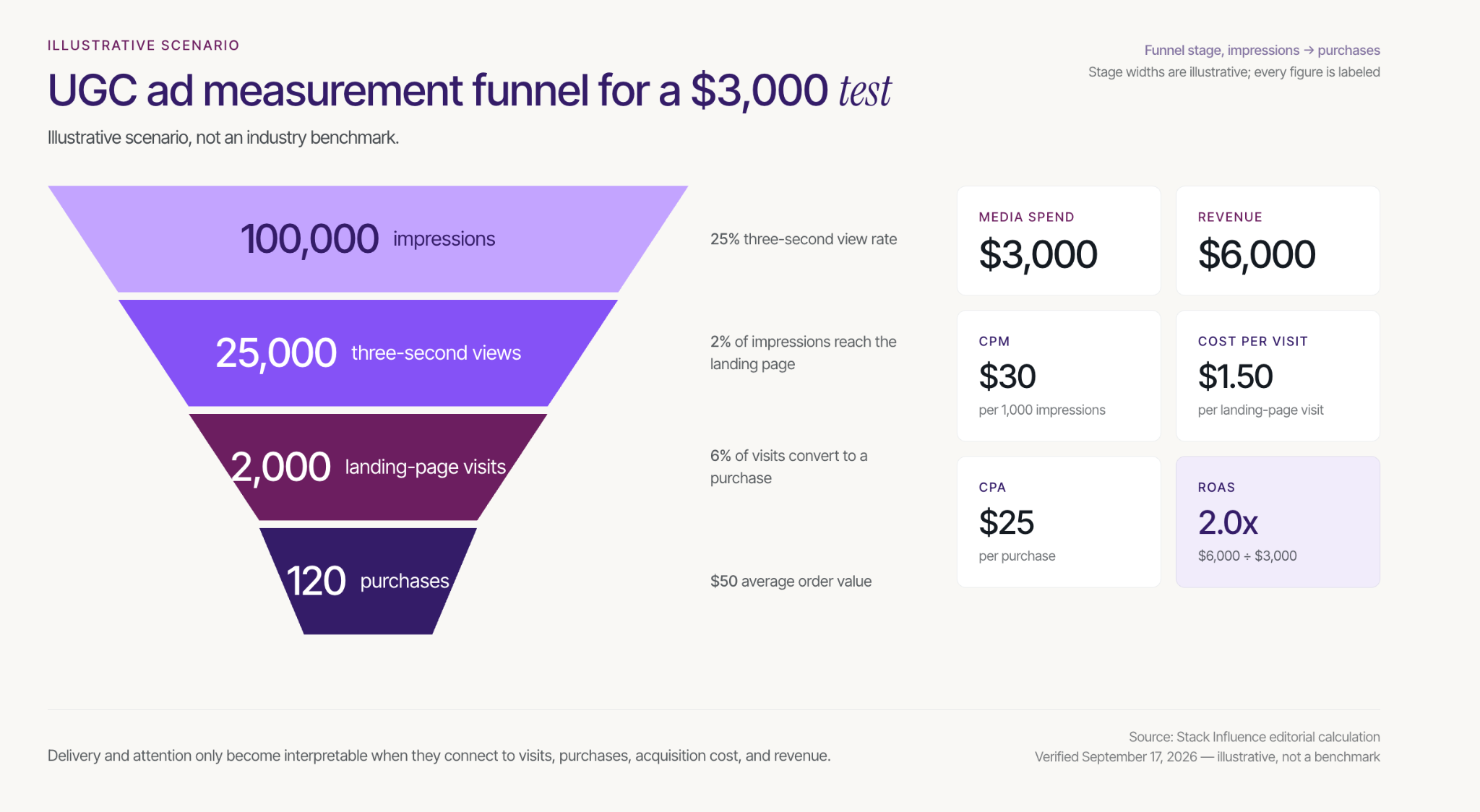
Consider an illustrative $3,000 ecommerce test with 100,000 impressions, 25,000 three-second views, 2,000 landing-page visits, 120 purchases, and $6,000 in revenue at a $50 average order value.
Those assumptions produce:
- A 25% three-second view rate.
- A 2% impression-to-landing-page-visit rate.
- A 6% landing-page-visit-to-purchase rate.
- A $30 cost per thousand impressions.
- A $1.50 cost per landing-page visit.
- A $25 cost per acquisition.
- A 2.0x return on ad spend.
These figures are an illustrative scenario, not an industry benchmark. Their purpose is to show why delivery, attention, intent, and outcome metrics need to be interpreted together.
Meta’s A/B testing guidance recommends comparing versions through a defined test rather than changing multiple variables without control. For UGC ads, the clearest first test is usually one hook against another, one proof sequence against another, or creator identity against brand identity while the surrounding setup remains as stable as practical.
Eligible Amazon advertisers can use Amazon Attribution to measure off-Amazon marketing that sends shoppers to Amazon product pages and Stores. Available reporting includes detail-page views, add-to-cart actions, and sales, and Amazon describes the methodology as a 14-day, last-touch attribution model.
An Amazon influencer marketing workflow can connect creator activation with external traffic and marketplace measurement. Shopify and other DTC brands can use consistent campaign naming, platform reporting, UTMs, and onsite analytics to follow the same matched-metric principle.
Attribution still has limits. A credited sale means the measured touchpoint received credit under the selected platform’s rules. It does not prove that the advertisement independently caused the purchase or that the sale would not have occurred through another path.
Where UGC Ads Usually Break
Most UGC ad failures are operational rather than visual. A creator-style recording cannot compensate for weak product evidence, unclear rights, uncontrolled testing, or a disconnected landing page.
- Cosmetic authenticity: Handheld footage, casual language, and limited production do not make an unsupported claim believable. Specific proof matters more than an intentionally rough appearance.
- Creator-product mismatch: A capable creator can still produce weak content when the product or use case feels unnatural.
- Simultaneous variable changes: Changing the creator, hook, offer, audience, placement, and destination at once makes the result difficult to interpret.
- Rights negotiated after success: Waiting until an asset performs before discussing commercial use can delay scaling or change the economics of the campaign.
- Claim drift: Repeated editing can transform a careful creator observation into a broader product promise that the evidence does not support.
- Landing-page mismatch: An advertisement may generate qualified clicks, but conversion can fall when the destination does not continue the same message.
- No refresh rule: Teams often continue spending on declining creative because they have not defined which performance changes should trigger a replacement.
The corrective principle is simple: authenticity is not the absence of structure. Strong UGC advertising protects the creator’s perspective while controlling the commercial variables needed for compliance, learning, and scale.
Scaling Creator Inputs Without Losing Control
Scaling UGC ads requires more relevant creator inputs and stronger campaign operations, not simply more video editing. Brands need a repeatable way to source creators, coordinate products, communicate requirements, verify completion, organize rights, and move approved assets into paid-media testing.
Some UGC platforms concentrate on asset production. Influencer marketing platforms can also support product seeding, creator partnerships, social posting, communication, and completion tracking. The appropriate workflow depends on whether the team needs isolated content files or a connected creator-activation process.
Stack Influence is built around gifted-first product seeding and campaign execution for ecommerce brands. The workflow supports creator sourcing, vetting, product coordination, campaign communication, completed-post tracking, UGC generation, and Amazon or Shopify campaign activity.
Its UGC production workflow connects briefing, creator participation, content submission, licensing, asset organization, and syndication. This is especially practical when the brand wants to move from individual creator relationships to a repeatable content pipeline.
The paid-media team still needs to choose the test design, budget, advertising account, destination, attribution method, and refresh rules. The operational advantage is having enough organized, permissioned creator content to keep the UGC Ad Control Loop moving.
Build a UGC Ads System, Not a One-Off Video
UGC ads work best when brands and creators treat them as a connected commercial system. Product evidence shapes the concept, clear rights define what can be used, controlled variants create measurable learning, native placements preserve context, and matched metrics determine what should be made next.
For ecommerce sellers, the next step is to identify one important buyer question and build a small creative matrix around it. For content creators, the next step is to define production, paid usage, account authorization, editing rights, and exclusivity before accepting the final brief.
A disciplined UGC ads workflow gives both sides clearer expectations and gives each new creative cycle a stronger foundation than the one before it.