



Black Friday falls on November 27, 2026, followed by Cyber Monday on November 30. For ecommerce sellers and content creators, that makes the real campaign deadline much earlier than the sale itself. Products must arrive, content must be approved, links must work, and audiences must recognize the offer before purchase intent peaks.
A strong black friday influencer marketing 2026 campaign is therefore not a single sponsored post. It is a coordinated system that connects creator selection, product seeding, offer design, content rights, tracking, inventory, and multiple publishing waves. This guide provides a practical 90-day plan for building that system without turning every creator into the same discount script.
Key Takeaways
- Start 90 days out: Lock the offer, economics, creator roles, and priority products before outreach becomes urgent.
- Publish in waves: Use early discovery content, Black Friday conversion content, and Cyber Monday urgency rather than one isolated post.
- Select for shopping fit: Product communication, audience relevance, reliability, and commercial readiness matter more than follower count alone.
- Measure margin, not only clicks: Track delivery, attention, intent, sales, contribution margin, marketplace movement, and reusable content.
- Protect both sides: Creators need clear deliverables, disclosure language, payment terms, approval limits, usage rights, and exact live dates before accepting.
Black Friday 2026 Is a Multi-Wave Commerce Event
Cyber Week demand is spread across several distinct shopping moments. In 2025, Adobe measured U.S. online spending of $6.4 billion on Thanksgiving, $11.8 billion on Black Friday, and $14.25 billion on Cyber Monday. Total Cyber Week spending reached $44.2 billion. Those figures support separate creator waves for discovery, offer launch, weekend reminders, and the final Cyber Monday push rather than concentrating every post on Friday.
Shopping behavior also differs by day and device. The National Retail Federation’s 2025 holiday-weekend survey counted 85.7 million online shoppers on Black Friday and 75.9 million on Cyber Monday, including 46.9 million who shopped on mobile that Monday. Creator landing pages, Amazon listings, discount-code instructions, and checkout flows must therefore work cleanly on a phone.
The opportunity extends beyond one storefront. Shopify reported approximately $14.6 billion in global merchant sales during its 2025 Black Friday Cyber Monday weekend, while TikTok Shop reported more than $500 million in four-day U.S. sales and nearly 10 million creator-affiliate shoppable videos during its campaign. Sellers should design a channel-specific path from content to checkout instead of copying one link and caption everywhere.
What Is Black Friday Influencer Marketing?
Black Friday influencer marketing is a coordinated creator campaign that helps shoppers discover, evaluate, and purchase promoted products around Black Friday and Cyber Monday. It may combine product seeding, sponsored content, affiliate links, live shopping, UGC licensing, brand ambassadors, and paid amplification. The strongest programs connect each creator deliverable to a defined buyer decision.
The distinction between product seeding and an unconditional gift matters. If a creator must publish specific content, meet a deadline, or grant usage rights, those requirements should be stated as a structured product-for-content agreement. The Stack Influence guide to hiring influencers explains how product seeding, paid sponsorships, affiliate partnerships, UGC-only work, and ambassador arrangements solve different campaign jobs.
The Six-Window Black Friday Creator System

The Six-Window Black Friday Creator System starts 90 days before Black Friday and continues through a two-week post-event period. Each window has a separate operational goal, which prevents late shipping, rushed approvals, inactive codes, and duplicate content from colliding during Cyber Week.
Window 1: Offer Economics, August 29 to September 13
Choose the products, discount structure, bundles, inventory limits, target customer, and allowable creator cost before recruiting. A large headline discount is not automatically a strong offer if the product is unfamiliar, the margin disappears after fulfillment, or the promoted SKU is likely to sell out before creator content peaks.
Creators should evaluate the same economics from their side. Before accepting, confirm whether compensation is product-only, flat-fee, affiliate, or blended; whether commission applies before or after discounts; and whether returns, cancellations, or attribution windows affect earnings.
Window 2: Creator Commitments, September 14 to October 4
Build a larger qualified pool than the final number of activations because availability, rates, conflicts, and shipping eligibility will remove candidates. The goal is not to collect names. It is to secure creators who can communicate the product credibly, meet the publishing window, and support the required commerce path.
A 2026 Modash survey of 53 influencer marketers found that planning began in late July on average, plans were finalized by mid-August, and almost all creators were hired by the end of September. It also found that 92.6% had been unable to work with a creator they wanted, with 71.1% of that group citing budget. These are survey findings, not universal benchmarks, but they show why October should be an execution month rather than the first outreach month.
Use past partners where evidence supports the relationship. In the same survey, 81% said fewer than half of their Black Friday collaborations were new relationships. Familiar creators already understand the product and workflow, while new creators can be tested through smaller seeding, affiliate, or UGC assignments before receiving a critical Cyber Week slot.
Window 3: Seeding and Production, October 5 to November 1
Ship products early enough for genuine use, troubleshooting, and reshoots. A beauty product, food item, household tool, or technical accessory may require different testing time, so the production calendar should begin with the experience needed to make an honest recommendation.
Provide a brief with the buyer problem, proof points, prohibited claims, required disclosure, offer details, landing destination, deliverable, due date, approval process, and usage rights. Keep the creative direction specific enough to prevent errors but open enough for the creator’s normal voice and format.
Brands can use a managed product-seeding workflow when individual outreach, shipping coordination, creator follow-up, and completion tracking become the bottleneck. Stack Influence works with roughly 600,000 vetted creators through a gifted-first model and supports creator activation, product seeding, campaign coordination, UGC generation, and completed-post accountability in one ecommerce workflow.
Window 4: Approval and Audience Warming, November 2 to November 15
Complete factual review, disclosure checks, link QA, code testing, captions, subtitles, and alternate assets before the main sales window. Approval should protect accuracy and compliance, not rewrite every creator into the brand’s voice.
Begin publishing non-discount discovery content during this period. Demonstrations, comparisons, routines, gift-recipient ideas, and problem-solution videos give audiences time to understand the product before the price becomes the main message. The broad holiday influencer campaign guide offers additional gift-guide and seasonal content formats that can support this warming stage.
Window 5: Conversion Waves, November 16 to November 30
Assign each creator to a defined wave instead of asking everyone to publish the same message. A practical sequence is:
- Discovery wave, November 16 to 22: Product education, wishlist content, gift guides, comparisons, and problem-solution demonstrations.
- Offer-preview wave, November 23 to 26: Exact sale timing, bundle details, reminders, saved-cart prompts, and early-access instructions.
- Black Friday wave, November 27 to 29: Live offer, product proof, objections, social responses, inventory updates, and retargeting-ready UGC.
- Cyber Monday wave, November 30: Final digital offer, deadline clarity, cart reminders, and a distinct creative angle rather than a recycled Friday caption.
TikTok creators can add live demonstrations or shoppable content where the product and account are eligible. Instagram creators can combine Reels, Stories, link stickers, codes, and commerce-oriented captions. The TikTok influencer qualification guide and Instagram influencer qualification guide explain how to assess product communication, audience evidence, commercial readiness, and reliability on each channel.
Window 6: Reuse and Retention, December 1 to December 14
The campaign is not finished when the discount ends. Collect source files, post URLs, performance screenshots, usage permissions, audience questions, top comments, code data, and creator feedback while the information is still easy to retrieve.
Reuse only the content and placements covered by the agreement. The UGC licensing and usage-rights guide explains why organic reposting, paid advertising, editing, duration, territory, and creator-identity permissions should be treated as separate rights.
Choose Creators for Shopping Fit, Not Follower Size
The most useful Black Friday creator is the one who can move a relevant audience from product problem to purchase decision without creating operational risk. Nano influencers and micro influencers can be particularly practical when the product serves a concentrated interest, needs explanation, benefits from multiple creative variations, or can be seeded economically.
Score creators across five dimensions:
- Audience relevance: The followers match the customer problem, geography, language, interests, and shopping context.
- Content capability: The creator can demonstrate, compare, teach, review, or integrate the product naturally.
- Commercial readiness: Prior brand content uses links, codes, product tags, storefronts, and disclosures clearly.
- Reliability: Communication, shipping details, draft delivery, analytics sharing, and deadlines are handled consistently.
- Portfolio role: The creator is assigned to discovery, conversion, UGC production, live shopping, or affiliate follow-through.
Do not rank every candidate with one blended score. A creator who makes excellent UGC may not have the strongest distribution, while a commerce creator may convert well but offer less visual variety. Assign a role first, then compare creators against the evidence required for that role.
For Amazon sellers, distinguish general social creators from Amazon influencers with storefront or affiliate capabilities. For DTC brands, look for creators who can send shoppers to a focused Shopify landing page rather than a crowded home page. The Shopify influencer marketing playbook provides a broader workflow for codes, creator content, and store-level conversion.
Campaign Formats That Match Buyer Intent
Different Black Friday formats answer different shopper questions. A campaign becomes repetitive when every creator receives the same “sale is live” instruction, so select formats according to the stage of the buyer journey.
- Problem-solution demonstration: Shows what the product changes and why it belongs in the shopper’s life.
- Gift-recipient guide: Connects the product to a specific person, interest, price point, or use case.
- Bundle explanation: Makes the savings and product combination easy to understand.
- Comparison or objection video: Addresses size, setup, ingredients, compatibility, durability, or value.
- Live shopping or Q&A: Lets creators answer objections and demonstrate the product in real time.
- Retargeting-ready UGC video: Produces a concise hook, proof sequence, and call to action that may be licensed for ads.
- Affiliate follow-through: Gives creators a reason to update Stories, links, storefronts, or comments as the deadline approaches.
Build the Offer, Tracking, and Rights Before Publishing
The campaign should pass a Black Friday Readiness Gate before any creator receives a final go-live date. Five approvals are required:
- Commerce approval: Inventory, discount, bundle, shipping cutoff, returns policy, and mobile checkout are ready.
- Creator approval: Deliverables, dates, compensation, revisions, disclosure, and contact paths are documented.
- Tracking approval: Every creator has the correct code, UTM, affiliate link, Amazon Attribution tag, or native shop link.
- Rights approval: Reposting, editing, paid use, creator identity, duration, and territory are explicit.
- Contingency approval: Backup assets, alternative links, out-of-stock language, and escalation contacts are prepared.
Material relationships must be disclosed clearly. The Federal Trade Commission’s influencer guidance says creators who recommend brands need a good disclosure of that relationship. A free product, payment, commission, or other material connection should not be hidden behind vague language or placed where shoppers are unlikely to notice it.
Paid reuse requires an additional permission check. Meta’s official documentation explains that partnership ads can run with creators, brands, or other partners when the relevant permissions are in place. Decide before production whether content may be amplified, because paid usage can affect creative requirements, compensation, and the creator’s approval decision.
How Should Brands Measure Black Friday Influencer ROI?
Brands should measure Black Friday influencer ROI by connecting creator delivery, audience response, shopping intent, net sales, contribution margin, and reusable content. Last-click revenue alone misses creative value and assisted demand, while views alone miss commercial performance. The measurement window and attribution method must be defined before links, codes, or posts go live.
Use the Signal-to-Sale Stack:
- Delivery signals: Contracted creators, products delivered, drafts received, approvals completed, posts live, and source files collected.
- Attention signals: Qualified views, watch time, saves, shares, substantive comments, and live-session participation.
- Intent signals: Link clicks, landing-page sessions, product-detail views, add-to-cart activity, code use, and storefront visits.
- Commerce outcomes: Units, net revenue, new customers, average order value, returns, contribution margin, and marketplace rank movement.
- Reuse value: Licensed assets, paid-media tests, email performance, product-page use, and remaining rights duration.
Amazon sellers can use Amazon Attribution to measure non-Amazon channels including social, video, email, affiliate, and influencer campaigns. Amazon says the free solution reports clicks, product-detail views, add-to-cart activity, purchases, units, product sales, and new-to-brand metrics within a 14-day attribution window. The Stack Influence Amazon marketing guide provides related implementation context.
Shopify sellers should combine creator-specific UTMs, discount codes, affiliate reporting, landing-page analytics, and order data. TikTok Shop campaigns should reconcile creator and shop reporting with net orders and returns. No method captures every assisted exposure, so treat same-period sales growth as an observed outcome, not automatic proof that one creator caused it.
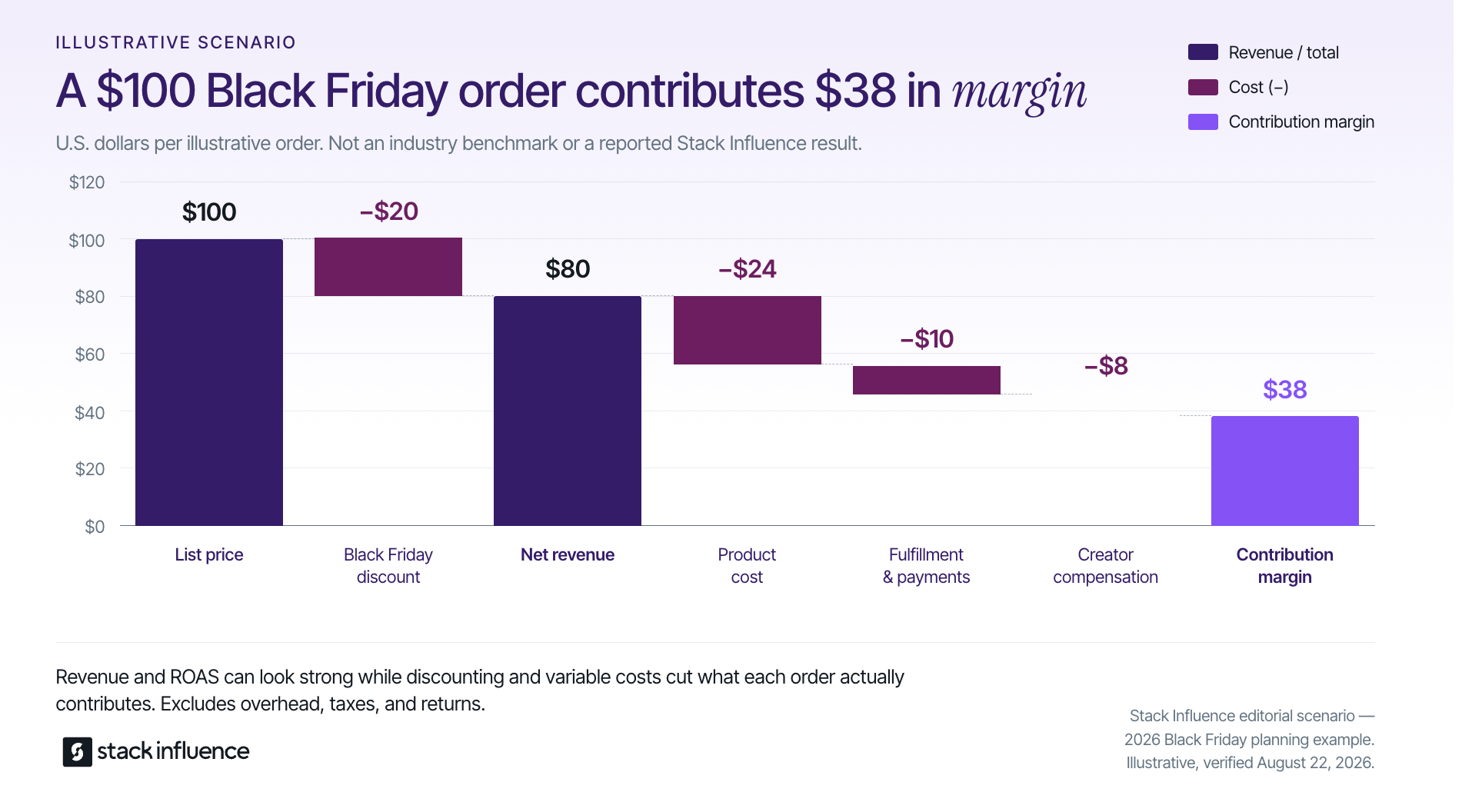
Margin must sit beside revenue. Consider an illustrative $100 list-price order: a $20 Black Friday discount leaves $80 in net revenue. Subtract $24 in product cost, $10 in fulfillment and payment costs, and $8 in allocated creator compensation or commission, and the contribution margin is $38 before overhead, taxes, and returns. A campaign can show attractive revenue or ROAS while producing weak economics if discounting, returns, or creator costs rise.
Marketplace movement may require a longer window than the promotion itself. During a verified three-month Stack Influence campaign for Targus, the campaign included 120 creator promotions, 275,560 social impressions, and 4,323 engagements. Average monthly unit sales were 56 at the start and 221 during the campaign, while Amazon Best Seller Rank moved from #151,547 to #47,811. The example does not predict Black Friday results, but it shows why campaign reporting can connect creator output, attention, sales, and marketplace indicators rather than reducing performance to one metric.
The Hidden Failure Is Operational Mismatch
Black Friday influencer campaigns often fail between otherwise competent teams. The creator publishes on time, but the discount starts later. The link reaches the wrong SKU. Inventory disappears after the first wave.
The brand may expect paid usage that was never licensed, while the creator may expect a commission that the tracking setup cannot verify. These are coordination failures, not audience failures.
Prevent these failures with a preflight test 72 hours before each wave:
- Open every link on a mobile device.
- Enter every code in the live checkout environment.
- Confirm the exact time zone for offer activation and expiration.
- Verify inventory and substitute-product rules.
- Recheck captions, disclosures, tags, and prohibited claims.
- Confirm who can approve emergency edits.
- Preserve the original asset and approved version.
- Document what happens if the item sells out.
A Late-Start Plan for October and November
With four to six weeks remaining:
- Activate past creators and qualified brand ambassadors first.
- Seed one hero product or a simple bundle.
- Separate organic distribution from UGC-only production.
- Approve links, codes, rights, and disclosures before shipping.
- Schedule one warming wave and two conversion waves.
- Reserve backup content for stock, shipping, or creator delays.
With fewer than two weeks remaining, product seeding may not leave enough time for genuine use and reliable shipping. Focus on creators who already own the product, existing affiliates, approved UGC, or content that can be produced without pretending to have experience the creator does not have.
Make Black Friday Influencer Marketing 2026 Useful Before Making It Urgent
Black Friday influencer marketing 2026 will reward teams that create proof before pressure. The discount can accelerate a decision, but the creator still needs to show why the product matters, who it serves, and what makes the offer worth acting on.
For sellers, the next step is to map one hero product through the Six-Window Black Friday Creator System, then confirm creator capacity, inventory, tracking, rights, and contribution margin. For creators, the next step is to evaluate the complete partnership package rather than accepting a deadline and discount code without the operational details.
A managed micro-influencer and product-seeding workflow can help ecommerce teams coordinate creator activation, product logistics, UGC, and completed posts as one campaign. The benefit is not more holiday noise. It is a campaign that reaches Cyber Week with the proof, creative, tracking, and accountability already in place.