




Finding names on TikTok takes minutes. Finding creators who understand your buyer, can produce convincing product content, and will follow through is the real work. For ecommerce sellers and content creators, learning how to find TikTok influencers should lead to a qualified shortlist, not a spreadsheet full of popular accounts.
This guide shows you how to search TikTok, use TikTok One and TikTok Shop Affiliate, evaluate micro influencers and nano influencers, structure outreach, and connect creator partnerships to sales and reusable UGC. The goal is a discovery system that works for one pilot and can still work when the campaign expands.
Key Takeaways
- Start with the campaign job, such as UGC production, audience reach, affiliate sales, or a long-term brand ambassador relationship.
- Combine discovery routes. Direct search offers control, while TikTok One, TikTok Shop Affiliate, and managed platforms reduce activation friction.
- Review a creator’s recent body of work, not one viral post or a follower count.
- Agree on compensation, product logistics, deadlines, disclosures, usage rights, and tracking before anything ships.
- Measure the full path from profiles reviewed to completed content, qualified traffic, sales, and reusable assets.
Start With the Campaign Job, Not the Follower Count
An influencer search works only when the campaign job is defined. In this guide, a TikTok influencer is a creator whose content, audience, or commerce activity can affect product discovery, consideration, or purchase. That can include nano influencers, micro influencers, UGC creators, TikTok Shop affiliates, and larger personalities. This broader definition of TikTok influencer marketing keeps the search tied to the outcome rather than a fixed follower tier.
Choose one primary job before building a shortlist:
- Distribution: Reach a relevant audience through the creator’s account.
- Content production: Generate a UGC video that demonstrates, explains, compares, or contextualizes the product.
- Commerce: Drive trackable TikTok Shop, Shopify, or Amazon actions through affiliate links, codes, or attribution tags.
- Relationship building: Develop repeat creator partnerships, brand ambassadors, or ongoing product-seeding collaborations.
Turn that job into a one-page creator brief. Include the product, target customer, problem being solved, required format, compensation model, geography, deadline, disclosure expectations, content rights, and measurement method. A skincare seller seeking shoppable demonstrations should search differently from a software brand seeking educational reach.
For content creators, the same exercise improves positioning. “Lifestyle creator” gives a brand little to search for. “Budget meal-prep creator for busy parents” connects a topic, audience, and commercial use case.
Where Can You Find TikTok Influencers?
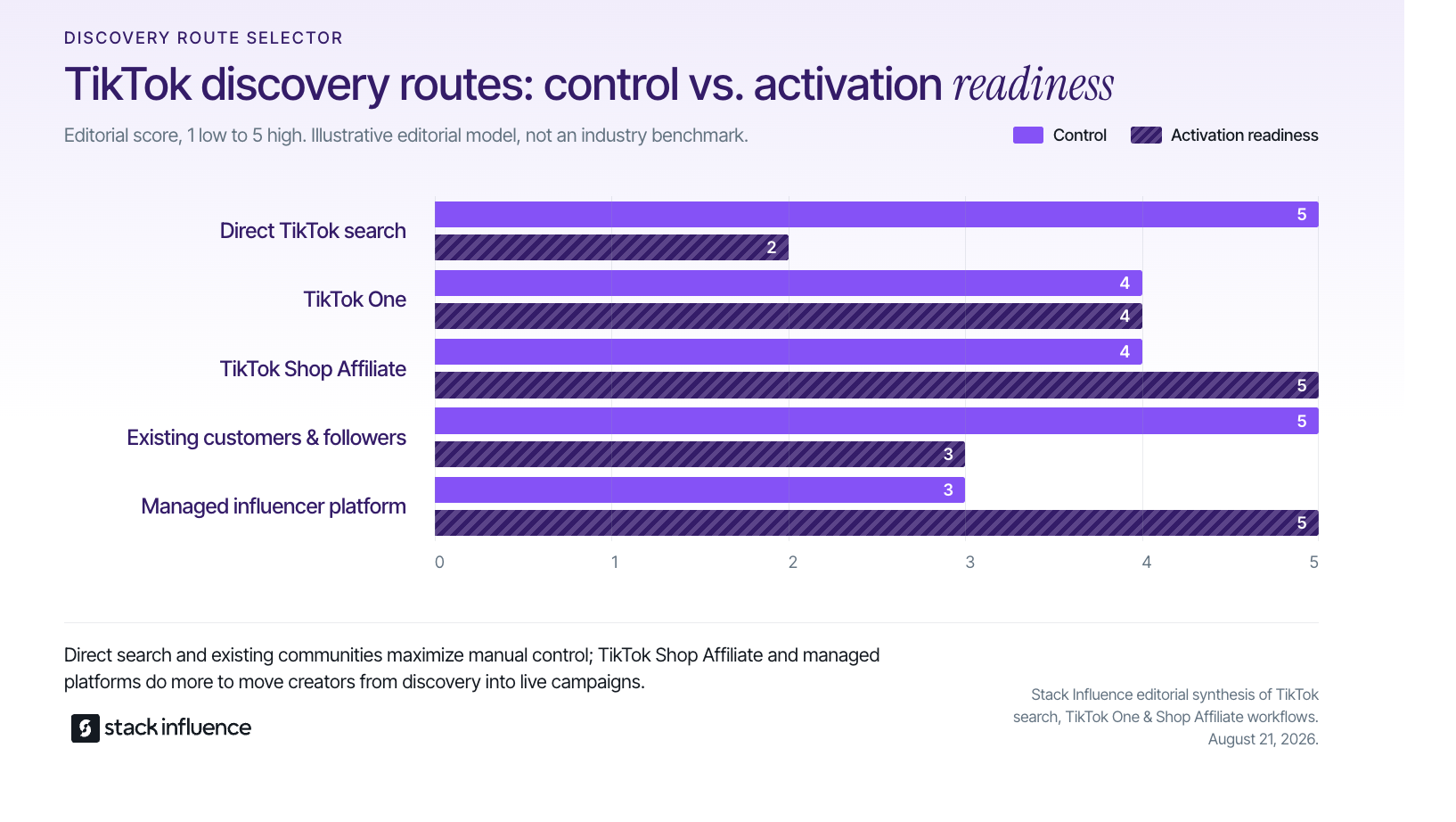
You can find TikTok influencers through direct TikTok search, TikTok One, TikTok Shop Affiliate Center, your existing customer community, and managed influencer marketing platforms. The right route depends on whether you need maximum manual control, commerce-ready creators, faster activation, or end-to-end campaign execution. Most scalable programs combine at least two routes.
Use this editorial 1-to-5 decision model as a planning tool, not an industry benchmark. A higher control score means your team chooses creators more directly. A higher activation-readiness score means the route includes more support for invitations, product collaboration, communication, or completion.
- Direct TikTok search: Control 5 of 5; activation readiness 2 of 5.
- TikTok One: Control 4 of 5; activation readiness 4 of 5.
- TikTok Shop Affiliate: Control 4 of 5; activation readiness 5 of 5 for eligible Shop campaigns.
- Existing customers and followers: Control 5 of 5; activation readiness 3 of 5.
- Managed influencer platform: Control 3 of 5; activation readiness 5 of 5.
Search TikTok Like a Researcher
TikTok’s Discover and Search tools can surface creators, videos, hashtags, sounds, and sponsored content. Search for the content your buyer would watch, not only the label an influencer might use. A TikTok user finder workflow can help when you have a partial username, memorable phrase, product clue, or existing video.
Build queries from four layers:
- Category: “clean beauty creator,” “small-space organization,” or “gaming desk setup.”
- Problem: “how to remove pet hair,” “sensitive scalp routine,” or “meal prep for night shift.”
- Format: “unboxing,” “before and after,” “three-month review,” or “comparison.”
- Commerce intent: “TikTok Shop finds,” “Amazon gadget review,” or “Shopify small business haul.”
Open promising videos, then inspect the creator’s profile, recurring topics, comment section, tagged brands, linked storefronts, and recent posting pattern. Comments often reveal adjacent creators because niche communities interact with one another. Search competitor product names too, but distinguish genuine category expertise from accounts that post any product offered to them.
Use TikTok One for Structured Discovery
TikTok One gives advertisers a structured creator-search workflow. TikTok’s current documentation says brands can search by username or keyword, use AI search when available to selected customers, filter by creator and audience details, and evaluate median video views, engagement, audience demographics, content portfolios, and performance trends. Shortlists can then feed directly into project invitations. TikTok One’s creator discovery documentation is the most reliable place to verify the available filters for your account and region.
TikTok One is practical when a brand needs more evidence than public profile browsing provides. It also reduces the handoff between discovery and invitation, although the final decision should still include a manual content review.
Use TikTok Shop Affiliate for Commerce-Ready Creators
TikTok Shop sellers can use Affiliate Center to find creators and choose between Open Collaboration and Target Collaboration. Open Collaboration makes selected products visible to a broader creator pool, while Target Collaboration lets a seller invite specific creators to promote specific products. TikTok’s affiliate collaboration guide also supports creator filtering, invitations, product selection, samples, and performance tracking.
Use Open Collaboration to discover unexpected creator-product matches, then move proven creators into targeted offers. Use Target Collaboration when the product needs a precise message, launch date, audience, or content style.
Mine Existing Affinity Before Buying More Discovery
Review customers, email subscribers, tagged videos, brand mentions, affiliate applicants, and followers. A smaller creator who already understands the product may require less education and produce more credible content than a larger account with no connection to the category.
Ask customer support and community teams for names. They often know which customers publish tutorials, answer questions, or recommend the brand without being prompted. Existing affinity is not proof of campaign fit, but it is a strong lead source.
Use a Managed Platform When Execution Is the Bottleneck
A creator database helps a team research profiles. A managed platform supports the work after discovery, including activation, product seeding, communication, content tracking, and completion. Stack Influence’s TikTok influencer solutions are built around vetted creator participation and managed ecommerce campaign execution.
Stack Influence works with roughly 600,000 vetted creators through a gifted-first product-seeding model. Its completions-only structure is designed so brands pay for completed creator posts rather than treating every shipped product as a completed campaign result.
The 12-Post Creator Review
The 12-Post Creator Review is a fast evidence framework for moving a creator from “interesting” to “qualified.” Review the creator’s 12 most recent non-pinned posts so one viral outlier, one sponsored video, or one inactive period does not control the decision. Twelve is an editorial starting point, not a universal platform benchmark.
Evaluate six signals:
- Topic repetition: At least 6 of the 12 posts should address the target category, customer problem, or a credible adjacent interest.
- Product communication: Look for at least 3 posts that demonstrate, compare, explain, test, or integrate a product naturally.
- Attention stability: Record views across all 12 posts and use the median as the baseline. Keep the highest-viewed post separate so one breakout result does not inflate expectations.
- Audience evidence: Read substantive comments for questions, personal context, product interest, and creator replies. Generic emoji clusters provide less evidence than real discussion.
- Commercial readiness: Check disclosure habits, public contact information, affiliate or Shop experience, prior brand work, and whether sponsored content still sounds like the creator.
- Operational fit: Confirm recent activity, content quality, response path, geography, language, brand safety, and the ability to meet the proposed format and timeline.
The micro-influencer recruitment and vetting guide expands the audience and reliability checks, while the guide to fake engagement on TikTok covers suspicious follower and interaction patterns.
Do not treat follower count as the final score. Followers can indicate potential distribution, but the 12-post evidence shows whether the creator can repeatedly make relevant content, hold attention, discuss products credibly, and support the campaign’s actual job.
How Do You Contact and Activate the Creators You Find?

Contact a TikTok influencer with a concise offer that explains why the creator fits, what the product is, what content or outcome is requested, how compensation works, and when the project runs. Include product logistics, disclosure rules, usage rights, approval boundaries, and tracking before the creator accepts so both sides can evaluate the same opportunity.
A practical first message contains six elements:
- One specific reason you selected the creator.
- The product and customer problem.
- The requested deliverable and platform.
- Compensation, gifting, or commission terms.
- Timing, approval, disclosure, and content-rights requirements.
- One clear next step.
The influencer outreach guide provides a fuller brand-and-creator workflow. For creators pitching brands, the same structure works in reverse: name the audience, propose a concrete video idea, show relevant proof, state the deliverable, and make the reply easy.
Treat influencer seeding as an operational process rather than “send and hope.” TikTok Shop’s current sample rules say sellers should review free-sample requests within 7 days, ship within 7 days after approval, and expect free-sample creators to post within 14 days of delivery. Those platform-defined windows total 28 days, excluding carrier transit.
Disclosures are part of activation, not a cleanup step. The FTC says a free or discounted product is a material connection that should be disclosed, and TikTok requires creators promoting a brand, product, or service to use its commercial content disclosure setting. Review the FTC’s influencer disclosure guidance and TikTok’s commercial content disclosure requirements before publishing.
Separate posting permission from reuse rights. State whether the brand may repost, edit, use the content in paid ads, request raw files, or use the asset on product pages, and define the permitted duration.
Measure the Search-to-Sales Chain
Measure influencer discovery from the first profile reviewed through the business outcome. A large creator list is not success if few creators qualify, accept, complete content, or generate useful audience and commerce signals.
Track the chain in six layers:
- Discovery: Profiles reviewed, relevant profiles found, and search yield by query or source.
- Qualification: Shortlist rate and the reasons candidates fail the 12-Post Creator Review.
- Activation: Invitations, replies, acceptances, samples approved, products delivered, and posts completed.
- Content: Median views, watch time, completion, saves, shares, comments, product clarity, and usable UGC.
- Commerce: Product clicks, add-to-cart activity, orders, GMV, conversion rate, and contribution margin.
- Asset value: Content approved for reuse, placements created, paid-media tests, and the performance of reused assets.
Match tracking to the storefront. Shopify Collabs can support creator invitations, gifts, discount codes, affiliate links, sales tracking, and payments. Amazon sellers can use Amazon Attribution to measure how non-Amazon channels, including social and influencer campaigns, affect activity on Amazon. DTC teams can add campaign parameters through Google Analytics URL builders so traffic-acquisition reporting distinguishes creators, campaigns, and content.
Attribution still has blind spots. A shopper may watch a creator, search the brand later, switch devices, buy through another link, or purchase after a code expires. Use channel data, storefront movement, content performance, and contribution economics together. Treat correlated improvement as evidence to investigate, not automatic proof that one post caused every sale.
A Creator List Is Not a Campaign
Most guides about how to find TikTok influencers stop when the shortlist is built. That is where the operational work begins. Every candidate needs an owner, contact path, offer, response status, product status, deadline, disclosure check, rights record, tracking method, and completion result.
This distinction explains why creator databases and managed campaign platforms solve different problems. A database expands research and manual choice. A managed workflow connects creator activation, product seeding, communication, UGC generation, and completed-post accountability.
The corrective insight is simple: optimize for qualified completions, not names collected. A smaller list that reliably produces useful content can create more value than a large database export that never reaches an accepted brief.
How Can Content Creators Become Easier for Brands to Find?
Content creators become easier for brands to find by making their niche, audience, recent performance, commercial experience, and contact path obvious. TikTok One says advertisers can filter and evaluate creators using details such as country, industry, language, follower count, audience characteristics, median video views, engagement, and recent content. Creators should make those signals consistent and current.
TikTok’s brand-discovery guidance for creators provides a useful view of what advertisers inspect.
Improve findability with five actions:
- Clarify the niche: Use specific topic and audience language in the bio, captions, spoken hooks, and recurring series.
- Pin proof: Pin one strong niche video, one product-friendly example, and one post that demonstrates audience interaction.
- Create repeatable topic clusters: Brands need evidence that a subject is part of the channel, not a one-time experiment.
- Show commercial readiness: Add a current contact method, location or market when relevant, disclosure habits, and a clear portfolio.
- Report the right metrics: Track median views, watch time, saves, shares, audience geography, and examples of completed partnerships.
The guide on how to find your niche as an influencer can help turn a broad creator identity into a searchable content promise.
Turn Creator Discovery Into a Repeatable System
Learning how to find TikTok influencers means connecting search, evidence, activation, and measurement. Start with one campaign job, search through at least two routes, apply the 12-Post Creator Review, and pilot with creators whose content and operating habits support the same goal.
For ecommerce sellers, the next step is to decide whether the bottleneck is discovery, vetting, outreach, product seeding, or completion. For content creators, the next step is to make your niche and commercial proof easier to evaluate. Stack Influence can support brands that want vetted creator activation, gifted-first product seeding, UGC generation, and completed-post accountability managed through one workflow.