




Finding a TikTok account becomes difficult when the display name is common, the username changed, or the only clue is a video, sound, topic, or screenshot. Content creators face an even broader task: locating collaborators, researching UGC creators, finding brands, and making their own profiles easier to discover.
A useful TikTok user finder is not a secret lookup box. It is a sequence that starts with the strongest public clue, adds context, verifies the result, and respects privacy. This guide explains that sequence and shows how to turn creator discovery into partnerships, brand deals, and a more searchable TikTok presence.
Key Takeaways
- Start with a direct identifier: An exact @username, profile URL, or QR code is usually faster and more reliable than a name-only search.
- Use a search ladder: Move from direct identifiers to relationships, content clues, web search, and creator platforms only as needed.
- Verify several public signals: Match the bio, recent videos, niche, linked pages, and posting style before assuming an account is correct.
- Respect privacy controls: Legitimate finders surface public or permission-based information. They do not unlock private profiles.
- Become easier to find: A clear niche, consistent topic language, stable username, and visible portfolio can attract creator partnerships and brand opportunities.
What Is a TikTok User Finder?
A TikTok user finder is a method or tool used to locate a TikTok profile from available clues. Those clues may include an @username, display name, profile link, QR code, mutual connection, video topic, hashtag, sound, screenshot, or public business detail. Safe finders use public information or data shared with permission.
TikTok profiles include several identifiers:
- Username: The unique @handle used in search, tags, and the profile URL.
- Nickname: The display name visible across TikTok. Different accounts can use the same or similar nicknames.
- Profile URL: The direct web address connected to the current username.
- User ID: A technical identifier used by some developer or analytics tools. Most creators do not need it for normal discovery or outreach.
Prioritize the username and profile URL when locating a known account. TikTok allows a username change once every 30 days, and the profile link changes with it, so an old handle may stop leading to the expected account. TikTok explains the distinction in its official username guidance.
Use the TikTok Finder Ladder

The TikTok Finder Ladder is a five-level framework for choosing the fastest and least invasive search method. Begin with the strongest available clue, then move down only when the earlier level fails. The ladder reduces wasted scrolling and lowers the chance of confusing a similar-looking profile with the correct creator.
Level 1: Direct Identifiers
Search an exact @username, open a direct profile URL, or scan a creator's QR code. TikTok's Discover and Search documentation says search can surface people, posts, sounds, hashtags, and other content, with filters that help narrow results.
Use this order:
- Search the handle with and without the @ symbol.
- Switch from Top results to Users or Accounts.
- Open the direct profile URL when available.
- Ask for a QR code when you are already in contact.
Level 2: Relationship Signals
Use contacts, mutual connections, shared links, and existing followers when you know the person and have a legitimate reason to connect. These clues can help when a creator uses a nickname or recently changed usernames.
TikTok may suggest accounts through synced contacts, mutual connections, followers, and shared links. Users can disable these settings and remove previously synced contact data, so review TikTok's suggested-account controls before uploading an address book.
Level 3: Content Signals
Search for what the creator makes, not only who you think they are. Combine a niche, format, product, location, or memorable phrase:
- budget meal prep creator
- Boston thrift fashion
- sensitive skin empties
- small apartment organization
- UGC creator pet products
Check videos, users, sounds, hashtags, mentions, Duets, Stitches, and recurring collaborators. A distinctive caption fragment or spoken phrase can be more useful than a common display name.
Level 4: External Verification
Use a web search when TikTok results are too broad or an old handle may still appear on indexed pages. Google supports quotation marks for exact phrases and the site: operator for domain-restricted searches in its search-refinement guidance.
Try searches such as:
- "@oldusername" TikTok
- "creator display name" site:tiktok.com
- "memorable caption phrase" TikTok
- "brand name" "UGC creator" TikTok
Treat each result as a lead. Verify the current bio, recent posts, linked website, and other public profiles before contacting the account.
Level 5: Collaboration Systems
Use creator marketplaces, influencer marketing platforms, or managed networks when the goal is finding qualified partners rather than one known account. These systems may support campaign briefs, niche matching, applications, creator vetting, outreach, approvals, and completion tracking.
In May 2026, TikTok announced Creator AI Search inside TikTok One. The system interprets campaign briefs and analyzes profiles to recommend relevant creators, reflecting a shift from handle-based lookup toward context-based matching.
How Do You Find a TikTok User by Username or Name?
To find a TikTok user by username or name, search the exact handle first, filter for accounts, and verify the result through its bio, recent videos, posting style, and linked pages. When you only know a display name, add a niche, city, profession, brand, school, or public content topic to reduce ambiguity.
Use this sequence:
- Check spelling, periods, underscores, and number substitutions.
- Compare the profile photo, bio, niche, and recent subjects.
- Open linked Instagram, YouTube, website, or portfolio pages.
- Search an old handle on the web when the account may have been renamed.
Do not rely on follower count as the identity test. Impersonators, fan pages, inactive profiles, and similarly named creators can all create false confidence. Save the confirmed profile URL and note why the account matters, especially when building a collaboration shortlist.
How Can You Find Someone Without Their Username?
You can find someone without a username through a QR code, permission-based contact matching, mutual connections, public content clues, linked profiles, or a screenshot of a public post. Choose the method that fits the clue you already possess. None of these approaches should bypass a private account or reveal information the person did not publish.
Ask for a QR Code
A QR code is the cleanest method when you can contact the person directly. TikTok lets users share profiles and display personal QR codes, which is useful at events, classes, brand activations, and creator meetups. Its sharing instructions explain how profiles and content can be shared.
Use Contacts With Consent
Contact matching may suggest an account when synced information and both users' discovery settings allow it. It is not a universal reverse phone or email lookup.
Only sync contacts when you are comfortable sharing address-book data with TikTok. The platform allows users to stop syncing and remove prior contact data. TikTok also applies more restrictive default discovery settings to users ages 13 to 17, as explained in its teen privacy guidance.
Reconstruct the Public Content Trail
Search a distinctive spoken phrase, caption, product, event, recipe, location, hashtag, or sound. Review your likes, favorites, watch history, messages, and shared links when available. Then follow tags, mentions, Duets, and Stitches around the remembered post.
Use a Screenshot as a Source Clue
Google Lens can search an uploaded screenshot and return similar images or webpages containing related imagery, according to Google's image-search documentation. Use this to locate the original public post, product, event, or webpage, not to identify a private person.
A visual similarity result is not proof of identity. NIST's face-recognition evaluation documents false-positive matches and demographic differences, so face-based finder claims require caution and independent verification.
How Do Content Creators Find Niche Accounts and Collaboration Partners?
Content creators find stronger collaborators by searching narrow topic clusters, following content relationships, and qualifying accounts for relevance rather than popularity alone. Start with a specific audience problem or format, then explore hashtags, sounds, mentions, Duets, Stitches, and recurring community interactions. The result should be a focused shortlist, not a giant directory.
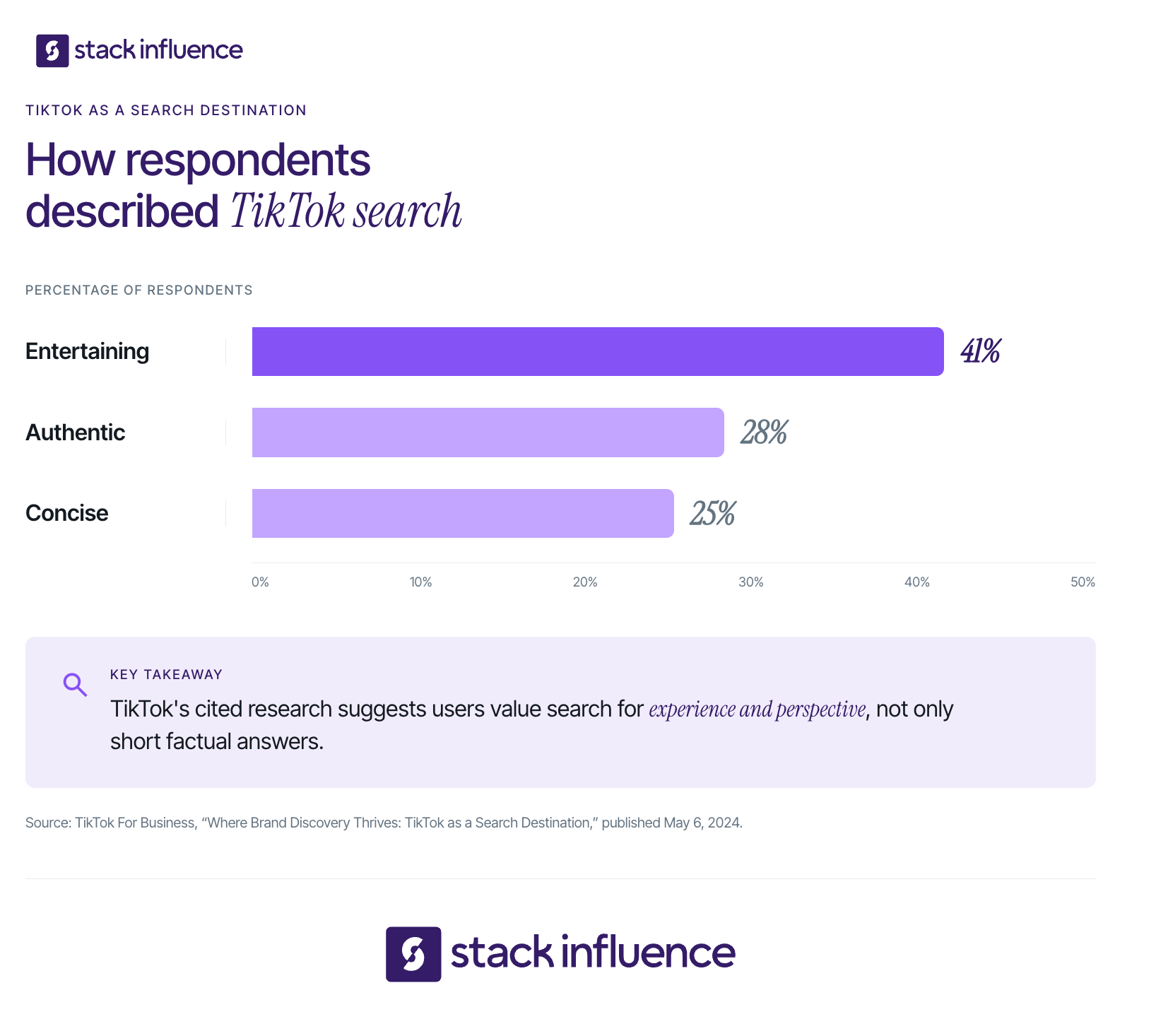
According to TikTok's 2025 search report, the platform handles billions of searches each day and search volume increased 40 percent year over year. Separate TikTok research found that respondents described TikTok search as entertaining (41 percent), authentic (28 percent), and concise (25 percent). These are platform-reported findings, not guaranteed creator outcomes.
Choose three to five topic clusters that reflect your real niche. A fitness creator might search beginner apartment workouts, mobility for desk workers, and budget home gym reviews instead of fitness influencer.
For each cluster:
- Review 20 to 30 relevant posts and accounts.
- Save creators who cover the topic repeatedly.
- Note common audience questions, formats, brands, and phrases.
- Identify a complementary skill or concrete collaboration idea.
- Record the public contact path and last active date.
TikTok's Creator Search Insights can surface topics people search for. Pair that research with Stack Influence's guide to TikTok search and creator discoverability and its content creator guide to TikTok marketing.
The 5-Check Creator Match Filter
Finding a profile is only the beginning. Use the 5-Check Creator Match Filter before following, pitching, collaborating with, or recommending an account:
- Niche relevance: The creator repeatedly covers the target subject, audience, or product category.
- Recent activity: The account has published meaningful content recently.
- Content consistency: Several posts demonstrate a recognizable voice, format, and quality level.
- Interaction quality: Comments show real questions, discussion, and shared interests rather than only generic reactions.
- Collaboration readiness: A public contact path, portfolio, partnership example, or stated invitation is available.
Do not dismiss nano influencers or micro influencers because their audiences are smaller. A focused creator may be more relevant than a larger general-interest profile. Stack Influence's article on how micro-influencers earn brand deals explains the value of niche clarity, while its UGC creator definition distinguishes content production from audience distribution.
What Most TikTok User Finder Tools Get Wrong
Many TikTok user finder tools confuse access with accuracy. They promise private accounts, exact locations, hidden contact details, or identity matches from a face, although more data does not guarantee a current or correct result. The safest approach is to separate profile lookup, creator discovery, and identity lookup because each solves a different problem.
- Profile lookup tools return public account details from a known username.
- Creator discovery tools search public creators by niche, content, activity, or campaign fit.
- Identity lookup tools attempt to connect a person, face, phone number, email, or alternate account across services.
The first two categories can support legitimate research when their methods are transparent. Identity lookup carries greater privacy and misidentification risk. Never treat a facial or cross-platform suggestion as confirmed identity.
Do not enter a TikTok password, verification code, or recovery information into a finder. Avoid tools that require unexplained downloads, claim to unlock private posts, or advertise unverifiable accuracy. Use the least invasive signal that answers the question: a handle for identity, a niche query for collaboration, and a creator platform for campaign execution.
Turn Discovery Into Brand Deals and Creator Partnerships
Account discovery becomes commercially useful when it leads to a respectful next step. For content creators, that may be a peer collaboration, UGC project, product-seeding opportunity, affiliate relationship, brand ambassador program, or paid sponsorship.
The IAB 2025 Creator Economy report expects U.S. creator advertising spend to reach $44 billion in 2026 and identifies finding the right creators as brands' leading challenge. For brands looking for influencers, a specific, searchable profile can therefore be more valuable than a vague account with a larger but unfocused audience.
Make your own profile easier to find:
- Keep the username stable and easy to spell.
- State the niche and audience benefit in the nickname or bio.
- Use consistent topic language in captions, spoken audio, and on-screen text.
- Pin posts that demonstrate your strongest format.
- Link a current portfolio or media kit.
- Name the formats you accept, such as UGC video, tutorials, reviews, or affiliate content.
Approach a relevant creator or brand with context:
Hi [Name], I found your work while researching [specific topic]. I create [format] for [audience], and I have an idea for [concrete collaboration]. Here is a relevant example: [portfolio link]. Would you be open to discussing it?
Before pitching, review Stack Influence's guides to getting brand deals on TikTok and Instagram, building a UGC portfolio, and planning UGC marketing work.
Stack Influence supports creator activation by connecting ecommerce brands with roughly 600,000 vetted creators through gifted-first product seeding and completed-post accountability. Creators can review the current workflow through the Stack Influence creator community.
When a brand pays you, gives you a free product, offers a discount, or provides another benefit for coverage, disclose the relationship clearly. The FTC says material connections include financial relationships and free or discounted products, and creators are responsible for obvious disclosure. Review its social media influencer disclosure guidance.
How Should You Measure a TikTok User Finder Workflow?
Measure a TikTok user finder workflow from discovery through collaboration, not by the raw number of profiles collected. Track relevant accounts found, qualification rate, outreach responses, completed partnerships, and the content or business outcome connected to each project. This distinguishes productive research from a spreadsheet that never creates a useful relationship.
Use the Discovery-to-Collaboration Metric Stack:
- Search yield: Relevant accounts found per query or topic cluster.
- Qualification rate: Shortlisted accounts divided by profiles reviewed.
- Response rate: Meaningful replies divided by personalized messages sent.
- Completion rate: Completed projects divided by accepted collaboration discussions.
- Outcome quality: Watch time, saves, profile visits, referral traffic, asset reuse, sales, or audience growth tied to the goal.
Search yield and qualification rate are leading indicators. Response and completion test positioning and outreach. Content and business results are lagging indicators.
Review outreach after 14 days, then assess published content at 7 and 30 days. Use trackable links, discount codes, or a brand's attribution system when relevant. Attribution remains imperfect because a viewer may discover a creator in one place and act through another, so treat correlated movement as evidence to investigate rather than proof of causation.
A Better TikTok User Finder Starts With Context
The right TikTok user finder depends on the job. Use an exact username, URL, or QR code for a known account. Use public content clues and web search when the handle is missing. Use creator discovery systems when the goal is building partnerships or influencer campaigns.
For content creators, the larger advantage is becoming findable. Clarify your niche, publish around consistent topic clusters, maintain a current portfolio, and approach relevant accounts with a specific idea. Start by auditing your username, bio, pinned posts, and portfolio, then build a five-account collaboration shortlist. That turns TikTok search into a repeatable path toward stronger creator partnerships, brand deals, and useful UGC opportunities.