




A creator shows your travel bag. Shoppers buy the bag. The matching packing set never appears, so it never becomes part of the purchase decision.
That is the difference between promoting a product and helping someone build a more useful basket. Learning how to increase Shopify average order value with influencers starts before outreach: choose an additional purchase worth explaining, give creators a credible demonstration, and make the same combination easy to buy.
For ecommerce sellers, this guide connects those decisions to Shopify bundles, creator briefs, shipping thresholds, attribution, and a measurement test that checks whether bigger orders actually improve the business.
Key Takeaways
- Brief creators around a useful product combination or upgrade rather than relying on a storewide discount.
- Send shoppers to the exact products demonstrated, with clear pricing, available variants, and a straightforward buying path.
- Evaluate average order value alongside conversion, contribution per session, and returns.
- Separate product-seeding purchases from audience purchases before judging campaign-driven basket growth.
Start With the Basket-First Creator Brief
To increase Shopify average order value with influencers, decide what should change inside the order before deciding who should promote it. A creator needs a reason to recommend the additional item, not simply an instruction to mention more products.
Use a Basket-First Creator Brief with five connected decisions:
- Basket: Identify the main product and one complementary item, multipack, or premium alternative.
- Explanation: Specify the practical benefit that makes the larger purchase worthwhile.
- Destination: Choose the Shopify page where shoppers can buy the demonstrated combination.
- Guardrail: Set the minimum acceptable contribution after discounts, fulfillment, and creator compensation.
- Comparison: Define which existing offer or page experience the new approach will be tested against.
For a travel bag, the extra purchase might be packing cubes that fit its compartments. The creator can demonstrate how the combination organizes a weekend's belongings rather than presenting two disconnected product endorsements.
Operational records matter from the beginning. Stack Influence's Shopify creator workflow describes creators purchasing through the store before promoting products. Tag those campaign-participation orders separately so they do not become apparent evidence that ordinary shoppers chose larger baskets.
The brief should therefore produce two distinct outputs: completed creator content and a testable audience-shopping experience. One does not prove the other succeeded.
What Should Your AOV Baseline Include?
Your baseline should use a consistent revenue definition and a comparable group of orders. Start with the relevant product category, sales channel, currency, and new-versus-returning customer segment rather than the storewide average alone.
According to Shopify's sales-report definitions, average order value is gross sales minus discounts, divided by orders, excluding post-order adjustments. That sales-report definition reflects product revenue when the order was placed, not shipping, taxes, or later edits, exchanges, and returns.
AOV = (gross product sales minus discounts, excluding post-order adjustments) ÷ orders
For a campaign evaluation, also build a clearly labeled view of genuine paid audience orders. Exclude test, unpaid, canceled, and reimbursed creator-participation orders consistently; this filtered view may differ from Shopify's default report.
Do not average individual creators' AOVs equally when their order counts differ. Add their qualifying revenue and divide by their combined qualifying orders. Deduplicate exports by order ID rather than treating every product row as another order.
An Illustrative Basket Calculation
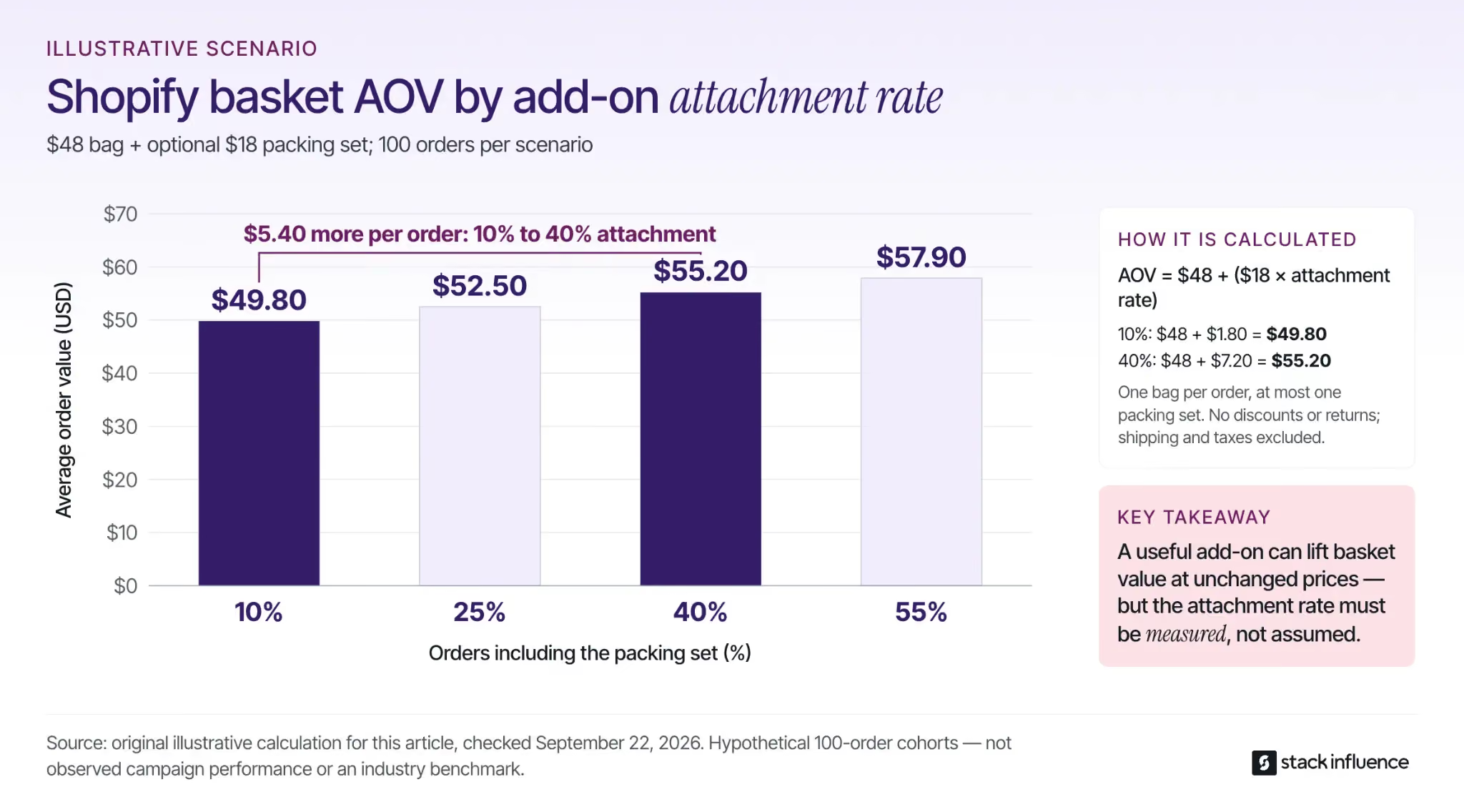
Assume 100 genuine customer orders, each containing one $48 travel bag. Some customers also buy one $18 packing set, with no other products, discounts, returns, or order adjustments; shipping and taxes are excluded.
At a 10% add-on attachment rate, AOV is $49.80. At 25%, it is $52.50; at 40%, it is $55.20; and at 55%, it is $57.90.
The calculation is 48+(18 × attachment rate). Moving from 10% to 40% attachment adds $5.40 per order without changing either product's price.
These are illustrative scenarios, not observed campaign results. They show why the relevant creator question is whether more buyers choose the useful addition, not whether the post generates more likes.
Choose the Purchase Behavior You Want to Change
Choose one basket-building mechanism for the first test. Combining an upgrade, a bundle discount, a free gift, and a shipping offer at once makes the result difficult to interpret.
Complementary Products
A cross-sell adds something useful to the original purchase. Ask the creator to demonstrate the relationship: packing cubes fitting inside the bag, refill tablets working with the dispenser, or replacement pages fitting the notebook.
Baymard's research on cart cross-sells recommends prioritizing relevant supplementary products over alternatives near checkout. The practical distinction is important: an add-on completes the purchase, while a competing substitute can reopen a decision the shopper already made.
Show the extra item's purpose and compatibility. Do not describe an optional accessory as essential unless it genuinely is.
Bundles and Multipacks
A bundle combines different products into one offer; a multipack groups quantities of the same product. Creators can explain either through a concrete use case, such as one organizing set for a work bag and another for a weekend bag.
Lead with usefulness before savings. A multipack should make sense for the customer's expected usage, while a bundle should solve a coherent problem rather than clear unrelated inventory.
Watch later buying behavior as well. Buying several units today may move a future purchase forward rather than increase total customer spending over time.
Premium Upgrades
An upsell replaces the original choice with a higher-priced option. The creator's job is to demonstrate the difference that justifies the additional price, such as extra capacity, included components, or a verified functional feature.
Keep the entry-level option available and explain who needs the upgrade. A higher AOV is not useful when a confusing comparison drives suitable customers away.
Recruit Creators Who Can Explain the Second Purchase
Select micro influencers and nano influencers for their ability to demonstrate the product combination to an appropriate audience. Follower count alone does not show whether someone can make the additional purchase understandable.
Review relevant tutorials, product comparisons, and audience questions. Look for evidence that the creator explains details such as fit, compatibility, packing, assembly, or everyday use rather than simply displaying products.
Build this selection into the wider Shopify influencer marketing program, but give the AOV campaign its own brief and success criteria.
Give Creators the Products Needed for the Demonstration
A creator cannot reliably demonstrate a combination when only the main product arrives. Confirm the exact items, variants, delivery timing, and agreed content format before production begins.
For teams coordinating multiple product-seeding collaborations, Stack Influence's gifted-first, completions-only model provides accountability for completed creator posts. Keep that delivery measure separate from the audience's attachment rate and order value.
An example brief could read: “Show the bag packed for a weekend, demonstrate how the packing set fits, explain what each item contributes, and direct viewers to the matching product offer.” Leave room for the creator's genuine experience rather than scripting praise.
Agree on Disclosure and Reuse
The FTC's influencer disclosure guidance covers material relationships involving payment, free products, and other benefits. Disclosures should be clear and placed with the endorsement; video disclosures belong in the video, not only in its description.
Also agree on website use, advertising use, editing permissions, duration, and asset delivery. When repurposing UGC across platforms, preserve the demonstration, qualifications, and disclosure context rather than turning the creator's experience into a stronger claim.
Build the Shopify Buying Path Before the Post Goes Live
Send shoppers to a page that fulfills the creator's recommendation. A video explaining a two-product setup should not leave visitors searching the entire catalog for the second item.
Make the Demonstrated Basket Easy to Buy
Shopify Bundles supports fixed product bundles and multipacks. Create the intended offer, verify its component variants and availability, set the price, and test the complete purchase before distributing creator links.
Keep the offer understandable without watching the video. State what is included, what remains optional, the total product price, and any relevant compatibility restrictions.
For individually purchased add-ons, Shopify Search & Discovery's complementary product recommendations can display selected products on compatible product-page templates. Shopify requires complementary items to be active and in stock, so check availability before a creator sends traffic.
Place licensed creator content beside the buying decision it supports. Use the Shopify theme evaluation guide to check product selectors, media display, and mobile interactions before introducing extra page complexity.
Keep Shipping Thresholds Consistent With Creator Offers
Choose a free-shipping threshold from the actual basket, shipping costs, and margin, not an arbitrary percentage above storewide AOV.
Shopify's free-shipping discount documentation explains that minimum-purchase eligibility uses product prices after applicable combinable discounts. Taxes do not count toward that minimum.
For example, the $48 bag and $18 packing set total $66. With a $65 threshold, that basket qualifies before a discount, but a combinable 10% product discount lowers it to $59.40 and leaves it below the threshold.
A creator promising both the discount and free shipping would therefore describe an offer the shopper cannot receive under those settings. Fix the offer or the message before publication.
Review Shopify's discount-combination rules, then test the bundle promotion, creator code, welcome offer, and shipping incentive together. Standard combinations require the relevant settings on each discount to permit the combination.
Finally, calculate whether the addition pays for its own product cost, extra handling, shipping subsidy, payment fees, and any commission. More items can increase revenue while leaving less contribution.
Measure Basket Lift Separately From Attribution
Use attribution to identify recorded shopping paths, then use a controlled comparison to evaluate the intervention. A creator code appearing on a large order does not establish that the creator caused the order to become larger.
Connect Posts to Orders Without Double Counting
Google Analytics campaign parameters identify referring campaigns and distinguish creative variants. For an unboosted social post, one naming approach is utm_source=instagram, utm_medium=social, utm_campaign=packing_pair, and utm_content=creator07_demo_a.
Keep paid amplification separately labeled. Record the creator, post, destination, offer, and publication date in the same campaign register, then connect available order records to those identifiers.
Treat discount-code redemptions as another signal, not a second batch of revenue to add to UTM-attributed sales. Codes can travel beyond the original audience, and clicks do not capture every later or cross-device purchase.
Shopify's marketing-performance documentation distinguishes AOV, conversion, attributed sales, and new-versus-returning customers. Keep those definitions visible in the report, because changing the customer mix can change AOV without changing anyone's basket behavior.
Test the Page Experience, Not Two Unrelated Audiences
Follow the random-assignment principle described in Optimizely's A/B testing explanation. Split eligible creator-referred visitors between an existing page and a version with the creator demonstration and clearer complementary-product presentation, while keeping products, prices, and incentives constant.
Use consistent visitor assignment so the same shopper does not repeatedly switch versions. This tests the onsite presentation among arriving visitors, not the incremental value of the entire influencer channel.
Comparing two creators with different audiences and different discounts is useful operational reporting, but it is not a clean test of which demonstration increased AOV. Change the offer in a separate test after establishing the content effect.
Check Revenue Per Session Before Calling the Test a Win
For a consistent cohort, product revenue per session equals AOV multiplied by orders per session. This connects basket size with order volume rather than rewarding a larger average among fewer buyers.
Consider a separate illustrative scenario with 10,000 eligible sessions per variant, at most one order per session, and no discounts, returns, or later adjustments. Shipping and taxes are excluded.
A $50 AOV at a 3% conversion rate produces $1.50 in product revenue per session. For a $65 AOV offer, conversion rates of 2%, 2.25%, 2.5%, 2.75%, and 3% produce approximately $1.30, $1.46, $1.63, $1.79, and $1.95 per session, respectively.
The $65 offer must convert at about 2.31% to match the baseline's revenue per session: $1.50 ÷ $65. That is a revenue-equivalence point, not a profit break-even point.
When conversion falls below that level in this scenario, larger baskets do not replace the lost revenue. Diagnose the buying-path friction using the Shopify conversion optimization guide rather than declaring victory from AOV alone.
For the financial decision, calculate the cohort's contribution after product costs, fulfillment, shipping, payment fees, creator commissions, and refunds. Subtract the campaign costs assigned to that cohort, then divide by its eligible sessions. Include content, product seeding, platform fees, and acquisition spending only once; the customer acquisition cost guide explains why consistent cost boundaries matter.
Decide What to Scale After Orders Mature

Use the Basket-First Creator Brief as the closing review, not just the launch document. Check whether customers bought the intended addition, whether the demonstration reached its destination, and whether contribution met the original guardrail.
Track page and cart behavior as early signals. Use attachment rate, audience-order AOV, order rate, revenue per session, and contribution as outcomes, then revisit the same customer cohort after the normal returns window.
A practical reporting setup can use the previous 28 days for diagnosis and weekly campaign reviews. Those are operating choices, not evidence that a week or a month automatically supplies enough data to establish a reliable lift.
Choose the test's sample requirements from the baseline order rate and the smallest improvement worth acting on. Avoid expanding the budget because a handful of unusually large orders raised the average, and do not treat pre-launch versus post-launch results as causal when promotions or traffic changed.
Make the Larger Basket Worth Buying
Knowing how to increase Shopify average order value with influencers means connecting a credible recommendation to a useful additional purchase, then checking the result against conversion and contribution.
Start with one product combination, one clear creator brief, and one measurable buying experience. Keep creator-participation orders separate, verify the final checkout offer, and scale only when audience orders support the decision.
For a coordinated product-seeding campaign, use that brief to evaluate a Stack Influence workflow that produces the demonstrations your Shopify offer needs. The objective is a basket customers understand and the business can profitably fulfill.