




Someone buying a coffee accessory as a gift needs answers the usual customer may already know: which machine it fits, what comes in the box, and whether it will arrive before the celebration. Those details belong in the gift guide, creator demonstration, and product page.
Holiday marketing brings seasonal content, offers, and customer communication together around an occasion. For ecommerce sellers planning year-end gifting, the opportunity is to help people choose confidently and then deliver the experience promised.
The following holiday marketing ideas cover gift discovery, creator partnerships, offer design, delivery, and retention. Each includes practical execution details and a constraint to check, so a small team can select useful campaigns and measure their commercial results.
Key Takeaways
- Organize gift campaigns around recipient suitability, clear value, and reliable arrival.
- Brief creators to answer buying questions, and schedule product seeding around the date usable content is needed.
- Calculate contribution after discounts, fulfillment, and returns before increasing campaign spend.
- Change the offer when delivery windows close, then distinguish gift buyers from recipients in follow-up marketing.
Which Holiday Marketing Ideas Should You Prioritize?
Prioritize the idea that resolves the biggest unanswered question between product discovery and purchase. Use customer questions, on-site searches, checkout exits, and support conversations to identify that obstacle before choosing another promotion.
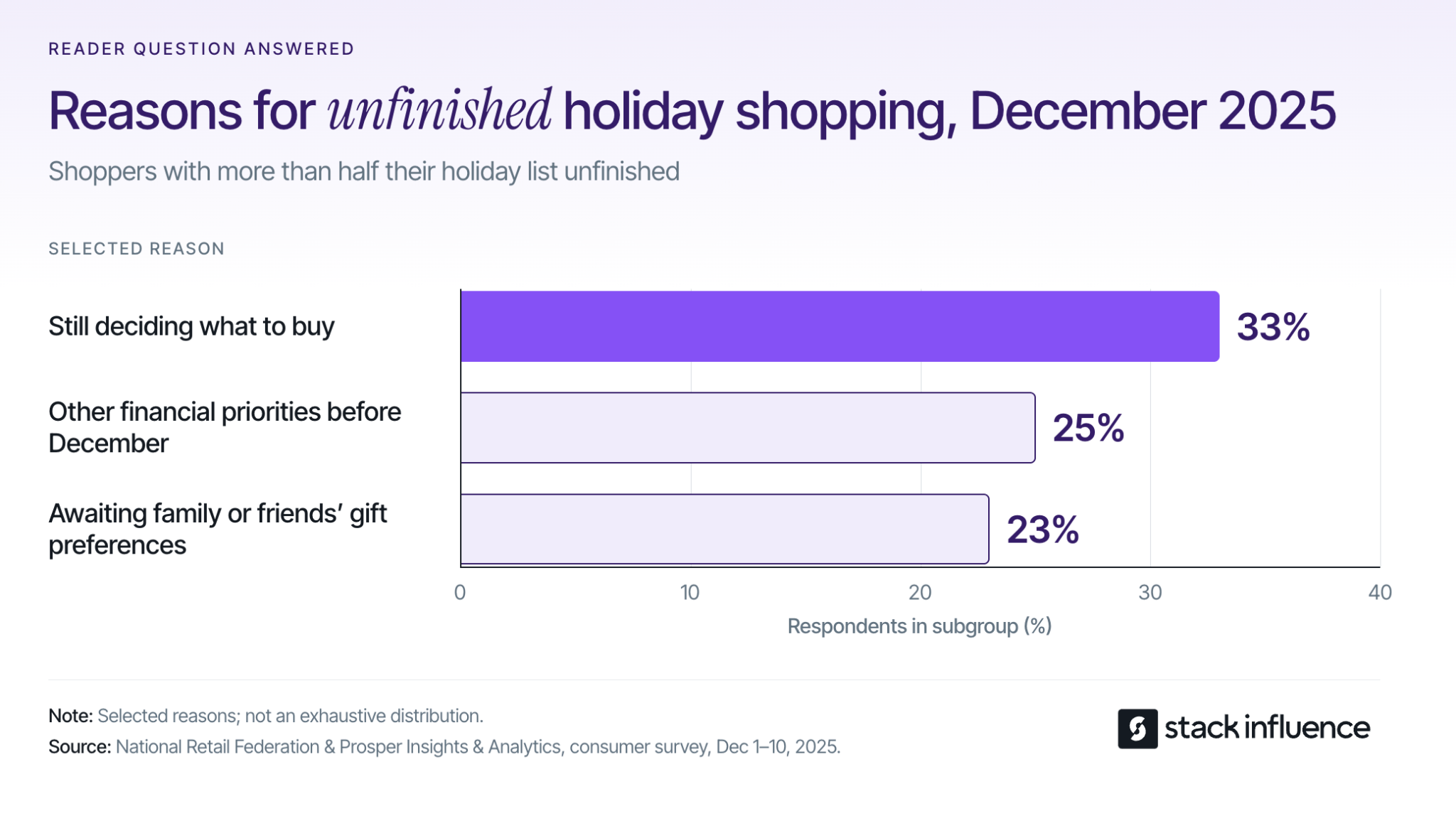
NRF and Prosper Insights & Analytics’ December 2025 survey covered 8,005 adults, surveyed December 1–10. Among shoppers with more than half their list unfinished, 33% were still deciding what to buy, 25% had other financial priorities before December, and 23% were awaiting family or friends’ gift preferences. These are selected reasons from that subgroup, not percentages of all shoppers.
The Four Gift Questions
Use these four questions to select and review a campaign:
- Who is this for? Name the recipient’s interest, routine, or practical need.
- Will it work for them? Explain sizes, compatibility, contents, and anything else required.
- Is the complete offer worth it? Show the product, packaging, delivery charges, and useful extras.
- Can it arrive in time? Connect the promise to the actual product, destination, and fulfillment method.
For example, if visitors repeatedly ask whether a coffee accessory fits their recipient’s machine, publish a compatibility demonstration before buying more traffic. If shoppers understand the product but abandon checkout after seeing shipping charges, work on the delivered offer.
Choose one primary obstacle and one outcome metric for the first test. The Four Gift Questions should help you decide what to build, not become four additional campaigns your team cannot support.
Help Shoppers Choose a Gift
1. Build Gift Guides Around Specific Recipients
Create a focused collection such as gifts for a home coffee enthusiast, a frequent traveler, or someone setting up their first kitchen. Explain why each product belongs, who would use it, and which version to choose. Add budget filters only where your catalog offers meaningful choices.
Keep the guide useful outside your website: give email subscribers and creators a direct collection link, and let shoppers share a preferred product and variant with someone buying for them. If you run a holiday influencer campaign, give creators the same recipient criteria so their recommendations and landing pages agree.
For a small catalog, a few carefully explained products can do the job. Measure product-page visits and orders from the guide, and remove unavailable items promptly.
2. Ask Micro Influencers to Demonstrate Gift Suitability
Recruit micro influencers and nano influencers whose content shows familiarity with the product’s use case. A useful brief asks them to show what arrives, demonstrate it in use, explain a relevant compatibility detail, and describe the recipient who would appreciate it. Give creators room to express an honest opinion.
Stack Influence’s automated product-seeding workflow connects vetted creator participation, product purchase, social-post completion, and reimbursement. Its gifted-first, completions-only model makes completion a concrete campaign milestone. For holiday planning, distinguish an accepted invitation from a finished asset you can actually use.
Work backward from the content deadline to allow product access, genuine use, creation, and agreed review. Reserve the relevant product variants before recruiting. Under the FTC’s social media disclosure guidance, free or discounted products can create a relationship that creators must disclose clearly with the endorsement.
3. Test Creator Content Against a Specific Buying Question
Turn approved user-generated content, or UGC, into a focused creative test. Compare a demonstration that answers “Will this fit?” with one that explains “What comes in the box?” while keeping the audience, offer, and destination comparable. Use the same product variant in the content and on the landing page.
Confirm the placements, duration, editing permissions, and advertising rights before reusing a creator’s work. The Meta Partnership Ads guide explains how content rights and permission to advertise through a creator’s identity are separate parts of that workflow.
Test the destination on a phone, including variant selection, shipping costs, and payment. Evaluate visits to the intended product page and customer acquisition cost; a popular organic post is a candidate for testing, not a forecast of paid-ad performance.
Make the Gift Offer Easier to Buy
4. Bundle Products Into a Complete, Useful Gift
Build a bundle around a finished experience: a travel organizer with compatible pouches, for example, or a starter kit with the consumables required for first use. Show the contents and explain the convenience. Check that the combination solves a recipient’s problem before using it to move excess stock.
Shopify’s bundle inventory documentation explains that availability depends on component quantities. Review inventory tracking and overselling settings, and watch the item that limits the number of complete bundles. Campaign traffic cannot compensate for a missing component.
Price the offer using contribution. For an illustrative $60 order, assume $33 for goods, payment, fulfillment, shipping, and expected return costs, leaving $27 before marketing. A 20% discount reduces revenue to $48 and contribution to $15 if those costs stay fixed; matching the original contribution requires 27 ÷ 15 = 1.8 times as many orders, or 80% more. This is a planning calculation, not a campaign benchmark.
5. Promote Gifting Convenience as Part of the Product
Offer services that remove work for the buyer: a gift message, clearly described wrapping, a gift receipt, or an understandable exchange process. Show the actual presentation before checkout. Include the price, any extra handling time, and the applicable return conditions.
Use approved ecommerce UGC to demonstrate the packaging and first-use experience where your rights allow. Brief content creators on what is included so decorative props do not imply that buyers receive additional products.
Test the fulfillment workflow with a real sample order. Check whether messages print correctly and whether packing slips reveal prices to recipients. Track the service’s attachment rate alongside packaging cost, labor, and delivery performance.
6. Match Holiday Emails to the Shopper’s Situation
Send different messages to subscribed browsers, previous customers, and recent purchasers. Browsers may need a recipient guide; previous customers may value genuine early access; someone who already ordered usually needs delivery information before another promotion.
Shopify supports rules-based targeting through customer segments. Use your own customer data to build relevant groups, and keep promotional sends within the audience that has opted in. A previous purchase can have been a gift, so do not automatically treat that category as the buyer’s personal interest.
For a Shopify influencer marketing program, keep the creator’s product recommendation consistent with the subscriber’s next message and destination. Suppress obsolete offers after purchase, and use actual stock or delivery changes for reminders. Review revenue per delivered message alongside unsubscribes and complaints.
Make Delivery Confidence Part of the Campaign
7. Promote Products You Can Still Fulfill Reliably
Build holiday collections around current stock and realistic arrival windows. A ready-to-ship collection should exclude products waiting for replenishment, personalization, or a missing bundle component. Update product pages, ads, and email copy together when the promise changes.
Google Merchant Center’s delivery-time guidance calculates estimates using handling time, transit time, order cutoff, and business days. Use those inputs to establish your own deadlines by destination and service. Do not copy a carrier’s final mailing date without allowing for your warehouse’s work.
Give one person responsibility for changing the campaign when a cutoff is reached. Check both conversion and the proportion of orders arriving within the promised window. A deadline that wins orders but produces late gifts can create refunds and additional service work.
8. Switch to Digital Gifts or Verified Local Pickup
When parcel delivery is no longer dependable for the occasion, change the product being promoted. Online-only sellers can feature digital gift cards; businesses with a functioning pickup operation can feature eligible local inventory. Explain how and when the customer receives the gift.
Adobe’s 2025 holiday ecommerce analysis found curbside pickup represented 17.1% of U.S. online orders at retailers offering that service during November 1–December 31, rising to 39.0% on December 23. The seasonal figure includes that date, so this compares a peak day with the full season rather than independent customer groups.
Shopify’s gift-card recipient fields support a recipient email, message, and scheduled send date where the feature is enabled. Test the notifications before advertising them. For pickup, promote only confirmed stock and a collection time your staff can meet.
Continue the Relationship After the Gift Is Opened

9. Give Gift Recipients Their Own Welcome Experience
Build a DTC recipient welcome page with setup instructions, care guidance, compatible accessories, and a clear way to get help. Include its address or a QR code in the package. Make essential product guidance available without requiring a marketing subscription.
Then offer a separate, voluntary invitation to receive useful follow-up content. The person paying for the order and the person using the product may be different people. A replenishment email based only on the buyer’s purchase history can therefore reach someone who never used the item.
Keep buyer delivery updates and recipient education on separate paths. Measure guide engagement, voluntary recipient signups, and later purchases from those subscribers. This approach is for your own DTC customer experience; marketplace orders need the communication and packaging practices permitted by that marketplace.
10. Build January Campaigns Around What Customers Now Own
Prepare useful follow-up content before holiday fulfillment consumes the team’s attention. Someone using a new travel organizer may appreciate packing advice; someone who received a starter kit may need help choosing refills. Introduce a complementary purchase when it supports that next task.
Keep gift-card redemption, belated gifting, and personal purchases distinct in campaign messages. A general clearance promotion does not answer all three needs. Use consenting customers’ stated preferences or observed activity to choose the next message, and avoid assuming that every January shopper is buying for themselves.
Compare later purchases by the original holiday campaign and customer group. Keep gift-card cash sales and redemption orders separate in the dashboard so their value is reconciled rather than credited twice. Monitor returns as well as repeat orders before deciding which holiday offer created the most lasting value.
How Should You Measure Holiday Marketing Results?
Measure whether a campaign produces usable assets, product-page visits, profitable orders, and customers who return. Connect those stages so a high impression count does not hide weak purchasing results or an offer that loses money after fulfillment.
Before launch, assign each campaign a destination, audience, offer, owner, content deadline, and stop condition. A missing required variant or an unavailable delivery promise should trigger a campaign change.
Use a consistent measurement chain:
- Execution: Track completed creator posts, accepted reusable assets, available stock, and fulfillment reliability.
- Shopping: Measure visits to the intended product or guide, add-to-cart activity, checkout completion, and new customers.
- Economics: Start with sales after discounts and refunds, then subtract product costs, payment fees, fulfillment, shipping subsidies, return handling, and campaign costs once each. Reconcile any return reserves as actual returns arrive.
- Retention: Compare return rates and subsequent purchases across holiday customer groups after they have had comparable time to respond.
For a Shopify creator pilot, record participating creators’ purchases and reimbursements separately from audience orders. Do not count those creators as customers acquired through their own posts. Apply the same distinction when measuring marketplace campaigns, and reconcile the purchase receipts and reimbursement costs in the economics.
Calculate customer acquisition cost using acquisition spending divided by newly acquired audience customers. Cost per order uses orders as the denominator and can include returning customers. Include the creator and production costs allocated to that campaign in the spending basis.
For a Shopify or other DTC destination, Google Analytics’ campaign URL guidance explains how tags identify campaign traffic, including creative variants. Keep naming consistent across creator links, email, and paid ads. Use the same attribution model when comparing results, and reconcile channel reports against store orders instead of adding their totals together.
Eligible Amazon sellers can use Amazon Attribution to measure tagged non-Amazon marketing and subsequent Amazon activity. Amazon documents a 14-day last-touch attribution model. Configure measurement before publishing creator links, then allow the reporting window to mature before making a final comparison.
Review stock, delivery, and spending daily while campaigns are active. Assess creator results over comparable periods after publication, then revisit contribution after the return window and repeat purchases after a defined follow-up period. Where the audience is large enough, a randomized email holdout can help estimate additional sales; attributed orders alone do not establish causation.
Keep the Gift Promise Beyond Checkout
Useful holiday marketing ideas stay consistent from the first recommendation to the moment a recipient uses the product. The Four Gift Questions connect your creative decisions with the value, fulfillment, and product experience that support a confident purchase.
Before expanding the calendar, check that each promotion explains the gift accurately and leads to an offer you can deliver. Bring those recipient questions and content requirements to Stack Influence when planning creator activation, so your product-seeding campaign produces demonstrations that serve the shopper’s decision.