




Most eCommerce sellers hear "TikTok Shop" and picture teenagers buying lip gloss. The reality is that TikTok Shop generated $66 billion in global GMV in 2025 and is projected to surpass $112 billion in 2026, and DTC brands that set up shop early are capturing meaningful revenue before their competitors even log in. If you are running a Shopify store, an Amazon listing, or a consumer brand of any size, understanding how tiktok shop for sellers actually works is no longer optional. This guide walks you through setup, creator strategy, fee structure, and the measurement model you need to operate profitably from day one.
Key Takeaways
- TikTok Shop's in-app checkout removes the biggest drop-off point in social commerce, converting browsers at 5-8% compared to the 2-4% benchmark on traditional ecommerce sites.
- The platform's affiliate model means sellers can activate dozens of nano influencers and micro influencers on a performance-only basis, paying commissions only on confirmed sales.
- Product seeding is the lowest-cost entry point for new sellers: send free products to creators, collect UGC video, and only pay referral fees when orders land.
- Fees on TikTok Shop are deceptively simple at a 6% referral rate but can stack to 35-55% of revenue once affiliate commissions, fulfillment, and ad spend are included.
- The SCALE framework helps sellers prioritize the five setup pillars that determine whether a new shop earns or burns in its first 90 days.
How to Launch a Profitable TikTok Shop in 2026
The fastest path to your first sale on TikTok Shop is not a paid ad. It is a pre-recorded creator video seeded with a product sample and a competitive affiliate commission. Before any of that is possible, you need a properly configured seller account with the right infrastructure in place.
Getting the basics right from the start saves weeks of rework. Here is the sequence that works:
- Register via TikTok Seller Center: Visit seller.tiktok.com, select your region, and submit business documentation. U.S. sellers need a government-issued ID, a valid business address, and a bank account.
- List products with scroll-stopping creative: Title, primary image, and the first 15 characters of your description appear in the shopping tab before any click. Treat the listing like an ad, not a warehouse entry.
- Set your affiliate commission rate before publishing: Creators browse the product marketplace looking for items with competitive commissions. A 10-15% rate gets you found; 20%+ gets you prioritized in beauty and wellness.
- Enable product tags in your own content: Even before affiliates post, your brand-owned videos should link directly to listings. This trains the algorithm to associate your content with purchase behavior.
- Connect TikTok Shop to your Shopify store or existing catalog: The Shopify integration syncs inventory in real time, reducing the risk of overselling during a viral moment.
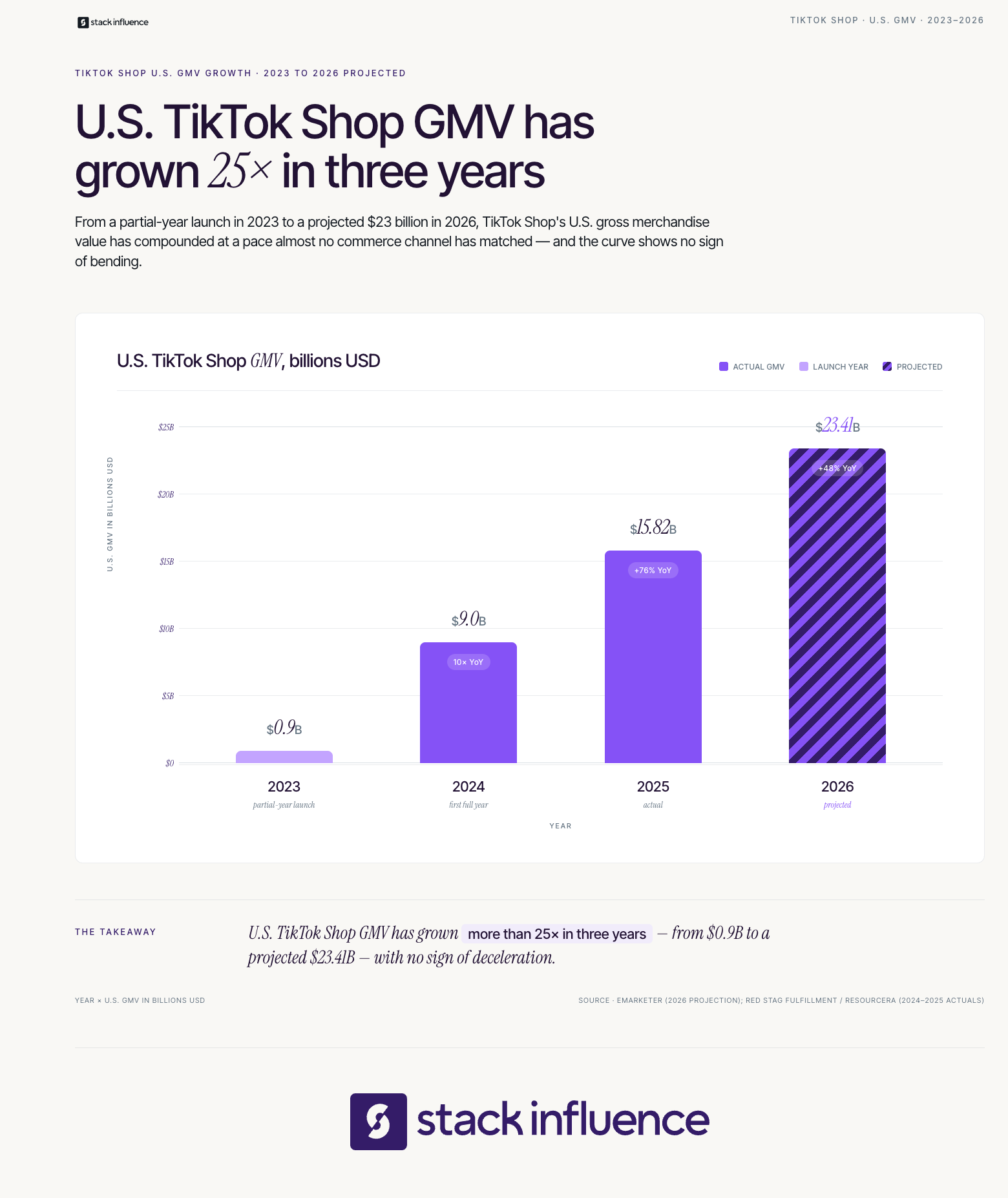
According to eMarketer's forecast, TikTok Shop's U.S. ecommerce sales are expected to reach $23.41 billion in 2026, a 48% increase year-over-year, which would give the platform a larger U.S. ecommerce business than Target, Costco, Best Buy, and Kroger combined. That trajectory means every month a seller waits is a month of compound growth they are not capturing. The window for early-mover advantage is narrowing, but it has not closed.
One commonly missed step is building your Shop Performance Score from day one. Settlement timelines for standard sellers run approximately 15 days, while Star Shops receive payouts in 1-8 days , making account health a direct cash flow lever. Respond to customer messages quickly, maintain a low return rate, and fulfill orders within your stated handling window from the first order onward.
What Is TikTok Shop for Sellers?
TikTok Shop is TikTok's native commerce infrastructure that lets brands and individual sellers list products, accept payments, and fulfill orders entirely within the app. Unlike linking out to a Shopify page or an Amazon listing, TikTok Shop closes the transaction at the exact moment purchase intent peaks, inside the scroll. This architecture is what separates it from every other social commerce attempt in the Western market.
The platform has experienced explosive growth since launching, with the U.S. market alone expanding from roughly 4,450 shops in mid-2023 to over 475,000 shops by mid-2025, a staggering 5,000% increase in just two years. That kind of adoption curve signals a platform shift, not a trend. The seller base includes everything from individual creators running one-product businesses to established DTC brands and Amazon sellers diversifying their channel mix.
The core mechanics sellers need to understand are:
- In-feed video shopping: Short-form videos with embedded product links appear in the For You feed. A viewer can tap, see the product card, and check out without leaving the video.
- TikTok LIVE shopping: Real-time livestreams with pinned product links. Urgency and host interaction drive impulse purchases, with conversion rates ranging up to 12% during active sessions.
- Product Showcase tab: A dedicated storefront tab on any TikTok account where all listed products appear, functioning as a mini shop page.
- Affiliate marketplace: Sellers list products with commission rates; approved creators browse and apply to promote them, creating a scalable, performance-based distribution network.
- Fulfilled by TikTok (FBT): TikTok's own warehousing and fulfillment service, which as of March 31, 2026, is now the required shipping method for U.S. sellers in most categories.
In the U.S., livestreams still account for under 30% of GMV, while pre-recorded creator videos drive about two-thirds of TikTok Shop sales, since viewers prefer on-demand content in their For You feed. This is a critical insight for sellers allocating creative resources: short-form video outperforms live for most product categories, at least in the American market.
The SCALE Framework: Five Pillars Every Seller Must Activate
The SCALE framework is a branded acronym designed to help eCommerce sellers audit and prioritize their TikTok Shop setup. Each letter maps to a distinct operational pillar. Use it as a scoring tool during onboarding and again every quarter.
S — Storefront health: Your listing quality, product images, review velocity, and Shop Performance Score. Weak storefront health suppresses organic reach even when creator content performs well.
C — Creator pipeline: The number of active affiliates promoting your products at any given time. A pipeline of 20 to 50 active creators is the minimum threshold for consistent daily GMV. Think of this as a media mix, not a one-off partnership.
A — Affiliate commission strategy: Your commission rates relative to category competitors. TikTok's affiliate marketplace is a competitive marketplace for creator attention. Setting rates too low means your products get skipped.
L — Live commerce cadence: How often your brand or creator partners host shoppable LIVE sessions. Even one weekly LIVE with a strong affiliate can meaningfully lift monthly GMV for impulse-friendly products.
E — Economics per order: Your true cost per sale once referral fees, FBT fees, affiliate commissions, and any ad spend are factored. This number must be modeled before you scale, not after.
TikTok Shop achieves conversion rates of 5-8% for in-app purchases, significantly outperforming traditional ecommerce benchmarks of 2-4%. That conversion premium is the core economic argument for investing in TikTok Shop, but it only translates to profit if your Economics per Order pillar in the SCALE framework is modeled correctly. High conversion rates mean nothing if your margin per unit is negative after the full cost stack.
Stack Influence's internal campaign data shows that eCommerce brands activating all five SCALE pillars within their first 60 days on TikTok Shop see significantly faster GMV ramp than brands that launch with only storefront and a handful of ad posts. Specifically, brands that seed at least 30 creators before their first paid promotion consistently establish a self-reinforcing content loop that sustains organic traffic beyond the seeding period. Building the creator pipeline early is the single highest-leverage action a new seller can take.
How Do Creator Partnerships Work on TikTok Shop?
Creator partnerships on TikTok Shop operate through a formal affiliate architecture, not the ad-hoc brand deals most sellers are used to from Instagram. Sellers set commission rates at the product level, and creators browse the affiliate marketplace to find products they want to promote. When a creator posts a video or hosts a LIVE with a tagged product and a sale is made, TikTok attributes the sale and pays the commission automatically after a 30-day settlement window.
The TikTok Shop affiliate program is a commission-based partnership model built directly into TikTok's native commerce infrastructure, connecting brand sellers with creator affiliates who promote products through short-form video, LIVE shopping, and product showcase tabs. This infrastructure removes the manual overhead of one-off brand sponsorship deals and creates a self-serve discovery layer where motivated creators come to you.
The two collaboration modes every seller should use together:
- Open Plan: Any creator who meets TikTok's eligibility criteria can apply to promote your products. This maximizes volume and discovery, especially for new products entering the market.
- Targeted Plan: You invite specific creators directly. This is the right mode for brand ambassador relationships, exclusives, and high-value product seeding campaigns with vetted nano influencers and micro influencers.
According to Capital One Shopping, TikTok affiliate links deliver a 30.1% engagement rate for creators under 50K followers, which is 1,570% higher than comparable rates on Instagram. This is why the creator economy emphasis on smaller creators is not just a trend preference but a data-backed performance signal. Nano influencers and micro influencers routinely outperform macro creators on this platform in terms of engagement per post.
TikTok Shop affiliate commissions are set by sellers, not the platform, which means competitive categories like beauty routinely see 15-20% rates, far above Amazon Associates benchmarks. Sellers entering the beauty or wellness category need to price their commission rates to match or exceed category norms, or their products will simply not appear in active creator prospecting. For context on how influencer seeding pairs with affiliate mechanics, the product seeding workflow for eCommerce brands covers the full sequence in detail.
From Stack Influence's experience running product seeding campaigns for eCommerce brands, sellers who seed 25 or more creators before launching their Open Plan affiliate collaboration consistently generate a higher baseline of organic content views, which in turn improves how the TikTok algorithm surfaces their products to new audiences. The seeded UGC video assets also serve as evergreen proof of product quality that new creator applicants can review before committing to promote.
What Most Guides Get Wrong About TikTok Shop for Sellers
The most common advice you will find in TikTok Shop guides is to focus on growing your own brand account's follower count before launching. This belief is wrong, and it costs sellers months of misdirected effort. TikTok Shop's algorithm does not reward follower count on seller accounts. It rewards transaction completion. A brand account with 500 followers that has 40 active affiliates posting daily will consistently outperform a brand account with 50,000 followers and no creator pipeline.
TikTok's algorithm does not care about follower count: a seeded creator with 8,000 followers can generate more sales than one with 800,000 if the content resonates. This is structurally different from how Instagram or YouTube favor established audience size. The For You Page is a relevance engine, not a popularity contest, and products that trigger genuine purchase behavior get pushed regardless of brand account size.
Micro-influencers outperform celebrity partnerships on TikTok with an 8.2% average engagement rate compared to 5.3% for macro-influencers, making them a more cost-effective and authentic choice for TikTok campaigns. The implication for sellers is that spreading creator budget across 30 to 50 nano influencers and micro influencers produces more consistent results than concentrating that same budget into one or two large-scale brand sponsorships. Influencer campaigns built on volume of authentic voices beat campaigns built on a single celebrity's reach, every time.
The alternative metric sellers should track instead of brand account follower count is what the CLEAR Metric Stack (detailed in the next section) calls Creator Content Velocity: the number of new affiliate posts containing a tagged product that go live each week. When that number is rising, GMV follows. When it stalls, no amount of paid Shop Ads will substitute for the organic credibility loss.
Influencer marketing platforms that specialize in eCommerce make it practical to run creator partnerships at the volume needed to feed TikTok Shop's algorithm consistently, without managing hundreds of individual brand deals manually. The TikTok-specific solutions page covers how automated product seeding can integrate directly with TikTok Shop's affiliate structure.
Across campaigns managed on the Stack Influence platform, brands that pivot from brand-account-growth tactics to creator-pipeline-growth tactics see a meaningful improvement in weekly GMV within the first four to six weeks. The shift requires accepting that your brand's own TikTok presence matters less than the collective reach of the creator network promoting your products. For most sellers accustomed to owning their content, this is the hardest strategic pivot to make, but the data consistently supports it.
How Should You Measure TikTok Shop Performance?
Tracking revenue from TikTok Shop requires a more layered approach than most social commerce reporting. The CLEAR Metric Stack is a named measurement model designed specifically for eCommerce sellers running creator-driven TikTok Shop campaigns. Use it as your primary performance dashboard.
C — Creator Content Velocity: New affiliate posts per week tagging your product. This is your leading indicator. GMV typically lags content velocity by 7-14 days on a healthy shop.
L — Listing Conversion Rate: The percentage of product page views that result in a completed purchase. Benchmark this at 5-8% for in-app checkout and investigate anything below 3% at the listing level.
E — Economics per Order: Your net margin after referral fee, FBT or shipping cost, affiliate commission, and any ad spend. This must be SKU-specific, not blended across the catalog.
A — Affiliate Activation Rate: The percentage of creators who applied to promote your product and actually posted at least one piece of content. A rate below 40% usually signals a brief problem, a pricing mismatch, or a product that does not demonstrate well on video.
R — Return Rate by SKU: Returns above 10% on TikTok Shop trigger platform penalties and suppress listing visibility. Monitor this at the individual product level, not the store level.
When you add transaction fees, shipping costs, affiliate commissions, Shop Ads spend, content production, returns, and chargebacks, the total cost of selling on TikTok Shop can run 35-55% of revenue depending on category and scale. This is why the Economics per Order component of the CLEAR Metric Stack must be calculated before setting prices, not after. Sellers who price based on the advertised 6% referral fee alone routinely discover their margins are negative once the full cost stack is modeled.
Brands have learned that $20 to $50 products outconvert $5 items and $100+ items on TikTok Shop, and that $20 to $50 sweet spot represents 58% of all transactions. This data point feeds directly into the Economics per Order pillar of the SCALE framework. If your current catalog skews above $100 or below $15, a bundling or entry-product strategy can move you into the conversion-optimized price band without a complete SKU overhaul.
The CLEAR Metric Stack also provides the right inputs for running TikTok Spark Ads efficiently. Spark Ads boost existing organic creator content, which means the highest-performing affiliate videos identified through Creator Content Velocity tracking are your best candidates for paid amplification. You are not creating new creative; you are putting spend behind the content that already proved it can convert.
The TikTok Shop Seller Launch Checklist

Use the Creator Readiness Checklist as your pre-launch audit. Run through it before activating your first affiliate plan. Reference it again at the 30-day mark to identify gaps before you invest in paid Shop Ads.
- Listing quality check: Does every product have at least three images, a video, bullet-point benefits in the description, and a clear primary use case?
- Commission competitiveness check: Is your affiliate commission rate at or above the category median? Check comparable products in the TikTok affiliate marketplace before publishing.
- Creator seeding batch ready: Have you identified at least 20 nano influencers or micro influencers to receive product samples before the Open Plan goes live? UGC platforms can accelerate this step significantly.
- Economics per Order modeled: Have you calculated your true net margin per SKU, including the 6% referral fee, FBT fulfillment starting at approximately $2.86-$3.58 per unit, and your target affiliate commission rate?
- Return policy set: Is your return window and process clearly stated on each listing? High return rates suppress visibility and trigger penalties.
- Brand account content plan: Do you have at least four short-form videos scheduled for your first two weeks, each with a tagged product and a clear demonstration of the product in use?
- Customer response protocol: Is someone monitoring your TikTok Seller Center inbox within a 24-hour window? Response time feeds your Shop Performance Score directly.
TikTok Shop charges sellers a 6% referral fee on most categories, plus a payment processing fee, bringing the true marketplace take-rate to approximately 7% before fulfillment and creator commissions. Understanding this cost baseline is the foundation of the Economics per Order calculation in the SCALE framework. Sellers who skip this step during onboarding are the ones who find themselves unprofitable six weeks into strong GMV growth.
The Creator Readiness Checklist is designed to be run before money is spent, not after. Most sellers who struggle in their first 60 days on TikTok Shop did not have a weak product. They had an incomplete infrastructure. The checklist catches that gap before it costs you anything beyond the initial product seeding budget. For a broader look at how influencer-led campaigns perform across eCommerce categories, the micro influencer and UGC eCommerce resource provides useful benchmark context.
Conclusion
TikTok Shop for sellers in 2026 is one of the most powerful customer acquisition channels available to eCommerce brands willing to invest in a creator pipeline rather than a paid ads dependency. The platform's in-app checkout, performance-based affiliate model, and algorithm that rewards transaction behavior over follower counts make it structurally different from anything that came before it. Apply the SCALE framework to audit your setup, use the CLEAR Metric Stack to track what actually drives profit, and run the Creator Readiness Checklist before spending a single dollar on promotion. The sellers who win on this platform are not the ones with the biggest brand accounts. They are the ones who built the deepest creator networks, fastest.