




Choosing between wholesale and retail changes far more than the price printed on an invoice. It determines who buys from you, how much they purchase, when you get paid, who creates consumer demand, and how much control you retain over the customer experience.
For ecommerce sellers, the wholesale vs retail decision is rarely as simple as “volume or margin.” A retail channel with a high selling price can become unprofitable after acquisition costs and returns. A wholesale channel with a lower unit price can produce attractive economics when orders are large, predictable, and operationally efficient.
This guide explains the differences, introduces a practical framework for choosing a model, and shows how Amazon sellers, Shopify brands, and DTC brands can operate wholesale and retail together.
Key Takeaways
- Wholesale primarily sells to businesses that will resell or commercially use products, while retail sells to the final consumer.
- Retail usually captures more revenue per unit, but wholesale can generate more units and contribution profit per order.
- Cash timing matters as much as margin because wholesale buyers may request payment terms while retail customers normally pay at checkout.
- Ecommerce is a sales method, not a separate alternative to wholesale or retail. Both models can operate online.
- A hybrid model often works best when pricing, product packs, inventory, and promotions are separated by channel.
Wholesale vs Retail at a Glance
Wholesale and retail are distinguished primarily by the buyer’s role in the distribution chain. The U.S. Census Bureau’s Wholesale Trade definition covers establishments that wholesale merchandise, while its Retail Trade definition describes retail as the final distribution step, generally involving sales in smaller quantities to the public.
The practical differences are:
- Wholesale: Products are sold to retailers, distributors, institutions, or other businesses. Orders are usually larger, unit prices are lower, and purchasing may involve quotes, purchase orders, account approval, or payment terms.
- Retail: Products are sold to the end user. Orders are usually smaller, selling prices are higher, and the seller manages the customer-facing shopping experience.
- Hybrid: The brand sells to business accounts and final consumers, often using different catalogs, pack sizes, pricing rules, and fulfillment workflows.
A company’s position can also change from one transaction to another. A brand may buy packaging wholesale, sell cases to retail stores, and sell individual products through its own ecommerce site.
Retail Is a Customer Type, Not a Store Type
Retail does not mean physical storefront, and wholesale does not mean offline sales. Both models can operate through ecommerce sites, marketplaces, sales representatives, electronic purchase orders, or physical locations.
The Census Bureau’s 2022 NAICS update removed the previous distinction between online and brick-and-mortar retail classification. Retail businesses are now classified according to the products they sell rather than whether customers order online or in a store.
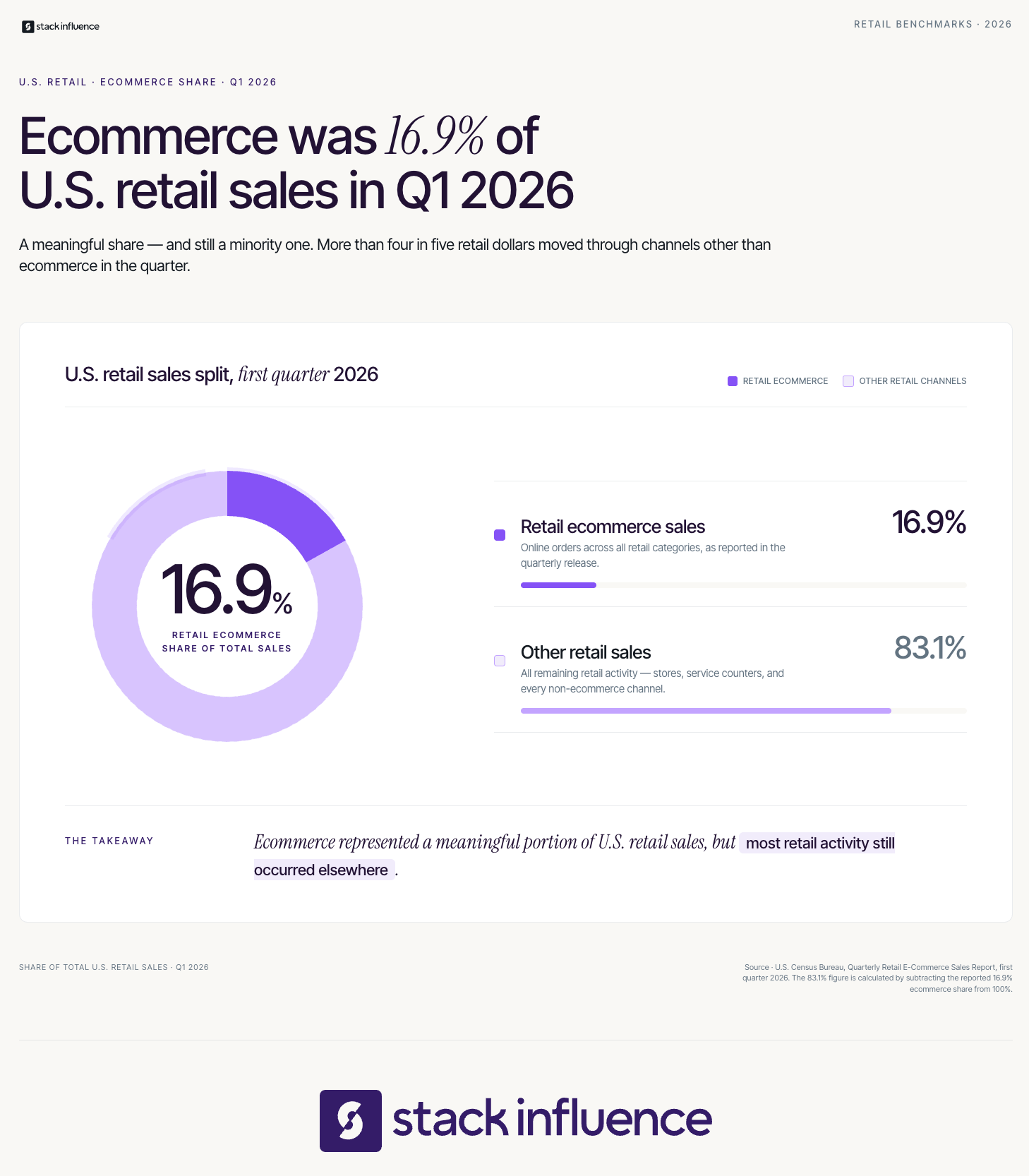
Online retail nevertheless represents a substantial market. According to the Census Bureau’s first-quarter 2026 ecommerce report, seasonally adjusted U.S. retail ecommerce sales totaled $326.7 billion, or 16.9% of total retail sales. By subtraction, the remaining 83.1% came through other retail channels.
This creates three distinct ecommerce configurations:
- Wholesale ecommerce sells online to verified business buyers.
- Retail ecommerce sells online to final consumers.
- A blended store serves both groups through buyer-specific pricing and checkout rules.
Brands still building their overall channel strategy can use this broader ecommerce business guide to connect the model decision with sourcing, storefront selection, marketing, and fulfillment.
The 5C Wholesale vs Retail Decision Framework
The 5C framework evaluates Customer, Cart, Cash, Control, and Capacity. Looking at all five prevents a brand from selecting a model based only on selling price or projected revenue.
Customer
Wholesale and retail serve customers with different purchase motives.
A consumer usually buys a product to use it. A wholesale buyer purchases because the product can be resold, distributed, incorporated into another offering, or used by an organization. The wholesale buyer therefore evaluates more than consumer appeal.
Wholesale buyers may examine:
- Expected sell-through
- Available retailer margin
- Case-pack configuration
- Reorder reliability
- Product documentation
- Delivery lead time
- Returns and damage policies
- Promotional support
Retail customers are more likely to focus on the product’s utility, price, reviews, availability, brand credibility, and purchase experience. A useful starting point for understanding direct retail relationships is the distinction between traditional distribution and the direct-to-consumer business model.
Cart
Wholesale generally concentrates more units into fewer transactions. Retail spreads units across many smaller carts.
That difference affects nearly every operating cost. One 100-unit wholesale order may require one sales conversation, one invoice, and several cartons. One hundred retail units may require dozens of individual checkouts, payment authorizations, packages, tracking messages, and customer-service interactions.
Wholesale sellers commonly use:
- Minimum order quantities
- Minimum order values
- Case packs
- Pallet quantities
- Quantity price breaks
- Opening-order minimums
- Lower reorder minimums
Retail sellers commonly use bundles, free-shipping thresholds, subscriptions, and upsells to increase average order value without turning the purchase into a business procurement process.
Cash
Retail customers normally pay when they order. Wholesale accounts may request time to pay, which creates accounts receivable and credit risk.
The Shopify B2B payment-term documentation, for example, supports immediate payment, deposits, due-on-fulfillment arrangements, and net payment periods. The presence of these options reflects a central wholesale reality: a booked sale and collected cash can occur on different dates.
Evaluate cash through three questions:
- How much inventory must be funded before the order?
- How many days pass between paying suppliers and collecting customers?
- What happens if a buyer pays late, disputes an invoice, or returns inventory?
A wholesale order can look excellent on an income statement while creating a cash shortage. Retail can collect faster, but advertising, marketplace reserves, returns, and fulfillment may consume the cash just as quickly.
Control
Retail provides greater control over pricing, presentation, customer data, merchandising, and post-purchase communication. Wholesale exchanges some of that control for distribution through another company’s audience or locations.
A DTC brand can test landing pages, bundles, subscriptions, and email campaigns directly. A wholesale brand may rely on a retailer to decide where a product appears, which adjacent products are displayed, and when promotions run.
The control tradeoff is not automatically negative. A capable retailer contributes local demand, merchandising, existing customer traffic, and category expertise. The relevant question is whether the retailer’s distribution value compensates for the margin and control being shared.
Capacity
The best model is the one the company can execute consistently.
Wholesale requires account prospecting, buyer follow-up, catalogs, purchase orders, case-level fulfillment, invoicing, compliance documents, and account service. Retail requires consumer marketing, conversion optimization, individual fulfillment, returns, customer support, and continuous creative production.
Before expanding, identify the current bottleneck:
- If demand generation is weak, retail expansion may increase marketing costs faster than sales.
- If individual fulfillment is overwhelming the team, wholesale orders may simplify transaction handling.
- If production capacity is uncertain, a large wholesale commitment may create service failures.
- If account concentration is already high, more retail sales may reduce dependence on a few buyers.
Which Model Is More Profitable?
Neither wholesale nor retail is inherently more profitable. Retail usually captures more revenue per unit, while wholesale can concentrate more units into each order and reduce the number of customer transactions required. The winning model is the one that produces stronger contribution profit, inventory turns, and cash conversion after every variable cost.
Gross margin is only the starting point. The IRS explains in its small-business tax guide that gross profit begins with net receipts minus cost of goods sold, with inventory, purchases, returns, and allowances affecting that calculation. Channel decisions require going further by subtracting the other costs that change when an order is placed.
Use this calculation:
Contribution profit per order equals net sales minus product cost, fulfillment, channel fees, returns and allowances, and variable sales or acquisition costs.
For wholesale, include:
- Buyer or marketplace commissions
- Pick, pack, pallet, and freight costs
- Volume discounts and promotional allowances
- Samples and account-acquisition costs
- Bad-debt or late-payment risk
- Returns, damages, and chargebacks
For retail, include:
- Payment and marketplace fees
- Individual pick-and-pack costs
- Customer acquisition
- Discounts and free shipping
- Returns and refunds
- Customer support
Consider a simplified hypothetical product with a $10 unit cost. A retail order at $35 might incur $6 fulfillment, $9 customer acquisition, and $4 in fees and return reserves, leaving $6 in contribution profit. A wholesale order at $18 with $2 in variable selling and fulfillment costs also leaves $6 per unit, but a 100-unit order produces $600 from one transaction.
The example does not prove wholesale is better. It shows why the retail price alone does not answer the profitability question.
Ecommerce Implementation on Shopify and Amazon
Wholesale and retail can share technology, inventory, and even the same storefront, but each buyer type needs the correct pricing, ordering, payment, and fulfillment experience.
Shopify Retail and Wholesale
A standard Shopify storefront is commonly used for individual consumer orders. The platform supports product pages, checkout, payments, discounts, and integrations that help brands manage a DTC retail operation, as explained in this guide to how Shopify works for ecommerce sellers.
Shopify also supports B2B catalogs that determine which products and prices business customers can access. Its official B2B catalog documentation describes customer-specific product availability, quantity rules, and volume pricing. These functions let one commerce system present different buying conditions to retail and wholesale customers.
A blended Shopify setup should separate:
- Consumer and company accounts
- Retail and wholesale catalogs
- Individual units and case packs
- Immediate payment and approved account terms
- Consumer promotions and business volume discounts
- Retail returns and wholesale account policies
Amazon Has Three Different “Wholesale” Meanings
The phrase “Amazon wholesale” is frequently used for three different business arrangements. Confusing them can lead to incorrect sourcing, pricing, and measurement decisions.
Wholesale sourcing for retail resale: An Amazon seller buys branded inventory from a wholesaler or distributor, then resells individual units to consumers in the Amazon store. The sourcing transaction is wholesale, but the customer transaction is retail. Amazon FBA is only the fulfillment method. This Amazon product-sourcing guide explains how wholesale sourcing differs from private label and other inventory models.
B2B selling through Amazon Business: Sellers offer products to organizational buyers. Amazon’s B2B selling program supports business prices, quantity discounts, case packs, pallets, quote requests, and other procurement-oriented features. An Amazon seller can use the same underlying inventory for retail and eligible B2B orders.
Selling inventory directly to Amazon: Under a vendor relationship, Amazon purchases products from the supplier and resells them. The supplier records a wholesale transaction, while Amazon handles the final retail sale. The operational and margin implications are covered in this Amazon Vendor Central guide.
These arrangements can coexist, but they should not be combined into one undifferentiated “Amazon wholesale” line in a financial model.
Demand Ownership Is the Overlooked Difference
The most important wholesale vs retail tradeoff may be who is responsible for creating demand.
Retailers provide distribution, but a wholesale purchase is not the same as consumer sell-through. If products remain on shelves, the account may not reorder. Brands therefore need to support retail partners with product education, content, merchandising assets, and demand-generation campaigns.
Retail brands own the customer-facing demand problem directly. Shopify influencer marketing, Amazon influencers, paid advertising, email, organic search, and product seeding can help create discovery, but the brand carries the execution cost.
Stack Influence supports this demand layer through gifted-first product seeding, creator coordination, UGC generation, and completed-post accountability. Its practical influencer-seeding guide explains the workflow from creator activation through content completion.
A verified Stack Influence case study recorded 3,448 creator promotions during a 12-month Magic Spoon campaign. Average monthly unit sales increased from 1,937 to 7,867 during the measured period, while Amazon Best Seller Rank moved from #828 to #181. The campaign results are a specific example, not a forecast or proof that one marketing activity caused every observed change.
Wholesale distribution and retail demand creation should therefore be treated as connected systems. More doors do not automatically create sell-through, and a strong consumer channel does not automatically produce profitable wholesale terms.
Building a Hybrid Model Without Channel Conflict

A hybrid model works when wholesale and retail reinforce each other without presenting buyers with contradictory prices, unavailable inventory, or competing offers.
Use six operating guardrails:
- Segment buyers clearly. Require business accounts to provide the information needed for wholesale approval. Do not expose every business price to consumer traffic.
- Create distinct pack architecture. Sell individual units or consumer bundles at retail, then use case packs, display packs, or channel-specific bundles for wholesale.
- Model the complete price ladder. Account for product cost, wholesale contribution, retailer economics, retail price, planned promotions, channel fees, and returns before publishing prices.
- Allocate inventory intentionally. Reserve stock according to confirmed purchase orders, forecasted retail demand, lead time, and service commitments. This inventory demand forecasting guide provides methods for planning reorder points and campaign-driven demand.
- Separate promotional rules. A direct discount that undercuts retail partners can damage account trust. Define which products, bundles, dates, and channels are eligible for each promotion.
- Use channel-specific reporting. Wholesale revenue, retail revenue, Amazon marketplace sales, and Shopify sales should remain separately visible even when they draw from the same inventory pool.
Brands combining a Shopify store with an Amazon storefront can also use this Shopify versus Amazon comparison to assign a clearer role to each channel.
The Channel Profitability Scorecard
A useful measurement system connects operating activity to contribution profit, inventory, and cash. Revenue alone cannot show whether wholesale or retail is creating a healthier business.
Track wholesale leading indicators such as:
- Qualified account pipeline
- Sample-to-order conversion
- Average opening order
- Reorder rate and reorder interval
- Retailer sell-through, when available
- Order fill rate
- Days sales outstanding
- Revenue concentration by account
Track retail leading indicators such as:
- Qualified traffic
- Conversion rate
- Average order value
- Customer acquisition cost
- Return rate
- Repeat-purchase rate
- Units per order
- Fulfillment cost per order
Then compare outcome metrics:
- Contribution profit by channel
- Contribution profit per order
- Inventory turnover
- Cash conversion time
- Gross profit after returns and allowances
- Customer or account lifetime value
- Percentage of revenue from repeat buyers
- Working capital required per dollar of sales
Attribution must match the selling environment. Shopify brands can connect traffic and orders within their storefront, while retailers and distributors may need to provide sell-through reports. Reorders are informative, but they do not reveal every consumer interaction that produced the demand.
For Amazon sellers, Amazon Attribution measures how eligible non-Amazon channels, including search, social, email, video, and influencer campaigns, contribute to activity in the Amazon store. The Amazon Brand Referral Bonus can provide eligible enrolled brands with a bonus averaging 10% of qualifying sales attributed to non-Amazon marketing, although the amount varies by category and transaction.
Use three review cadences:
- Weekly: Inventory, fulfillment, overdue invoices, campaign delivery, and account issues
- Monthly: Contribution profit, acquisition cost, returns, reorders, and channel cash flow
- Quarterly: Channel concentration, capacity, pricing architecture, and strategic investment
Do not treat a simultaneous increase in sales and marketing activity as proof of causation. Seasonality, promotions, distribution gains, marketplace conditions, pricing, and organic demand can move at the same time.
Wholesale vs Retail Decision Checklist
A wholesale-first expansion is more credible when:
- Production can support larger orders.
- Product costs leave room for both supplier and retailer economics.
- The brand can fulfill case quantities reliably.
- Business buyers have a clear reason to stock the product.
- Account concentration will remain manageable.
A retail-first expansion is more credible when:
- The brand can create or acquire consumer demand efficiently.
- Customer feedback is needed to refine the offer.
- Direct control over merchandising and positioning is strategically important.
- Individual fulfillment and support are operationally sustainable.
- Repeat purchases can justify acquisition costs.
A hybrid model is more credible when the company has clean channel reporting, differentiated packs or catalogs, enough inventory visibility, and a price structure that supports both business buyers and final consumers.
Choose the Model That Fits the Constraint
The wholesale vs retail decision should be based on contribution profit, cash timing, demand ownership, operational capacity, and strategic control. Retail is not automatically more profitable because its prices are higher, and wholesale is not automatically more scalable because its orders are larger.
Model both channels at the order level, run a controlled pilot, and review the Channel Profitability Scorecard over at least one meaningful buying and reorder cycle. Where retail demand is the constraint, a structured creator activation and product-seeding workflow can help produce the content and product discovery needed to support direct sales and wholesale sell-through.