




An invitation to Amazon Vendor Central sounds like a milestone. Amazon wants to buy your products wholesale and sell them directly to its customers, which means your listings get the "Ships from and sold by Amazon" badge, a trust signal that genuinely moves conversion rates. But the invite comes with trade-offs that catch brands off guard: Amazon sets your retail price, controls your inventory, and pays you on net terms that can stretch to 90 days. For eCommerce sellers evaluating whether to accept or pursue a vendor relationship, understanding exactly how Amazon Vendor Central works, how it compares to Seller Central, and what it means for your brand's long-term pricing and marketing control is the difference between a strategic upgrade and an expensive loss of leverage.
Key Takeaways
- Amazon Vendor Central is an invitation-only program where brands sell inventory wholesale to Amazon, which then resells it directly to customers under the "Sold by Amazon" designation.
- Vendors give up retail pricing control in exchange for simplified fulfillment, increased listing credibility, and access to premium advertising formats not available to third-party sellers.
- The margin difference between vendor wholesale pricing and Seller Central fees is tighter than most brands expect, and the net payment terms of 60 to 90 days create cash flow pressure that can constrain growth.
- Brands running creator-driven external traffic campaigns need to structure their Amazon Attribution tagging differently under Vendor Central because the Brand Referral Bonus program is not available to first-party vendors.
- Many brands operate hybrid models, using Vendor Central for high-volume core SKUs while retaining Seller Central accounts for new product launches, DTC-adjacent SKUs, and promotional flexibility.
What Is Amazon Vendor Central?
Amazon Vendor Central is the portal through which first-party (1P) sellers, brands that sell directly to Amazon as a wholesale supplier, manage their business relationship with the platform. When you sell through Vendor Central, Amazon is your customer. You receive purchase orders, fulfill them to Amazon's fulfillment centers, and receive payment at the negotiated wholesale price. Amazon then lists, prices, and sells the product to end consumers.
Access to Vendor Central is invitation-only. Amazon extends invitations based on brand scale, sales velocity in the third-party marketplace, category strategic value, and occasionally through direct outreach from Amazon's vendor recruitment teams. Brands cannot apply to join; they can only be invited. That exclusivity creates a perception of prestige that sometimes leads sellers to accept vendor terms without fully modeling the financial and operational implications.
The four things that define the Vendor Central relationship:
- Wholesale pricing: You sell to Amazon at a negotiated cost price, typically 40 to 60% of the anticipated retail price. Amazon controls the final retail price and can discount it at will, including below your cost if they choose to compete on price.
- Purchase order fulfillment: Amazon sends purchase orders when inventory is needed. You fulfill those orders to Amazon's specifications, including labeling, packing, and shipping requirements that are significantly more stringent than standard FBA inbound requirements.
- Net payment terms: Vendor Central payment terms are typically net 30, net 60, or net 90 days depending on your negotiated agreement. For brands with inventory carrying costs, those extended terms create real cash flow constraints.
- Limited listing control: As a vendor, you lose direct control over your product detail page content in some cases, including the ability to update images and copy as freely as a Seller Central brand owner can.
According to Jungle Scout's seller survey data, roughly 21% of Amazon sellers have some form of first-party vendor relationship, though many maintain concurrent Seller Central accounts. Understanding the structural mechanics of Vendor Central is the starting point for any brand evaluating whether the model fits their current stage.
How Does Amazon Vendor Central Compare to Seller Central?
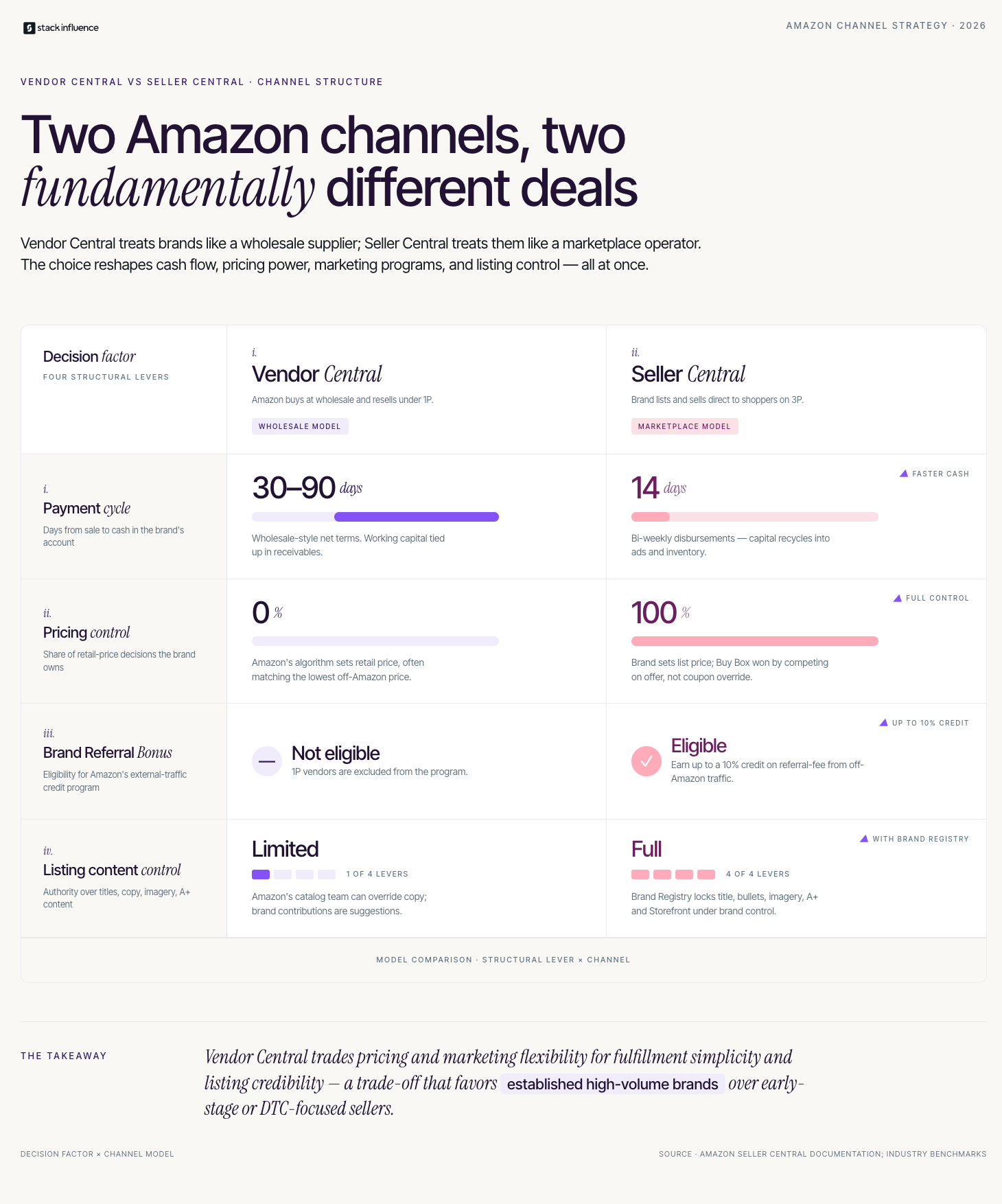
The Vendor Central versus Seller Central decision is one of the most consequential structural choices an Amazon brand makes, and it is rarely reversible in the short term once a vendor relationship is established. The comparison is not simply about fees versus wholesale margins. It is about control, cash flow, brand authority, and the ability to execute growth strategies that depend on platform flexibility.
Seller Central is the third-party (3P) marketplace where brands list products, set their own prices, manage their own inventory, and pay Amazon a referral fee on each sale. Brands either fulfill orders themselves or use Amazon FBA to outsource storage and shipping. The seller retains pricing authority, listing control, and the ability to participate in programs like the Amazon Brand Referral Bonus that reward external traffic generation.
The key decision factors when comparing the two models:
- Pricing control: Seller Central gives you full retail price authority. Vendor Central transfers that authority to Amazon, which can discount your products at any time without your consent, including in ways that undermine your DTC pricing or create channel conflict with retail partners.
- Listing content control: Brand-registered Seller Central accounts have direct control over A+ Content, images, and copy. Vendor Central brands have similar access through Vendor Central's content management tools, but updates can take longer to process and Amazon retains override authority.
- Advertising access: Vendor Central unlocks certain premium advertising formats including Amazon Marketing Services placements and some DSP capabilities not available to third-party sellers. However, Seller Central brands with Brand Registry access can run Sponsored Brands and Sponsored Display campaigns that cover most equivalent use cases.
- Cash flow: Seller Central pays out every two weeks based on actual sales. Vendor Central pays on purchase order terms of 30 to 90 days, which means your cash is tied up in Amazon's payment cycle rather than recycling into inventory purchases.
- Brand Referral Bonus eligibility: This program, which credits Seller Central brand owners a percentage of the sale price for external traffic they drive to Amazon, is not available to Vendor Central accounts. For brands investing in [creator partnerships](INTERNAL: creator partnership strategy for Amazon brands) and off-platform traffic, this is a material financial difference.
From Stack Influence's experience running creator campaigns for eCommerce brands, vendors who switch from Seller Central to Vendor Central without first modeling the Brand Referral Bonus impact frequently discover they have eliminated a 8 to 12% effective cost reduction on their external traffic investment that they can no longer recover. That loss compounds significantly for brands running active [micro influencer campaigns](INTERNAL: micro influencer marketing for Amazon sellers) driving meaningful external traffic volume.
The Vendor Central Readiness Framework
Before accepting a Vendor Central invitation or actively pursuing one, brands should run through a structured evaluation. The Vendor Central Readiness Framework covers five dimensions that determine whether the first-party model creates or destroys value for your specific business situation.
The five dimensions of the Vendor Central Readiness Framework are:
- Margin modeling: Calculate your true net margin under vendor terms at the wholesale price Amazon is offering. Account for payment terms impact on your cost of capital, chargebacks for non-compliance with purchase order requirements, and the removal of Brand Referral Bonus income. Compare that net margin to your current Seller Central contribution margin after FBA fees and advertising.
- Cash flow capacity: Model the impact of net 60 or net 90 payment terms on your inventory purchasing cycle. If you are currently reinvesting Seller Central payouts every two weeks to fund inventory, transitioning to vendor terms with extended payment cycles requires either a credit facility or a reduction in growth rate.
- Pricing strategy alignment: Assess whether Amazon's retail pricing for your products will create channel conflict with your DTC site, your Shopify store, or any retail partners. Amazon's willingness to discount below MAP (minimum advertised price) is a known vendor pain point that affects brand equity and partner relationships.
- Product catalog fit: Evaluate which SKUs in your catalog benefit from the "Sold by Amazon" trust signal enough to justify the trade-offs. High-volume, established SKUs with proven demand are better vendor candidates than new product launches that need pricing flexibility and rapid listing iteration.
- Growth stage alignment: Vendor Central is better suited to brands with stable, high-volume SKUs and the operational infrastructure to meet Amazon's fulfillment compliance requirements. Early-stage brands and DTC brands still optimizing their product-market fit typically benefit more from the flexibility of Seller Central.
Running through the Vendor Central Readiness Framework before any negotiations begin gives brands a documented position rather than an improvised response to Amazon's terms. The framework is most useful when shared across the finance, operations, and marketing functions simultaneously, because the decision affects all three in ways that no single department can fully evaluate alone.
Revisiting the Vendor Central Readiness Framework annually ensures that a decision that made sense at one stage of growth remains the right structural choice as your brand scales.
Should You Accept a Vendor Central Invitation?
The invitation to Vendor Central arrives framed as an opportunity, and for some brands it genuinely is. For others, accepting without negotiation or financial modeling leads to a structural arrangement that is difficult to exit and that constrains the very growth strategies that made the brand attractive to Amazon in the first place.
The honest answer is that Vendor Central is right for a specific type of brand at a specific stage. It works well for brands with commodity or near-commodity products where pricing control is less critical, brands with strong enough volume to negotiate favorable wholesale margins and payment terms, and brands whose primary growth lever is retail shelf presence rather than brand-building and DTC differentiation.
Three scenarios where accepting a Vendor Central invitation makes strategic sense:
- High-velocity SKUs with stable pricing: If your top-selling product has a stable retail price and you are not running active DTC pricing strategies, Amazon's wholesale purchasing removes the logistics overhead of FBA management without meaningful pricing risk.
- Retail distribution ambitions: Vendor status signals to traditional retail buyers that your brand has cleared Amazon's supplier qualification threshold, which can strengthen wholesale pitches to physical retailers who use Amazon performance as a proxy for brand legitimacy.
- Category dominance plays: In some categories, the "Sold by Amazon" badge drives a conversion rate lift significant enough to justify the margin trade-off, particularly in categories where consumer trust in the seller identity is a purchase decision factor.
Across campaigns managed on the Stack Influence platform, brands that retain Seller Central accounts alongside their vendor relationships consistently outperform pure vendor brands on external traffic conversion, because the Seller Central account preserves Brand Referral Bonus eligibility and Amazon Attribution flexibility for creator and influencer campaigns. The hybrid model costs more to manage but produces measurably better economics on off-platform marketing investments.
Measuring Performance as an Amazon Vendor: The Vendor Attribution Stack

Measurement in Vendor Central is structurally different from Seller Central in ways that affect how brands evaluate their marketing investments. Vendors access performance data through the Amazon Retail Analytics (ARA) dashboard, which provides shipped revenue, ordered revenue, glance views, and conversion rate data. However, the attribution capabilities available to Seller Central brands through Amazon Attribution are not natively available to pure Vendor Central accounts in the same form.
Use the Vendor Attribution Stack to build a complete performance picture despite those limitations:
- Layer 1: ARA core metrics. Track ordered revenue (consumer demand signal) separately from shipped revenue (Amazon's purchase orders to you). The gap between these two numbers reveals inventory gaps and demand forecasting accuracy. Monitor glance views and conversion rate weekly for your top ten SKUs.
- Layer 2: Advertising performance. Vendor Central brands running Amazon Marketing Services campaigns have access to campaign-level ROAS, click-through rate, and attributed sales data within the advertising console. Compare advertising cost of sale across campaign types monthly and reallocate toward formats with the strongest return.
- Layer 3: External traffic tracking. Vendor Central brands cannot directly access the Brand Referral Bonus, but they can still use Amazon Attribution to track external traffic performance in some configurations. Brands running creator content and [influencer campaigns](INTERNAL: influencer campaign attribution guide) should work with their vendor manager to confirm Attribution tagging options for their account structure.
Stack Influence's internal campaign data shows that brands maintaining a parallel Seller Central account for external traffic routing recover an average of 9% of their referral fees through the Amazon Brand Referral Bonus program on creator-driven traffic, a recovery that pure Vendor Central accounts cannot access. For brands spending $10,000 per month on creator and influencer traffic, that recovery represents roughly $900 in monthly fee credits that compound significantly over an annual campaign cycle.
Reviewing the Vendor Attribution Stack monthly keeps your performance picture complete and ensures your marketing budget allocation reflects actual channel economics rather than assumed ones.
What Most Vendor Central Guides Get Wrong About Brand Building
Most guides to Amazon Vendor Central focus entirely on the operational and financial mechanics: how purchase orders work, how to avoid chargebacks, how to negotiate better wholesale margins. That focus is useful and necessary. What those guides consistently miss is the brand-building dimension, specifically how the vendor model affects your ability to run the external traffic and creator content strategies that drive organic rank improvement and long-term brand equity.
The core tension is this: Vendor Central optimizes for Amazon's retail efficiency, not for your brand's growth trajectory. Amazon wants predictable inventory and competitive pricing. Your brand wants pricing authority, DTC traffic, and the kind of authentic creator content that builds consumer trust beyond the Amazon marketplace. Those objectives are not impossible to pursue simultaneously, but they require deliberate structural decisions that vendor-only brands frequently do not make.
Three things other Vendor Central guides leave out of the brand-building conversation:
- Creator seeding still works for vendor brands: Even without Brand Referral Bonus eligibility on vendor listings, [product seeding](INTERNAL: product seeding strategy for vendor brands) campaigns that generate UGC and organic social content drive search volume spikes that improve organic rank on Amazon through increased branded search queries, a signal the algorithm responds to regardless of traffic source tagging.
- Amazon storefront pages remain valuable for vendors: Vendor Central brands with Brand Registry can still build and maintain branded storefronts that house their full catalog, run Sponsored Brand ads pointing to the storefront, and use the storefront as the destination for creator content links.
- DTC brand building is a hedge against vendor dependency: Brands that invest in their own [content creator](INTERNAL: content creator partnerships for eCommerce brands) relationships and owned audience while in a vendor relationship maintain the ability to migrate traffic away from Amazon if vendor terms deteriorate, giving them negotiating leverage they would otherwise lack.
Conclusion
Amazon Vendor Central offers real advantages for the right brand at the right stage, but it is not the automatic upgrade it is often positioned as. The Vendor Central Readiness Framework gives you the structure to evaluate the decision honestly, the Vendor Attribution Stack gives you the measurement model to track performance accurately, and the hybrid model gives you the structural flexibility to preserve the marketing capabilities that drive long-term brand growth. For eCommerce sellers navigating the vendor decision, the goal is not to choose between Amazon Vendor Central and Seller Central as if only one can be right. It is to understand which model, or which combination of models, fits the specific economics and growth strategy of your brand right now.
If you are building the external traffic infrastructure that makes both vendor and seller accounts perform at their ceiling, Stack Influence connects eCommerce brands with micro influencers for product seeding campaigns that drive the organic search signals and creator content assets your Amazon listings need.