




Starting an ecommerce business from scratch is technically easier than it was a decade ago, but building one that survives is still difficult. The hard work is proving that customers want the product, each order leaves enough margin, and inventory, fulfillment, content, and customer acquisition can work together.
This guide is for first-time founders, Amazon sellers, Shopify merchants, and emerging DTC brands. It provides a practical path from idea to measured launch without confusing a polished website, early revenue, or social engagement with a viable business.
Key Takeaways
- Validate a specific customer problem before committing to meaningful inventory.
- Calculate contribution margin and break-even customer acquisition cost before choosing a marketing budget.
- Start with one primary product, one main sales channel, and one measurable acquisition loop.
- Build fulfillment, returns, tracking, and customer support before driving a traffic spike.
- Scale only after completed orders confirm demand, margin, delivery quality, and repeat-purchase potential.
What Does Starting an Ecommerce Business From Scratch Require?
Starting an ecommerce business from scratch requires six connected proofs: a real customer problem, a compelling offer, workable unit economics, a suitable sales channel, reliable operations, and repeatable demand. Business registration and store software matter, but neither can compensate for a product people do not want or an order that loses money.
The opportunity is substantial, but growth also attracts more products, ads, and competitors. The U.S. Census Bureau’s quarterly ecommerce report estimated that ecommerce represented 16.9% of total U.S. retail sales in the first quarter of 2026, while ecommerce sales grew 9.8% year over year compared with 3.9% for total retail sales.
An ecommerce business sells through digital channels such as an owned website, marketplace, social platform, or app. It may hold inventory, manufacture products, use a third-party supplier, sell digital goods, or combine models. A broader ecommerce business guide can help compare those options, but the launch sequence remains the same: prove before scaling.
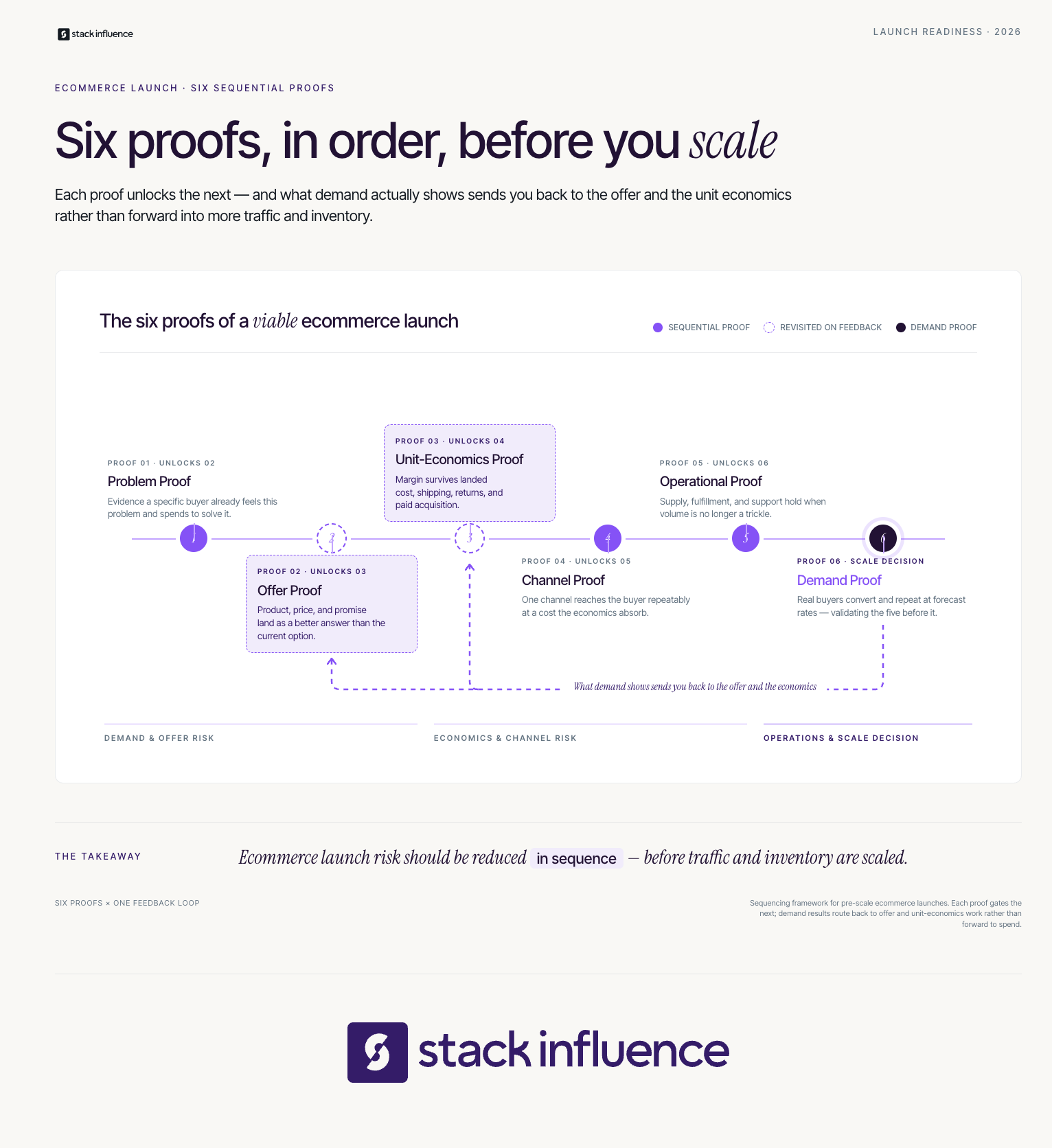
The Proof-to-Scale Framework
The Proof-to-Scale Framework organizes a new ecommerce business around six questions. Each removes a different risk, and the sequence matters because later mistakes cost more. Do not scale traffic before proving the offer or place a large purchase order before proving the economics.
1. Problem Proof
Problem proof establishes that a defined group of customers experiences a frequent, expensive, emotional, or inconvenient problem. “People who like skincare” is a market description. “Travelers who need leak-resistant, carry-on-size skincare storage” is a problem hypothesis that can be tested.
Interview potential buyers, analyze competitor reviews, study marketplace questions, and record the words customers use. The U.S. Small Business Administration’s market-research guidance recommends evaluating demand, market size, location, saturation, and existing prices. Look for evidence that customers already spend time or money solving the problem.
Use a simple validation file with four columns:
- Customer: The exact person or business experiencing the problem.
- Trigger: The event that makes the problem urgent.
- Current Alternative: What the customer uses or buys today.
- Unresolved Friction: What remains slow, costly, confusing, or unsatisfying.
2. Offer Proof
Offer proof determines whether customers understand and value the product. Test with samples, prototypes, small batches, landing pages, waitlists, or buyer interviews before committing to a large inventory order.
A useful offer statement identifies the customer, problem, mechanism, proof, price, and purchasing risk. “A washable, leak-resistant travel organizer designed to separate carry-on liquids in under one minute” is easier to test than “premium organizer.”
Preorders can provide stronger evidence than email signups, but they create real fulfillment obligations. Under the FTC’s Mail, Internet, or Telephone Order Merchandise Rule, sellers need a reasonable basis for the promised shipping time. When no shipping time is stated, the rule generally requires shipment within 30 days, or the seller must obtain consent for a delay or issue a refund.
3. Unit-Economics Proof
Unit-economics proof shows whether one additional order creates cash or consumes it. Gross revenue is not the answer. Calculate contribution margin before marketing:
Selling price
minus landed product cost
minus payment or marketplace fees
minus pick, pack, and outbound shipping
minus discounts
minus an expected return, refund, and damage reserve
equals contribution margin before marketing
Break-even customer acquisition cost is the contribution margin available before marketing. If a $50 order leaves $14 after variable costs, spending more than $14 to acquire it creates a first-order loss unless repeat purchasing is proven and included deliberately.
Landed cost should include product, freight, duties, inspection, prep, packaging, and transportation into fulfillment. Founders considering Fulfillment by Amazon (Amazon FBA) can use this margin-first product sourcing guide to pressure-test quotes. Shopify founders should separate the subscription from payment processing, apps, domains, creative, fulfillment, and marketing, as explained in this 2026 Shopify cost guide.
4. Channel Proof
Channel proof identifies where the customer already shops and which channel supports the product’s economics. Shopify gives direct-to-consumer (DTC) brands control over merchandising, email capture, bundles, customer data, and retention. Amazon offers marketplace demand and familiar checkout, but Amazon sellers must account for fees, fulfillment costs, and marketplace rules.
Amazon currently charges $0.99 per item sold on the Individual plan or $39.99 per month on the Professional plan, plus applicable selling fees. Amazon says FBA costs depend on the product and services used. This Amazon beginner selling guide compares FBA with merchant fulfillment.
Use one primary channel at launch:
- Shopify-first: Useful when education, bundles, subscriptions, customer ownership, or a distinctive brand experience drives conversion.
- Amazon-first: Useful when buyers already search the marketplace for the category and marketplace trust reduces purchasing friction.
- Hybrid: Useful after inventory, pricing, attribution, and fulfillment can support two destinations without fragmenting the initial test.
The Amazon Influencer Program is a creator affiliate program, not a seller-account type. Eligible creators can curate an Amazon presence and earn on qualifying purchases. Founders should separate creator storefront traffic from their own marketplace operations before designing an Amazon influencer campaign.
5. Operational Proof
Operational proof confirms that the business can accept, fulfill, support, and reconcile real orders. Place test orders through expected devices and payment methods. Confirm taxes, shipping rates, inventory deductions, emails, tracking, returns, refunds, and customer-service ownership.
For physical products, define:
- supplier lead time and reorder quantity
- quality-control checks
- units available versus units reserved
- order cutoff and handling time
- lost, damaged, and returned-item procedures
- support response standards
- cash needed for the next purchase order
The right fulfillment setup depends on SKU size, fragility, order volume, sales channels, and return requirements. This ecommerce fulfillment guide provides a structured way to evaluate FBA, third-party logistics providers, and other fulfillment workflows.
6. Demand Proof
Demand proof shows that the business can repeatedly attract qualified prospects and convert some of them without one lucky post or discounted launch. Start with one acquisition loop, such as search to email to purchase, creator content to product page, or marketplace search to listing to sale.
New brands need evidence, not just reach. Demonstrations, comparisons, customer questions, founder explanations, and user-generated content (UGC) can reduce purchasing uncertainty. A controlled ecommerce social media marketing system should connect each asset to an audience, destination, and measurable next action.
Creator campaigns are one way to generate both distribution and reusable proof. During a three-month Stack Influence new-product campaign for Targus, the case study recorded 120 creator promotions while average monthly unit sales increased from 56 to 221 and Amazon Best Seller Rank moved from #151,547 to #47,811. The result is a specific campaign example, not a forecast for a new brand, and performance varies by product, category, price, marketplace conditions, creative quality, and execution.
How Much Does It Cost to Start an Ecommerce Business?
There is no universal startup cost for an ecommerce business. Required cash depends on the product model, inventory commitment, formation fees, software, fulfillment, creative, and marketing tests. Build the budget from the actual launch sequence plus a working-capital reserve, not a generic online estimate.
Build a startup cost stack with these categories:
- Validation: Samples, prototypes, customer interviews, and test landing pages.
- Legal and administrative: Registration, licenses, permits, insurance, bookkeeping, and professional advice.
- Inventory: Product cost, freight, duties, quality checks, prep, and packaging.
- Commerce infrastructure: Platform, domain, theme, apps, email, analytics, and payment costs.
- Fulfillment: Storage, supplies, pick and pack, postage, returns, and damage reserves.
- Demand generation: Photography, video, product seeding, ads, creators, and launch offers.
- Working capital: Cash needed to reorder before the first inventory cycle fully pays back.
The SBA’s launch guidance notes that structure, registration, taxes, licenses, permits, insurance, and location-specific requirements can vary. Founders should verify state, local, category, and tax obligations with qualified professionals.
Platform fees are only one line. Recheck current terms at launch, then model the cash conversion cycle: when inventory is paid for, when it becomes sellable, when platforms pay out, and when the next purchase order is due.
A 12-Week Ecommerce Launch Plan
A 12-week plan provides structure without pretending every product follows the same schedule. Custom manufacturing, regulated categories, international sourcing, and complex software can take longer. Treat the timeline as a decision sequence, not a promise.
Weeks 1 and 2: Define the Customer and Problem
Complete at least ten substantive customer conversations, examine competing offers, and document triggers, alternatives, objections, and pricing expectations. Select one problem and customer. Reject ideas that receive polite interest but no evidence of urgency.
Weeks 3 and 4: Test the Offer
Obtain samples or build a prototype. Create the promise, price hypothesis, core images, and a simple landing page. Ask prospects to join a product-specific waitlist, request a sample, place a compliant preorder, or agree to a purchase interview.
Weeks 5 and 6: Finalize Economics and Operations
Calculate landed cost, contribution margin, break-even acquisition cost, reorder point, and working-capital needs. Compare fulfillment options, test packaging, choose the legal structure, register where required, arrange banking and bookkeeping, and confirm category obligations.
Weeks 7 and 8: Build the Store and Measurement
Create one complete product page, not a large unfinished catalog. Add shipping, returns, privacy, contact, and support information. Configure analytics, campaign names, conversion events, marketplace tags, and reporting before traffic arrives.
Weeks 9 and 10: Run a Controlled Soft Launch
Sell to a limited but relevant audience. Watch questions, checkout abandonment, delivery problems, product use, refunds, and support tickets. Improve the offer and operations before increasing traffic.
Weeks 11 and 12: Scale One Proven Loop
Increase volume only through the channel with the clearest combination of qualified traffic, conversion, contribution margin, and operational reliability. Keep the test narrow. Adding products, platforms, countries, ads, and creators at once obscures what worked.
How Should You Measure a New Ecommerce Business?
A new ecommerce business should measure demand, conversion, unit economics, operations, and retention as one connected system. Traffic and revenue are useful, but neither proves viability alone. The central question is whether the business can acquire and serve a customer while preserving enough contribution margin and cash to fulfill, support, and replenish inventory.
Use the Launch Measurement Stack:
- Demand indicators: Qualified sessions, product-page engagement, email capture, creator link clicks, and branded search.
- Conversion indicators: Add-to-cart rate, checkout initiation, purchase conversion rate, and offer-specific conversion.
- Economic outcomes: Average order value, contribution margin, customer acquisition cost, refund-adjusted revenue, and first-order profit.
- Operational outcomes: On-time shipment, delivery exceptions, damage rate, support contacts, cancellation rate, and return rate.
- Retention outcomes: Repeat purchase, time to second order, cohort revenue, subscription retention, and referral behavior.
Google Analytics 4 ecommerce metrics report website or app purchases. For Amazon sellers, Amazon Attribution measures how eligible non-Amazon channels such as social, search, email, video, and influencer campaigns contribute to shopping activity on Amazon.
Eligible U.S. brand owners enrolled in the program may also receive an Amazon Brand Referral Bonus averaging 10% of qualifying attributed sales. Treat the bonus as part of contribution analysis, not as gross sales. Attribution still has limits because buyers may encounter several touchpoints, switch devices, purchase later, or be influenced by untracked word of mouth.
The First 30 Orders Scorecard is a practical checkpoint, not an industry rule. After 30 fulfilled orders, assess contribution margin before founder labor, return patterns, delivery consistency, repeated customer language, and whether one acquisition source can be tested again. Thirty orders do not prove product-market fit, but they reveal more than impressions or a launch-day revenue screenshot.
Why Many Ecommerce Startups Look Healthier Than They Are
Many ecommerce startups look healthy because dashboards emphasize gross sales, traffic, followers, and return on ad spend while hiding inventory risk, refunds, discounts, labor, and cash timing. Revenue can grow while financial stability declines.
Watch for five false positives:
- Revenue without margin: Sales rise, but fulfillment, discounts, fees, returns, and acquisition consume the order.
- Demand created only by discounts: Customers buy the promotion rather than the underlying value proposition.
- A viral spike without repeatability: One post sells inventory, but the business cannot reproduce the audience or creative.
- Large purchase orders mistaken for confidence: Inventory commitment increases risk before demand is proven.
- Multi-channel activity without attribution: Shopify, Amazon, paid social, email, and creator traffic operate simultaneously without consistent tracking.
The corrective is sequencing. Keep the line narrow, document assumptions, test one growth lever at a time, and review contribution margin and cash weekly. Expand inventory after evidence improves, not merely to secure a lower quote.
When Should You Add Influencer Marketing?
Add influencer marketing after the product can be shipped reliably, the product page explains the offer, the economics can absorb product and campaign costs, and attribution is configured. Creators can accelerate discovery and generate useful content, but sending traffic to an unproven offer or unstable fulfillment process usually magnifies existing weaknesses.
For Shopify influencer marketing, give each creator a trackable link, code, landing page, or campaign identifier and define content reuse in advance. This Shopify influencer marketing playbook connects product seeding, affiliate relationships, UGC, and measurement.
For Amazon influencers, distinguish affiliate storefront activity from brand-managed campaigns. Use Amazon Attribution where eligible, direct traffic to the correct listing or Amazon storefront, and evaluate content quality, attributed shopping activity, contribution margin, and reuse value separately.
Stack Influence is a micro-influencer platform built around gifted-first product seeding, vetted creator activation, campaign coordination, UGC, and completed-post accountability. Its workflow is designed for ecommerce brands that want sourcing and execution managed as one campaign. The influencer seeding guide explains gifting, product-for-content arrangements, and paid sponsorships.
When creators receive free, discounted, or reimbursed products, the material relationship should be disclosed clearly. The FTC’s social media disclosure guidance states that free or discounted products can create a material connection that must be disclosed. Brands should set expectations, monitor compliance, and preserve creators’ ability to express honest opinions.
Starting an Ecommerce Business From Scratch: Build Proof Before Scale
Starting an ecommerce business from scratch is not primarily a website project. It is a sequence of proofs that turns an uncertain idea into a product, an order, a fulfilled promise, and eventually a repeatable operating system.
Start with one customer problem, one offer, one contribution-margin model, one primary channel, and one acquisition loop. Once the business can deliver those pieces reliably, the next step is to increase volume carefully and evaluate whether creator content, product seeding, marketplace expansion, or paid acquisition can compound what is already working.