




Shopify’s advertised subscription is only the first layer of its actual cost. Payment processing, apps, themes, domains, tax tools, marketplace connections, retail hardware, and customer acquisition can raise the monthly total considerably.
For founders, DTC brands, and Amazon sellers adding a direct-to-consumer channel, the useful question is not only “how much does Shopify cost?” It is “what will Shopify cost at my sales volume, with my payment mix and operating stack?” This guide answers both questions using current U.S. pricing and a practical cost model.
Key Takeaways
- Shopify Starter costs $5 per month, while a full online store starts with Basic at $39 monthly or $29 per month on annual billing.
- Annual billing lowers the effective subscription price, but Shopify charges the full year upfront.
- Payment processing usually costs more than the plan itself once sales begin, so plan selection should include a break-even calculation.
- Apps, domains, themes, POS Pro, marketplace syncing, and Shopify Tax can materially change the real budget.
- Marketing, inventory, fulfillment, and creator campaigns are ecommerce operating costs, not Shopify subscription fees.
How Much Does Shopify Cost Per Month?
Shopify costs $5 per month for Starter, while a full online store starts with Basic at $39 month to month or $29 per month on annual billing. Grow costs $105 or $79, Advanced costs $399 or $299, and Shopify Plus starts at $2,300 per month for standard three-year agreements.
As of July 2026, the current U.S. plan prices are:
- Starter: $5 per month.
- Basic: $39 month to month, or $29 per month when billed annually.
- Grow: $105 month to month, or $79 per month when billed annually.
- Advanced: $399 month to month, or $299 per month when billed annually.
- Plus: Starts at $2,300 per month on a three-year term, or $2,500 per month on a one-year term for standard setups and integrations.
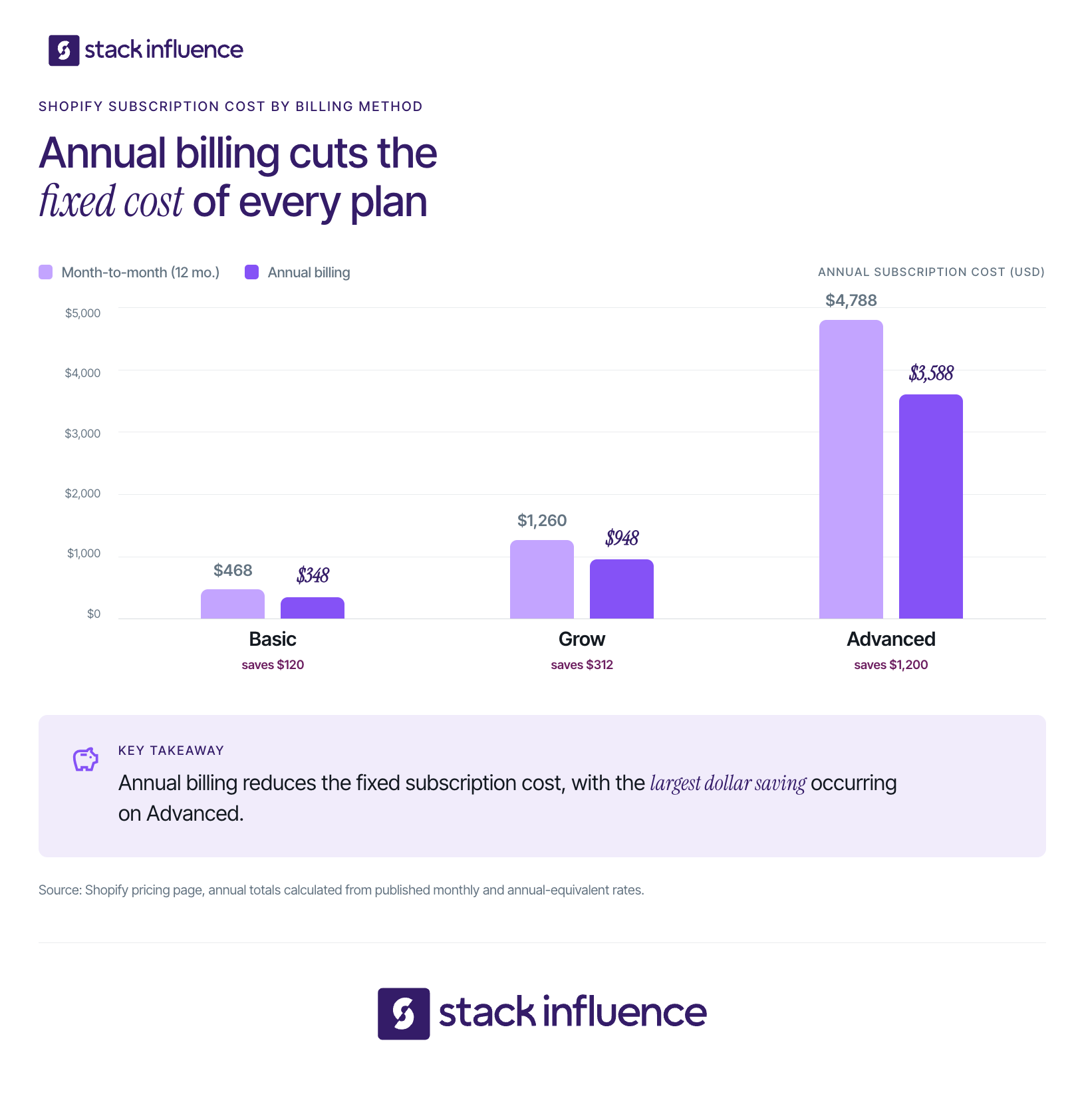
The annual option is an effective monthly rate, not a monthly installment plan. Shopify charges $348 upfront for Basic, $948 for Grow, and $3,588 for Advanced. Paying month to month for 12 months totals $468, $1,260, and $4,788 respectively, so annual billing saves $120 on Basic, $312 on Grow, and $1,200 on Advanced.
Shopify’s billing overview confirms that the full annual amount is collected upfront in exchange for a lower effective monthly price.
Shopify also advertises a three-day free trial and, for many new accounts, a promotional rate of $1 per month for the first three months. Treat that as an introductory offer, not the long-term price used in a profitability forecast. The official Shopify pricing page displays the current promotion and standard rates.
Shopify Plans Explained
The cheapest plan is not always the lowest-cost plan after transaction fees, staff needs, and operational add-ons are included.
Starter
The Shopify Starter plan is a lightweight option for social, messaging, email, and shareable product links. It costs $5 per month, includes a simple storefront and checkout, and charges a 5% transaction fee with Shopify Payments. It is designed for testing demand rather than building a fully customizable standalone website.
Basic
Basic is the normal starting point for a standalone ecommerce store. It includes a full online store, unlimited products, hosting, SSL, inventory management across up to 10 locations, and reporting, but no additional staff accounts.
Its U.S. standard online card rate is 2.9% plus 30 cents, and its third-party-provider surcharge is 2%.
Grow
Grow adds five staff accounts, lowers the standard online rate to 2.7% plus 30 cents, and reduces the third-party-provider surcharge to 1%. It becomes practical when team access or processing savings recover the higher subscription.
Shopify recommends considering expected sales volume and payment setup when evaluating a plan upgrade.
Advanced
Advanced supports 15 staff accounts, enhanced support, higher API limits on selected interfaces, a 2.5% plus 30-cent standard online rate, and a 0.6% third-party-provider surcharge.
High-volume sellers should compare its $299 annual-billing equivalent against processing savings and operational requirements rather than upgrading solely because revenue reached a predetermined level.
Plus
Shopify Plus adds enterprise checkout customization, priority support, higher API capacity, unlimited staff accounts, expanded B2B capabilities, and included POS Pro locations. Standard U.S. pricing starts at $2,300 per month on a three-year term or $2,500 on a one-year term, while complex businesses may use a variable platform fee.
Shopify Plus pricing explains the contract structure and notes that migration, custom development, third-party apps, and themes can create additional expenses.
The Six-Layer Shopify Cost Stack
A defensible Shopify budget separates platform fees from the broader cost of running and growing an ecommerce business. This prevents software costs, pass-through transaction costs, and customer-acquisition spending from being blended into one unhelpful number.
Use this six-layer cost stack:
- Platform layer: Shopify subscription, hosting, SSL, and plan-specific features.
- Transaction layer: Card processing, premium or international card rates, third-party gateway surcharges, and tax-calculation fees.
- Storefront layer: Custom domain, theme, apps, development, design, and maintenance.
- Channel layer: POS Pro, retail hardware, marketplace syncing, and international selling tools.
- Operations layer: Shipping labels, fulfillment, returns, customer support, and fraud-related costs.
- Growth layer: Advertising, email, SMS, affiliates, creator campaigns, product seeding, and UGC production.
The core monthly formula is:
Shopify total cost = plan fee + payment fees + third-party transaction fees + apps + channel add-ons + tax-tool fees + amortized one-time costs.
Inventory, fulfillment, and marketing should then be layered on to calculate the total cost of operating the store. This distinction is especially useful when building a complete ecommerce launch cost checklist.
How Much Does Shopify Take Per Sale?
Shopify takes a payment-processing fee on each sale, and the amount depends on the plan, card type, country, and payment gateway. In the United States, standard online Shopify Payments rates are 2.9% plus 30 cents on Basic, 2.7% plus 30 cents on Grow, and 2.5% plus 30 cents on Advanced.
For a $100 standard online card order, the processing cost is:
- Basic: $3.20.
- Grow: $3.00.
- Advanced: $2.80.
Premium card rates are higher at 3.5%, 3.3%, and 3.1% plus 30 cents respectively. Shopify also lists an additional 1% for international online payments on these plans. The exact card mix matters because two stores with the same revenue can have different payment costs.
Using Shopify Payments avoids Shopify’s separate third-party transaction surcharge. If a seller uses an outside payment provider, the provider’s own processing fees still apply, then Shopify adds 2% on Basic, 1% on Grow, 0.6% on Advanced, or 0.2% on Plus.
Shopify Payments is available only in supported countries and for eligible businesses. Sellers should verify Shopify Payments country eligibility before building a forecast that assumes Shopify Payments rates.
The Shopify Plan Break-Even Test
The plan break-even test identifies the sales volume at which lower payment rates recover the extra subscription cost. It is more reliable than choosing a plan from a generic label such as “small business” or “growing brand.”
Use this equation:
Monthly break-even card volume = additional monthly plan cost ÷ processing-rate reduction.
Using Shopify’s current U.S. standard online card rates produces the following estimates:
- Basic to Grow with annual billing: The effective plan difference is $50 per month and the rate reduction is 0.2 percentage points. Break-even volume is approximately $25,000 per month, or $300,000 per year.
- Basic to Grow with monthly billing: The plan difference is $66 per month. Break-even volume is approximately $33,000 per month.
- Grow to Advanced with annual billing: The effective plan difference is $220 per month. Break-even volume is approximately $110,000 per month, or $1.32 million per year.
- Grow to Advanced with monthly billing: The plan difference is $294 per month. Break-even volume is approximately $147,000 per month.
The fixed 30-cent fee is the same across these three standard online rates, so it cancels out of this simplified comparison. The result changes for in-person sales, premium cards, international payments, refunds, and mixed gateways. Shopify also notes that exact upgrade economics vary by region and payment setup.
The third-party-provider calculation can move the upgrade point much lower. With annual billing, Basic to Grow saves one percentage point in Shopify’s added surcharge, creating a simple break-even near $5,000 in monthly third-party-processed volume.
Grow to Advanced saves 0.4 percentage points, creating a break-even near $55,000 per month. These calculations do not include the external provider’s own processing fees.
Extra Costs That Change the Real Shopify Budget

The base plan includes hosting, unlimited bandwidth, and SSL, but it does not eliminate every technology and operating expense. Shopify states that it has no setup fee, yet optional and usage-based charges can still create a meaningful difference between the advertised price and the amount on the monthly bill.
Domain and Business Email
Every store receives a free myshopify.com address. A branded domain is purchased or renewed separately, and the price depends on the top-level domain selected.
Shopify’s domain purchasing guide states that domains are registered for one year, renew annually, and are billed separately from the plan. Shopify does not provide email hosting, so a business email service is another independent expense.
Themes and Design
Shopify offers free themes, while premium themes are one-time purchases for an individual store. The official Shopify Theme Store currently displays paid examples at $230, $320, $350, and $360.
A theme price is not the same as a finished storefront budget. Photography, copy, custom sections, accessibility work, migration, and developer support can cost more than the theme itself.
Apps
App expenses can be recurring, usage-based, or one-time. Some developers also bill merchants outside Shopify, which means those charges might not appear in the Shopify admin.
Shopify’s app billing documentation recommends reviewing each app’s billing cycle, usage charges, and external subscription terms. A disciplined budget should assign each paid app to a measurable job, then remove overlapping tools.
POS Pro and Retail Hardware
Casual in-person selling is included with paid plans, but permanent retail locations may need POS Pro. Shopify POS pricing lists POS Pro at $89 per month per location when billed yearly, with hardware purchased separately.
A one-location retailer on Basic therefore has a known software floor of $118 per month on annual-equivalent pricing before card processing, hardware, apps, and domain costs.
Marketplace and Tax Charges
Shopify currently includes 50 synced marketplace orders per month. After that, its pricing page lists a 1% fee on synced marketplace orders, capped at $99 per month. This matters for Amazon sellers using Shopify as a central catalog or order-management layer.
Shopify Tax pricing changed for stores created on or after May 13, 2026. For a U.S. non-Plus store created on or after that date, Shopify Tax is free until $100,000 in lifetime global sales, then charges 0.35% on applicable transactions, capped at 99 cents per order.
Stores created before May 13, 2026 use a $100,000 annual threshold. For U.S. stores on Basic, Grow, or Advanced, the post-threshold rate is 0.35%, with a 99-cent maximum per order and a $5,000 annual maximum per region. Review the current Shopify Tax pricing against the store’s creation date.
Three Known-Cost Shopify Scenarios
These examples isolate the annual-billing plan equivalent and standard online card fees. They exclude apps, domains, themes, premium cards, international payments, taxes, refunds, shipping, and marketing.
- New store: At $10,000 in monthly sales from 200 orders, Basic costs $290 in percentage fees, $60 in per-order fees, and $29 for the plan, totaling $379.
- Growing store: At $50,000 from 1,000 orders, Grow costs $1,350 in percentage fees, $300 in per-order fees, and $79 for the plan, totaling $1,729. Basic would total $1,779 under the same assumptions.
- High-volume store: At $150,000 from 3,000 orders, Advanced costs $3,750 in percentage fees, $900 in per-order fees, and $299 for the plan, totaling $4,949. Grow would total $5,029.
These scenarios demonstrate why the subscription price alone can be misleading. Processing costs become the dominant Shopify expense as sales volume increases. The calculations use Shopify’s published U.S. plan prices and standard online card rates.
Shopify Cost Is Not the Same as a Growth Budget
A Shopify subscription creates the commerce infrastructure, but it does not create demand by itself. Ecommerce brands still need a separate acquisition and retention budget for advertising, email, SMS, affiliates, creator partnerships, content, and conversion work.
A Shopify influencer marketing budget should separate creator activation, product cost, shipping, content rights, amplification, and measurement. The Shopify influencer marketing playbook, ecommerce influencer-seeding workflow, and guide to UGC for ecommerce show how those costs connect to storefront traffic and reusable creative.
Stack Influence is a micro-influencer marketing platform built around gifted-first product seeding, vetted creator activation, campaign coordination, UGC generation, and completed-post accountability. Its Shopify creator campaign solution belongs in the growth layer rather than the Shopify software fee.
Amazon sellers operating Amazon FBA and Shopify should also maintain separate channel ledgers. Amazon storefront activity, Amazon influencers and the Amazon Influencer Program, Amazon Attribution, and the Brand Referral Bonus belong to the Amazon channel.
Amazon’s official guide explains that Amazon Attribution measures the on-Amazon impact of non-Amazon marketing. It uses a 14-day, last-touch model, and eligible U.S. seller brand owners can use attributed traffic in connection with the Brand Referral Bonus program.
Which Shopify Plan Should You Choose?
The right Shopify plan is the lowest tier that supports your current team, sales channels, reporting, and payment economics without forcing unnecessary workarounds. Most new standalone stores can begin on Basic, while Grow and Advanced become more attractive when staff access, operational features, or lower transaction rates justify the higher subscription.
Use this decision sequence:
- Choose Starter when the goal is to test products or sell through social and messaging links without building a full storefront.
- Choose Basic when one store owner needs a complete website and standard ecommerce features.
- Choose Grow when the business needs up to five staff accounts or exceeds the calculated payment-fee break-even point.
- Choose Advanced when sales volume, 15 staff accounts, integrations, support, or lower payment fees justify the higher fixed cost.
- Evaluate Plus when enterprise checkout, B2B, multi-store, API, support, and governance requirements make a contracted platform appropriate.
Do not upgrade only because revenue crossed a round number. Run the fee calculation, identify the operational feature that removes work or risk, and compare the annual savings with the annual commitment.
The Shopify Cost-Control Dashboard
A monthly cost review should connect Shopify expenses to order economics rather than merely compare invoices. Track:
- Fixed platform cost: Plan, POS subscriptions, and fixed apps.
- Payment cost rate: Payment and transaction fees divided by processed sales.
- Software cost per order: Plan, app, and channel-software costs divided by orders.
- Variable technology cost: Usage-based apps, marketplace sync, and tax-tool fees.
- Contribution margin: Net revenue minus product, fulfillment, payment, software, returns, and acquisition costs.
- Upgrade savings: Current-plan fees compared with another plan using the same order mix.
Leading indicators include order count, average order value, card mix, app count, and staff requirements. Outcome metrics include contribution margin, acquisition cost, payback period, repeat purchase rate, and profit.
Review subscriptions monthly and rerun the break-even test quarterly or after a material sales shift. Use a consistent attribution window and separate correlation from causation. The influencer marketing ROI checklist provides a parallel model for creator-led growth.
The Real Answer to How Much Shopify Costs
The minimum Shopify price is $5 per month, but a full ecommerce store generally starts at $39 monthly or an effective $29 with annual billing. The real total depends on sales volume, card mix, gateway choice, apps, theme, domain, retail setup, marketplace activity, tax tools, and the growth systems surrounding the store.
Build two forecasts before choosing a plan: a 12-month fixed-cost model and a variable-cost model tied to orders and revenue. Then apply the break-even test rather than upgrading by instinct. Once the platform budget is clear, allocate the remaining capital to inventory, fulfillment, retention, and measurable customer acquisition so the store has both infrastructure and demand.