




Amazon's marketplace has more than 9.7 million registered sellers worldwide, according to Marketplace Pulse, and the number keeps climbing. For eCommerce sellers entering the platform now, that statistic is both an opportunity and a warning. The opportunity is a marketplace with 300 million active customer accounts. The warning is that getting lost is easy if you start without a system. This guide walks you through how to sell on Amazon for beginners in a way that is structured, realistic, and built for the market conditions of 2026, not 2018. You will leave with a clear launch sequence, a measurement framework, and an understanding of the traffic levers that most beginner guides ignore entirely.
Key Takeaways
- Amazon offers two primary selling plans: Individual (no monthly fee, $0.99 per sale) and Professional ($39.99/month), with Professional being the right choice for anyone planning to sell more than 40 units monthly.
- Fulfillment by Amazon (FBA) handles storage, packing, and shipping but charges fees that must be factored into your margin calculation before selecting a product.
- Product research is the highest-leverage decision a beginner makes; a product with weak demand or an entrenched competitor set will not perform regardless of how well everything else is executed.
- Off-platform traffic through creator partnerships and the Amazon Brand Referral Bonus program can significantly lower your effective cost of customer acquisition compared to relying on Amazon PPC alone.
- New sellers who build an external traffic strategy from day one consistently outpace those who depend exclusively on Amazon's internal algorithm for organic visibility.
How Do You Actually Set Up an Amazon Seller Account?
Before a single product goes live, you need a seller account. The process is straightforward but has a few decision points that matter more than most beginner guides acknowledge. Head to Seller Central and choose between the Individual and Professional plans. If you expect to sell more than 40 units per month, Professional is cheaper per unit and unlocks advertising tools you will need.
Amazon will ask for a valid government-issued ID, a bank account for disbursements, a credit card for fees, and tax information. In most cases, account verification takes 24 to 48 hours, though some categories require additional documentation. Set up two-factor authentication immediately; account hijacking is a real risk for new sellers with no support history.
Key setup decisions to make before you list your first product:
- Business entity: Selling as a sole proprietor is fine to start, but an LLC provides liability separation and looks more credible to suppliers.
- Seller name: This becomes your storefront name and is visible to buyers. Choose something brand-forward, not a generic placeholder you will want to change later.
- Brand Registry eligibility: If you have a registered trademark, enroll in Amazon Brand Registry immediately. It unlocks A+ Content, Sponsored Brands ads, and stronger counterfeit protection.
- Category approval: Some categories (grocery, beauty, topicals) require ungating. Research whether your product category needs approval before committing to a sourcing decision.
Once your account is verified and configured, resist the urge to list immediately. The next step, product research, determines whether your Amazon business has a viable foundation or a structural problem that no amount of optimization can fix.
What Makes a Product Worth Selling on Amazon?

Product selection is where most beginner Amazon sellers make their most expensive mistake. The common error is choosing a product based on personal interest or surface-level search volume rather than running the numbers on demand, competition, and margin simultaneously.
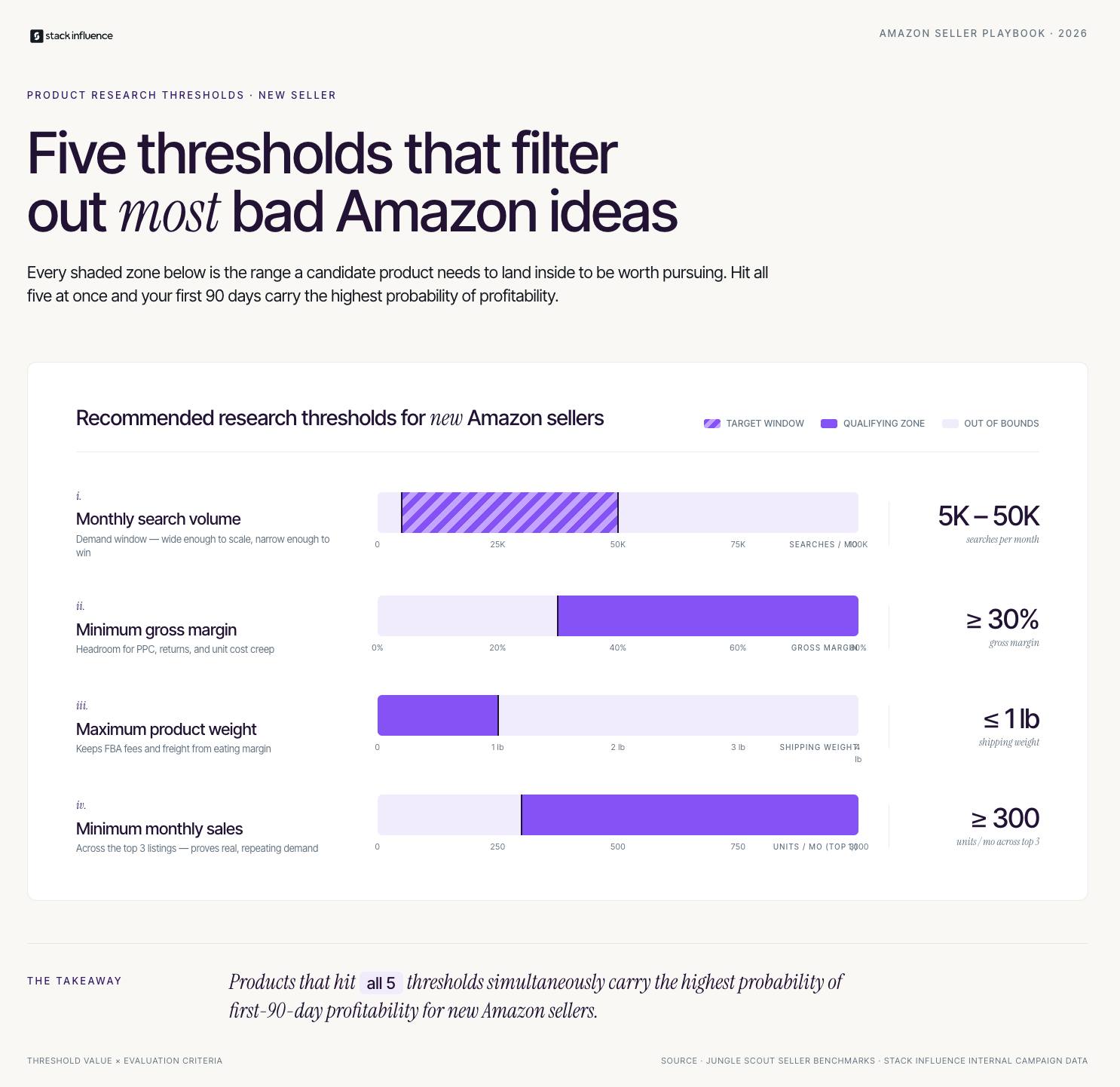
A viable Amazon product in 2026 meets three criteria. First, it has consistent, proven demand: ideally 300 or more monthly sales across the top three listings in its subcategory, which you can estimate using tools like Jungle Scout or Helium 10. Second, the existing competition has identifiable weaknesses in their reviews, images, or listing quality that you can address. Third, the landed cost (product plus shipping plus FBA fees) leaves you with a gross margin of at least 30% before advertising.
Use this framework when evaluating any product candidate:
- Monthly search volume: Look for keywords with 5,000 to 50,000 monthly searches. Below that is too thin; above that typically means entrenched competition.
- Review velocity: If the top three sellers have more than 1,000 reviews each, entering without a differentiated product and a review acquisition strategy is a slow path to losing money.
- Weight and dimensions: Products that are small and light cost significantly less to ship and store under FBA. Aim for under one pound and under one cubic foot to stay in the lowest fee tiers.
- Seasonality: Use Google Trends to confirm the product has year-round demand before committing to inventory.
- Supplier availability: Confirm you can source the product domestically or from a verified international supplier with a minimum order quantity you can afford to test.
Across campaigns managed on the Stack Influence platform, brands that validated product-market fit with small creator seeding runs before scaling their Amazon listings saw a 40% lower rate of slow-moving inventory compared to brands that launched at full volume without external validation. Seeding a product to ten micro influencers before your main inventory order is one of the lowest-cost product research tools available to new sellers.
FBA vs FBM: Which Fulfillment Model Is Right for You?
Fulfillment method is the second-biggest structural decision after product selection. Amazon FBA means you ship your inventory to Amazon's warehouses and Amazon handles picking, packing, shipping, and customer returns. Fulfillment by Merchant (FBM) means you store and ship orders yourself or through a third-party logistics provider.
For most beginners, FBA is the right starting point. Prime eligibility alone meaningfully improves conversion rates because a large percentage of Amazon shoppers filter search results by Prime delivery. FBA also removes the operational complexity of managing shipping at the early stage when you are still learning listing optimization, advertising, and product development simultaneously.
The case for FBM is narrower but real:
- Oversized or heavy products: FBA fees for large items can exceed $20 per unit, making FBM or a 3PL cheaper even after accounting for your own labor.
- Products with long storage cycles: FBA charges monthly storage fees, and items sitting in a warehouse for more than 365 days incur long-term storage surcharges.
- Custom or handmade goods: If your product requires individual customization before shipping, FBA's standardized process does not accommodate it.
- High-return categories: In apparel and shoes, FBA return rates can be significant, and each return creates additional FBA processing fees.
Calculate your total landed cost for both models using Amazon's FBA Revenue Calculator before committing. Most new sellers underestimate FBA fees by 15 to 20% because they forget to include inbound shipping to the warehouse, prep service fees, and the storage cost for units that do not sell in the first 60 days.
The Amazon Seller Launch Sequence
Launching on Amazon without a structured approach means your listing goes live to very few buyers, generates no initial sales velocity, and drops into algorithmic obscurity within weeks. The Amazon Seller Launch Sequence is a five-step process designed to build ranking momentum from day one.
The five steps of the Amazon Seller Launch Sequence are:
- Listing optimization: Write a title that leads with the primary keyword and includes two to three secondary keywords naturally. Write five bullet points that address the top buyer objections in your category's one-star reviews. Use all available image slots with a hero shot, lifestyle images, and an infographic.
- Initial inventory sizing: Send enough inventory for 60 to 90 days of projected sales. Running out of stock resets your ranking and is one of the most damaging things a new seller can do in the first 90 days.
- Launch pricing: Price 10 to 15% below your target long-term price for the first 30 days to accelerate early sales velocity and review accumulation without using coupon codes, which can attract low-quality reviewers.
- PPC activation: Launch Sponsored Products campaigns on day one with automatic targeting to gather keyword data. After two weeks, shift to manual campaigns targeting the highest-converting search terms from your automatic campaign data.
- External traffic activation: Begin driving off-Amazon traffic through creator content and social promotion in weeks two through four. This is where the Amazon Seller Launch Sequence separates from what most beginner guides recommend.
Referencing the Amazon Seller Launch Sequence throughout your first 90 days gives you a clear check-in point at each stage. Most sellers who stall do so because they complete steps one through three and assume the work is done. Steps four and five are where compounding growth actually begins.
The fifth step of the Amazon Seller Launch Sequence is the one most beginner resources skip entirely, and it is often the difference between a listing that ranks organically by month three and one that remains dependent on paid traffic indefinitely.
Measuring What Actually Matters: The Amazon Seller Metrics Stack
Tracking the right numbers from the start prevents the most common beginner failure: optimizing for the wrong signal. Many new sellers focus exclusively on total revenue when the more important numbers are margin per unit, advertising cost of sale, and organic rank progression.
Use a three-tier measurement framework called the Amazon Seller Metrics Stack:
- Tier 1: Unit Economics. Track contribution margin per unit (revenue minus COGS, FBA fees, and a per-unit advertising allocation). This is your true profit per order, and it should be positive before you scale volume.
- Tier 2: Traffic Quality. Monitor your conversion rate (CVR) relative to your category average. Amazon's average CVR across all categories is roughly 10 to 15%, per Jungle Scout's seller report. If your CVR is below 8%, a listing problem is suppressing sales that traffic is generating.
- Tier 3: Channel Attribution. Use Amazon Attribution to tag all off-platform traffic sources, including influencer links, social posts, and email campaigns. Sellers who tag correctly can qualify for the Amazon Brand Referral Bonus, which returns up to 10% of the sale price as a credit against referral fees for traffic you drove from outside Amazon.
Stack Influence's internal campaign data shows that Amazon sellers who implement Attribution tagging before their first influencer campaign recover an average of 8 to 12% of their referral fees through the Brand Referral Bonus, which materially improves the ROI calculation for external traffic investments. That credit compounds over time as external traffic volume grows.
Revisiting the Amazon Seller Metrics Stack weekly for the first 90 days will surface problems at the unit economics level before they become expensive at the traffic investment level.
What New Amazon Sellers Overlook About Building External Traffic Early
Most beginner guides to how to sell on Amazon focus entirely on the platform itself: listing optimization, PPC campaigns, and review strategies. The advice is accurate but incomplete. The sellers who build durable businesses on Amazon are almost always the ones who treat off-Amazon traffic as a first-90-days priority, not a year-two ambition.
The practical reason is algorithmic. Amazon's A9 ranking system rewards sales velocity and conversion rate. External traffic that converts drives both signals simultaneously, which is why a well-executed [micro influencer campaign](INTERNAL: micro influencer marketing for Amazon sellers) during a launch can produce a ranking lift that paid PPC alone struggles to replicate at the same cost.
Three external traffic channels that consistently perform for new Amazon sellers:
- Creator seeding and UGC: Sending product to [nano and micro influencers](INTERNAL: nano influencer product seeding strategy) in your niche generates authentic content that drives traffic through social posts, Stories, and YouTube videos. The content continues generating impressions long after the creator posts it.
- Email and SMS list building: Even with no existing audience, a simple landing page collecting emails in exchange for a launch discount creates a list you own and can activate for future launches without paying Amazon for each visit.
- TikTok Shop and Instagram organic: Short-form video content showing your product in use drives both direct sales and Amazon search spikes that improve organic rank without touching your PPC budget.
Based on Stack Influence's work with eCommerce brands entering Amazon, sellers who activate at least one external traffic channel within the first 30 days of going live consistently achieve top-50 keyword rankings 45 to 60 days faster than sellers who rely on PPC alone. That ranking acceleration compounds into lower long-term advertising cost of sale as organic traffic takes an increasing share of the sales mix.
The [creator economy](INTERNAL: creator economy for eCommerce brands) has created an accessible, low-cost traffic channel that did not exist at meaningful scale when most of the foundational Amazon seller playbooks were written. Incorporating it from day one is one of the clearest competitive advantages available to beginners today.
Conclusion
Learning how to sell on Amazon for beginners has never required more careful execution, but the upside has also never been more accessible to sellers who build with intention. The platform rewards listings with strong conversion signals, consistent sales velocity, and traffic from multiple sources. Following the Amazon Seller Launch Sequence, tracking your numbers through the Amazon Seller Metrics Stack, and activating external traffic through creator partnerships in your first 90 days puts you in a fundamentally stronger competitive position than the majority of sellers who launch reactively and optimize reactively.
If you are ready to add creator-driven traffic to your Amazon launch strategy, explore how Stack Influence connects eCommerce brands with micro influencers who specialize in product content that converts.